
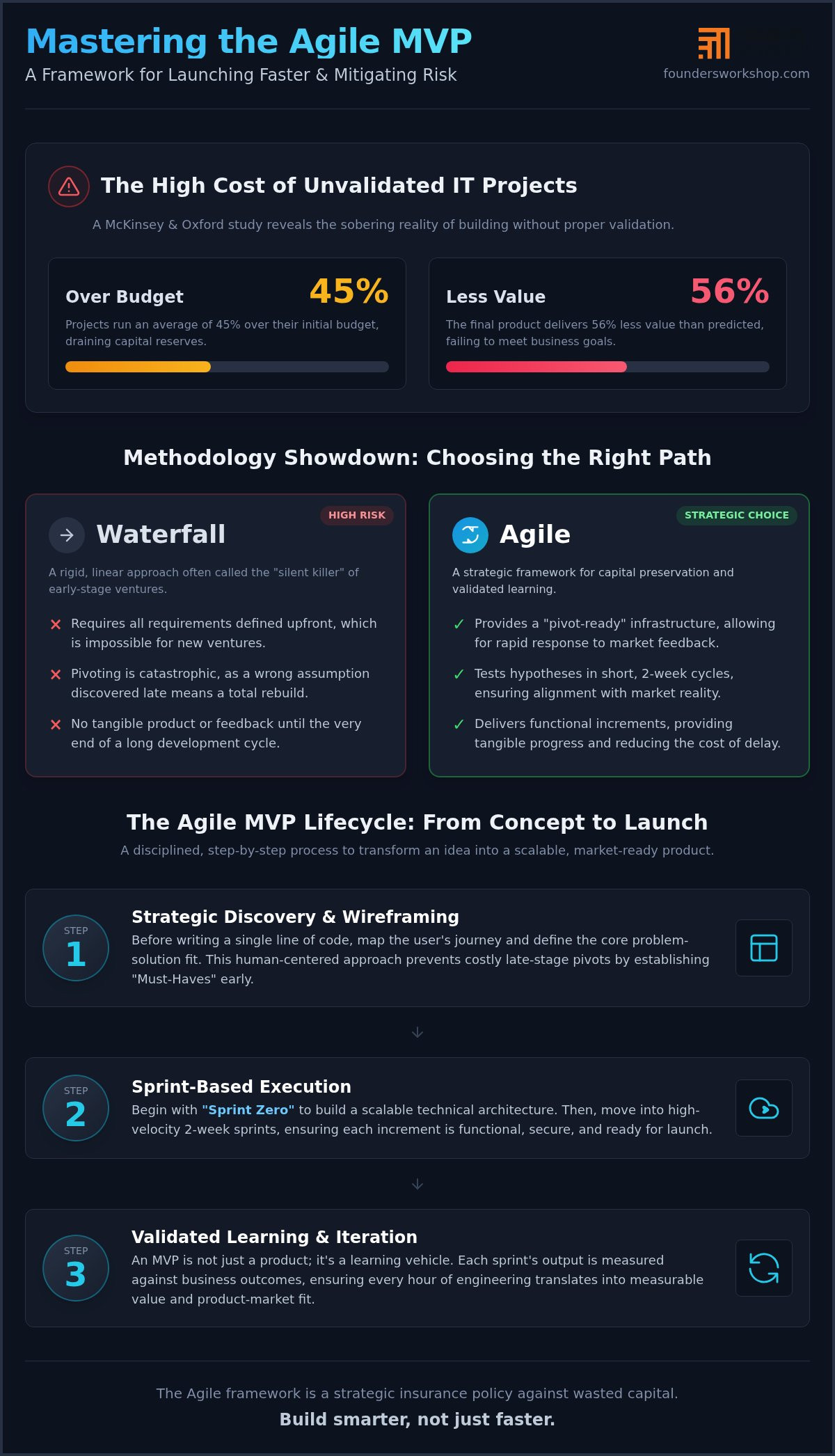
According to a McKinsey and Oxford University study, IT projects without proper validation run an average of 45% over budget while delivering 56% less value than predicted. This statistic is a sobering reminder for any leader trying to balance innovation with fiscal responsibility. You’ve likely felt the tension between the need to launch quickly and the fear of building a product that misses the market mark entirely. It’s frustrating when the promise of agile development for MVP projects feels more like a cycle of endless iterations rather than a clear path to market delivery.
We believe that Agile shouldn’t be a chaotic race to code. Instead, it serves as a strategic insurance policy against wasted capital. This article provides a 2026 framework to help you master the intersection of Agile methodology and MVP development to launch faster and mitigate technical risk. We’ll walk through the journey from initial concept to a successful market launch, covering how to prioritize features based on ROI and establish a scalable foundation for long term growth. By the end, you’ll have the clarity needed to choose the right development partners and lead your project with seasoned confidence.
Key Takeaways
- Understand why agile development for MVP projects is a strategic framework for validated learning rather than just a race to write code.
- Master the MoSCoW prioritization method to protect your budget from feature creep and focus on high-ROI functionalities.
- Discover how human-centered wireframing and a robust “Sprint Zero” architecture prevent technical debt before development begins.
- Learn why nearshore team alignment is critical for real-time communication and maintaining the high-velocity cycles required for a successful launch.
- Gain a clear roadmap from discovery to deployment that ensures your MVP is both investor-ready and built for long-term scalability.
Redefining Agile Development for MVP Projects
In 2026, agile development for MVP projects has evolved beyond a mere coding workflow. It is now a strategic framework designed for validated learning. While early iterations of the Minimum Viable Product concept focused on the smallest set of features, today’s market saturation has turned the “minimum” into a moving target. Users expect polish, security, and immediate utility. If you launch a product that feels unfinished, you risk permanent brand damage rather than gathering useful feedback. We see the MVP as a professional commitment to your users, not an excuse for poor quality.
The shift we advocate is moving from a “feature-first” mindset to an “outcome-first” approach. Instead of asking what the software does, we ask what business result it achieves. In this ecosystem, the founder must step into the role of the Product Owner. This isn’t just a title; it’s a commitment to being the final arbiter of value. You must ensure every sprint moves the needle on business growth rather than just clearing a backlog of technical tasks. This human-centered approach ensures the technology serves the business, not the other way around.
Agile vs. Waterfall for Startups
Waterfall methodology is often the silent killer of early-stage software ventures. Its rigid, linear structure requires you to define every requirement upfront, which is impossible when you’re still discovering your market fit. If you realize your core assumption was wrong six months into a Waterfall build, the cost of a pivot is often catastrophic. Agile provides the pivot-ready infrastructure founders need. It allows you to test hypotheses in two-week cycles, ensuring that technical execution always remains aligned with market reality. This flexibility is what allows a startup to survive the volatile transition from idea to product-market fit. To further support your journey as a founder, you can learn more about One Labs, which offers a voice-first AI co-founder designed to help you navigate these strategic transitions with persistent memory and insight.
Using agile development for MVP projects is fundamentally a tool for capital preservation. While the budget risks of unvalidated projects are well-documented, the McKinsey and Oxford study also highlights that these ventures often deliver 56% less value than predicted. By shipping functional increments, you significantly reduce the cost of delay. You aren’t waiting for a “big bang” launch to see an ROI. Instead, every sprint provides stakeholders with tangible markers of progress. This methodical approach helps manage your burn rate while building the technical truth needed to secure future funding or scale operations with confidence.
The Agile MVP Lifecycle: From Discovery to Deployment
The journey from a concept to a functional product is rarely a straight line. It is a series of loops designed to uncover what we call “technical truth.” According to Forbes, The Agile MVP Lifecycle is an ongoing process of continuous refinement that helps founders avoid the trap of building features in a vacuum. When managing agile development for MVP projects, your lifecycle must prioritize high-velocity feedback over rigid adherence to a static plan. This ensures that every hour of engineering time translates into measurable business value.
Step 1: Strategic Discovery and Wireframing
Before writing a single line of code, you must map the human-centered journey of your user. We start with visual blueprints that define the core problem-solution fit. Understanding what is a wireframe and why it serves as the first step in technical alignment is vital. These wireframes allow us to establish “Must-Haves” versus “Nice-to-Haves” early on. By visualizing the user flow now, you prevent expensive late-stage pivots that often derail projects during the build phase.
Step 2: Sprint-Based Execution
Execution begins with “Sprint Zero.” This phase isn’t about shipping features; it is about setting up a technical architecture that supports long-term scalability. Once the foundation is set, we move into two-week sprints to maintain high engineering velocity. A clear “Definition of Done” is essential here to ensure that every increment is functional and secure. We utilize continuous integration to keep the product in a constant “launch-ready” state. If you want to ensure your build remains focused, our team at Founders Workshop can help you implement these disciplined execution standards.
Step 3: Validated Learning and AI Integration
In 2026, a smart MVP doesn’t just collect data; it anticipates needs. This is where agile development for MVP projects integrates with modern intelligence. By leveraging AI strategy consulting, you can identify automation opportunities or predictive analytics features that significantly enhance your value proposition. We use real-world usage patterns to refine the product backlog. This iterative loop of building, measuring, and learning ensures that your second and third versions are driven by user evidence rather than founder assumptions.
Avoiding the ‘Feature Creep’ Trap: Prioritization Strategies
The most dangerous phrase in a startup’s vocabulary is “let’s just add one more thing.” This “feature creep” is the primary reason why many agile development for MVP projects exceed their budgets and miss launch dates. As a founder, your job is to protect the core value proposition from the noise of secondary ideas. According to the Minimum Viable Product (MVP) definition by the Agile Alliance, the goal is to maximize learning with the least amount of effort. Overbuilding doesn’t just cost money; it obscures the very feedback you need to succeed. We’ve seen projects stall because they tried to be everything to everyone at once.
To maintain discipline, we use the MoSCoW method. This categorizes features into Must-have, Should-have, Could-have, and Won’t-have. It forces a hard conversation about what is truly essential for day one. We also apply the Kano Model to distinguish between “basic needs”—features users expect as a baseline—and “delighters”—those unique elements that create a competitive edge. Rushing these features without a plan often results in a “Technical Debt” tax. This is the hidden cost of messy code that slows down future development and eventually requires a significant payment in time and resources to fix.
The Founder’s Dilemma: Speed vs. Quality
“Gold-plating” occurs when teams spend excessive time on features that provide little incremental value. It’s a subtle budget drain that often goes unnoticed until capital is low. Maintaining a clean codebase is essential, even during rapid MVP iterations. You must balance immediate market demands with long-term stability. This often involves planning for refactoring legacy code strategies as your platform scales. A disciplined approach ensures that the speed you gain today doesn’t become a bottleneck tomorrow. It’s about building a foundation that can actually support growth.
Data-Driven Prioritization
Prioritization shouldn’t be based on a hunch. We use the Build-Measure-Learn feedback loop as a rigorous filter. If analytics show that users aren’t engaging with a specific feature, we don’t just stop developing it; we shut it down. Reducing system complexity is as important as adding new capabilities. By using agile development for MVP projects to test specific hypotheses, you ensure that every line of code serves a verified user need rather than a founder’s assumption. This keeps your development engine lean and focused on features that drive actual ROI.
Building the Engine: Nearshore vs. Offshore Agile Teams
Efficiency in agile development for MVP projects isn’t just about the number of tickets closed; it’s about the speed of the feedback loop. If your engineering team is 12 hours ahead, you’re effectively operating on a 24-hour delay for every clarification or code review. This “Agile Friction” is the hidden tax of offshore models. Real-time communication is the lifeblood of successful sprints. Without it, your daily standups become status reports rather than strategic huddles. We’ve seen countless projects lose momentum because the “wait-until-tomorrow” cycle killed the team’s creative energy.
Nearshore Staff Augmentation has emerged as the preferred model for US startups because it aligns high-quality Latin American talent with domestic timezones. Cultural alignment and language proficiency are critical components of high-velocity product engineering. When your developers understand the business context and can debate a technical solution in real-time, you move faster. This proximity allows for a level of partnership and accountability that offshore models simply cannot replicate. It’s the difference between hiring a vendor and building a team.
The Nearshore Advantage for Agile
Eliminating the timezone gap is a game changer for technical execution. When a developer in Medellin or Buenos Aires pushes code, your lead architect in the US can review it immediately. This synergy is why nearshore staff augmentation is so effective for facilitating daily standups and pair programming. You get the cost-efficiency of global talent without the massive communication overhead that traditional outsourcing creates. It allows your team to maintain a steady, informative pace that mirrors a stable business partnership.
Structuring Your Hybrid Team
Integrating nearshore developers requires more than just a Slack channel. It demands a clear product roadmap and a Technical Partner who understands how to manage distributed engineering teams. This structure allows you to scale up or down based on funding rounds and development milestones. A seasoned partner provides the steady hand needed to navigate these transitions without losing technical momentum. If you’re ready to build a high-velocity engine, explore our nearshore partnership models to see how we bridge the gap between strategy and execution.
Strategic Execution: The Founders Workshop Model
Building a successful product requires more than technical proficiency; it demands a partner who understands the high stakes of capital allocation and market timing. Our model for agile development for MVP projects is built on 30 years of leadership experience. We have seen technology trends come and go, but the core need for reliable, scalable execution remains constant. We bridge the gap between high-level executive strategy and hands-on technical reliability, ensuring that your vision is translated into a functional, market-ready reality.
We take a human-centered approach to complex software challenges. This means we prioritize the user’s experience and the founder’s business objectives over technical novelty for its own sake. Whether we are handling strategic MVP development or modernizing a legacy system, our goal is to remove technical friction. We offer fixed-fee MVP builds to provide budget certainty during the initial launch phase. Once you have validated your concept and are ready to scale, our nearshore staff augmentation model allows you to expand your team with speed and precision. This flexibility ensures that your development costs stay aligned with your funding rounds and revenue milestones.
Beyond Coding: Partnering for Business Growth
Your roadmap to launch begins with an initial consultation. We work with you to identify your core MVP value proposition and strip away the features that drain budgets without adding value. From there, we help you select the most effective engagement model for your current stage. Whether you need a full project-based build or a dedicated nearshore team to augment your internal staff, we provide the steady hand you need to navigate the path from idea to market leader. If you are ready to build with confidence and scale without friction, schedule a consultation with our veteran leadership team today.
Leading Your MVP with Strategic Confidence
Successful product launches in 2026 require more than technical skill; they demand a disciplined approach to validated learning. By prioritizing high-ROI features through the MoSCoW method and maintaining a clean technical architecture, you protect your capital while building a scalable foundation for growth. Timezone alignment through nearshore partnerships remains the most effective way to keep your engineering velocity high and your feedback loops tight. Mastering agile development for MVP projects ensures your team remains focused on human-centered business outcomes rather than just clearing a backlog of tasks.
With 30 years of leadership experience and specialized expertise in AI and healthcare technology, we provide the steady hand you need to navigate these complexities. Our proven nearshore LatAm talent network ensures your team is always aligned with your strategic vision and ready to execute. We are committed to removing technical friction so you can focus on what matters most: growing your business. If you are ready to move from concept to a high-performance reality, scale your vision with our strategic MVP development services. The path to market leadership is challenging, but with the right framework and partnership, you can build a product that truly resonates with your users.
Frequently Asked Questions
Is Agile development more expensive for an MVP than Waterfall?
Agile is often more cost-effective because it prevents you from spending capital on features that users don’t actually want. While Waterfall requires a massive upfront investment based on assumptions, Agile allows you to build in small increments. This reduces the risk of a total project failure. You preserve your burn rate by only investing in verified value, making it a smarter choice for capital-conscious founders.
How long does a typical Agile MVP development cycle take?
A standard initial build usually spans 12 to 16 weeks, depending on the complexity of your core solution. This timeframe includes an intensive discovery phase followed by several two-week sprints. By focusing strictly on the most impactful features, you can get a functional version into the hands of early adopters quickly. This speed is essential for gathering the data needed to secure your next funding round.
What is the difference between an MVP and a prototype in Agile?
An MVP is a functional, production-ready product, while a prototype is a non-functional visualization used for testing ideas. Prototypes help you validate user flows during the discovery stage without writing code. The MVP is the actual software your customers will use to solve their problems. Agile development for MVP projects ensures that your transition from a prototype to a live product is grounded in technical truth.
How do I manage a nearshore Agile team effectively?
Effective management requires treating nearshore developers as a direct extension of your internal team. You should maintain daily standups and use collaborative tools to keep everyone aligned on the sprint goals. Because nearshore teams work in your timezone, you can provide instant feedback and engage in pair programming. This real-time interaction is the lifeblood of high-velocity engineering and prevents the communication gaps common in offshore models.
Can I use Agile if I have a fixed budget for my MVP?
Yes, you can use Agile with a fixed budget by focusing on a fixed-fee for a prioritized backlog. Instead of fixing the exact scope, we fix the budget and timeframe, then deliver the highest-priority features first. This ensures you launch a functional, high-quality product without the risk of cost overruns. It’s a pragmatic way to maintain financial discipline while benefiting from the flexibility of iterative development.
What are the most common Agile pitfalls for new founders?
The biggest mistake is treating Agile as an excuse for a lack of documentation or planning. Founders often fall into the trap of “just one more feature,” which leads to scope creep and technical debt. Another common issue is failing to take an active role as the Product Owner. Agile development for MVP projects only works when the leadership provides a clear strategic vision for every sprint cycle.
How do I know when my MVP is ready to move to the next stage?
Your MVP is ready to scale when you have achieved validated learning and consistent user engagement. If your early adopters are successfully using the core features to solve their pain points, you have found a market fit. At this point, you can move from a project-based build to a staff augmentation model. This allows you to scale your engineering team quickly to support new features and growing user demands.
Why is timezone alignment critical for Agile development?
Timezone alignment eliminates the “wait-until-tomorrow” friction that stalls development. In Agile, developers often need immediate clarification on user stories or technical requirements to maintain momentum. If your team is 12 hours ahead, every small question results in a day of lost productivity. Nearshore teams work during your business hours, enabling the instant collaboration and rapid code reviews necessary to keep your project on its strategic roadmap.