

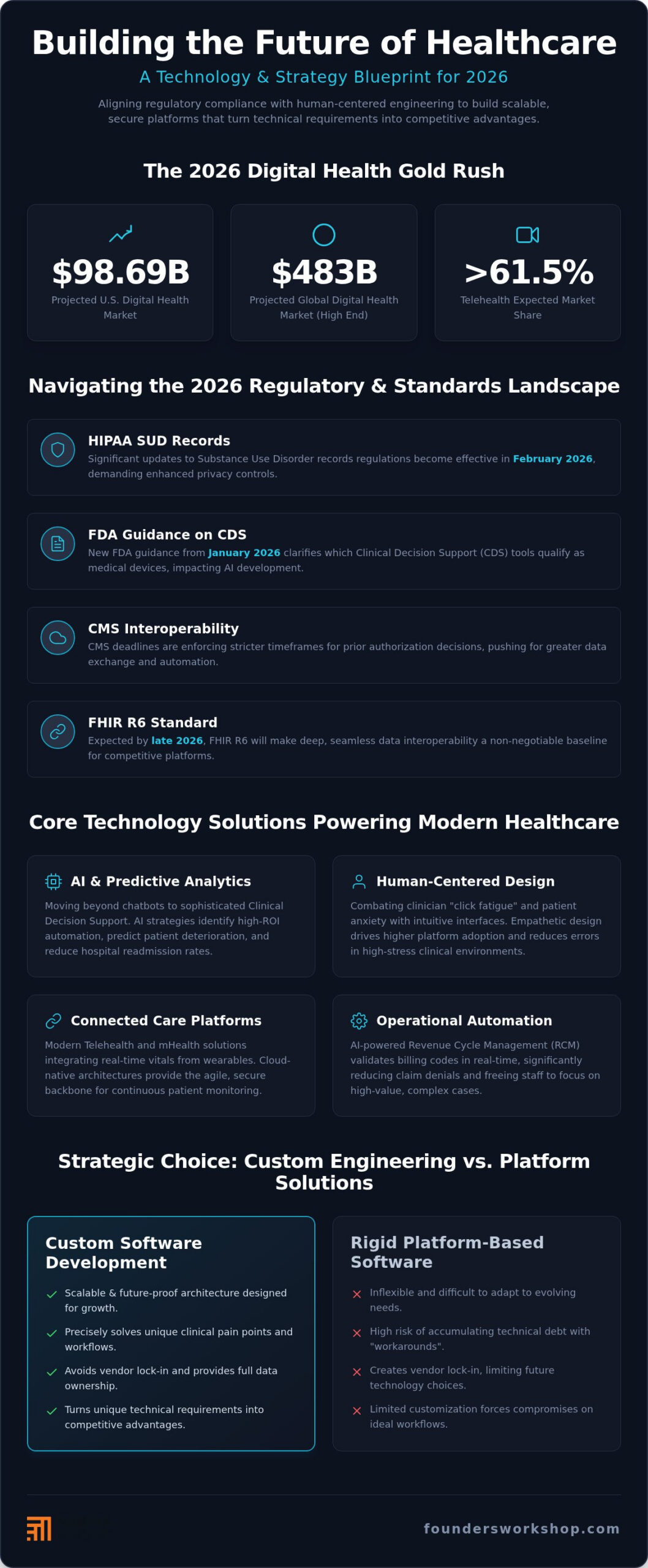
With the U.S. digital health market projected to reach $98.69 billion by 2026, the stakes for innovation have never been higher. You likely recognize that clinging to legacy systems creates a technical bottleneck that slows down both clinical impact and market growth. It’s a common struggle to balance the high cost of local engineering talent with the constant pressure of avoiding million dollar information blocking penalties or evolving security breaches.
You deserve a path forward that doesn’t force you to choose between speed and safety. Partnering with a specialized custom healthcare software development company allows you to align strict regulatory compliance with human-centered engineering. This article will show you how to build a scalable, secure platform that turns technical requirements into competitive advantages. We’ll explore the top technology solutions for 2026, including the transition to FHIR R6 standards and the strategic use of timezone-aligned development to move your roadmap from a lean MVP to a full-scale healthcare solution without the communication friction of traditional offshoring.
Key Takeaways
- Learn how the shift toward predictive care and FHIR R6 standards makes deep interoperability a non-negotiable requirement for 2026 healthcare software.
- Identify the core features for your healthcare MVP that solve clinical pain points quickly and secure stakeholder buy-in through rapid prototyping.
- Compare the strategic benefits of custom engineering against the technical debt and vendor lock-in often found in rigid, platform-based software.
- Discover how a custom healthcare software development company leverages nearshore talent to provide timezone-aligned support and cost-effective scaling.
- Explore how modernizing legacy medical data through AI strategy can bridge the gap between historical records and future-ready patient care.
Navigating the 2026 Healthcare Technology Landscape
The healthcare sector is moving away from reactive “sick care” toward a model defined by proactive, data-driven interventions. By 2026, the global digital health market is expected to reach a value between $323 billion and $483 billion. Success in this environment requires more than just functional code; it demands a strategic alignment of technology with clinical reality. For a custom healthcare software development company, staying compliant means tracking several moving targets in 2026:
- Updates to HIPAA SUD records regulations effective February 2026.
- New FDA guidance on Clinical Decision Support (CDS) software.
- CMS interoperability deadlines regarding prior authorization decision timeframes.
Interoperability is no longer a luxury. With FHIR R6 expected by late 2026, the ability to exchange data seamlessly is the baseline for staying competitive. Modern platforms must balance this rapid innovation with the strictures of HIPAA and HITECH compliance, ensuring that security doesn’t come at the cost of speed.
The Role of AI and Predictive Analytics
AI has matured past simple administrative chatbots. Today, the focus is on sophisticated Clinical Decision Support systems. Following the updated FDA guidance from January 2026, developers must be precise about which tools qualify as medical devices. AI strategy consulting helps founders identify high-ROI automation, such as optimizing discharge workflows or predicting patient deterioration. Specifically, predictive analytics reduces hospital readmission rates by identifying high-risk patients before they leave the facility. This shift allows providers to intervene early, moving the needle on patient outcomes and operational efficiency.
The Human-Centered Design Mandate
Technical debt isn’t always about old code; sometimes it’s about outdated usability. Software failure in clinical settings is frequently a UX problem where the tool adds friction instead of removing it. Medical professionals are often burdened by “click fatigue,” while patients may feel anxious when interacting with digital portals. To see a comprehensive overview of medical software and its evolution, one must look at how design impacts safety and adoption. Human-centered solutions drive higher platform adoption by making data entry intuitive for the clinician and providing clarity for the patient. A custom healthcare software development company that prioritizes empathy in design ensures that the final product actually gets used in high-stress environments. This focus on the human element is what ultimately bridges the gap between a technical requirement and a successful business outcome.
Essential Healthcare Technology Solutions: A 2026 Roundup
The 2026 digital health ecosystem is defined by high-performance tools that bridge the gap between clinical data and patient action. Telehealth is no longer a temporary fix; it’s a primary care delivery method expected to command over 61.5% of the market share this year. Building these solutions requires a partner who understands that software is a business asset, not just a technical expense.
Clinical and Patient-Facing Solutions
Modern telehealth platforms must do more than host video calls. They need to integrate real-time vitals from wearables with asynchronous patient data to provide a holistic view of health. When these tools provide a medical function, they often fall under the FDA’s definition of SaMD, requiring specialized engineering to ensure safety and compliance.
Mobile health (mHealth) applications are also evolving. They now leverage continuous monitoring to alert providers before a minor issue becomes a crisis. For many organizations, this innovation starts with refactoring legacy code to move from rigid on-premise systems to agile, cloud-native architectures. A custom healthcare software development company ensures these patient-facing tools remain secure while providing the consumer-grade experience users now expect.
Operational and Administrative Infrastructure
Operational efficiency is the engine of healthcare growth. Revenue Cycle Management (RCM) systems are being transformed by AI to validate billing codes in real-time, which significantly reduces claim denials. This automation allows staff to focus on complex cases rather than manual data entry, improving the overall financial health of the practice.
True scalability depends on connectivity. Using system integration services, providers can connect siloed EHR, pharmacy management, and e-Prescribing (eRx) tools into a unified data stream. This interoperability is supported by healthcare-specific CRMs that manage the patient journey from the first inquiry through long-term chronic care management. If your current infrastructure feels fragmented, exploring custom software solutions can help you consolidate these systems into a high-performance platform.
Custom vs. Platform-Based Software: A Strategic Comparison
The decision to build a proprietary platform or purchase an off-the-shelf solution is a pivotal moment for any healthcare founder. While many vendors claim their platforms are “fully customizable,” the reality often involves significant technical debt and rigid workflows that stifle innovation. Choosing a custom healthcare software development company allows you to own your code and your future, ensuring that the software adapts to your clinical vision rather than forcing your staff to work around a vendor’s limitations.
When to Choose Custom Development
Custom engineering is the right path when your competitive advantage relies on proprietary algorithms or unique data processing. If you’re involved in clinical trials or academic studies, adhering to established guidelines for clinical software research is much easier when you have total control over the data lifecycle. Custom builds are also necessary for complex integrations with specialized medical hardware or fragmented legacy systems that generic APIs can’t handle. This approach ensures that security and HIPAA compliance are baked into the core architecture, not simply bolted on as an afterthought.
The Limitations of Off-the-Shelf Solutions
Off-the-shelf platforms often come with hidden costs that aren’t apparent during the initial demo. Rigid workflows frequently force clinicians to change their practice patterns, which leads to “click fatigue” and lower platform adoption. Scaling becomes a financial burden as licensing costs increase alongside patient volume, often without a corresponding increase in value. Perhaps most critically, vendor lock-in makes it difficult to extract clean, structured data for advanced AI strategy consulting. Without the ability to freely access and analyze your own data, your long-term growth is tethered to the vendor’s development roadmap.
A strategic partnership with a custom healthcare software development company removes these barriers. It provides a scalable foundation that grows with your business, allowing you to pivot as market demands or regulatory requirements shift. By investing in custom software, you’re not just buying a tool; you’re building a long-term business asset that supports sustainable growth and superior patient outcomes.
The Healthcare MVP Roadmap: Engineering for Velocity
Engineering a healthcare product requires a delicate balance between rapid market entry and the uncompromising requirements of patient safety. While many competitors focus exclusively on multi-year enterprise deployments, a seasoned custom healthcare software development company understands that speed to market is a competitive necessity. The goal is to identify the “Minimum Viable” features that solve a core clinical pain point without sacrificing the long-term integrity of the platform. This approach prevents technical debt from legacy systems from slowing down future innovation by establishing a clean, modern foundation from the start.
Phase 1: Discovery and Strategic Alignment
Strategic discovery ensures that the development roadmap aligns with both clinical needs and business goals. Success metrics should be specific; you might target a reduction in clinician charting time, an improvement in patient engagement scores, or a decrease in hospital readmission rates. A Strategic MVP in the healthcare sector serves as the essential foundation for a scalable, compliant platform that evolves based on real-world clinical usage. By mapping the clinical workflow early, you can use rapid prototyping and wireframing to secure stakeholder buy-in before investing in full-scale engineering. This phase is about removing technical friction before it starts, ensuring that the software solves the right problem for the right audience.
Phase 2: Execution and Engineering Velocity
Maintaining velocity in a regulated environment requires a compliance-first architecture. Security frameworks must be established on day one, not treated as a final checklist item. Because HIPAA compliance engineering adds an estimated 20% to 30% to the base cost of a project, integrating these standards into the initial build is more cost-effective than refactoring later. Integrating automated testing for HIPAA compliance and data integrity allows your team to move quickly without risking a breach. This iterative approach uses user feedback to drive the product roadmap, ensuring every feature adds tangible value to the clinician or patient while adhering to the latest FDA and CMS guidelines.
Utilizing feature flags and a robust CI/CD pipeline allows a custom healthcare software development company to ship code safely. This methodology ensures that updates are decoupled from releases, allowing for continuous improvements without disrupting clinical operations. It’s about building a sustainable engine for growth that can scale as your patient volume increases. If you’re ready to move from concept to clinical reality, exploring a tailored development roadmap can help you launch your healthcare solution with confidence and precision.
Partnering with a Healthcare Software Development Company
Choosing a technology partner in the medical space is a decision that extends far beyond technical proficiency. You aren’t just looking for someone to write code; you’re seeking a strategic partner who understands that software failure can have direct consequences on patient care and business viability. Moving from a traditional vendor model to a strategic partnership ensures that your technology roadmap remains aligned with evolving clinical needs and regulatory shifts. A custom healthcare software development company should act as an extension of your leadership team, providing the technical reliability needed to scale without friction.
The Nearshore Advantage for Healthcare
In a field where real-time support can be a matter of patient safety, timezone alignment is a non-negotiable requirement. Offshore outsourcing often creates a “black box” environment where communication delays of twelve hours or more stall critical updates. By contrast, nearshore staff augmentation allows you to access high-quality talent in Latin America that operates within US timezones. This proximity enables real-time collaboration, allowing your internal stakeholders and external engineers to sync daily. It eliminates the communication gaps that plague offshore projects, providing a cost-effective way to scale your engineering capacity without sacrificing the quality of execution or the speed of your release cycles.
Founders Workshop: Human-Centered Healthcare Engineering
At Founders Workshop, we bridge the gap between high-level executive strategy and hands-on technical execution. With over 30 years of leadership experience, we’ve navigated multiple eras of technological shifts, from the first digital records to the current AI-driven landscape. Our methodology centers on human-centered engineering, which means we focus on how a clinician actually uses a tool in a high-pressure environment. We specialize in AI strategy and legacy modernization, helping medical providers turn fragmented historical data into actionable clinical insights. We don’t just build software; we help founders navigate the inherent complexity of healthcare tech launches by providing a steady hand and a disciplined roadmap. By focusing on business outcomes rather than technical novelty, we ensure your platform is built for long-term sustainability and peace of mind.
Building the Future of Patient-First Technology
The landscape of 2026 demands more than just functional code; it requires a strategic alignment between clinical workflows and technical execution. By prioritizing human-centered design and a compliance-first architecture, you can move past the limitations of legacy systems and rigid off-the-shelf platforms. Partnering with a custom healthcare software development company ensures that your vision is supported by a scalable, secure foundation that evolves alongside patient needs and regulatory shifts.
Success in this era depends on a partnership built on accountability and deep industry expertise. At Founders Workshop, we leverage 30+ years of experience to provide a human-centered ROI focus that removes technical friction from your clinical operations. Our nearshore model provides the timezone alignment necessary for real-time collaboration, ensuring your roadmap stays on track without the communication gaps of traditional offshoring. If you’re ready to modernize your infrastructure, Schedule a Strategic Healthcare Tech Consultation today. Let’s build a solution that drives better outcomes for both your patients and your business.
Frequently Asked Questions
What is the average cost of custom healthcare software development?
Industry averages for healthcare software depend heavily on the depth of integrations and regulatory requirements. Generally, mid-complexity applications require a higher investment than standard consumer apps due to the mandatory 20% to 30% overhead for compliance engineering. A custom healthcare software development company focuses on building a scalable foundation that balances initial investment with long-term business growth and clinical utility. This strategic approach ensures every dollar spent directly supports patient outcomes.
How long does it take to build a healthcare MVP?
Building a healthcare MVP generally takes between three to six months. This timeline allows for discovery, prototyping, and the rigorous testing required for regulatory standards. By adopting a “Strategic MVP” mindset, founders can launch core clinical features quickly to gather user feedback. This iterative process ensures the product scales effectively without the multi-year delays common in traditional enterprise development. It’s about finding the fastest path to clinical value.
Is custom healthcare software always HIPAA compliant?
Custom software is not inherently HIPAA compliant; compliance must be intentionally engineered into the architecture. It requires specific administrative, physical, and technical safeguards, such as end-to-end encryption and audit trails. A veteran custom healthcare software development company ensures these protocols are established on day one. Simply hosting on a compliant cloud provider like AWS or Azure is not enough to meet federal standards without proper application-level security.
What is the difference between EMR and EHR in custom development?
The primary difference lies in the scope of data sharing and interoperability. An Electronic Medical Record (EMR) is a digital version of a patient’s chart within a single practice; while an Electronic Health Record (EHR) is designed to share information across different providers and organizations. Modern development focuses on EHR standards like FHIR to ensure that data follows the patient throughout the entire healthcare ecosystem, improving the continuity of care.
Can you integrate AI into an existing legacy healthcare system?
Yes, AI can be integrated into legacy systems through modern API layers and system integration services. You don’t always need a full system replacement to benefit from automation. By implementing a targeted AI strategy, you can modernize legacy medical data to support predictive analytics or automated billing. This approach allows you to extend the life of existing infrastructure while adding high-value, modern capabilities that drive operational efficiency.
Why is nearshore development better than offshore for healthcare projects?
Nearshore development is often superior because it provides timezone alignment and cultural proximity. Offshore teams frequently have twelve-hour time differences, which creates a “black box” where communication gaps stall critical clinical updates. Nearshore partners in Latin America allow for real-time collaboration during US business hours. This proximity is vital for the rapid troubleshooting and daily syncs required in complex projects, ensuring a more stable and accountable business partnership.
How do you ensure data security during the development process?
Security is maintained through a combination of zero-trust architecture, automated compliance testing, and strict access controls. Developers should use de-identified or synthetic data during the build phase to ensure no real Protected Health Information (PHI) is exposed. Continuous monitoring and regular third-party audits further protect the integrity of the platform. This disciplined approach ensures that security is a core component of the engineering lifecycle, providing peace of mind to stakeholders.
What are the most common mistakes when building healthcare technology solutions?
The most common mistakes include ignoring human-centered design and failing to plan for interoperability. Many founders build technically sound tools that clinicians find too cumbersome to use in high-stress environments. Others create siloed systems that can’t communicate with existing EHRs, leading to high technical debt. Starting with a clear roadmap and focusing on clinical workflows helps avoid these costly pitfalls during the scaling phase, ensuring better long-term adoption.