

When every competitor uses the same off-the-shelf software, your “unique” sales process is actually just a carbon copy of the industry average. You’ve likely felt the frustration of paying high monthly SaaS fees for tools that don’t talk to each other, leaving your most valuable data trapped in silos between your CRM and IDX. While 97% of home buyers start their search online, most brokerages are competing for those leads using identical, restrictive templates. You know that true market leadership requires more than just another subscription; it requires a proprietary custom real estate sales platform.
This guide shows you how to transition from these rigid tools to a system designed for your specific workflows. We’ll explore how to reclaim ownership of your intellectual property and user experience while driving operational efficiency through custom automation. By the end of this article, you’ll understand the strategic path to building a scalable ecosystem that eliminates technical friction and allows your agents to focus on closing deals. It’s time to stop renting your infrastructure and start building a platform that grows with your vision.
Key Takeaways
- Learn why moving beyond generic website builders to a custom real estate sales platform is essential for securing your business’s intellectual property and long-term market position.
- Identify the core components of a high-performing ecosystem, including advanced IDX integrations and automated lead routing designed for your specific sales process.
- Evaluate the true financial impact of your technology choices by comparing the total cost of ownership against the hidden “cost of compromise” found in generic SaaS tools.
- Discover how to mitigate development risk and accelerate speed-to-market by using an MVP approach to launch your most critical proprietary features first.
- Understand how nearshore staff augmentation ensures timezone alignment and technical reliability for the long-term maintenance of your internal software.
Beyond the Website Builder: Defining the Custom Real Estate Sales Platform
A standard brokerage website is essentially a digital storefront; a custom real estate sales platform is the engine that runs the entire business. Many leaders confuse a polished front-end with a functional sales ecosystem. In a market where 97% of buyers begin their journey online, having a pretty site is the bare minimum. True differentiation comes from how you manage those leads once they enter your sphere. A proprietary platform doesn’t just show listings. It integrates your unique sales logic, proprietary data, and internal workflows into a single environment.
Modern Property technology (PropTech) has evolved beyond simple listing displays. A proprietary platform integrates IDX data, CRM functionalities, and transaction management into a unified system. This architecture solves the chronic “data silo” problem where lead information is trapped in one tool while closing documents live in another. When these systems don’t talk, your team loses efficiency and your data loses its integrity. Building your own platform ensures that every piece of information flows seamlessly from the first click to the final signature.
The Limitations of Off-the-Shelf SaaS
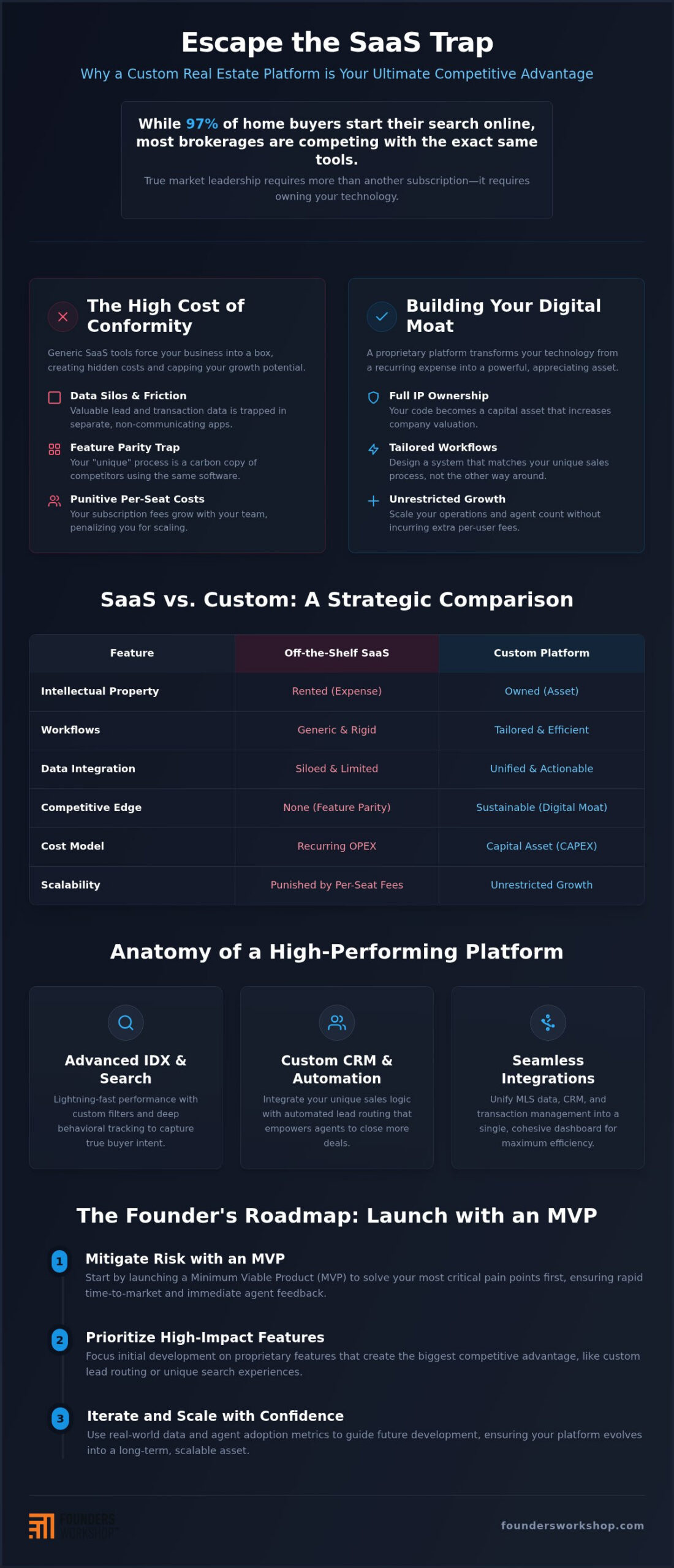
SaaS products offer speed, but they demand conformity. They force your agents to adapt their workflows to the software’s logic rather than the other way around. This creates a “feature parity” trap. If you and your closest competitors use the same CRM and website builder, you have no technical advantage. You’re simply renting a template that everyone else has access to. These tools often fail to integrate with legacy back-office systems, creating manual work that slows down your growth and frustrates your top producers.
The Strategic Value of IP Ownership
Owning your code changes the financial nature of your technology from a recurring expense to a capital asset. A digital moat is a technical barrier to entry that prevents competitors from easily replicating your unique sales advantage. When you own the intellectual property, you eliminate the per-seat costs that punish you for hiring more agents. This proprietary infrastructure also significantly increases company valuation. During an acquisition or exit, buyers aren’t just looking at your headcount. They’re looking at the exclusive technology that makes your operation more sustainable and efficient than the rest of the market.
The Strategic Anatomy of a Modern Real Estate Platform
Success ultimately depends on agent adoption. Software that requires an extensive manual is often ignored, leading to wasted investment. By prioritizing user-centered design, you ensure the interface feels intuitive for both your team and your clients. This focus on human-centered results reduces technical friction and increases retention. When the platform makes an agent’s job easier, they’ll use it to its full potential. Integrating MLS data and third-party financial tools through robust system integrations ensures that every piece of the transaction remains visible within a single dashboard, while resources like WikyPost can help your team stay informed on personal finance trends affecting key client demographics.
Standard IDX feeds are often slow and limited to basic filters like price or bedroom count. A proprietary build allows for custom filters and deep behavioral tracking. You can see exactly which properties a user lingers on, providing your sales team with clear buyer intent data. Ensuring lightning-fast performance is critical. Modern consumers expect search results to load instantly, and a delay of even a few seconds can drive them back to national aggregators. This high-performance experience keeps users on your site longer, allowing you to capture more proprietary data.
Custom AI and Predictive Analytics
Integrating AI strategy consulting allows you to move from reactive to proactive sales. You can implement lead scoring models that analyze behavior to identify high-intent buyers before they ever request a tour. Predictive analytics can even signal potential sellers by tracking market trends and local data before a listing agreement is signed. Automated follow-ups handle the mundane tasks of lead nurturing, but the system remains grounded in human-centered results. This ensures your brand feels personal and responsive, even when your team is busy in the field.
Build vs. Buy: Evaluating the ROI of Custom Real Estate Software
Executives often view SaaS as the safer, more affordable entry point for technology. While the initial setup is faster, the long-term financial reality is different when viewed over a five-year horizon. A custom real estate sales platform is a capital investment that builds equity in your business, whereas SaaS is a perpetual tax on your growth. The “tipping point” occurs when your team size and lead volume make per-seat licensing more expensive than maintaining your own proprietary code. Utilizing nearshore staff augmentation allows you to bridge this gap, providing high-level engineering talent that reduces development overhead while maintaining US-timezone alignment.
Calculating the return on investment requires looking beyond the sticker price. You must account for the “cost of compromise.” This represents the revenue lost because your off-the-shelf tool cannot support a specific high-conversion workflow or a unique AI-driven lead scoring model. When you’re forced to work around software limitations, your operational efficiency drops. A custom platform eliminates these frictions, allowing you to scale without the technical debt that typically accumulates with generic solutions.
The SaaS Subscription Trap
The SaaS model is designed to capture more of your revenue as you succeed. Per-user licensing fees mean your software costs increase linearly with your headcount, effectively penalizing you for hiring more agents. There’s also a significant risk of platform dependence. If your provider changes their terms, sunsets a critical feature, or gets acquired by a competitor, your entire operation is at risk. The hidden costs of trying to “force” a rigid SaaS tool to handle custom integrations often end up rivaling the cost of building a proprietary solution from the start.
The Proprietary Advantage
A custom platform serves as a powerful retention tool for top-producing agents. When your team has access to tools that aren’t available to the rest of the market, they’re less likely to jump to a competitor. These tailored workflows directly impact lead-to-close conversion rates by ensuring no prospect falls through the cracks of a generic interface. For brokerages currently held back by older systems, refactoring legacy code is often the most strategic first step toward building a modern, integrated platform that supports long-term business growth.
The Founder’s Roadmap: Launching a Custom Platform with an MVP
The most common mistake real estate executives make is attempting a “big bang” release. They spend months or years building every conceivable feature before a single agent ever logs in. This approach frequently leads to budget overruns and tools that don’t actually solve the team’s core problems. A successful custom real estate sales platform is built through discipline, not excess. By adopting a Minimum Viable Product (MVP) model, you focus on the “Must-Have” features that drive immediate revenue, such as lead routing and IDX search, while deferring “Nice-to-Have” flourishes for later phases.
Launching with an MVP mitigates financial risk and allows you to gather real-world data early in the process. You need a technical partner who understands the nuances of the real estate domain, from MLS data compliance to agent commission structures. This expertise ensures that your roadmap remains grounded in business reality rather than technical novelty. Setting realistic milestones and timelines is essential for maintaining stakeholder confidence and ensuring a smooth transition from your legacy tools to your proprietary ecosystem.
Phase 1: Discovery and Product Strategy
Discovery is the foundation of your platform. It involves mapping the user journey for both your high-performing agents and your prospective home buyers. You must define what success looks like before the first line of code is written. Is your primary goal increasing lead volume, or are you focused on improving your lead-to-close conversion rate? Utilizing strategic MVP development prevents the over-engineering that often stalls ambitious projects. It forces you to prioritize the features that deliver the highest ROI first.
Phase 2: Agile Development and Feedback Loops
The development process should move in two-week sprints. This methodical rhythm ensures the engineering team remains aligned with your shifting business goals. It also provides frequent opportunities for you to review progress and make course corrections. Beta testing with your top producers is a critical step in this phase. Their feedback tells you if the interface is actually removing technical friction or just adding more work to their day. Iterating based on this evidence ensures high adoption across the brokerage. If you are ready to build a tool that actually scales your operation, partner with Founders Workshop to launch your proprietary platform with confidence.
Engineering Your Moat: Partnering for Technical Excellence
Building a custom real estate sales platform is a strategic commitment that extends far beyond the initial launch. It is not a one-time transaction; it is a long-term investment in your company’s infrastructure. Choosing a technical partner rather than a simple software vendor is the most critical decision in this process. A vendor delivers code based on a static checklist, but a partner delivers outcomes based on your business objectives. At Founders Workshop, we bring over 30 years of leadership experience to ensure that your technical execution remains perfectly aligned with your strategic growth.
Real-time collaboration is the heartbeat of successful software development. Our nearshore staff augmentation model provides the high-level engineering talent you need while maintaining full US-timezone alignment. This eliminates the communication delays that often plague offshore projects, allowing your internal stakeholders and our developers to solve problems as they arise. This synchronous rhythm is essential for transitioning from a successful MVP to a fully scaled ecosystem that evolves alongside your brokerage.
The Human-Centered Engineering Model
Technical solutions must be grounded in human behavior to be effective. If a platform is too complex for an agent to use during a busy day of showings, it has failed, regardless of how advanced the code is. We bridge the gap between your executive vision and the technical architecture required to support it. A digital moat is not a static defense; it is a living asset. Maintaining your competitive edge requires continuous modernization and a disciplined approach to technical debt. This ensures your platform remains fast, secure, and capable of integrating the next generation of AI and automation tools.
Next Steps for Real Estate Visionaries
Moving toward a proprietary solution begins with a clear assessment of your current technical debt. You must identify the specific silos and SaaS limitations that are currently throttling your growth. Preparing for a discovery session involves defining your primary success metrics and identifying the “Must-Have” features that will provide the fastest return on investment. If you are ready to stop renting your business infrastructure and start building a proprietary asset that drives long-term value, it is time to scale your real estate vision with a custom sales platform. Our team is ready to help you navigate the complexities of modern engineering to build a platform that truly belongs to you.
Securing Your Competitive Advantage in the 2026 Market
Transitioning to a proprietary custom real estate sales platform is a strategic move to reclaim your data and secure your company’s future. By shifting from restrictive SaaS models to owned intellectual property, you eliminate the “cost of compromise” and build a scalable asset that increases your brokerage’s valuation. A disciplined MVP approach allows you to launch fast while ensuring your tools are grounded in the actual behaviors of your top-performing agents. You no longer have to settle for the same tools as your competitors.
Founders Workshop brings over 30 years of software development experience to every project. Our seasoned executive leadership ensures that your technical architecture remains perfectly aligned with your high-level business goals. By leveraging our nearshore talent model, you gain cost-effective development and the benefit of real-time US-timezone collaboration. It’s time to stop fighting against rigid software and start building an ecosystem that truly reflects your vision. Launch your custom real estate platform with Founders Workshop today and build the digital moat your business deserves.
Frequently Asked Questions
How much does it cost to build a custom real estate sales platform?
The investment for a custom real estate sales platform depends on the complexity of your integration requirements and whether you’re building a basic MVP or an enterprise-grade system. Key cost drivers include the depth of MLS data licensing, custom AI implementations, and the complexity of your internal workflows. Rather than looking at it as an expense; executives view this as a capital investment in proprietary intellectual property that eliminates recurring per-seat SaaS fees.
How long does it take to launch an MVP for a real estate platform?
Launching an MVP typically requires a timeline of three to six months. This duration allows for a thorough discovery phase followed by agile development cycles. By focusing on core “Must-Have” features like lead routing and advanced IDX search, you can enter the market quickly. This phased approach enables you to gather real-world agent feedback and iterate based on data rather than assumptions, ensuring the platform scales effectively without unnecessary technical debt.
Can a custom platform integrate with my existing MLS and CRM?
Seamless connectivity is a primary advantage of a proprietary build. A custom platform can integrate with multiple MLS feeds through the RESO Web API and sync bidirectionally with your existing CRM or financial tools. These system integrations eliminate the data silos that often plague brokerage operations. By centralizing your data, you ensure that lead information flows directly into your transaction management system without the need for manual data entry or duplicate records.
Why should I build a custom platform instead of using a white-labeled app?
White-labeled apps provide the same features to everyone, which means they can’t offer a competitive advantage. A custom platform allows you to build a digital moat by owning your intellectual property and user experience. You gain the flexibility to implement unique workflows that match your specific sales logic. This ownership also increases your company’s valuation during an exit, as you’re selling a proprietary asset rather than a subscription to someone else’s software.
What are the security considerations for proprietary real estate software?
Security focuses on protecting sensitive client data and ensuring compliance with evolving regulations. This includes implementing robust encryption, role-based access controls, and preparing for requirements like the FinCEN Residential Real Estate Reporting Rule effective in 2026. Custom software allows you to build specific security protocols that meet your brokerage’s unique risk profile. Regular audits and a disciplined approach to technical debt ensure your platform remains resilient against modern cyber threats and wire fraud attempts.
How do I ensure my agents will actually use the new platform?
Agent adoption relies on human-centered design and proven utility. If the software makes an agent’s job easier, they’ll use it. Involving your top producers early in the development process through beta testing ensures the interface is intuitive and solves actual pain points. Focusing on automation for mundane tasks, such as lead nurturing and follow-ups, provides immediate value. This collaborative approach reduces technical friction and demonstrates a commitment to your team’s productivity and long-term success.
What is the role of AI in a custom real estate sales stack?
What is the role of AI in a custom real estate sales stack?
AI transforms a custom real estate sales platform from a passive database into a proactive sales engine. It powers predictive analytics that identify potential sellers before they list and scores leads based on their online behavior. AI-driven automation handles initial lead responses and qualifications, allowing your agents to focus their energy on high-intent clients. These tools ensure your brokerage stays ahead of market trends by providing deeper insights into buyer intent and operational efficiency, and for those looking to explore the future of property ownership, you can learn more about the vetted providers in the tokenized capital markets ecosystem.