

Shipping code and releasing a feature are not the same thing. Treating them as identical is the primary reason engineering teams feel paralyzed by the fear of a production-breaking deployment. You want to move fast, but the pressure to ensure every update provides immediate business value often creates a bottleneck that slows down your entire roadmap. It’s an exhausting cycle where engineering speed and marketing data needs constantly clash, leaving you caught in the middle of slow feedback loops and manual rollbacks.
We understand that your goal isn’t just to write code; it’s to build a resilient product that scales. Mastering the strategic application of feature flags vs a/b testing is the most effective way to decouple deployment from release. This guide will help you discover the fundamental differences between these two methodologies so you can accelerate engineering velocity without sacrificing business validation. We’ll explore how to manage technical risk and measure feature impact separately, giving you a clear path to ship code faster and build a sustainable progressive delivery culture.
Key Takeaways
- Distinguish between feature flags as a technical mechanism for risk management and A/B testing as a statistical methodology for business validation.
- Learn how to ship “dark” code daily to increase engineering velocity while keeping new functionality invisible to users until it is fully ready.
- Apply a strategic framework for feature flags vs a/b testing to determine when to toggle for infrastructure stability and when to test for user engagement.
- Adopt a progressive delivery culture that bridges the gap between engineering speed and marketing data needs for more predictable product growth.
- Leverage nearshore expertise to integrate these advanced release strategies into your development lifecycle without the friction of mismatched time zones.
Feature Flags vs. A/B Testing: Clearing the Confusion
Engineering leaders often conflate technical control with business validation. While both methodologies rely on conditional logic to alter the user experience, they serve fundamentally different masters. The confusion usually stems from the implementation layer; since both require an if/else statement in the codebase, many teams assume they are interchangeable. They aren’t. Understanding the nuance between feature flags vs a/b testing is the difference between a team that simply survives deployments and one that strategically drives product growth.
The core of this distinction lies in the paradigm shift of decoupling deployment from release. Deployment is a technical event where code moves to a production environment. Release is a business decision where that code becomes visible to users. If your team treats these as the same event, you’re likely experiencing the friction of “all-or-nothing” launches. Feature flags manage the risk of the deployment, while A/B testing manages the value of the release itself.
What is a Feature Flag? (More Than an If-Statement)
A Feature toggle, or feature flag, is a strategic tool for decoupled deployment that allows you to change system behavior without changing code. From a technical perspective, these can be managed through local configuration files or remote management platforms that update in real-time. This capability provides a safety net for several critical engineering scenarios:
- Kill Switches: Instantly disabling a buggy feature without a full rollback or emergency patch.
- Canary Launches: Routing a small percentage of traffic to a new service to monitor performance and error rates.
- Dark Launches: Testing backend infrastructure under real production load while keeping the UI hidden from users.
Ultimately, a feature flag is a mechanism designed for engineering stability and operational peace of mind.
What is A/B Testing? (The Science of Validation)
A/B testing is a statistical methodology used to compare two or more versions of a feature to determine which one performs better against a specific KPI. It’s not about whether a feature works technically, but whether it works for the business. Every test begins with a hypothesis and requires a control group to ensure the results aren’t just noise. If you don’t reach statistical significance, your data is just an anecdote.
Product teams use A/B testing to measure hard metrics like conversion rates, user retention, and average session duration. While a feature flag tells you that the code didn’t break the site, an A/B test tells you if the code actually improved the user experience. It’s the process of turning product management guesswork into a disciplined, data-driven strategy.
By separating these two concepts, you give your engineering team the freedom to ship code daily while giving your product team the time they need to validate their vision. This alignment is the foundation of a modern, high-velocity development culture.
Engineering Velocity vs. Business Validation: The Strategic Divide
The tension between engineering speed and business certainty is a constant in product development. While your developers want to ship code as soon as it’s written, your product managers want to ensure that code actually moves the needle. This is where the distinction between feature flags vs a/b testing becomes a strategic asset rather than just a technical choice. Feature flags are about the “how” of shipping, whereas A/B testing is about the “should” of releasing. One prioritizes the stability of the system; the other prioritizes the success of the product.
Feature Flags for Engineering Velocity
Feature flags empower teams to practice trunk-based development, where all code is merged into the main branch daily. By wrapping new features in Feature Toggles (aka Feature Flags), engineers can ship “dark” code that remains dormant in production until it is ready. This approach significantly reduces merge conflicts and the overhead of managing long-lived feature branches. It also provides an essential safety mechanism; if a new deployment causes a memory leak or an unexpected crash, a kill switch can disable the feature in milliseconds. This removes the need for high-pressure emergency rollbacks and allows your team to maintain a steady, predictable pace of delivery.
A/B Testing for Business ROI
On the other side of the divide, A/B testing serves as a guardrail against the “build trap,” a common scenario where teams keep shipping features that provide no real value. For a non-technical founder, A/B testing justifies the ROI of every development dollar spent. It validates an MVP by providing empirical evidence: Does this change actually solve a user problem? By killing low-performing features early based on statistical data rather than intuition, you ensure your engineering resources are focused on high-impact work. This data-driven approach is vital for scaling a product without bloating the codebase with unused functionality.
Assigning ownership is critical for organizational alignment. Engineering must own the lifecycle of the toggle, ensuring flags are removed once a feature is permanent to prevent technical debt from accumulating. Conversely, Product and Marketing should own the test design and KPI analysis. When you clearly define these roles, you can leverage the distinct strengths of feature flags vs a/b testing to create a workflow where engineering speed never compromises business logic. If you are looking to accelerate your roadmap, you can leverage nearshore staff augmentation to implement these advanced release strategies without the friction of mismatched time zones.
Ultimately, flags mitigate the risk of technical failure, while tests mitigate the risk of market failure. A high-performing organization uses both to bridge the gap between writing code and creating value.
A Decision Framework: When to Toggle and When to Test
Choosing the right tool for the job requires an understanding of your primary objective. While the technical Difference between Feature Flag and A/B Testing might seem subtle at the code level, the strategic implications are vast. To help your team navigate these choices, we’ve developed a decision framework that aligns technical requirements with business goals.
| Attribute | Feature Flags | A/B Testing |
|---|---|---|
| Purpose | Operational safety and risk mitigation | Statistical validation and ROI |
| Primary User | Engineering and DevOps | Product and Marketing |
| Duration | Temporary or permanent lifecycle | Short-term until significance |
| Key Metric | System health and error rates | Conversion and user behavior |
Consider these three common scenarios. When you’re re-architecting a backend database, you should flag it. You aren’t looking for user feedback on your data schema; you’re ensuring the system doesn’t crash under load. Conversely, if you’re changing the “Sign Up” button color to increase registrations, you must test it. A flag alone won’t tell you which version drives more revenue.
Complex deployments, such as launching a new AI recommendation engine, require both. You use a feature flag to manage the technical rollout via a canary launch, ensuring the infrastructure scales. Simultaneously, you run an A/B test to determine if the new engine actually provides more relevant suggestions than the legacy version. This hybrid approach is the hallmark of a mature feature flags vs a/b testing strategy.
The ‘Flag-First’ Scenarios
Infrastructure migrations and legacy modernization projects are prime candidates for a flag-first approach. These are high-risk technical maneuvers where user preference is irrelevant compared to system uptime. Flags also excel in beta testing environments where you grant access to a small group of “power users” to find edge-case bugs before a global release. In these instances, feature flags serve as the ultimate insurance policy for modern software builds.
The ‘Test-First’ Scenarios
When the goal is to optimize for human behavior, testing takes precedence. Price point sensitivity and subscription model changes are too risky to roll out without empirical data. Similarly, onboarding flow optimizations and UI/UX refinements require a test-first mentality to ensure that “new and improved” actually results in higher engagement. For complex performance tracking platforms like VO2WOD, these data-driven refinements are essential for maintaining a seamless user experience. If you can’t measure the impact of the change on your bottom line, you’re just guessing.
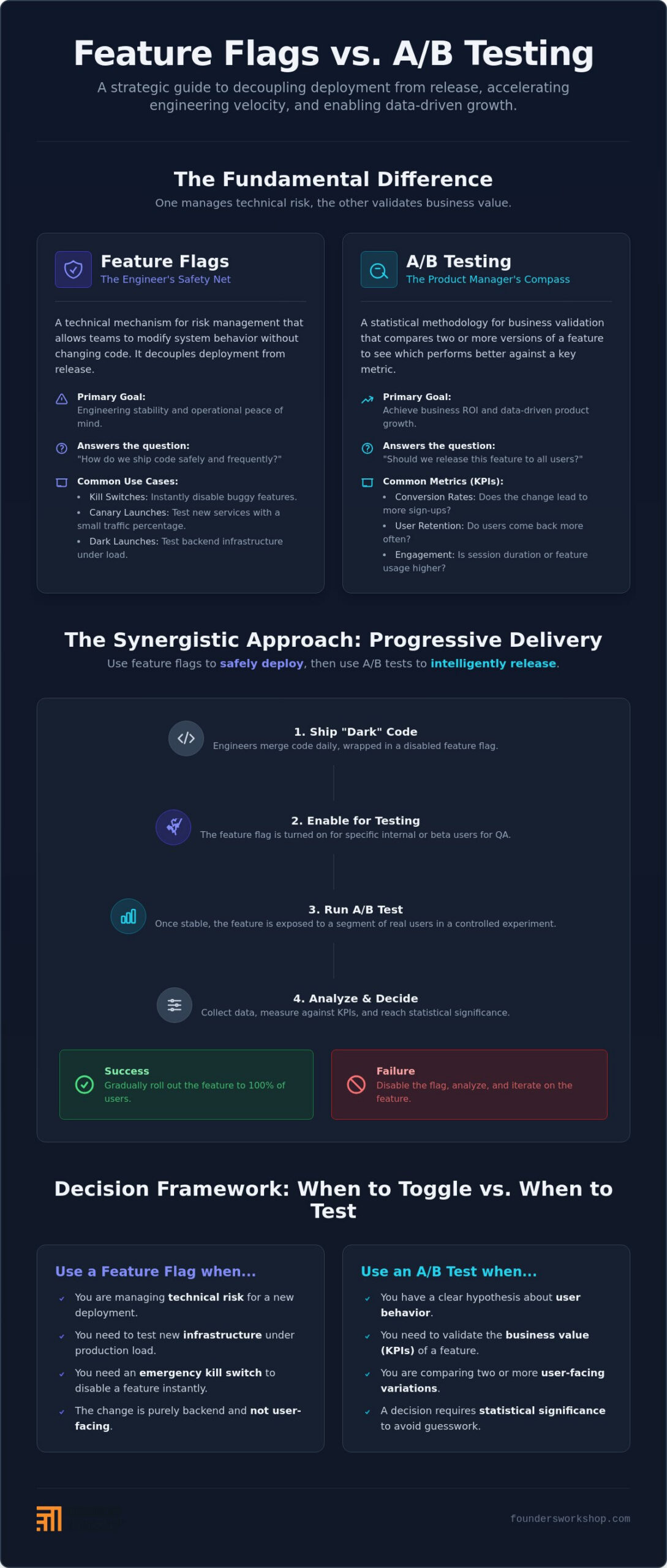
Implementing Progressive Delivery: The Synergistic Approach
The most sophisticated product teams have moved beyond the binary choice of feature flags vs a/b testing. Instead, they view these tools as complementary layers within a Progressive Delivery framework. Progressive Delivery is the natural evolution of Continuous Delivery; it shifts the focus from how fast you can deploy code to how safely and effectively you can release value. In this model, feature flags provide the technical “how” by controlling traffic, while A/B testing provides the strategic “why” by measuring user impact. When used together, they transform the release process from a high-stakes event into a controlled, data-driven experiment.
This synergy allows you to manage the entire lifecycle of a feature with precision. You use a flag to hide the code during the initial deployment, then use an A/B test to expose it to specific segments for validation. This approach ensures that you never release a feature to your entire user base until you have both technical confidence and statistical proof of its value. If you want to accelerate your product roadmap while maintaining this level of rigor, you can partner with a nearshore software development team to integrate these advanced release patterns into your existing CI/CD pipeline.
The Canary Release Workflow
The canary release is the ultimate intersection of flags and testing. It’s a staged rollout strategy that limits the “blast radius” of any potential issue. The workflow typically follows a structured path:
- Deploy to 1%: Use a feature flag to expose the new code to a tiny, low-risk subset of users.
- Monitor Health: Use performance telemetry to check for spikes in error rates, latency, or memory usage.
- Expand to 10%: If the system remains stable, increase the exposure to gather initial behavioral data.
- Full Release: Proceed to 100% only after the technical health is verified and the A/B test results show positive engagement.
This process relies on automated rollbacks. If your monitoring tools detect a regression, the system can automatically toggle the flag to “off,” protecting your users before a human even needs to intervene.
Best Practices for Engineering Teams
Managing the complexity of multiple flags and tests requires organizational discipline. Naming conventions are your first line of defense; a toggle named new_header_v2 is useless in a crisis. Instead, use descriptive names like feature_onboarding_redesign_july2026 that provide context for both engineers and product managers. Flag cleanup is equally critical. You must treat every temporary flag as technical debt. Set “expiration dates” for your toggles and ensure they are removed from the codebase once a feature is permanently rolled out. Shared visibility is the final piece of the puzzle; both Product and Engineering should have access to a single dashboard that shows exactly what is live, who is seeing it, and how it’s performing.
Scaling Product Engineering with Nearshore Expertise
Scaling an engineering team is often where the friction between development speed and product quality becomes most visible. At Founders Workshop, we don’t just provide developers; we provide a disciplined release strategy that integrates feature flagging and A/B testing into the very foundation of your MVP. This ensures that as your product grows, your ability to manage risk and validate value scales alongside it. By treating the choice between feature flags vs a/b testing as a strategic framework rather than a technical afterthought, we help you maintain a steady pace of innovation without the typical growing pains of a scaling startup.
The success of these complex release strategies depends heavily on high-fidelity communication and real-time collaboration. This is where the advantage of a nearshore partner becomes undeniable. Implementing a canary release or a toggle-based migration requires your team to be in constant sync. Our nearshore teams operate in your timezone, eliminating the 12-hour feedback delays that often lead to misaligned deployments in offshore models. This proximity allows for the human-centered problem solving that a simple dev shop cannot provide, ensuring your technical execution remains perfectly aligned with your business vision.
One of the most impactful ways we’ve used this approach is in modernizing legacy systems. By employing toggle-based migrations, we’ve successfully transitioned aging platforms to modern architectures with zero downtime. We wrap legacy components in feature flags, allowing us to route traffic to the new system incrementally. This methodology provides the safety net needed to modernize without disrupting your existing revenue streams, and it pairs naturally with proven refactoring legacy code strategies that transform aging systems into high-performing assets, proving that tools are always secondary to a sound business outcome.
Strategic Partnership for Engineering Excellence
We believe that sustainable growth is rooted in alignment, not just one-off code delivery. Our Latin American talent is selected for their ability to integrate seamlessly into your existing team, bringing with them the best practices of progressive delivery. We focus on building a bridge between your current capabilities and your long-term strategic vision. You can learn about our nearshore staff augmentation and how we help companies bridge the gap between engineering speed and operational stability.
Founders’ Peace of Mind
For many non-technical founders, the fear of shipping is a real barrier to growth. Our goal is to remove that technical friction and replace it with seasoned confidence. By implementing rigorous flagging and testing protocols from day one, we ensure that every code change is backed by data and protected by a safety switch. This alignment between technical execution and business KPIs provides the peace of mind you need to focus on scaling your company. When you’re ready to move beyond guesswork and start building for the future, you can schedule an AI or Product Strategy Consultation to discuss your roadmap.
Mastering the Path to Progressive Delivery
Success in modern product engineering requires more than just writing clean code; it demands a disciplined approach to how that code reaches the user. By mastering the strategic application of feature flags vs a/b testing, you decouple technical risk from business validation. This shift allows your engineering team to maintain high velocity while your product team gathers the empirical data necessary to scale operations. You’ve moved from a world of high-stakes, all-or-nothing releases to a sustainable culture of progressive delivery where every deployment is a controlled opportunity for learning.
Implementing these advanced workflows is easier with a partner who has navigated these challenges before. Scale your engineering velocity with a Founders Workshop nearshore team to bridge the gap between strategy and execution. We bring 30+ years of software development experience to every project, specializing in both rapid MVP launches and complex legacy modernization. Our nearshore developers work in your timezone to ensure immediate collaboration and total accountability. You have the vision to build something great. We have the steady hand to help you get there safely and efficiently.
Frequently Asked Questions
Can you use feature flags for A/B testing?
Yes, feature flags are the primary delivery mechanism used to conduct A/B tests. While a flag simply toggles a feature on or off, an A/B test adds a layer of logic to split traffic between versions and track specific KPIs. Understanding the technical synergy of feature flags vs a/b testing allows you to use the same infrastructure for both operational safety and experimental validation.
Do feature flags slow down application performance?
When implemented with local evaluation SDKs, feature flags have a negligible impact on application performance. Modern platforms evaluate flag rules in sub-millisecond timeframes by keeping the configuration in memory rather than making a network request for every user. If you use a robust management tool, the overhead is typically less than the latency of a single database query.
How long should a feature flag stay in the code?
Most feature flags should be removed within one to two weeks of a successful release to prevent technical debt. You should treat temporary toggles like scaffolding that must be taken down once the building is complete. Only permanent flags, such as kill switches for third-party integrations or circuit breakers for legacy systems, should remain in your codebase indefinitely.
Is A/B testing worth it for a startup MVP?
A/B testing is often less effective for early-stage MVPs because they lack the traffic volume required to reach statistical significance quickly. For startups, it’s usually better to use feature flags for rapid “dark” deployments and focus on qualitative user feedback. Once your user base scales and you have consistent traffic, you can transition to formal testing to optimize specific conversion funnels.
What is the difference between a feature flag and a canary release?
A feature flag is the technical toggle that controls visibility, while a canary release is the strategic process of using that toggle for a gradual rollout. In a canary release, you use a flag to expose new code to a small percentage of users, such as 1%, to monitor system health. If no errors occur, you gradually increase the flag’s reach to the entire population.
What tools are best for managing feature flags in 2026?
As of July 2026, LaunchDarkly remains the enterprise standard for feature management, offering robust developer plans and advanced guardian controls. Statsig has gained significant ground for data-heavy teams, especially following its integration with Amplitude’s analytics platform. For organizations prioritizing data ownership, warehouse-native tools like GrowthBook provide the flexibility to connect directly to your existing data stack.
How do I convince my stakeholders to invest in an A/B testing platform?
Stakeholders respond best when you frame the investment as an insurance policy against wasted development time. Explain the strategic divide of feature flags vs a/b testing: flags protect the system from crashing, while tests protect the business from shipping features that users don’t want. Highlighting that only a small fraction of new features actually improve metrics helps justify the cost of validation.
What is a ‘dark launch’ and how does it relate to feature toggles?
A dark launch is a release strategy where new code is deployed to production but remains invisible to the end user. This is achieved by wrapping the new functionality in a feature toggle that is set to “off” by default. It allows your engineering team to test how new backend logic performs under real production load without risking any disruption to the actual user experience. Non-technical founders weighing the technical co-founder vs agency decision will find that a strategic nearshore partner can implement these dark launch protocols from day one, providing the safety and scalability that an early in-house hire often cannot.