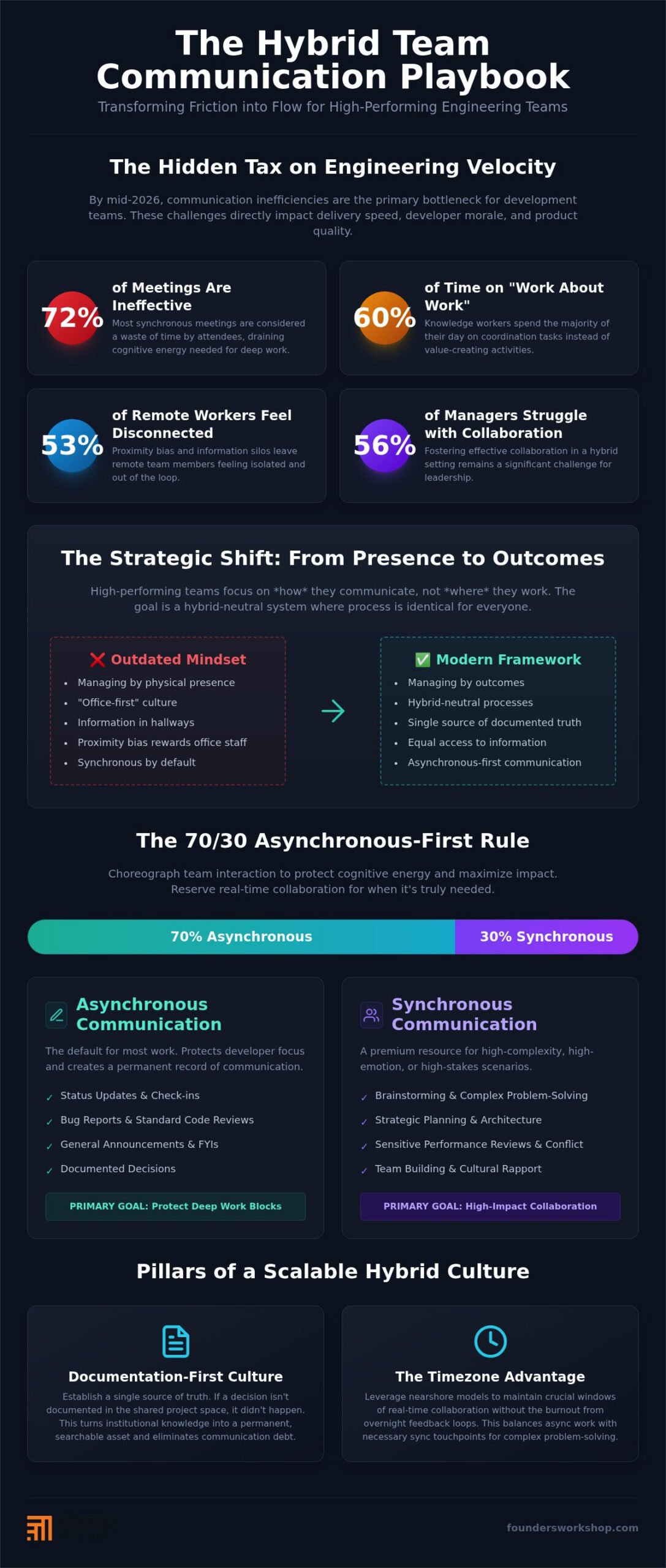
Did you know that 72% of meetings are considered ineffective by the people sitting in them? By mid-2026, knowledge workers are still spending 60% of their day on “work about work” instead of actually building. You’ve likely felt the sting of engineering velocity stalling because your talent is trapped in a cycle of timezone-induced delays and information silos. Implementing communication best practices for hybrid teams is no longer just a perk; it’s a strategic necessity to prevent top-tier developers from losing their flow to meeting fatigue or documentation gaps. It’s frustrating to watch a high-performing team lose its momentum to logistical friction that could have been avoided.
We understand that tools aren’t the solution; strategy is. This guide will show you how to master the frameworks and timezone-aligned strategies needed to eliminate friction and foster a culture of accountability. You’ll learn to prioritize deep work and documentation over constant, low-value synchronization. We’ll walk through the specific shifts from managing by presence to managing by outcomes, ensuring your hybrid development environment remains a competitive advantage rather than a hurdle to your scaling operations.
Key Takeaways
- Shift your strategic focus from physical location to communication methodology by adopting an asynchronous-first framework that protects engineering deep work.
- Implement communication best practices for hybrid teams to eliminate communication debt and ensure every contributor stays aligned regardless of their desk coordinates.
- Leverage the “Timezone Advantage” of nearshore models to maintain real-time collaboration without the burnout associated with overnight feedback loops.
- Establish a documentation-first culture where AI automates technical updates, turning institutional knowledge into a permanent and searchable asset for the entire organization.
- Transform your development process from managed chaos into a predictable engine that accelerates MVP delivery and supports long-term scaling.
The State of Hybrid Team Communication in 2026
By 2026, the strategic conversation has moved past the physical location of a developer’s desk. The real challenge for technical leaders is “Communication Debt.” Much like technical debt, this is the cumulative cost of fragmented conversations, undocumented decisions, and interrupted focus. When communication best practices for hybrid teams aren’t prioritized, the interest on this debt is paid in delayed releases and developer burnout. It’s a hidden tax on software delivery that many organizations ignore until velocity grinds to a halt.
The old debate of “remote versus office” is now obsolete. High-performing leaders have shifted their focus to the balance between synchronous and asynchronous workflows. While 80% of employees have experimented with AI to streamline tasks by 2026, the human element of alignment remains the primary bottleneck. Research shows that 56% of managers still find it challenging to foster collaboration in these environments. Communication friction doesn’t just slow down a sprint; it directly correlates with technical debt and higher churn among senior engineers who value deep work over endless status meetings.
Moving Beyond the ‘Office-First’ Mindset
A sustainable hybrid model must be hybrid-neutral. This means the process works identically whether a team member is in a conference room or a home office. Proximity bias is a silent killer of engineering velocity. It occurs when in-office staff receive information or opportunities faster than remote counterparts, leading to 53% of remote workers feeling disconnected from their team. Establishing a single source of truth for all project data ensures that every contributor has the same context at the same time. If a decision is made in a hallway, it isn’t real until it’s documented in the shared project space.
The ROI of Communication Alignment
Strategic alignment offers a measurable return on investment. When you reduce meeting overhead, you aren’t just saving time; you’re reclaiming the cognitive energy required for complex tasks like legacy application modernization. Proactive alignment reduces the cost of rework by ensuring requirements are clear before a single line of code is written. By quantifying these velocity gains, leaders can justify the shift toward a more structured, outcome-based framework. This disciplined approach transforms communication from a source of friction into a predictable engine for growth and scalable delivery.
Balancing Synchronous and Asynchronous Workflows
High-performing teams in 2026 don’t just “work”; they choreograph their interactions. The 70/30 rule has emerged as the gold standard for maintaining engineering velocity. Under this framework, 70% of communication happens asynchronously. This shift isn’t about avoiding people; it’s about respecting the cognitive load required for software development. By moving status updates and routine check-ins to async channels, you protect “Deep Work” blocks. These are the uninterrupted four-to-six-hour stretches where engineers actually solve complex problems. When 72% of meetings are considered ineffective, reclaiming this time is the fastest way to boost your team’s output.
Identifying which tasks require real-time “sync” is a foundational step in implementing communication best practices for hybrid teams. Updates, bug reports, and standard code reviews should live in documentation or recorded video snippets. Real-time collaboration is a premium resource. It should be spent on brainstorming, complex problem-solving, or high-stakes decision-making. Using virtual whiteboarding and AI-driven summaries ensures that when the team does meet, the insights are captured and accessible to everyone later. This prevents the loss of information that often occurs in casual office conversations.
When to Go Synchronous
Not every interaction belongs in a chat thread or a ticket. Real-time meetings are reserved for high-complexity or high-emotion scenarios where the nuance of tone is vital. Strategic planning and complex system architecture discussions benefit from the immediate feedback loop of a live conversation. Similarly, sensitive performance reviews or conflict resolution require the empathy that only a face-to-face interaction provides. Building cultural rapport through non-transactional video calls also helps maintain the human bond that 53% of remote workers feel they are missing. These sessions are about alignment and connection, not just checking off a to-do list.
Mastering the Asynchronous Handover
Mastery of the asynchronous handover is what separates scaling startups from those stuck in managed chaos. It requires a commitment to self-contained documentation. Every ticket or message must include the “why,” the “how,” and the “acceptance criteria” so the recipient can proceed without waiting for a reply. Video snippets for bug demonstrations or code walkthroughs are often more effective than long paragraphs. AI now plays a critical role here, bridging the gap by summarizing long threads or translating technical jargon into business-ready status reports. If your current structure feels fragmented, nearshore staff augmentation can introduce developers who are already experts in these disciplined communication frameworks, helping you scale without the friction.
The Timezone Advantage: Why Nearshore Wins
While software and AI tools provide the infrastructure for collaboration, they cannot fix the fundamental physics of time. Many leaders realize too late that offshore models carry a hidden “overnight tax.” If a developer in a 12-hour offset makes a mistake or needs clarification at 4 PM, the correction doesn’t happen for another full day. This lag creates a cycle of frustration and burnout for onshore managers who must work late nights or early mornings just to sync. Transitioning to timezone-aligned talent is one of the most impactful communication best practices for hybrid teams because it restores the natural rhythm of the workday.
Timezone alignment allows for real-time collaboration without the sacrifice of personal well-being. It’s the difference between a project that moves at the speed of thought and one that is constantly stalled by a 12-hour feedback loop. For North American firms, Latin American talent has become the strategic choice. It offers the rare combination of high-level technical expertise and a shared workday, ensuring that your team stays in sync without anyone having to sacrifice their sleep or sanity.
Eliminating the ‘Waiting on an Answer’ Bottleneck
Engineering velocity depends on the speed of the feedback loop. In a nearshore staff augmentation model, a question asked at 10 AM is usually answered by 10:05 AM. This real-time accessibility builds a psychological safety net and fosters trust. Teams know they aren’t shouting into a void. Same-day problem solving prevents minor misunderstandings from evolving into project scope creep. When your onshore and nearshore talent work the same hours, you eliminate the bottleneck of waiting, allowing for a predictable and scalable delivery engine.
Strategic Alignment with Latin American Talent
Latin American markets offer more than just geographic proximity; they provide cultural compatibility that offshore regions often lack. This alignment makes it easier to integrate augmented staff into existing agile ceremonies like daily stand-ups or sprint retrospectives. High English proficiency ensures that complex technical requirements aren’t lost in translation. By building a unified team culture across borders, you move from a “vendor” mentality to a true partnership. This human-centered approach is what allows businesses to scale operations sustainably while keeping everyone focused on the strategic vision.
Building a Documentation-First Culture
In a hybrid environment, verbal agreements are fragile. The mantra “If it isn’t documented, it didn’t happen” is the bedrock of successful software delivery in 2026. This is a core component of communication best practices for hybrid teams because it eliminates the “he said, she said” friction that frequently stalls sprints. By standardizing templates for Request for Comments (RFCs) and Architecture Decision Records (ADRs), you create a trail of logic that any contributor can follow. It’s not just about recording what was done; it’s about preserving the context behind every technical pivot. This level of clarity prevents the loss of institutional knowledge when staff members transition or timezones shift.
AI has revolutionized this process by removing the manual burden that engineers often dread. Instead of developers spending hours updating wikis, AI tools now handle the heavy lifting of summarizing technical discussions and updating project status. Implementing a robust AI strategy consulting framework helps you identify exactly which parts of your workflow can be automated. This strategic approach allows your talent to focus on high-value building rather than administrative overhead, ensuring that your documentation stays current without sacrificing velocity.
Automating Alignment with AI
AI-generated meeting transcripts are no longer just rough drafts; they’re now precise records of intent. By 2026, these tools provide actionable summaries and can even identify communication silos before they cause project delays. Integrating AI into your internal software ensures knowledge is shared seamlessly across the organization. Predictive analytics can flag when a specific module lacks sufficient documentation, prompting a review before technical debt accumulates. This proactive stance keeps the entire team aligned, regardless of where or when they’re working.
The Founder’s Role in Documentation
Culture starts at the top. As a leader, you must lead by example. Every strategic decision should be captured in writing before it’s broadcast to the wider team. This discipline signals to the organization that clear communication is a non-negotiable standard. Rewarding thorough documentation as highly as code commits changes the internal incentive structure for the better. This results in a searchable knowledge base that allows for rapid onboarding of new talent. If you’re ready to build a more disciplined, high-velocity organization, our experts can help you optimize your internal software development today.
Scaling Hybrid Teams: From Friction to Growth
Scaling a technical organization requires more than just increasing your headcount. It demands a fundamental shift from founder-led interactions to system-led frameworks. When you implement communication best practices for hybrid teams, you move away from being the primary bottleneck in every decision loop. This transition is essential for rapid MVP development, where speed and clarity are the only variables that truly matter. By building a predictable delivery engine, you ensure that your strategic vision is translated into code without constant manual intervention or repetitive status updates.
Moving from managed chaos to a scalable engine is a deliberate process. It requires moving beyond the “hope for the best” approach to remote work and adopting a disciplined methodology. A system-led communication model ensures that the culture of accountability remains intact as the team grows. This allows you to maintain high engineering velocity even as project complexity increases. The right technical partner doesn’t just provide talent; they provide the communication infrastructure that bridges the gap between your business goals and technical execution.
The Strategic Partnership Model
Managed teams consistently outperform freelance marketplaces for complex, high-stakes builds. While marketplaces offer quick access to individuals, they lack the cohesive communication frameworks necessary for long-term sustainability. Founders Workshop integrates human-centered design with rigorous technical execution, ensuring that augmented staff aren’t just “extra hands” but strategic partners. We focus on building a unified culture where communication is a first-class citizen. This disciplined approach removes the technical friction that often stalls growth, allowing you to scale your operations with seasoned confidence.
Next Steps for Founders
The path to a frictionless hybrid environment begins with an honest assessment of your current bottlenecks. Start by auditing your team’s calendar to identify where meeting fatigue is highest. This week, implement these three changes for immediate impact: move all status updates to an asynchronous channel, block out four hours of daily “deep work” for your engineers, and mandate that every architectural decision be recorded in a shared knowledge base. These small shifts lay the groundwork for a more efficient, documentation-first culture. If you’re ready to move beyond managed chaos and build a world-class engineering team, it’s time to scale your team with Founders Workshop.
Mastering the Future of Distributed Delivery
Mastering communication best practices for hybrid teams isn’t about adopting more tools; it’s about refining your methodology to protect your most valuable asset: developer focus. By shifting to an asynchronous-first framework and prioritizing documentation, you eliminate the communication debt that inevitably slows down software delivery. Timezone alignment remains the ultimate strategic lever, ensuring your team can collaborate in real-time without the burnout of mismatched schedules or the lag of offshore models. These structural shifts turn communication from a source of friction into a competitive advantage.
At Founders Workshop, we bring 30+ years of executive leadership to every partnership. We specialize in US-Latin America nearshore alignment and human-centered AI strategy to help you bridge the gap between high-level vision and technical execution. Our approach focuses on removing friction so your business can scale sustainably and predictably. If you’re ready to scale your engineering team with timezone-aligned talent, contact Founders Workshop today. We’re here to help you turn managed chaos into a scalable engine for growth. You’ve navigated the challenges of a changing landscape; now it’s time to build with confidence.
Frequently Asked Questions
What are the biggest communication challenges for hybrid teams in 2026?
Proximity bias and communication debt are the primary hurdles. As of 2026, 52% of remote-capable employees work in hybrid models, which often leads to information silos between in-office and remote staff. Managers frequently struggle to foster collaboration; research shows 56% report difficulties in this area. These challenges usually stem from a lack of structured frameworks, resulting in meeting fatigue and a measurable loss of deep work for engineering teams.
How do I balance synchronous vs. asynchronous communication for developers?
Adopting a 70/30 ratio is the most effective way to balance these workflows. You should reserve synchronous meetings for high-complexity tasks like architectural planning or sensitive performance reviews. Asynchronous channels are better suited for routine status updates and bug reports. This balance is a core part of communication best practices for hybrid teams because it protects the uninterrupted time developers need for complex problem solving and deep focus.
Why is timezone alignment more important than cost in software outsourcing?
Timezone alignment is a superior metric for ROI because it eliminates the “overnight tax” common in offshore models. While offshore rates might seem lower initially, the 12-hour feedback loop creates massive delays in engineering velocity. Nearshore teams working in your same workday allow for real-time problem solving and immediate clarification. This alignment prevents project scope creep and reduces the heavy management overhead that typically eats into offshore cost savings.
How can AI improve communication for distributed engineering teams?
AI improves communication by automating the capture and synthesis of technical data. By 2026, 82% of business leaders see AI-powered collaboration as pivotal for summarizing meetings and managing complex workflows. Predictive analytics can now identify communication silos before they stall a sprint. Our AI strategy experts focus on integrating these tools directly into internal software to ensure knowledge sharing happens seamlessly without adding any administrative burden to your developers.
What documentation tools are essential for hybrid software development?
Essential tools include Architecture Decision Records (ADRs) for technical context and virtual whiteboards for visual alignment. Beyond basic chat platforms, you need a centralized knowledge base that acts as a single source of truth. AI transcription tools and automated documentation generators are also critical. These tools ensure that institutional knowledge remains accessible to all staff, preventing the loss of information that often occurs during casual, undocumented office interactions.
How do I prevent remote employees from feeling excluded in a hybrid model?
You must adopt a hybrid-neutral mindset where every meeting and decision is digital by default. If a conversation happens in a hallway, it isn’t official until it’s documented in a shared channel. Proximity bias affects 53% of remote workers who feel it’s harder to be part of the team. Leading by example through written communication ensures that remote staff have the same context and influence as those in the physical office.
What is the ‘documentation-first’ approach in hybrid work?
The documentation-first approach is a commitment to recording every strategic decision and technical requirement in writing before execution. It’s the hybrid team mantra that “if it isn’t documented, it didn’t happen.” This methodology reduces the need for constant synchronization and allows new contributors to onboard rapidly. It creates a searchable trail of logic that remains useful long after a project is completed, supporting long-term sustainability and your overall growth strategy.
How does nearshore staff augmentation solve communication delays?
Nearshore staff augmentation solves delays by providing talent that operates within your specific workday. Unlike offshore models, a question asked at 10 AM gets an answer by 10:05 AM. This real-time accessibility is one of the essential communication best practices for hybrid teams. It fosters a high-trust environment where same-day problem solving is the norm, allowing your organization to maintain a predictable and scalable delivery engine without the friction of timezone gaps.