
Managing a remote nearshore development team in 2026 is no longer about simply “outsourcing” tasks to reduce overhead. It is about engineering a single, borderless culture that operates in real-time. While the promise of significant savings on engineering spend remains attractive, the true executive challenge lies in bridging the gap between geographic proximity and operational synergy. Tools alone cannot solve for a lack of strategic alignment.
You probably recognize the frustration of communication lags in asynchronous environments or the creeping anxiety of technical debt when standards aren’t uniform across borders. It is difficult to maintain a high-velocity sprint when cultural misunderstandings or poor oversight stall your momentum. We understand these pressures because we have navigated these shifts for over 30 years. This guide provides the strategic frameworks and AI-driven workflows you need to lead high-performing teams in Latin America with zero friction. You will learn how to leverage timezone alignment and recent labor shifts in regions like Mexico and Argentina to create a true “one-team” feel. We will move past the basics of remote work to focus on predictable velocities, high developer retention, and the removal of technical friction to allow your business to scale.
Key Takeaways
- Understand why timezone alignment is the foundation of high-synchronicity models compared to traditional offshore “throw it over the wall” methods.
- Implement a “Default to Open” communication policy and a Single Source of Truth to eliminate information silos and build a true one-team culture.
- Discover how to leverage AI-driven code reviews and automated documentation to maintain technical standards when managing a remote nearshore development team.
- Transition from simple oversight to performance-based management by tracking Engineering Velocity and Cycle Time through clear, data-driven KPIs.
- Learn the strategic triggers for moving from individual staff augmentation to a fully managed nearshore pod integrated into your core planning.
The Strategic Shift: Why Managing Nearshore Teams Differs from Offshore
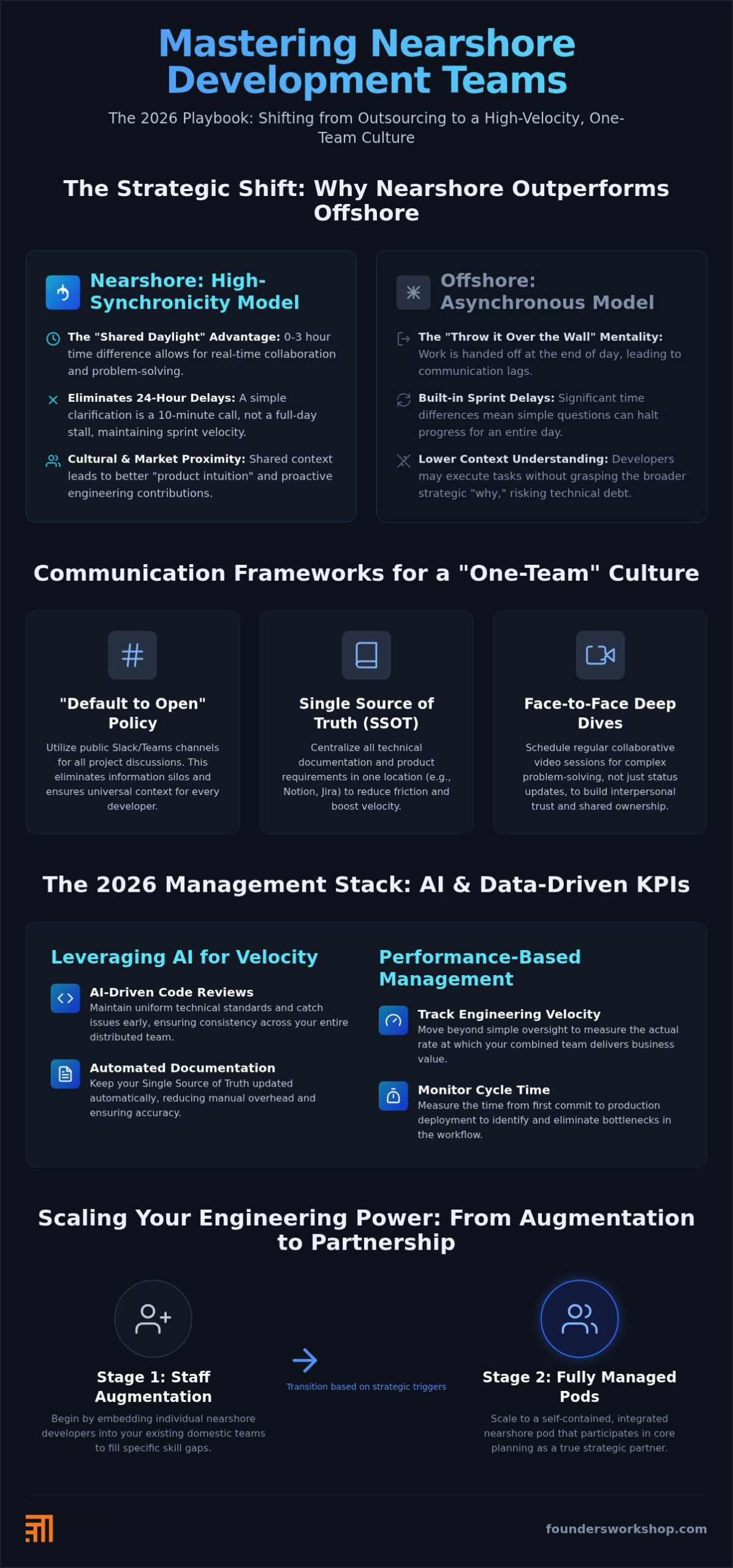
Many executives treat all remote engineering as a single category, but this is a strategic error. Traditional offshore models often rely on a “throw it over the wall” mentality; you send requirements at the end of your day and hope for the best while you sleep. Managing a remote nearshore development team requires a different mindset. It is a high-synchronicity model that leverages a 0 to 3 hour time difference to turn distance into a competitive advantage.
The “Shared Daylight” principle is the cornerstone of this approach. It means your lead architect can jump on a call with a developer in Latin America to solve a logic error in real-time. This eliminates the 24-hour delay common when waiting for teams in distant timezones to wake up. Real-time problem solving reduces sprint delays and ensures that your internal and nearshore units operate as a single, cohesive engine.
The Timezone Advantage as a Management Tool
Real-time communication is your most potent tool for maintaining velocity. In offshore models, a simple clarification can stall a sprint for an entire day. With nearshore teams, these hurdles are cleared in minutes. This synchronicity is critical for incident response. When a production bug appears at 2 PM EST, your nearshore team is active and ready to deploy an emergency hotfix alongside your domestic staff. Nearshore management is the bridge between cost-efficiency and operational synchronicity.
Cultural Proximity and its Impact on Product Intuition
A foundational step in understanding nearshoring is recognizing that geographic proximity often mirrors cultural alignment. Developers in Latin America share consumer trends and business logic with North American markets. This shared context leads to “product intuition,” where engineers understand the “why” behind a feature rather than just the “how.”
Latin American work cultures often favor high-context communication, which significantly reduces requirement misunderstandings. Because they operate within the same business cycles, these developers act as product engineers who can challenge assumptions. This proactive engagement is vital when managing a remote nearshore development team. It prevents the accumulation of hidden technical debt that often occurs when developers act as mere code executors without a grasp of the broader strategic vision.
Building a “One-Team” Culture: Communication Frameworks for 2026
Success in managing a remote nearshore development team depends on moving past the “vendor” mindset. You need to treat your Latin American engineers as core employees rather than external contractors. A “One-Team” culture isn’t a buzzword; it’s a structural requirement for high-velocity software delivery in 2026. This starts with a “Default to Open” communication policy. Use public Slack or Teams channels for all project-related discussions instead of private DMs. This prevents information silos and ensures every developer sees the context behind strategic technical decisions.
You must also establish a Single Source of Truth (SSOT). Whether you use Notion, Jira, or a dedicated internal wiki, all technical documentation and product requirements must live in one central location. When documentation is fragmented, friction increases and velocity drops. To build interpersonal trust, schedule regular “Face-to-Face” virtual deep dives. These aren’t just status updates; they are collaborative sessions where you solve complex architectural problems together.
Synchronous vs. Asynchronous Balance
Effective management requires a sophisticated mix of real-time and recorded communication. Leverage the “Golden Hours” strategy by maximizing the 4 to 6 hours of daily overlap for high-bandwidth collaboration. Reserve this time for brainstorming and pair programming. For lower-priority updates or code walkthroughs, use asynchronous tools like Loom. This approach respects deep work time while maintaining momentum. Following best practices for managing nearshore teams ensures that your asynchronous handoffs don’t result in lost context or missed deadlines.
Integrating Nearshore Talent into Core Company Rituals
Don’t limit your remote team to technical standups. Include them in all-hands meetings and share high-level business goals. When engineers understand the commercial “why,” they develop a sense of product ownership that code-only developers lack. This level of engagement is a primary reason why savvy leaders prefer nearshore vs offshore software development models. To reduce churn and foster loyalty, create “Virtual Watercoolers” or non-work channels where personal connections can form naturally.
Finally, you must standardize your definition of “Done.” Both local and remote members must share the same criteria for testing, documentation, and deployment. If you’re looking to build a more cohesive engineering unit, our nearshore staff augmentation services focus on this cultural and operational integration from day one. When everyone operates on the same playbook, you eliminate the friction that often plagues cross-border partnerships.
The 2026 Tech Stack: Leveraging AI for Nearshore Management Velocity
Managing a remote nearshore development team in 2026 requires more than just a shared Slack workspace. As engineering speeds accelerate, manual oversight becomes a bottleneck that can’t keep pace with AI-assisted coding. To maintain velocity, you must deploy a tech stack that uses artificial intelligence to handle routine governance. A 2026 McKinsey report found that developers using AI coding assistants are 35 to 45 percent more productive than those working without them. This surge in output necessitates automated systems to ensure that quality doesn’t suffer as volume increases.
Deploying AI-driven code review agents allows your senior architects to maintain technical standards without reviewing every line of code personally. These agents flag logic errors and security vulnerabilities in real-time, ensuring that the nearshore team ships clean code. You should also implement automated documentation tools. These platforms update your Single Source of Truth as the team commits code, meaning your technical debt remains visible rather than hidden. To keep leadership informed, use AI standup summarizers. These tools distill daily LATAM standups into executive briefs, giving you visibility into progress without requiring your presence in every meeting.
AI-Enhanced Technical Oversight
AI tools now identify technical debt in nearshore repositories by analyzing code patterns over time. This proactive oversight allows you to address architectural rot before it stalls a sprint. You can also automate the QA feedback loop between US-based product managers and LATAM developers. When a bug is found, AI agents can categorize the issue, assign it to the right developer, and suggest a potential fix based on previous documentation. Our AI strategy and development services help founders choose the right management tools to integrate these capabilities into their existing workflows. This ensures your technical oversight remains lean and effective.
Productivity Tracking Without Micromanagement
The era of “hours logged” is over. Modern leadership uses AI-driven insights from Jira or Linear to track “value delivered” and “Cycle Time” instead. These tools provide a transparent view of engineering velocity without the friction of micromanagement. You can also utilize sentiment analysis tools in Slack to gauge team morale. By monitoring communication patterns, these tools can predict team burnout or disengagement before it leads to developer churn. Setting up automated “Nudge” bots for missing documentation or overdue reviews keeps the process moving. It allows you to manage by exception, only stepping in when the AI signals a deviation from your established sprint health metrics.
Managing Performance and Accountability Across Borders
Accountability in a cross-border environment isn’t about tracking hours; it’s about measuring outcomes. When managing a remote nearshore development team, your leadership must shift from surveillance to alignment. This requires a foundation of clear, data-driven KPIs that prioritize Engineering Velocity and Cycle Time. These metrics provide an objective view of how quickly value moves from a concept to a production-ready feature. It removes the subjective friction that often occurs in remote partnerships.
To maintain these standards, you should conduct quarterly performance reviews that align with the 2026 nearshore staff augmentation guide. These sessions shouldn’t be one-way critiques. They’re strategic opportunities to align developer growth with your business roadmap. By creating a transparent career ladder, you ensure that your nearshore talent sees a long-term future within your organization. This reduces churn and preserves the institutional knowledge that is vital for scaling your operations.
Metric-Driven Leadership
High-performing teams rely on DORA metrics to benchmark their success. You should track Deployment Frequency and Lead Time for Changes across your entire engineering unit, regardless of location. This data removes the guesswork from managing a remote nearshore development team. Sprint Predictability is perhaps your most important indicator of management health. If your nearshore team consistently hits their committed story points, it signals that your requirements are clear and your processes are stable. When underperformance occurs, address it with a mix of empathy and clarity. Focus on the “why” behind the data, offering support or training before escalating to more formal measures.
Building Trust Through Transparency
Transparency is the antidote to the “us vs. them” mentality. Implement open-access dashboards where nearshore developers can see the direct impact of their code on business ROI. When engineers see how a specific feature improves user retention or revenue, their sense of ownership deepens. This level of insight is often a core component of successful AI strategy consulting outcomes, where technical execution is tied directly to commercial goals.
In Latin American professional cultures, a “Radical Candor” approach works exceptionally well. It combines personal care with direct challenge, allowing for honest feedback that doesn’t damage relationships. Encourage a peer review culture where local and remote developers audit each other’s work equally. This levels the playing field and ensures that technical excellence is the only standard that matters. If you want to build a team that thrives under this level of accountability, our nearshore staff augmentation services provide the seasoned talent you need to succeed.
Scaling Your Engineering Velocity: From Augmentation to Partnership
Scaling an engineering unit requires a fundamental shift from tactical oversight to strategic integration. When managing a remote nearshore development team, you eventually reach a point where individual contributors aren’t enough to sustain your growth. You need a model that scales with your vision. This transition involves moving from simply “hiring hands” to building a partnership where your nearshore engineers are stakeholders in your success. A technical partner acts as the bridge that allows you to stop managing tasks and start scaling your broader business goals.
The long-term ROI of a stable, timezone-aligned engineering unit is found in the reduction of operational friction. When your senior developers and architects in Latin America are integrated into your core strategic planning, they provide a layer of stability that offshore models cannot match. They don’t just execute tickets; they help you navigate technical hurdles before they become business risks. This level of partnership ensures that your engineering capacity is an asset, not a management burden.
The Evolution of the Nearshore Relationship
Your relationship with a nearshore team often begins with staff augmentation to fill immediate gaps. However, as your product matures, this should evolve into a long-term custom software development partnership. This evolution is particularly visible when handling “Knowledge Transfer.” Over time, your nearshore team becomes the primary expert on your systems, which reduces the institutional weight on your domestic leadership.
A strategic partner doesn’t just build new features; they also help you manage the health of your existing codebase. Leveraging nearshore teams for refactoring legacy code strategies allows you to reduce technical debt while your internal team stays focused on high-level innovation. This balanced approach ensures that your engineering velocity remains high even as your system complexity increases.
Choosing the Right Management Model
Deciding between managed teams and staff augmentation depends on your current growth stage. Staff augmentation is ideal for specialized tasks or temporary surges in workload. A fully managed nearshore pod, however, provides an autonomous unit that includes its own delivery manager. This role is crucial for reducing the founder’s day-to-day burden, as the delivery manager handles the operational nuances of managing a remote nearshore development team.
Before you scale your operations, use this executive checklist to ensure your partnership is ready for the next level:
- Are your senior nearshore developers included in sprint planning and roadmap discussions?
- Is there a documented process for knowledge transfer to ensure system continuity?
- Has your engineering velocity reached a predictable, data-driven baseline?
- Is your delivery model optimized to reduce the management overhead for your internal leadership?
Mastering Your Borderless Engineering Unit
Success in 2026 requires moving beyond transactional outsourcing and toward a high-synchronicity partnership. By leveraging timezone alignment and AI-driven workflows, you can eliminate the friction that historically plagued cross-border collaboration. You’ve seen how a “one-team” culture and a focus on engineering velocity turn geographic proximity into a competitive advantage. The goal is to move past simple oversight and create a self-sustaining engine that scales with your vision.
Managing a remote nearshore development team is a complex journey, but you don’t have to navigate it alone. Founders Workshop brings over 30 years of software leadership experience to your side. We specialize in Latin American tech talent and a human-centered approach to technical execution. Whether you’re building a startup MVP or scaling internal software development, we provide the seasoned guide you need to bridge the gap between vision and reality.
Scale your engineering velocity with Founders Workshop’s expert nearshore teams. We’re ready to help you build a high-performing engineering unit that drives long-term business ROI.
Frequently Asked Questions
What are the main challenges when managing a remote nearshore development team?
The primary obstacles include communication lag in asynchronous environments and the difficulty of maintaining uniform technical standards across borders. Executives often fear hidden technical debt due to poor oversight or cultural misunderstandings that affect sprint outcomes. Overcoming these requires a structural shift toward high-synchronicity models. By establishing a Single Source of Truth and clear KPIs, you can move past these friction points and achieve a seamless one-team feel.
How do I handle cultural differences in a Latin American nearshore team?
Latin American professional cultures are often high-context and relationship-oriented, meaning trust is the foundation of productivity. You should adopt a Radical Candor approach that combines personal care with direct technical challenges. Including nearshore developers in all-hands meetings and company rituals helps bridge the gap. Shared consumer trends and business logic between North and Latin America naturally reduce requirement misunderstandings, making these teams more intuitive product partners than offshore alternatives.
What is the best way to track productivity for remote developers in different timezones?
The most effective method involves tracking Engineering Velocity and Cycle Time rather than hours logged. In 2026, leaders use AI-driven insights from platforms like Jira or Linear to monitor value delivery in real-time. You should also measure DORA metrics, such as Deployment Frequency and Lead Time for Changes. These objective data points provide a transparent view of team health and help identify potential burnout or bottlenecks before they impact your sprint goals.
Is it better to hire freelancers or use a nearshore staff augmentation agency?
A nearshore staff augmentation agency is superior for long-term strategic growth. While freelancers might fill short-term gaps, an agency provides vetted talent, leadership oversight, and a stable partnership model. Agencies like Founders Workshop bring 30 years of experience to ensure your team is timezone-aligned and culturally integrated. This approach reduces the administrative burden on your domestic leadership and provides a clear career ladder that keeps high-performing developers engaged with your vision.
How do I ensure data security and IP protection with a nearshore team?
Security is managed through robust legal frameworks and modern infrastructure standards. Your contracts must explicitly define IP ownership and comply with data privacy regulations like GDPR or specific U.S. state laws. Use secure, cloud-based environments and implement AI-driven monitoring to flag unauthorized access. By partnering with an established agency, you gain the benefit of pre-vetted security protocols and compliance measures that are difficult to manage when working with individual cross-border contractors.
Can nearshore teams help with AI strategy and implementation in 2026?
Yes, nearshore teams are ideally positioned for AI implementation due to their high-synchronicity collaboration model. In early 2026, McKinsey reported that AI-assisted developers are 35 to 45 percent more productive than those working without them. Nearshore partners can help you deploy AI-driven code review agents and predictive analytics to monitor sprint health. This allows your organization to integrate advanced automation into existing workflows while maintaining the human-centered oversight necessary for responsible AI development.
How much overlap in working hours is necessary for a nearshore team to be effective?
An overlap of 4 to 6 “Golden Hours” is the industry standard for high-bandwidth collaboration. This window allows for real-time pair programming, brainstorming, and immediate problem-solving that eliminates the 24-hour feedback loops common in offshore models. While asynchronous communication handles routine updates, this daily overlap ensures that your nearshore developers act as an extension of your domestic team. It’s this real-time synergy that drives predictable engineering velocity and faster time-to-market.
What tools are essential for managing a remote engineering team in 2026?
Your 2026 tech stack must include AI-driven project management tools like Jira and communication platforms like Slack or Teams. Essential tools for managing a remote nearshore development team also include AI code review agents and automated documentation platforms that update in real-time. You should implement a Single Source of Truth for all technical requirements. Using AI standup summarizers further keeps leadership informed without constant meeting attendance, allowing you to focus on high-level strategy.