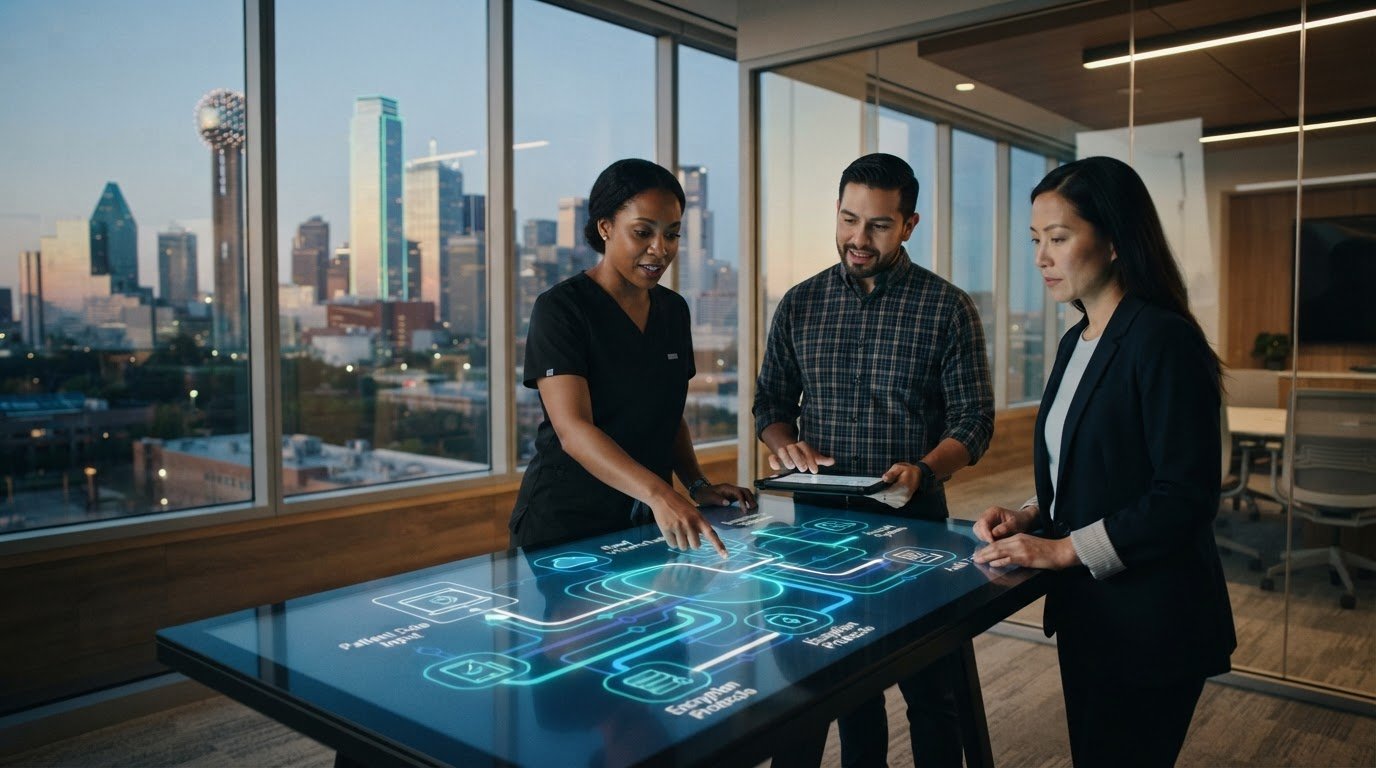
With over 16 million developers now building on GitHub across Latin America, the region has transitioned from a budget-friendly backup to a primary engine for high-stakes engineering. Yet, many leaders find that simple proximity isn’t a cure-all for delivery friction. You’ve likely realized that timezone alignment doesn’t automatically solve the challenges of cross-border collaboration. Even with overlapping hours, engineering teams often battle communication lags and inconsistent standards that quietly erode sprint velocity and frustrate your internal stakeholders.
This guide provides a strategic framework for nearshore development team integration best practices to help you blend LATAM talent into your US team seamlessly. We’ll show you how to move beyond transactional hiring to build a unified, high-velocity unit that operates with predictable delivery cycles. You’ll learn how to implement zero-trust security, bridge cultural nuances, and scale your operations without the unsustainable costs of domestic-only hiring. We’re going to explore the specific rituals and technical standards required to turn a group of remote developers into a permanent, strategic extension of your core team.
Key Takeaways
- Shift your mindset from transactional vendor management to strategic integration to avoid the common pitfalls that cause remote partnerships to stall after the initial honeymoon phase.
- Maximize the Latin American timezone advantage by designing a communication framework that balances real-time synchronous collaboration with an asynchronous-first culture.
- Apply nearshore development team integration best practices to bridge cultural communication gaps and cultivate the psychological safety necessary for developers to challenge specs and drive innovation.
- Secure your distributed engineering environment by implementing Zero Trust protocols and cloud-native parity that ensure your remote team remains as protected as your local office.
- Understand why a managed partnership model offers the strategic oversight and technical reliability required to scale high-velocity squads beyond the limits of domestic hiring.
Beyond Hiring: Why Strategic Integration is the Real Key to Nearshore Success
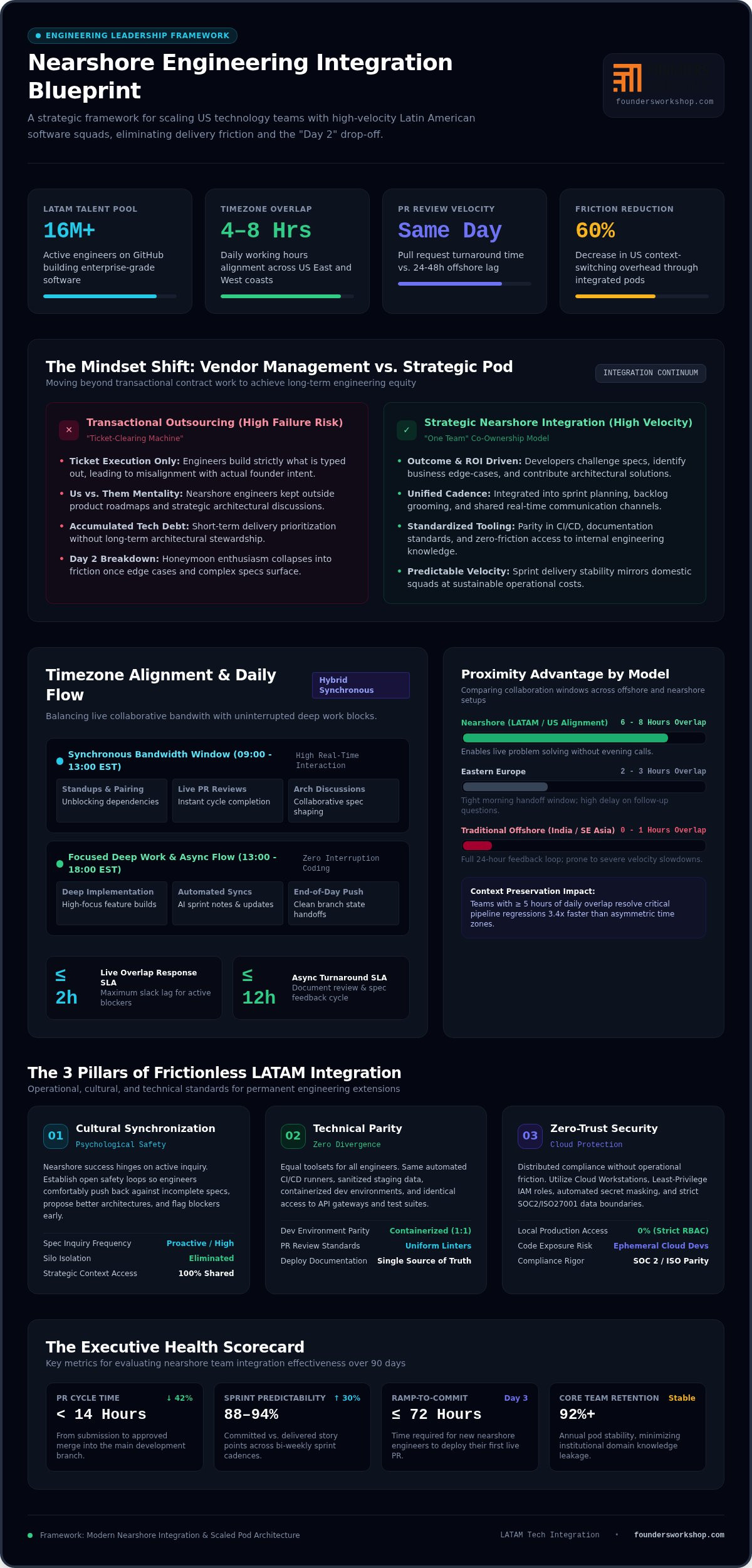
Many engineering leaders view hiring as the finish line. In reality, signing the contract is just the beginning of the race. The nearshore development model offers immense potential for scaling, but the difference between a high-performing squad and a costly distraction lies in strategic integration. You can’t treat these engineers as a separate ticket-clearing machine. True sustainability requires shifting your perspective from vendor management to team integration. When you treat your nearshore partners as a strategic extension of your core team, you remove the friction that typically slows down distributed development.
The “Day 2” problem is the most common reason these partnerships fail. After the initial honeymoon phase, communication often breaks down. If the developers don’t understand the founder’s long-term vision, they’ll build what you ask for, but not what you need. Successful nearshore development team integration best practices dictate that technical execution must be tethered to business strategy. You should measure success by business outcomes and ROI, not just ticket counts or lines of code. This alignment ensures that every sprint advances the product roadmap in a meaningful way.
The ROI of Seamless Team Integration
Effective integration directly impacts your engineering velocity and the health of your codebase. When your nearshore talent is fully integrated, they contribute to architectural decisions instead of just executing tasks. This proactive approach significantly reduces long-term technical debt. Managing nearshore staff augmentation requires a more deliberate approach than local hiring. It’s about reducing the context switching tax for your US-based leaders. By creating a unified environment, your internal leads spend less time explaining basic requirements and more time on high-level innovation.
Avoiding the “Us vs. Them” Mentality
Silos are the silent killers of remote engineering. If your onshore team views the nearshore squad as “the other guys,” you’ve already lost the battle for efficiency. You must establish a “One Team” philosophy from the very first kick-off meeting. Executive leadership plays a critical role here by modeling inclusive communication. Consider the following strategies to prevent silos:
- Include nearshore leads in high-level strategic planning sessions to ensure they understand the “why” behind the “what.”
- Standardize documentation and tooling so that every developer, regardless of location, has access to the same information.
- Use shared Slack channels and collaborative workspaces to foster casual interaction and build rapport.
When you break down these barriers, you create a culture of accountability where every developer feels responsible for the final product’s success.
Establishing a Communication Framework for Timezone Alignment
Latin America provides a significant advantage for U.S. engineering leaders: a 4 to 8 hour working day overlap. This window is the bedrock of nearshore development team integration best practices, enabling real-time standups, interactive pairing, and same-day pull request reviews that offshore models simply can’t match. However, proximity alone doesn’t guarantee efficiency. Without a structured framework, timezone alignment can lead to a “meeting-heavy” culture that drains productivity. The goal for 2026 is to leverage this overlap for high-bandwidth collaboration while protecting the focused “deep work” time that engineers need to ship quality code.
Your 2026 tech stack should do more than just facilitate chat; it must preserve context. While Slack and Jira remain foundational, modern teams now utilize AI-powered tools for automated meeting summarization and asynchronous status syncs. Setting clear expectations for response times is critical to prevent bottlenecks. For instance, establishing a 2-hour response window during the synchronous overlap and a 12-hour window for asynchronous requests ensures that developers aren’t left waiting on blockers. If you’re finding it difficult to strike this balance, exploring a strategic partnership model can help you implement these communication cadences from the start.
The Synchronous vs. Asynchronous Balance
High-velocity teams distinguish between when to jump on a Zoom call and when to keep it in a thread. Synchronous meetings should be reserved for complex architectural discussions, sprint retrospectives, or conflict resolution where nuance and tone are vital. For routine updates or code reviews, asynchronous methods are superior. Asynchronous communication is the exchange of information that does not require an immediate response, allowing engineers to process context and contribute on their own schedule without breaking their cognitive flow.
Implementing “Deep Work” blocks that respect both teams’ schedules is a proven way to boost velocity. You might designate Tuesday and Thursday mornings as “no-meeting” zones across the entire organization. This ensures that when your U.S. lead is heads-down in a critical feature, their nearshore counterpart isn’t accidentally interrupting them for a non-urgent status update.
Standardizing Documentation and Knowledge Sharing
In a distributed environment, documentation is your single source of truth. Every decision made during a real-time call must be memorialized in a shared Wiki or Jira ticket to ensure nothing is lost in translation. Aligning your documentation with the NIST Secure Software Development Framework ensures that security protocols and code integrity are baked into your processes from day one. Utilizing AI-driven tools to automatically update documentation based on PR descriptions helps keep your nearshore developers in the loop without adding a manual burden to your onshore leads.
Cultural Synchronization: Bridging the Gap Between US and Latin American Teams
Engineering velocity often dies in the silence of cultural misunderstanding. While timezone alignment removes the physical barrier to collaboration, cultural synchronization addresses the cognitive ones. U.S. business culture is typically “low context,” meaning communication is direct, explicit, and task-oriented. In contrast, many Latin American cultures are “high context,” where relationship-building and nuanced social cues are prioritized. For an engineering leader, failing to account for these differences can lead to “yes-man” syndrome, where developers agree to deadlines they know are impossible simply to avoid perceived confrontation. Mastering nearshore development team integration best practices requires you to decode these signals and build a bridge between these two styles.
Psychological safety is the most critical component of this bridge. You must explicitly encourage nearshore developers to challenge product specs and voice concerns during sprint planning. In many LATAM regions, there’s a deep-seated respect for hierarchy that can prevent junior or mid-level engineers from speaking up. To counter this, shift toward a “blameless” culture. When a deployment fails or a bug reaches production, focus on the process rather than the person. This approach signals that technical honesty is valued over social deference. Integrating your nearshore squad into every ritual, from daily standups to company-wide all-hands meetings, reinforces that they’re a core part of the mission, not just a remote resource.
Human-Centered Solutions in Remote Tech
Success in remote engineering is driven by empathy. It’s easy to forget the individual behind the GitHub handle, but recognizing personal milestones and local holidays builds the rapport necessary for long-term partnership. Managing the feedback loop across cultures requires a delicate balance; you should provide direct technical critiques while maintaining a supportive, relationship-focused tone. Founders Workshop draws on 30 years of leadership experience to ensure that every developer we provide is culturally aligned with U.S. business norms. We vet for more than just code quality; we look for the soft skills required to thrive in a fast-paced, collaborative environment.
Retention Strategies for Augmented Staff
High attrition is a silent tax on your engineering budget. Nearshore developers often quit when they feel like “code monkeys” disconnected from the business’s success. To prevent this, offer clear growth paths and involve them in high-level architectural decisions. Linking their daily efforts to strategic MVP development goals gives their work purpose. When developers see how their code directly impacts the product’s market fit, they’re more likely to stay engaged. Trust is also built through security; following NIST guidelines for enterprise telework and remote access security ensures that your team has the right tools to work safely, which reduces friction and demonstrates a professional commitment to their success.
Technical Integration and Security Protocols for Remote Engineering
Technical friction is the silent killer of engineering velocity. When you scale across borders, the phrase “it works on my machine” becomes a significant liability. Achieving environment parity is a cornerstone of nearshore development team integration best practices. In 2026, engineering leaders must move beyond manual setup guides. You should enforce standardized local development environments using containerization or ephemeral cloud-native workstations. This ensures that a developer in Medellin or Mexico City is working in an identical sandbox to your lead architect in the U.S., removing the configuration hurdles that often stall sprint starts.
Security is no longer about perimeter defense; it’s about Zero Trust. You shouldn’t rely on simple VPNs that grant broad network access. Instead, implement a Zero Trust Architecture (ZTA) where access is granted based on identity, device health, and least-privilege principles. This approach protects your intellectual property while simplifying compliance with regional regulations like Brazil’s LGPD or Mexico’s LFPDPPP. By automating security scanning directly into your CI/CD pipeline, you catch vulnerabilities before they reach production, maintaining a high bar for code integrity without manual gatekeeping or constant oversight.
The Integrated DevOps Workflow
Standardizing your workflow prevents the technical silos that often plague distributed teams. Docker and Cloud IDEs like GitHub Codespaces allow for near-instant onboarding, reducing the time to first commit from days to minutes. For multi-region cloud infrastructure, use Infrastructure as Code (IaC) to ensure consistency across staging and production environments. In 2026, the standard protocol for remote code access requires developers to commit code directly to secure remote repositories without source code ever being stored on unmanaged local hardware. This methodology minimizes the risk of data leakage and ensures that your IP remains within your controlled perimeter.
AI-Augmented Engineering Velocity
Integrating AI strategy consulting into your nearshore workflows is no longer optional. It’s a strategic necessity for maintaining a competitive edge. Use AI-driven tools for automated code reviews and unit test generation to maintain quality at scale. When you standardize AI tool usage across your entire engineering organization, you ensure that your nearshore squad is as productive and tech-forward as your internal team. If you’re ready to build a secure, high-velocity engineering engine, partner with a seasoned guide who understands these technical and strategic nuances.
Scaling with Founders Workshop: A Strategic Partnership Model
Scaling an engineering organization requires more than just access to a talent pool; it demands a disciplined approach to integration that many freelance marketplaces simply aren’t built to provide. At Founders Workshop, we’ve refined a managed nearshore model that prioritizes long-term partnership over transactional staffing. This approach allows us to act as a strategic extension of your company, taking full responsibility for the vetting, onboarding, and ongoing performance of your distributed squad. We use our 30 years of leadership experience to ensure that your team integration is seamless, allowing you to focus on high-level product strategy instead of administrative friction.
By focusing on human-centered solutions, we bridge the gap between your strategic vision and technical execution. our process incorporates the nearshore development team integration best practices discussed throughout this guide, from establishing secure Zero Trust environments to fostering a “One Team” culture. We don’t just provide developers. We provide a framework for long-term technical reliability that evolves with your business. This commitment to accountability means you aren’t just hiring contractors; you’re gaining a partner invested in your delivery cycles and overall ROI.
From MVP to Modernization
Your technical needs will shift as your product evolves. Our teams are equipped to support you through every stage of the lifecycle, whether you’re focused on legacy application modernization or scaling a successful MVP to an enterprise-grade platform. We understand the delicate balance between rapid AI innovation and the necessity of managing technical debt. This dual focus ensures that your engineering engine remains agile enough to pivot while maintaining the architectural stability required for sustainable growth. As your product moves from initial validation to market dominance, our squads scale with you, providing the consistent expertise needed to handle increasing complexity.
Your Executive Partner in Tech Growth
The primary advantage of working with Founders Workshop is our U.S.-based leadership team. We act as your executive partners, providing the accountability and strategic oversight that offshore models often lack. Our Latin American talent pool is the secret weapon for North American startups, offering the perfect blend of timezone alignment and high-level engineering proficiency. We’ve navigated multiple eras of technology, and we’re here to help you navigate yours with a steady hand and a proven methodology that removes technical friction. We handle the cultural onboarding and technical alignment so that your team can hit the ground running from day one.
Ready to scale your engineering capacity without the friction? Consult with our experts at Founders Workshop today to build your high-velocity team.
Building Your Unified Engineering Engine
Building a high-velocity engineering organization is no longer just about where you hire; it’s about how you integrate. Transitioning from a vendor-management mindset to a unified team philosophy allows you to bridge the gap between strategic vision and technical execution. By prioritizing environment parity, Zero Trust security, and psychological safety, you create a sustainable environment where remote engineers thrive as a core part of your mission.
Mastering nearshore development team integration best practices is the key to unlocking predictable delivery cycles without the high cost of domestic-only hiring. Whether you’re focused on AI innovation or the complexities of legacy application modernization, the right partnership provides the stability your business needs to scale. Founders Workshop brings 30+ years of software leadership to help you navigate this path, providing elite Latin American talent that operates in your timezone. It’s the most effective way to ensure your technology supports your business outcomes rather than hindering them.
It’s time to remove the friction from your development pipeline and focus on growth. Scale your engineering team with elite nearshore talent from Founders Workshop
Frequently Asked Questions
What are the main challenges of nearshore team integration?
Main challenges include communication silos, cultural deference that prevents developers from questioning product specs, and technical environment drift. Overcoming these requires a shift from vendor management to strategic integration. Leaders must establish psychological safety and unified documentation to ensure nearshore engineers don’t become an isolated black box of development. Success depends on treating these teams as a core extension of your internal engineering culture rather than a third-party resource.
How does timezone alignment improve nearshore development velocity?
Timezone alignment provides 4 to 8 hours of real-time overlap, which eliminates the 24-hour feedback loop common in offshore models. This proximity allows for synchronous standups, live pair programming, and interactive sprint retrospectives. When a developer hits a blocker, they can resolve it in minutes through a Slack huddle instead of waiting until the next day. This real-time interaction significantly increases sprint velocity and ensures that delivery cycles remain predictable and agile.
Is nearshore software development more secure than offshore?
Nearshore models are often more secure because they align with U.S. timezones and regional trade agreements. However, location alone isn’t enough. Effective nearshore development team integration best practices involve implementing Zero Trust Architecture and NIST-compliant remote access protocols. By using cloud-native workstations and automated security scanning in the CI/CD pipeline, you protect your intellectual property more effectively than traditional offshore models that rely on unmanaged hardware and broad VPN access.
How do I handle cultural differences with developers in Latin America?
Handling cultural differences requires moving from a high-context relationship-oriented style to a low-context direct communication style. You must explicitly build psychological safety by encouraging LATAM developers to challenge ideas and speak up during planning sessions. At Founders Workshop, we draw on 30 years of leadership experience to bridge these gaps. We ensure our developers are culturally aligned with U.S. business norms, focusing on technical honesty and proactive problem-solving rather than social deference.
What tools are best for managing an integrated nearshore engineering team?
Managing an integrated team requires a stack that supports both synchronous and asynchronous workflows. Essential tools include Docker or GitHub Codespaces for environment parity, Slack for real-time coordination, and Jira or Linear for task management. Additionally, AI-powered documentation tools help maintain a single source of truth without manual overhead. Using these tools ensures that your nearshore squad remains in sync with your core team’s architectural standards and strategic product roadmap.
How long does it typically take to integrate a nearshore developer into an existing team?
Most nearshore developers reach full productivity within two to four weeks, provided you have a structured onboarding process. The integration speed depends on the quality of your documentation and the clarity of your initial technical standards. A successful integration starts with a clear One Team kick-off and immediate access to standardized development environments. By day 30, the developer should be contributing to complex features and participating fully in all engineering rituals.
Can nearshore teams help with AI strategy and implementation?
Yes, nearshore teams are increasingly becoming hubs for AI strategy and implementation. At Founders Workshop, we specialize in identifying AI opportunities and building custom predictive analytics or automation tools. Our Latin American talent pool includes experts in LLM fine-tuning and AI-native application architectures. Integrating these specialists into your team allows you to accelerate innovation and modernize legacy applications without the high cost of sourcing scarce AI talent domestically in the United States.
What is the cost difference between nearshore integration and US-based hiring?
U.S. engineering organizations typically achieve 40% to 60% savings on loaded talent costs when using nearshore development team integration best practices instead of hiring locally. While base salaries are lower in Latin America, the real value comes from the reduced management overhead compared to offshore teams. When you factor in the benefits of real-time collaboration and reduced rework, the Total Cost of Engagement is significantly lower than maintaining an exclusively U.S.-based team.