Saving 70% on labor costs is a hollow victory if your engineering velocity drops by half. Most founders realize too late that the debate over nearshore vs offshore software development isn’t just about hourly rates; it’s about the hidden tax of communication debt. You’ve likely felt the friction of waking up to missed deadlines or realizing a 12 hour timezone gap has turned a simple feature update into a three day ordeal. It’s exhausting to manage teams that are technically capable but strategically disconnected from your business goals.
This guide shifts the focus from bottom line savings to sustainable growth. You’ll discover why timezone alignment and cultural proximity are the true drivers of engineering velocity and long term ROI in the 2026 landscape. We’ll explore how to scale your team without increasing management overhead, ensuring your developers act as strategic partners rather than just ticket takers. By the end, you’ll have a clear framework for choosing a partnership model that eliminates technical friction and keeps your product roadmap on track.
Key Takeaways
- Learn to calculate your Total Cost of Engagement (TCE) by accounting for management overhead and rework rather than just hourly rates.
- Understand the critical differences between nearshore vs offshore software development, specifically how timezone alignment prevents the buildup of communication debt.
- Discover why cultural proximity reduces technical debt by encouraging developers to challenge assumptions instead of defaulting to a “yes-culture.”
- Identify the specific scenarios where nearshore models excel, such as AI implementation, healthcare tech, and core product scaling.
- Master a framework for scaling your engineering team without increasing your management burden or sacrificing product quality.
Beyond the Hourly Rate: Why Software Outsourcing Models Matter in 2026
The era of simple labor arbitrage is over. In 2026, successful founders have stopped looking for the cheapest hands and started looking for the most efficient minds. The old “body shopping” model, where companies rented developers to fill seats, has been replaced by strategic partnerships that prioritize long term product health. This shift has fundamentally changed how we evaluate nearshore vs offshore software development. Success is no longer measured by the thickness of a requirements document, but by Engineering Velocity: the speed at which a team can deliver high quality, production ready code that moves the business needle.
Nearshore development is a partnership model where the engineering team operates within one to three timezones of the client. This proximity isn’t just a logistical detail; it’s the foundation of modern technical execution.
The Evolution of Outsourcing: From Cost-Cutting to Value-Adding
The 2020s forced a massive maturation in remote engineering. We’ve moved past the days when “remote” meant “disconnected.” Today, high bandwidth collaboration is the oxygen of modern DevOps cycles. If your team can’t participate in real time standups or provide immediate feedback on a failing CI/CD pipeline, your momentum stalls. Many companies previously relied on “Follow-the-Sun” models, hoping for 24 hour productivity. Instead, they often encountered “Follow-the-Problem” delays, where a simple bug found at 5:00 PM stays broken for 12 hours while the offshore team sleeps. In 2026, value is found in synchronous problem solving, not just asynchronous task completion.
Defining the Models: Nearshore, Offshore, and Onshore
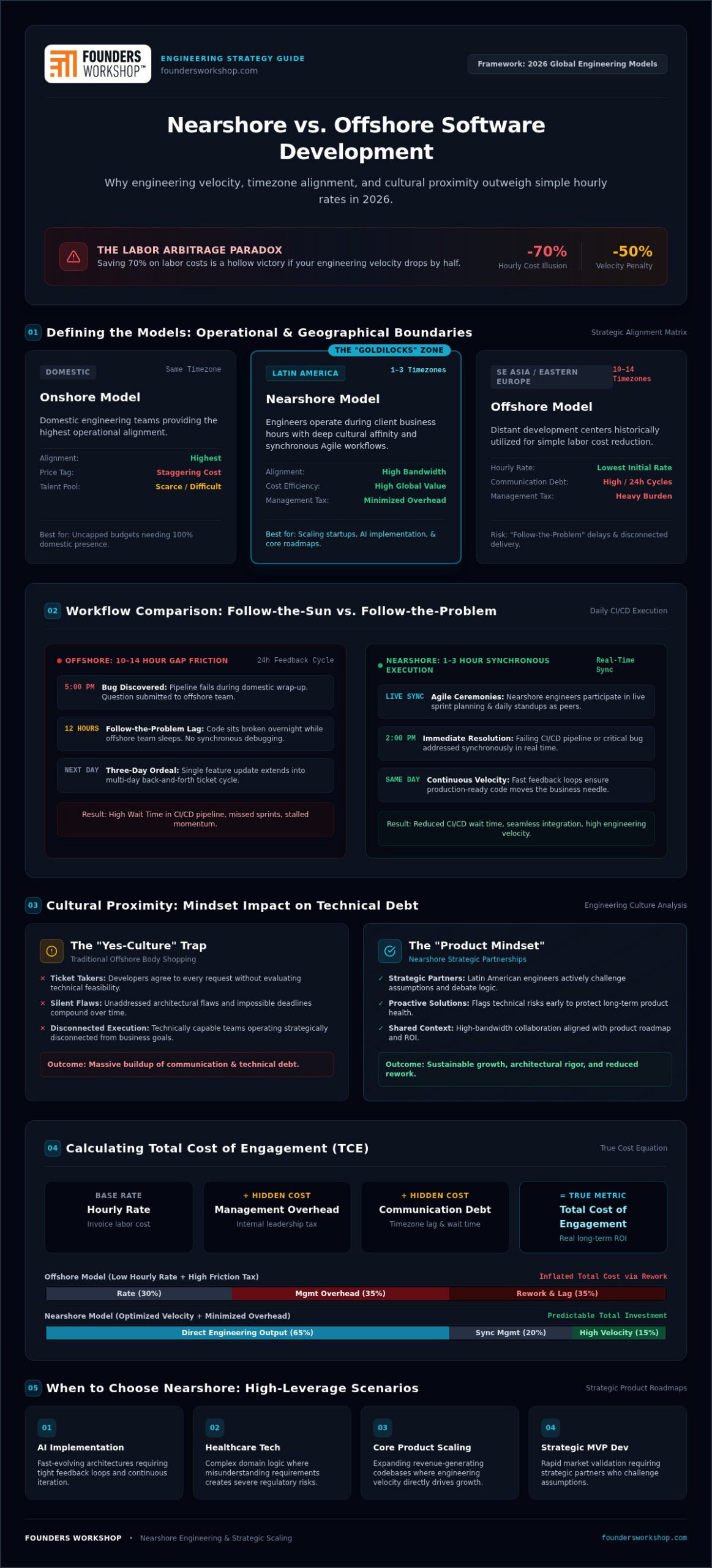
Choosing between nearshore vs offshore software development requires a clear understanding of geographical and operational boundaries. Each model serves a different strategic purpose:
- Nearshore: Teams are located in nearby regions, such as Latin America for US based companies. They share similar work cultures and operate during your business hours, allowing for seamless integration into Agile ceremonies.
- Offshore: This involves offshore outsourcing to distant locations like Southeast Asia or parts of Eastern Europe. While these regions often offer the lowest hourly rates, the 10 to 14 hour timezone gaps create significant communication friction.
- Onshore: Domestic development offers the highest level of alignment but comes with a staggering price tag and a talent pool that’s increasingly difficult to tap into.
For a scaling startup, the “Goldilocks” zone is almost always nearshore. It provides the cost efficiencies of global talent without the heavy management tax that distant offshore teams impose on your internal leadership.
Nearshore vs. Offshore: Architectural and Operational Differences
Proximity changes the architecture of your workday. When comparing nearshore vs offshore software development, the biggest differentiator is operational friction. It’s the difference between a team that works with you in real time and a team that operates in a vacuum while you sleep. For founders, these operational nuances determine whether a project stays on schedule or collapses under the weight of communication debt.
The Timezone Advantage in Agile Development
Agile ceremonies rely on tight feedback loops and high bandwidth communication. Offshore teams often force a 24 hour feedback cycle; you ask a question at 5:00 PM, and you don’t get an answer until the following morning. This lag kills momentum. Nearshore teams participate in live sprint planning and daily standups as peers, not just as distant resources. This synchronous work schedule significantly reduces “Wait Time” in your CI/CD pipeline. When a build fails or a critical bug appears at 2:00 PM, a nearshore team addresses it immediately, keeping your engineering velocity high.
Cultural Alignment and the ‘Product Mindset’
Many offshore models suffer from a “Yes-Culture” where developers agree to every request without questioning the underlying logic. While this sounds helpful, it often leads to massive technical debt because the team isn’t flagging architectural flaws or impossible deadlines. In contrast, nearshore teams in Latin America tend to cultivate a “Product Mindset.” These engineers act as partners who challenge assumptions and offer proactive solutions. This level of engagement is vital for strategic MVP development, where technical decisions must align with evolving business goals.
Latin American tech hubs have matured into high density talent centers with strong English proficiency and direct communication styles. While software developer labor costs and market data show that domestic salaries continue to climb, nearshore talent offers a “Goldilocks” balance of high level expertise and manageable costs. By choosing a team that shares your business values, you eliminate the friction that typically plagues nearshore vs offshore software development comparisons. If you’re ready to scale without the headache of 12 hour timezone gaps, consider how nearshore staff augmentation can provide the seasoned expertise your product requires.
Calculating the Total Cost of Engagement (TCE) Beyond Hourly Rates
Founders often fall into the trap of comparing spreadsheets based solely on hourly rates. This narrow view ignores the Total Cost of Engagement (TCE), which is the comprehensive financial impact of a development partner over the project lifecycle. To get an accurate picture, you must look at a formula that includes the hourly rate, management overhead, and rework costs. When you analyze nearshore vs offshore software development through this lens, the math changes significantly. While U.S. software developer salary benchmarks serve as a high water mark for domestic hiring, the “savings” from distant offshore teams are often clawed back by invisible inefficiencies.
The Hidden Costs of Offshore Timezone Gaps
Communication Debt is a real financial liability. If a feature is misinterpreted because of a midnight briefing, you pay for it twice: once to build it wrong and once to fix it. This rework isn’t just about money; it’s about time. A 12 hour delay on every clarifying question can add months to a product launch. There’s also a significant human cost to consider. Managing offshore teams often requires late night or early morning calls, which quickly leads to executive burnout. Logistics also play a role. A short flight to a nearshore partner in Latin America is a routine business trip, while a 20 hour journey to Southeast Asia is a massive disruption to your schedule.
Nearshore ROI: Why Higher Hourly Rates Often Cost Less
Nearshore teams typically require less management overhead because they operate during your business hours. You don’t need a dedicated “bridge manager” just to keep the wheels turning. Because these teams work in sync with your internal staff, they often feel like a natural extension of your office. This alignment increases retention. High turnover in offshore shops creates a revolving door of developers, forcing you to pay for constant onboarding and knowledge transfer. With nearshore partners, real time pairing and collaborative AI strategy become possible. This synchronous work drives efficiency gains that far outweigh the slightly higher hourly cost. By evaluating nearshore vs offshore software development based on engineering output rather than just input, you gain a clearer picture of your true project costs.
Strategic Alignment: Matching Your Development Model to Your Business Goals
Choosing between nearshore vs offshore software development isn’t a one-size-fits-all decision. It depends on where your product sits in its lifecycle. Offshore models are often appropriate for legacy maintenance or non-critical back-end tasks where requirements are static and speed isn’t a priority. However, if you’re building something new, the calculus changes. For core product scaling, high-stakes AI implementation, or building a new MVP, nearshore is the superior choice. These projects require constant iteration and high-level strategic alignment. This is where AI strategy consulting becomes essential. You need a partner who understands the “why” behind the code, not just the “how.”
Founders often ask if the 20% to 30% premium for nearshore is worth it. It’s a fair question. But if that premium buys you a 50% increase in engineering velocity and eliminates the need for expensive rework, the ROI is undeniable. You’re paying for the removal of technical friction. By aligning your development model with your specific business goals, you ensure that your technical investment actually drives growth rather than just occupying a line item on your balance sheet.
When to Choose Nearshore Staff Augmentation
High-growth companies prioritize velocity. If you need to hit a market window, you can’t afford a slow feedback loop. Nearshore teams are ideal for rapidly scaling engineering teams, developing complex AI systems, and managing intricate system integrations. They function as a natural extension of your internal staff. Our 2026 Nearshore Staff Augmentation Guide details how to integrate these teams into your existing workflow for maximum impact. If your goal is to build a high-performance engineering culture, nearshore staff augmentation is the most reliable path forward.
Identifying the Red Flags in Offshore Partnerships
Offshore partnerships often carry hidden risks that don’t appear on an initial quote. Watch out for “shadow developers.” This happens when the senior engineer you interviewed is quietly replaced by a junior developer after the contract is signed. This leads to the “Black Box” problem: you lose visibility into what’s actually happening until a deadline is missed. Other red flags include:
- Excessive turnover: High churn rates in offshore shops mean you’re constantly paying for new developers to learn your codebase.
- Lack of transparency: If you aren’t seeing regular, clear code reviews and updated documentation, you’re building a house of cards.
- Communication silos: When developers don’t feel comfortable challenging a requirement, you end up with a product that’s technically functional but commercially useless.
In the debate over nearshore vs offshore software development, transparency is the ultimate currency. Nearshore models succeed because they prioritize open communication and shared accountability, ensuring you always know the exact state of your product.
Scaling with Founders Workshop: The Nearshore Advantage
Scaling a technology company requires more than just a headcount. It requires a partner who understands that every line of code must serve a business outcome. At Founders Workshop, we combine 30 years of leadership experience with elite Latin American talent to eliminate the technical friction that often plagues high-growth startups. Our approach is rooted in human-centered solutions. We don’t just provide resources; we build sustainable engineering cultures that allow you to focus on your core business vision. When evaluating nearshore vs offshore software development, the deciding factor is often the level of accountability you receive from your partner. We take that responsibility seriously.
Our Latin American Talent Network
We’ve spent decades refining our vetting process to ensure our network represents the top tier of technical talent. We look beyond coding proficiency to find engineers who possess high emotional intelligence and a deep understanding of the US market. This cultural alignment is the secret sauce of our nearshore staff augmentation model. Our developers don’t just follow instructions; they contribute to the conversation. The friction inherent in nearshore vs offshore software development often stems from a lack of shared context. By working in your timezone, we maintain high-bandwidth communication that keeps your product roadmap moving. This level of synchronization turns a remote team into a true extension of your office.
From AI Strategy to Execution
The rapid advancement of AI has made real-time collaboration even more critical. AI development is inherently iterative, requiring constant testing and adjustment. A synchronized team can pivot instantly based on data, whereas a distant offshore team might spend days pursuing a dead end. Whether you’re modernizing a legacy system or launching a healthcare tech platform, our teams integrate seamlessly into your workflow. We help you move from high-level AI strategy to practical execution without the typical delays associated with global outsourcing.
If you’re ready to move past the frustrations of 12 hour timezone gaps, you can scale your engineering team with our Nearshore Staff Augmentation services. We’re here to provide the steady hand you need to navigate your next stage of growth, from initial MVP development to complex system integrations.
Scaling Your Engineering Velocity for the Decade Ahead
Choosing between nearshore vs offshore software development is a decision that defines your technical legacy and long term engineering velocity. You’ve seen that the true cost of a partner isn’t found in a spreadsheet of hourly rates; it’s found in the speed of delivery and the strategic health of your codebase. By prioritizing timezone alignment and cultural proximity, you remove the friction that stalls innovation and leads to executive burnout.
Sustainable growth requires a team that acts as a strategic partner rather than just an order-taker. Focusing on the Total Cost of Engagement and leveraging high density talent networks in Latin America provides the stability your product needs to thrive. With 30+ years of executive experience and a specialized network of engineers, we’ve built a proven record of successful MVP and AI delivery.
You don’t have to navigate the complexities of scaling alone. The right partnership will turn your technical roadmap into a sustainable competitive advantage for years to come.
Frequently Asked Questions
What is the primary difference between nearshore and offshore development?
The primary difference lies in geographical proximity and timezone alignment. Nearshore development involves teams in neighboring regions, typically within one to three timezones of your headquarters. Offshore development refers to partners in distant locations with significant time differences. This gap fundamentally changes how your teams communicate and collaborate on daily tasks. While managed staffing providers such as Sprint Labs help organizations recruit and employ offshore engineers across Asia for cost efficiency, nearshore models prioritize real-time integration and reducing the communication debt that often stalls complex engineering projects.
Is nearshore software development more expensive than offshore?
Nearshore hourly rates are generally higher than offshore rates, but the total cost of engagement is often lower. You’ll spend less on management overhead, rework, and the “bridge managers” needed to handle 12 hour timezone gaps. When comparing nearshore vs offshore software development, founders should look at the output per dollar spent. Synchronized teams deliver code faster and with fewer misinterpreted requirements, which ultimately protects your budget and your product roadmap from expensive delays.
Why is Latin America considered the best nearshore hub for US companies?
Latin America is the premier hub due to its perfect timezone overlap with North American businesses. This allows for synchronous workdays where developers participate in live standups and real-time debugging. Beyond logistics, the region offers high talent density and a strong cultural affinity with US business practices. Developers in these hubs typically possess high English proficiency and a proactive product mindset, which means they challenge assumptions rather than just following tickets blindly.
How do I manage a nearshore team effectively?
Effective management starts by treating your nearshore developers as a natural extension of your internal team rather than a separate vendor. You should include them in all Agile ceremonies, from daily standups to sprint retrospectives. Use high-bandwidth communication tools like Slack and Zoom to maintain a steady flow of information. Because they work during your business hours, you can implement real-time pair programming and immediate code reviews to keep engineering velocity high and technical debt low.
Can nearshore teams help with AI strategy and implementation?
Yes, nearshore teams are exceptionally well-suited for AI strategy and implementation. AI development is an iterative process that requires constant testing and rapid feedback loops. A synchronized team can adjust models and refine data sets in real time based on your feedback. At Founders Workshop, we integrate AI into existing workflows to enhance automation and decision-making. Working in the same timezone ensures that these complex, high-stakes technical decisions are made collaboratively and accurately.
What are the common problems with offshore software development?
The most common problems include significant communication delays and a “Yes-culture” that leads to technical debt. When teams are 12 hours away, a simple question can stall a feature for an entire day. Additionally, many offshore firms struggle with high turnover and “shadow developers,” where the senior talent you interviewed is quietly replaced by juniors. These issues create a black box environment where founders lose visibility into the actual state of their product until it’s too late to pivot.
How does timezone alignment affect engineering velocity?
Timezone alignment is the primary driver of engineering velocity in modern software development. It eliminates the wait time that plagues distributed teams. When your developers work while you work, they can resolve blockers immediately and provide instant feedback on code reviews. This synchronous cycle prevents the buildup of communication debt and ensures that your CI/CD pipeline stays moving. In a post-AI world, the ability to iterate daily rather than weekly is a massive competitive advantage.
What industries benefit most from nearshore staff augmentation?
High-growth industries that require complex technical execution and rapid scaling benefit the most. This includes healthcare tech development, where regulatory compliance and precision are non-negotiable. Startups building MVPs also find immense value in the nearshore model because it allows them to pivot quickly based on user feedback. Any business dealing with system integrations or legacy modernization needs the high-level strategic alignment that only a synchronized, nearshore vs offshore software development comparison can truly highlight.