The biggest risk to your startup isn’t a lack of features; it’s the invisible weight of technical debt accumulated before you even launch. Many founders believe that “minimum” means cutting corners, but a poorly architected foundation can stall growth just as you’re hitting your stride. When you’re searching for an MVP development company, you aren’t just looking for someone to write code. You’re looking for a strategic partner who understands that every line of software must serve a specific business outcome.
It’s frustrating to deal with communication gaps or builds that feel disconnected from your long-term vision. At Founders Workshop, we recognize that in 2026, a successful launch requires more than just functionality; it needs a technical architecture ready for AI integration and rapid scaling. This article explains how to transform your vision into a high-impact MVP that balances technical excellence with business strategy. We’ll look at building a foundation that acts as an extension of your leadership team, ensuring your product is built for the marathon, not just the sprint.
Key Takeaways
- Learn why treating an MVP as a strategic learning tool rather than a stripped-down app prevents the technical debt that often cripples early-stage startups.
- Discover how to vet an mvp development company phoenix by looking for a partner mindset that prioritizes long-term business outcomes over simple ticket-taking.
- Understand the critical role of timezone alignment and nearshore collaboration in maintaining development velocity and reducing the hidden costs of rework.
- Explore a human-centered development lifecycle that uses a dedicated Discovery Phase to align your technical architecture with specific growth goals.
- Gain insights into building a cloud-native foundation in 2026 that supports seamless AI integration and prevents your MVP from becoming a legacy system.
The Strategic Role of an MVP in Modern Business Growth
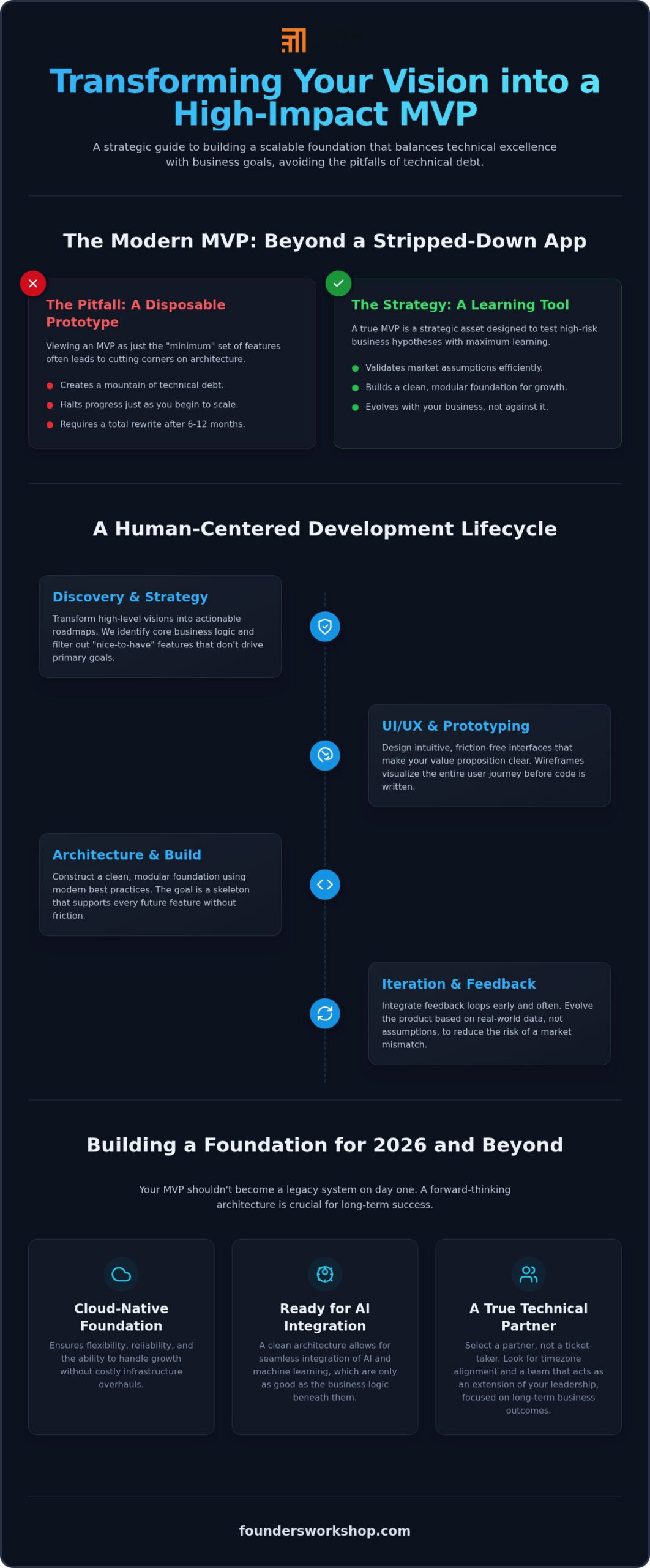
An MVP is often misunderstood as a skeleton version of a final product. In reality, a Minimum Viable Product is not merely a feature-light application; it is a strategic learning tool designed to test high-risk business hypotheses with the least amount of effort. Choosing an mvp development company phoenix requires a shift in perspective. You aren’t just buying code; you’re investing in a vehicle for market validation. By 2026, the standard for success has moved past simple technical prototypes. Modern founders treat their software as business-aligned digital assets that must provide immediate utility while remaining flexible enough to pivot.
The “minimum” in MVP often becomes a trap. When speed is prioritized over structure, the result is a mountain of technical debt that halts progress just as you begin to scale. Building with clean, modular code from the start creates a blueprint for legacy application modernization that allows your software to evolve rather than expire. This forward-thinking approach ensures that your initial investment remains a functional part of your ecosystem for years, rather than a disposable prototype that needs a total rewrite after six months.
Beyond the Prototype: Building for Sustainability
Architecture isn’t a luxury; it’s the skeleton that supports every future feature. Sustainability begins on day one. A veteran mvp development company phoenix acts as a filter, ensuring your budget isn’t wasted on vanity features that don’t drive core value. You must balance speed-to-market with a foundation that avoids technical friction. This requires a founder’s mindset: treating code as a strategic investment rather than a one-time expense. While some competitors claim AI is the only thing that matters in 2026, seasoned leaders know that AI is only as effective as the business logic beneath it.
Identifying Your Core Value Proposition
Human-centered design is the most effective tool for identifying “must-have” features. It forces you to look past your own assumptions and focus on the specific pains of your users. Rigorous strategic filtering prevents feature bloat, which is the primary cause of budget overruns and delayed launches. By focusing on the smallest set of features that solve the biggest problem, you gain clarity and speed. The MVP is a bridge between a vision and a scalable market solution.
A Human-Centered MVP Development Process
Building software in 2026 requires more than just technical proficiency; it demands an obsession with the end user. While many firms focus on the latest technical trends, a veteran mvp development company phoenix recognizes that human-centered design is the only reliable way to drive adoption. This approach ensures that every technical decision serves a specific human need, creating a product that feels intuitive rather than forced. By prioritizing user outcomes over technical novelty, you build a solution that people actually want to use, which is the ultimate goal of any MVP.
A structured lifecycle is essential for maintaining momentum. This process moves through strategy, UI/UX design, technical architecture, and rapid iteration. Each phase builds upon the last, ensuring that the final product isn’t just functional, but strategically aligned with your growth objectives. Integrating feedback loops early allows the product to evolve based on real-world data rather than assumptions, reducing the risk of a market mismatch.
The Discovery and Strategy Phase
The journey starts with discovery. This phase is where we turn high-level visions into actionable technical roadmaps. It’s about more than just listing features; it’s about identifying the core business logic that will drive your company forward. Engaging in strategic MVP development prevents wasted capital by filtering out “nice-to-have” features that don’t contribute to your primary goals. We define success metrics before the first line of code is written, giving you a clear benchmark for performance and a solid foundation for future scaling.
UI/UX Design and Prototyping
Effective design is about removing friction. Creating intuitive interfaces drives user engagement and ensures that your value proposition is clear from the first click. We use wireframes to visualize the entire product journey, allowing you to see how users will interact with the system before development begins. This step is critical for bridging the gap between aesthetic design and technical feasibility. It ensures that the interface is beautiful, but also practical to build and maintain. If you want to see how these principles apply to your vision, starting a conversation with a seasoned technical partner can provide the clarity needed to move forward. A professional mvp development company phoenix will help you balance these design aspirations with the realities of your budget and timeline.
Nearshore vs. Offshore: Why Timezone Alignment is Critical for Velocity
Choosing the right talent model is a pivotal decision for any founder. When you evaluate an mvp development company phoenix, the geographic location of the engineering team impacts more than just your budget; it dictates your daily rhythm. Offshore development in regions like the Asia-Pacific offers the lowest entry price, with 2026 rates averaging $3,500 to $5,500 per developer per month. However, the 12-hour timezone gap creates a “latency tax” that often results in significant rework. If a critical misunderstanding occurs during your afternoon, it won’t be addressed until the following morning. This lag accumulates, turning a three-month build into a six-month ordeal.
Nearshore development solves this by aligning engineering talent with your business hours. Latin American tech talent has become the gold standard for North American startups because of this overlap. Real-time communication acts as a catalyst for Agile development, allowing for immediate feedback and rapid pivots. When your developers are available for a quick sync or a screen share during your workday, the friction of remote work disappears. This level of integration is what separates a simple vendor from a true technical partner.
The Velocity Advantage of Real-Time Collaboration
Eliminating the “wait-until-tomorrow” cycle is essential for maintaining momentum. High-velocity teams don’t have time to wait half a day for a response to a simple architectural question. Utilizing nearshore staff augmentation improves engineering velocity by ensuring that collaboration happens in the moment. Language and cultural alignment also play a massive role in complex software builds. When the team understands the business context and the nuances of the user experience, they make better autonomous decisions. This reduces the management burden on your leadership team and keeps the project on track.
Cost-Efficiency Without Strategic Compromise
Nearshore teams offer a superior ROI compared to both high-cost domestic hires and low-cost offshore alternatives. While nearshore rates typically range from $4,000 to $7,000 per month in 2026, the absence of communication friction makes them more cost-effective in the long run. You get the benefit of high quality standards without the overhead of a local office. This model allows you to optimize your development budget while building a sustainable team for long-term product evolution. In an era where AI coding tools can speed up routine tasks by 40% to 60%, the value of an engineer has shifted from “writing code” to “solving problems.” A partner who understands your market is far more valuable than one who simply follows instructions from a different timezone.
From Launch to Legacy: Planning for Scalability and AI Integration
Building an MVP in 2026 requires a vision that extends far beyond the initial release date. A successful product is never finished; it’s a living system that must evolve with market demands. A professional mvp development company phoenix ensures that your technical stack doesn’t become a liability as your user base grows. Avoiding the legacy trap means adopting cloud-native architectures from the start. This allows you to scale from a single managed team to a full staff augmentation model without needing to rewrite your entire codebase. By treating your MVP as a strategic foundation, you create a path for sustainable growth rather than a one-time technical experiment.
In high-stakes sectors like healthcare and enterprise software, the MVP phase is also a testing ground for compliance. Research shows that integrating HIPAA or SOC-2 compliance can add 30% to 50% to the initial build cost. However, bake these requirements into the architecture early and you avoid the catastrophic expense of refactoring later. These sectors use MVPs to validate not just user interest, but the viability of their security frameworks in a regulated environment. This disciplined approach ensures that your product is ready for the rigors of the enterprise market from day one.
Integrating AI and Predictive Analytics
AI is no longer a futuristic add-on; it’s a core requirement for competitive software. McKinsey projects that by 2026, 72% of organizations will be deploying generative AI at scale. To stay ahead, you must identify AI opportunities during your initial roadmap. This involves building data pipelines that support future machine learning needs even if you don’t launch those features immediately. Engaging in AI strategy consulting during the MVP phase informs your technical architecture, ensuring your data is structured for predictive intelligence and agentic AI. While adding AI features can increase budgets by 15% to 30%, the long-term ROI in user retention and automation is significant.
Modernizing for Long-Term Growth
As your product matures, your team structure must change. The transition from a small MVP team to a dedicated nearshore personnel model allows for continuous improvement without losing institutional knowledge. A veteran mvp development company phoenix helps you navigate this shift, replacing early prototypes with robust, enterprise-grade components. This strategy ensures the technical stack remains sustainable for five years or more. If you’re ready to build a product that scales with your ambition, you can schedule a technical strategy session to map out your journey from launch to legacy. Focusing on longevity now prevents the friction that stalls most growing startups.
Selecting the Right Technical Partner for Your Strategic Vision
Choosing an mvp development company phoenix is about finding an executive peer, not just a coding shop. In 2026, software is too central to business success to be outsourced to a firm that doesn’t understand your bottom line. A vendor mindset focuses on completing tickets; a technical partner mindset focuses on achieving business outcomes. This distinction is critical when your capital is on the line. You need a team that will challenge your assumptions if a proposed feature doesn’t align with your core value proposition. This level of accountability removes technical friction and provides the peace of mind necessary to focus on market growth.
Assessing a leadership team’s experience is vital. You want to work with veterans who have navigated multiple eras of technology, from the early web to the current agentic AI landscape. This historical perspective allows them to distinguish between fleeting trends and sustainable innovations. Additionally, look for a partner capable of handling both project-based builds and nearshore staff augmentation. This hybrid flexibility ensures that as your product matures, you can seamlessly transition from an outsourced build to a dedicated team of Latin American talent without losing momentum or institutional knowledge.
Evaluating Experience and Strategic Alignment
In a rapidly changing tech landscape, 30+ years of leadership experience matters. It signals stability and a proven ability to adapt. When reviewing a portfolio, look for human-centered results rather than just flashy interfaces. A seasoned mvp development company phoenix should demonstrate a deep understanding of both modern AI implementations and the complexities of legacy systems. This dual expertise is rare but necessary for startups that need to integrate with existing enterprise ecosystems or modernize outdated workflows as they scale. Sustainability is built on this foundation of technical reliability and strategic vision.
Next Steps: Launching Your 2026 MVP
The path to a successful launch begins with a discovery session that uncovers real business needs rather than just technical requirements. This phase is about alignment. It’s where you set realistic timelines for a high-quality market entry and define the success metrics that will guide your growth. Avoid the temptation to rush the architecture phase. A disciplined start leads to a faster, more stable finish. If you’re ready to transform your vision into a scalable digital asset, you should schedule a consultation with Founders Workshop to align your technical execution with your strategic vision. Partnering with a veteran founder’s team ensures your MVP is built for long-term success in the 2026 market.
Building Your Scalable Future Today
Building an MVP in 2026 requires more than just a functional prototype; it demands a technical foundation designed for longevity. We’ve explored how human-centered design and strategic architecture prevent the “legacy trap” and ensure your product is ready for AI integration. Selecting the right mvp development company phoenix means choosing a partner that values real-time collaboration and timezone alignment to maintain peak development velocity.
Success depends on bridging the gap between a visionary idea and a high-impact market solution. With 30+ years of executive leadership and specialized expertise in AI and healthcare tech, we provide the seasoned guidance needed to navigate complex builds. Our nearshore timezone alignment ensures your team operates as a seamless extension of your own. Partner with a seasoned MVP development company to launch your vision. Your journey from a minimum product to a market leader starts with a single strategic decision.
Frequently Asked Questions
What is the typical timeline for developing a startup MVP in 2026?
A typical timeline for a startup MVP in 2026 ranges from 12 to 16 weeks. This window includes the discovery, design, and technical development phases. While routine coding tasks are now 15% to 25% faster due to AI-assisted tools, the strategy and architecture phases still require a deliberate approach. Rushing this foundation often leads to technical debt. A structured process ensures your product is market-ready without compromising long-term scalability.
How much does it cost to build a high-quality MVP with a professional agency?
Industry data for 2026 shows that most high-quality MVP projects fall between $40,000 and $100,000. Simple applications might cost less, while complex builds involving heavy compliance or AI features can exceed $150,000. When you evaluate an mvp development company phoenix, it’s essential to look beyond the initial price tag. Focus on the total cost of ownership, including future maintenance which typically averages 15% to 25% of the initial build cost annually.
Why is nearshore development better than offshore for startup founders?
Nearshore development offers real-time collaboration that offshore models can’t match. Working with teams in Latin America eliminates the 12-hour timezone gap, which often leads to communication friction and rework. This alignment allows for agile workflows and immediate feedback loops. Founders benefit from higher development velocity and a partnership that feels like an extension of their leadership team. It removes the latency tax associated with waiting until the next day for answers.
Can an MVP be integrated with AI features after the initial launch?
Yes, provided the technical foundation is built with AI in mind from day one. Integrating predictive analytics or generative AI features often adds 15% to 30% to a budget. However, if your architecture includes clean data pipelines and cloud-native structures, these additions are seamless. A seasoned partner will help you identify these opportunities during the initial roadmap. This ensures your MVP isn’t just a prototype but a scalable asset ready for the 2026 AI landscape.
What is the difference between a project-based build and staff augmentation?
A project-based build involves a fully managed team that handles everything from strategy to launch for a specific scope. This is ideal for initial MVP development where you need external expertise to lead the process. Staff augmentation provides dedicated developers who integrate directly into your existing internal team. This model is better for scaling operations or maintaining a product post-launch. Both models allow you to leverage high-quality talent without domestic hiring overhead.
How do you ensure a healthcare MVP is compliant with security standards?
Compliance must be baked into the technical architecture from the start rather than added later. For healthcare MVPs, this involves rigorous data encryption, access controls, and audit trails to meet HIPAA or SOC-2 requirements. These standards can increase development costs by 30% to 50% but are necessary for market entry. A partner with specialized expertise in healthcare tech will guide you through these regulations, ensuring your product is secure and enterprise-ready on launch day.
What happens to the MVP after it successfully launches in the market?
Post-launch, the focus shifts from building to iterating based on real user data. Maintenance costs generally run 15% to 25% of the original build price each year. This phase involves monitoring performance, fixing bugs, and rolling out new features identified during the learning phase. Many founders transition from a project-based model to a staff augmentation retainer at this point. This provides the continuous support needed to scale the product while maintaining technical excellence.
Is it better to hire a technical partner or build an in-house team for an MVP?
Hiring a technical partner is usually more efficient for the initial build because it provides immediate access to a full suite of experts. Building an in-house team is time-consuming and expensive, often delaying your market entry. An mvp development company phoenix brings 30+ years of collective experience to your project, reducing the risk of costly architectural mistakes. Once you have validated your product, you can slowly transition to an in-house team using a staff augmentation model.