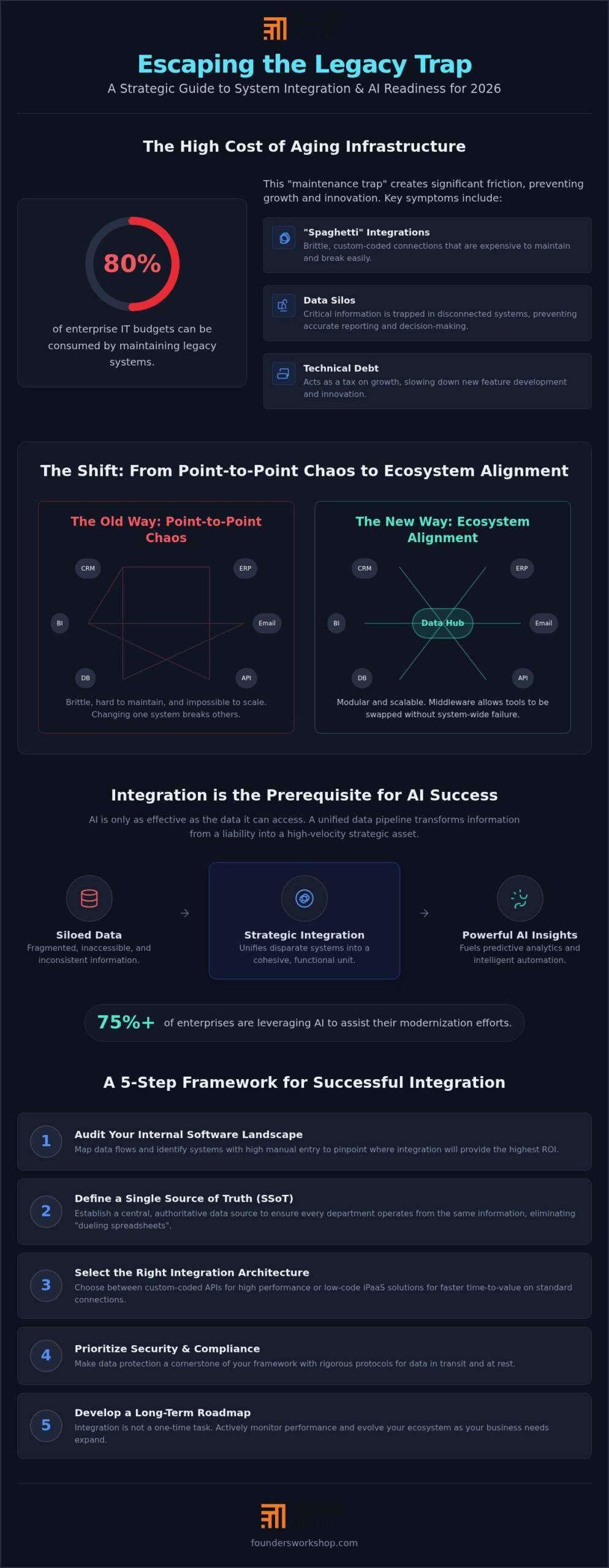
Did you know that 60 to 80 percent of enterprise IT budgets are now swallowed by the cost of maintaining aging infrastructure? For many leaders, the dream of innovation is stalled by a “spaghetti” of legacy system integration that requires constant, expensive manual intervention. It’s a frustrating reality. Data silos prevent accurate reporting while technical debt acts as a literal tax on your company’s growth. You likely feel that your current stack is holding you back, yet the risk of a total rebuild feels just as daunting as staying the course.
We understand that technology should be an accelerator, not a friction point. In this guide, you’ll discover how to transform fragmented software into a unified, AI-ready engine that drives genuine strategic value. We’ll explore how over 75 percent of enterprises are already leveraging AI to assist their modernization efforts. We’ll also provide a clear roadmap for reducing manual data entry and aligning your tech ecosystem for the unique demands of 2026. It’s time to move past the maintenance trap and build a foundation for sustainable scale.
Key Takeaways
- Learn why 2026 demands a shift from basic API links to a comprehensive ecosystem approach that prepares your business for AI scalability.
- Discover how legacy system integration serves as a low-risk alternative to “rip and replace” strategies by modernizing your existing infrastructure incrementally.
- Identify the strategic steps to eliminate data silos and establish a single source of truth that reduces costly manual data entry.
- Explore how nearshore staff augmentation provides the high-touch communication and timezone alignment necessary for complex integration projects.
- Understand the importance of a human-centered philosophy that aligns technical execution with your long-term strategic business goals.
What are System Integration Services in the AI Era?
At its core, system integration is the engineering process of unifying disparate software subsystems into a single, cohesive functional unit. While the concept isn’t new, the stakes for legacy system integration have changed. Entering 2026, we’ve moved past the era of simply linking a CRM to an email tool. Successful leaders now focus on ecosystem thinking. This approach ensures that every piece of software, from your accounting package to your proprietary database, works in harmony to support overarching business goals.
Many organizations struggle with “integration debt.” This occurs when “spaghetti” code and brittle connections create a web of technical friction that drains resources. Instead of building new features, your engineering team might spend nearly half their time managing broken links and manual data corrections. This fragmented environment doesn’t just slow you down; it creates blind spots that lead to poor decision-making. Strategic legacy system integration isn’t just about fixing what’s broken. It’s about building a sustainable pipeline that transforms your data from a liability into a high-velocity business asset.
The Shift from Point-to-Point to Ecosystem Alignment
Brittle, one-to-one integrations often fail as a company scales because they create a complex web that’s impossible to maintain. If you change one system, three others break. Modern architecture favors middleware and centralized data hubs that act as a universal translator for your tech stack. This structure allows for modularity, where you can swap out individual tools without collapsing the entire system. Ecosystem alignment is the primary goal of 2026 integration.
Integration as a Prerequisite for AI Strategy
Artificial intelligence is the defining competitive advantage of this era, but these tools are only as effective as the data they can access. If your critical business information is trapped in silos, your AI models will be starved of the context they need to provide value. Clean, automated integrations fuel the predictive analytics and workflow automation that modern enterprises require to stay ahead. Before you can execute a successful AI strategy consulting initiative, you must ensure your data is accessible and unified across the organization. Without this technical foundation, even the most sophisticated AI will fail to deliver a meaningful return on investment.
The Strategic Framework for Successful System Connectivity
Successful connectivity requires more than just technical skill. It demands a disciplined framework that aligns your current tools with your future growth targets. Before writing code, you must audit your technical debt to understand where data silos are choking your operations. Defining a Single Source of Truth (SSoT) ensures every department works from the same data set. This prevents the “dueling spreadsheets” problem that plagues many scaling companies. Legacy system integration is most effective when you choose patterns based on specific latency and volume requirements rather than taking a one-size-fits-all approach.
Security and compliance are the cornerstones of this framework. For those in healthcare tech, this means implementing rigorous protocols for data in transit and at rest. Finally, you need a long-term roadmap. Strategic legacy system integration isn’t a “set it and forget it” task. It requires active monitoring to maintain performance as your ecosystem evolves and your data needs expand. This methodical approach turns a messy tech stack into a reliable engine for growth.
Auditing Your Internal Software Landscape
Identifying which systems are worth saving is a critical first step. Some platforms are too brittle to support growth, while others contain unique logic better preserved through refactoring legacy code strategies. Mapping data flow across sales and finance helps pinpoint where manual entry is highest. The U.S. Government Accountability Office emphasizes the necessity of modernizing critical legacy systems to mitigate cybersecurity risks. This audit ensures you prioritize investments that offer the highest return.
Selecting the Right Integration Architecture
Choosing between custom-coded APIs and low-code iPaaS solutions depends on your performance needs. Custom APIs offer the control required for high-volume transfers, while iPaaS provides faster time-to-value for standard connections. Your architecture must scale alongside your user base. Security is paramount when bridging cloud and on-premise systems. We often guide leaders through these trade-offs via our system integration services to ensure their technology supports their strategic vision.
Modernizing Legacy Systems Through Strategic Integration
The “rip and replace” method is often a recipe for budget overruns and operational chaos. Instead, savvy leaders opt for gradual modernization. This approach uses legacy system integration to peel away functionality from old systems one piece at a time. By wrapping aging code in modern APIs, you make your core business logic accessible to new web applications without disturbing the underlying database. This preserves your previous investments while enabling the high-velocity capabilities required in 2026.
A common concern is whether these changes will break critical business processes. It’s a valid fear. However, a structured integration strategy includes rigorous testing layers that act as a safety net. The National Institute of Standards and Technology (NIST) highlights the complexity of digital transformation with legacy components, emphasizing that security and reliability must be baked into the architecture from day one. By extending the life of your existing internal software, you achieve a higher ROI and avoid the massive upfront costs and risks associated with total replacement.
Breaking Down the Monolith with Microservices
Moving from a monolithic structure to microservices allows your tech stack to become flexible and modular. Instead of one giant, unchangeable program, you build smaller services that communicate through APIs. This flexibility is vital for future-proofing your business growth. For example, it’s common to connect a decades-old SQL database to a modern React frontend. This setup allows the user experience to feel cutting-edge while the reliable, older data engine continues to run in the background without interruption.
Data Governance and Integrity During Migration
Maintaining data consistency is a major challenge during any transition. You must decide which processes require real-time updates and which can handle batch processing. If your inventory system doesn’t talk to your sales platform in real-time, you risk overselling and damaging customer trust. Data integrity is the invisible foundation of integration success. Without clean data mapping and strict governance, even the most elegant API will eventually fail to deliver accurate business insights.
Accelerating Execution with Nearshore Staff Augmentation
Execution speed is where many legacy system integration projects stall. It isn’t just a matter of hiring more developers. It’s about how those developers integrate into your existing workflow. Complex systems require high-touch communication and real-time collaboration. When you’re bridging an old mainframe with a modern AI engine, you can’t afford a 12-hour delay between a question and an answer. This is why many US-based engineering teams are turning to nearshore staff augmentation to maintain their momentum.
For non-technical founders, the management burden of a global team can be overwhelming. A managed nearshore team provides a layer of accountability and seasoned leadership that removes technical friction. You get the benefit of high-velocity execution without having to micromanage every API call or database migration. This approach to legacy system integration ensures that technical execution remains disciplined and focused on human-centered results. It allows you to focus on strategic growth while your technical partners handle the practicalities of connectivity.
Timezone Alignment: The Secret to Rapid Integration
The “follow the sun” model sounds efficient in theory, but it often fails during complex integration troubleshooting and QA. When a critical bug appears during a deployment phase, you need your external partners online at the same time as your internal stakeholders. Synchronous communication reduces the friction that typically kills momentum in software projects. Real-time collaboration ensures that QA cycles are tight and that deployment hurdles are cleared in minutes rather than days. This alignment is the invisible engine that drives rapid project completion.
Accessing High-Quality Tech Talent at Scale
Bridging the talent gap in specialized fields like healthcare technology or AI development is a primary driver for the nearshore model. Latin American tech hubs have matured significantly. They offer a cost-to-quality ratio that is often superior to offshore alternatives. You gain access to developers who understand the nuance of US business culture and regulatory requirements. This proximity allows for a higher integration velocity, helping you ship features faster and maintain a competitive edge. It’s about finding the right hands to build your vision without the geographic friction.
If you’re ready to scale your engineering capacity without the overhead of local hiring, explore our nearshore staff augmentation services to find the right fit for your next project.
The Founders Workshop Approach: Human-Centered Integration
At Founders Workshop, we operate under a “Seasoned Executive Guide” philosophy. We believe that technology is a means to an end, not the end itself. Before we discuss APIs or database schemas, we focus on your core business objectives. With a 30-year track record of navigating major technical transitions, we’ve helped leaders move from the early days of client-server architecture to the complex, AI-driven ecosystems of 2026. This depth of experience allows us to approach legacy system integration with a level of pragmatic wisdom that younger agencies simply can’t match. We understand that your existing tools carry the weight of your business logic, and our job is to preserve that value while removing technical friction.
Our approach is fundamentally human-centered. We don’t just look at how data moves between servers; we look at how those connections affect your team’s daily productivity. If an integration is technically sound but adds complexity for your operations staff, it has failed. We prioritize solutions that simplify workflows and provide peace of mind. By focusing on alignment and sustainability, we ensure that your legacy system integration project serves as a bridge to future innovation rather than a temporary patch on a sinking ship. We take the burden of technical complexity off your shoulders, allowing you to lead with confidence.
From MVP to Enterprise: Scaling Your Ecosystem
Startups often face a “technical wall” when they attempt to scale, usually because their initial build wasn’t designed for connectivity. We specialize in strategic MVP development that is integration-ready from day one. This foresight prevents the need for a total rebuild when you’re ready to move from a handful of users to an enterprise-grade audience. We act as a strategic partner, consulting on the “why” behind every integration choice to ensure it supports your long-term roadmap. Our goal is to build a foundation that grows alongside your vision without the typical pains of technical debt.
Your Technical Partner for Long-Term Growth
A successful integration requires more than just code; it requires accountability. We treat our clients as partners, offering a level of professional commitment that feels like an extension of your own leadership team. We handle the intricate details of data governance and system architecture so you can focus on scaling your business and serving your customers. If you are ready to transform your fragmented software into a unified engine for growth, schedule a consultation to audit your tech ecosystem today. We provide the steady hand and seasoned expertise you need to navigate the complexities of modern software engineering.
Building a Unified Foundation for Future Scalability
As 2026 approaches, the gap between companies with fragmented data and those with unified ecosystems will only widen. We’ve explored how moving beyond brittle, point-to-point connections toward true ecosystem alignment allows your business to scale without the weight of technical debt. Successful legacy system integration isn’t just a technical upgrade; it’s a strategic move that prepares your data for the AI-driven demands of the future. By choosing a partner that prioritizes human-centered engineering and real-time collaboration through nearshore models, you ensure your technology remains an asset rather than a friction point.
Founders Workshop brings over 30 years of technical leadership to help you navigate these transitions with seasoned confidence. Our proven nearshore execution model provides the high-touch communication necessary for complex system connectivity. We handle the technical complexity so you can focus on leading your company toward its next milestone. It’s time to transform your technical debt into a competitive advantage.
Align your tech ecosystem for growth-Partner with Founders Workshop
Your tech stack should be the engine that drives your vision forward. Let’s build a foundation that lasts.
Frequently Asked Questions
What is a system integration service provider?
A system integration service provider is an expert partner that unifies disparate software applications into a single, cohesive ecosystem. Instead of managing isolated tools, businesses use these providers to ensure data flows seamlessly across the organization. At Founders Workshop, we act as a seasoned executive guide. We focus on your strategic business goals first, ensuring that every technical connection supports long term growth and operational efficiency.
How do system integration services reduce technical debt?
These services reduce technical debt by replacing brittle, manual workarounds with automated, scalable connections. Effective legacy system integration allows you to modernize your infrastructure incrementally. This approach eliminates the “spaghetti code” that often results from years of patchwork fixes. By cleaning up these data pipelines, you lower annual maintenance costs and free up your engineering team to focus on high value innovation rather than constant troubleshooting.
What is the difference between point-to-point and hub-and-spoke integration?
Point to point integration involves creating a direct link between two specific applications. While simple at first, this creates a tangled web that’s difficult to maintain as you scale. Hub and spoke integration uses a central middleware “hub” to manage all connections. This centralized model is much more sustainable. It allows you to add or replace individual software tools without breaking the rest of your technical ecosystem.
How long does a typical system integration project take in 2026?
Project timelines in 2026 depend heavily on the scope of the data and the age of the underlying systems. A focused API integration might take eight to twelve weeks. However, a comprehensive legacy system integration for an enterprise usually follows a phased roadmap over several months. We prioritize high velocity execution through our nearshore model. This ensures that your team sees incremental value and improved data flow throughout the development lifecycle.
Can you integrate legacy software with modern AI tools?
Yes, you can integrate aging software with modern AI tools by using APIs to “wrap” the legacy code. This process makes your historical data accessible to predictive analytics and automation engines. AI tools are only as effective as the data they can reach. By bridging these gaps, you transform stagnant databases into a high speed fuel source for custom AI models that drive strategic business value.
What are the security risks of system integration?
The primary risks include data exposure during transit and potential vulnerabilities at the connection points between systems. If you’re in the healthcare sector, these risks are even higher due to strict compliance requirements. We mitigate these dangers by implementing end to end encryption and rigorous identity management. A human centered approach to security ensures that every integration point is audited for both technical reliability and regulatory alignment.
Why should I choose nearshore developers for integration projects?
Nearshore developers offer the real time timezone alignment that is critical for complex integration troubleshooting. Unlike offshore models that suffer from twelve hour communication delays, nearshore teams in Latin America work during your business hours. This allows for synchronous collaboration and faster deployment cycles. When you’re managing intricate data migrations, having your external partners available for immediate feedback is the secret to maintaining project momentum.
How much do system integration services cost?
The cost of integration services is determined by the complexity of your technical debt and the volume of data being moved. Every business has a unique software landscape that requires a tailored strategy. At Founders Workshop, we typically structure our engagements through fixed fee project contracts or monthly staff augmentation retainers. This provides transparency and allows you to scale your engineering capacity based on the specific needs of your growth roadmap.