

Choosing the wrong software agency isn’t just a budget mistake; it’s often the quiet catalyst that kills a promising startup before it can even scale. If you’re wondering how to vet a software development agency, you’re likely already feeling the pressure of potential technical debt or the frustration of communication gaps that lead to missed deadlines. It’s a common struggle to find a partner who understands your business goals as well as they understand their tech stack, but settling for a poor fit can derail your entire roadmap.
We’ve navigated these waters for decades and understand that a successful partnership requires more than just a signed contract. This guide provides the exact framework for evaluating technical partners to ensure they align with your strategic vision and long-term scalability. You’ll learn how to identify technical excellence and assess the value of nearshore models that bridge the gap between cost and quality. We’ll walk through a clear checklist for vetting, giving you the confidence to move from a risky search to a successful product launch.
Key Takeaways
- Learn why flashy portfolios often mask technical debt and how to look deeper into an agency’s actual delivery track record.
- Discover how to vet a software development agency by prioritizing business alignment and strategic AI capabilities over simple coding skills.
- Understand why nearshore talent provides the optimal middle ground for real-time collaboration and timezone alignment.
- Master a two-phase vetting process that moves from initial screening to a paid discovery phase for maximum risk mitigation.
- Transition from a simple vendor-client relationship to a long-term strategic partnership that supports your product’s scalability.
Beyond the Portfolio: Why Traditional Agency Vetting Often Fails
Vetting is often misunderstood as a simple procurement task. For a founder, it’s actually the first step in Vendor Relationship Management (VRM). The goal is to secure a strategic ally rather than a temporary pair of hands. If you’re learning how to vet a software development agency, you must look past the hourly rate trap. A low rate often masks a high total cost of ownership (TCO) caused by bugs, poor documentation, and the need for expensive future refactoring. A great developer might write clean code, but a true business partner ensures that code actually moves your business metrics.
The Trap of Superficial Case Studies
A flashy portfolio usually highlights the user interface, which is the easiest part to polish. You need to look at the plumbing. Ask how many of those projects are still running three years later. Did the agency maintain them, or did the client have to hire a rescue team to fix the underlying architecture? Real experience in your industry niche matters because it reduces the time spent explaining basic business logic. If they’ve built healthcare tech or complex system integrations before, they already understand the regulatory and architectural hurdles you’re facing. Look for longevity and structural integrity, not just pretty screenshots.
Technical Debt vs. Business Outcomes
Shipping fast is a celebrated startup mantra, but without a scalable roadmap, it’s a liability. Vetting for code quality and documentation isn’t just about technical pride; it’s about ensuring your product doesn’t collapse under its own weight when you hit 10,000 users. A strategic partner asks about your three-year vision before they suggest a framework. They should prioritize business outcomes over technical novelty. If an agency pushes the latest trendy tool without explaining how it supports your long-term growth, they aren’t thinking like a founder. They’re thinking like a hobbyist. You need a partner who understands that every line of code is a business investment that must be protected.
- Architecture over Aesthetics: Prioritize agencies that can explain the “why” behind their technical choices.
- Maintenance History: Ask for references from clients who have been with the agency for over two years.
- Strategic Alignment: Ensure the agency understands your revenue model, not just your feature list.
The Strategic Vetting Framework: Evaluating for Business Alignment
Most founders prioritize technical skills during their search, but coding proficiency is merely the baseline. The real challenge is finding a partner who understands your business model as deeply as you do. When you’re determining how to vet a software development agency, you must look for strategic alignment. A partner should be able to explain how their technical choices will impact your customer acquisition costs or operational efficiency. If they can’t connect a line of code to a business outcome, they aren’t a strategic partner; they’re a commodity vendor.
Assessing Strategic Vision and AI Readiness
In 2026, the gap between AI hype and practical ROI has never been wider. You need to know if an agency is simply wrapping third-party APIs or if they possess genuine expertise in AI strategy consulting. A veteran team looks at your data architecture first. They’ll evaluate how predictive analytics or automation can solve specific bottlenecks rather than suggesting AI for the sake of novelty. Ask for examples of how they’ve turned raw data into actionable business intelligence for past clients.
Human-Centered Solutions vs. Technical Novelty
Technical novelty is often the enemy of a successful launch. Engineers who prioritize the latest “shiny” framework over user experience often leave founders with a product that’s technically impressive but difficult to use. Vetting for a product-first mindset is critical. This requires empathy for the end user and a focus on human-centered design. A great agency asks about user personas and pain points before they discuss the database schema. They should demonstrate a history of building startup MVPs that focus on solving human problems through intuitive interfaces.
Leadership experience plays a massive role in this strategic oversight. Teams with decades of tenure have navigated multiple technological shifts and understand that tools are secondary to outcomes. They provide a steady hand, helping you avoid common pitfalls in healthcare tech or complex system integrations. This seasoned perspective is what transforms a standard contract into a professional commitment. If you’re ready to move beyond basic development and find a guide who has “been there before,” Founders Workshop offers the executive strategy needed to scale with confidence.
- Business Model Fluency: Can they explain your revenue drivers?
- AI Practicality: Do they focus on ROI or just the technology?
- User-Centricity: Does their process start with the user or the code?
- Tenure: Does the leadership team have a track record of long-term stability?
Operational Vetting: Timezones, Communication, and Delivery Models
Operational excellence isn’t a “nice-to-have” feature; it’s the engine that drives your project’s velocity. When founders analyze how to vet a software development agency, they often overlook the day-to-day mechanics of collaboration. You can hire the most brilliant engineers in the world, but if they’re asleep while your team is working, your development cycle will inevitably grind to a halt. Real-time communication is the only way to prevent minor misunderstandings from turning into week-long delays.
The Hidden Costs of Timezone Gaps
A 12-hour timezone difference creates a persistent bottleneck in your engineering pipeline. If an engineer hits a roadblock at 9:00 AM in your timezone, they’ll wait until your evening to get an answer, effectively losing an entire day of productivity. This lag kills momentum and makes agile development nearly impossible. When you vet a partner, look for “US-timezone” availability that allows for synchronous problem-solving. This is why nearshore staff augmentation consistently outperforms traditional offshore models. By aligning your team with developers in Latin America, you ensure that daily standups and Slack huddles happen in real-time, maintaining a steady development pace without the fatigue of midnight meetings.
Cultural and Linguistic Alignment
Technical proficiency is useless without clear communication. Vetting for English proficiency goes beyond basic conversation; it requires the ability to discuss complex architectural trade-offs and business logic without losing nuance. Latin American nearshore teams often share similar business values and work ethics with US companies, which simplifies the integration process. This alignment is particularly vital when you choose staff augmentation over simple project outsourcing. True “augmentation” means the engineers become an extension of your internal team, participating in your Slack channels and Jira workflows. This level of integration requires a deep cultural bridge that many offshore providers simply cannot provide. You aren’t just buying code; you’re building a collaborative environment where every engineer understands the “why” behind the ticket.
- Communication Stack: Verify they use industry-standard tools like Slack and Jira for transparent progress tracking.
- Meeting Cadence: Ensure they commit to daily standups within your core working hours.
- Integration Level: Ask if their engineers will participate in your internal meetings or remain siloed.
- Linguistic Nuance: Conduct a video call to ensure the lead engineers can explain technical concepts clearly in English.
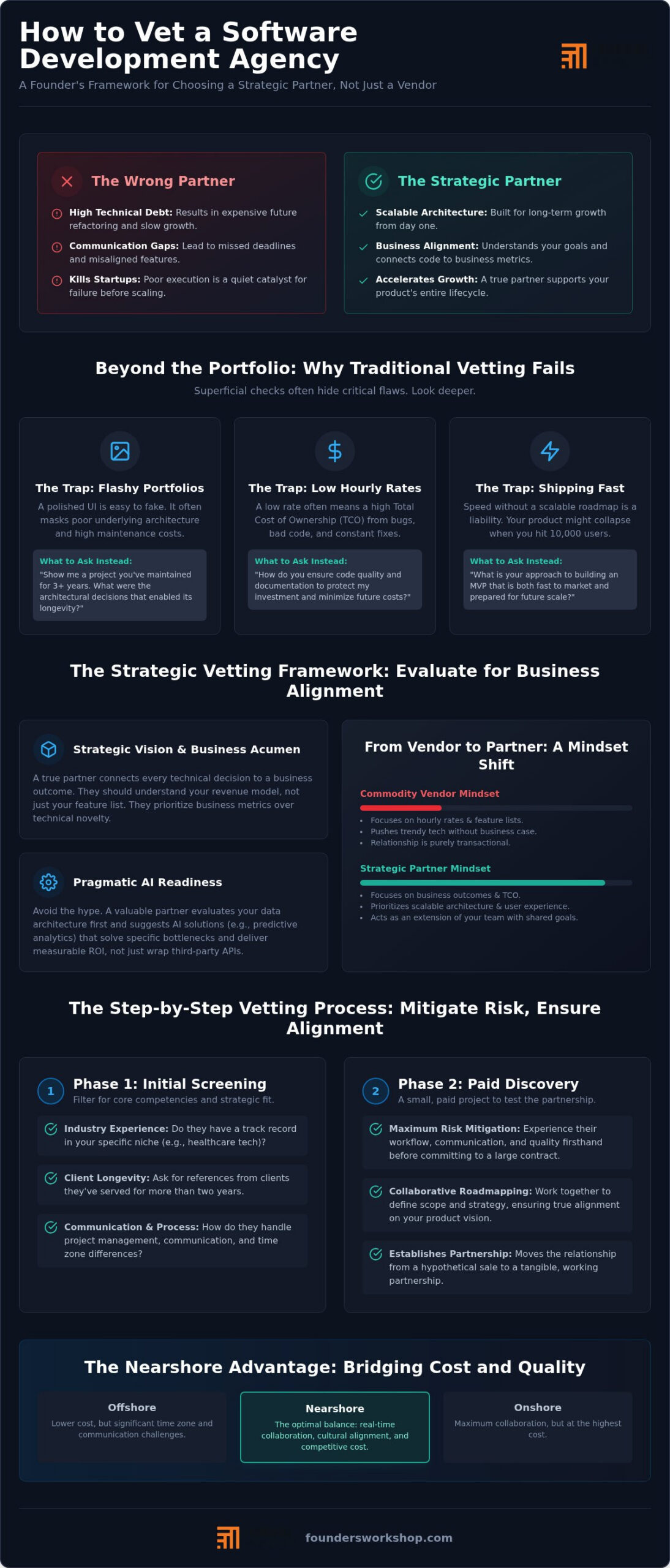
The Step-by-Step Vetting Process: From RFP to Paid Discovery
Understanding how to vet a software development agency requires a disciplined, multi-phase approach. It’s not enough to rely on a single meeting or a polished slide deck. Instead, founders should view vetting as a funnel that narrows down a long list of vendors into a single, high-alignment partner. This process moves from high-level cultural screening to deep technical interrogation, ensuring that your choice is based on evidence rather than intuition. By the time you reach a final decision, you should have total clarity on their delivery model and strategic mindset.
- Phase 1: The Initial Screen. Review their portfolio for longevity and check verified reviews on third-party platforms. Look for projects that survived past the initial launch.
- Phase 2: The Strategic Interview. Ask hard questions about their business model. Do they understand your revenue drivers, or are they just focused on the feature list?
- Phase 3: The Technical Deep Dive. This is where you audit their code quality, documentation standards, and architectural preferences.
- Phase 4: The Paid Discovery Session. This is the final “test drive” to see how the team actually collaborates under pressure before you commit to a full-scale build.
Asking the Right Technical Questions
During the deep dive, you must challenge their engineering philosophy. If you’re dealing with an existing product, ask about their specific refactoring legacy code strategies. You need to know if they’ll suggest a total rewrite or a sustainable, incremental modernization. For those in specialized fields, vetting for security and HIPAA compliance in healthcare tech is non-negotiable. Don’t just ask if they are compliant; ask for a walkthrough of their QA automation and data encryption protocols. A partner who can’t explain their testing pipeline is a partner who will eventually ship bugs to your users.
The Value of Paid Discovery and Roadmapping
The most expensive mistake a founder can make is skipping the planning phase to save time. A paid discovery session provides the foundation for strategic MVP development. It results in a high-quality technical roadmap that defines the scope, budget, and timeline with precision. This phase is designed to identify red flags, such as communication gaps or technical misunderstandings, before you’ve invested significant capital. It’s the ultimate risk mitigation tool. If you’re ready to move from uncertainty to a clear execution plan, book a discovery session with Founders Workshop to see how veteran leadership can accelerate your launch.
Partnering for Growth: Why Founders Workshop is the Strategic Choice
The ultimate goal of knowing how to vet a software development agency is to find a partner who shares your commitment to results. Many firms can write code, but few can offer the strategic oversight of a veteran founder who has navigated multiple eras of technology. At Founders Workshop, we provide more than just technical execution. We offer a steady hand rooted in over 30 years of leadership experience. Our model is designed to bridge the gap between high-level business strategy and hands-on technical reliability, ensuring your product is built for the long haul.
A Veteran Hand in Modern Software
Our leadership team understands that tools are always secondary to business outcomes. This seasoned perspective allows us to align every technical decision with your growth milestones. We don’t chase fleeting trends; we focus on sustainable architecture and custom software development that supports your long-term vision. This commitment to accountability transforms the typical vendor-client dynamic into a true strategic partnership. We’ve been through the struggles of scaling companies before, and we use that discipline to help you avoid the common pitfalls of technical debt and missed deadlines.
Scalable Nearshore Talent for US Companies
Accessing elite engineering talent shouldn’t require the astronomical overhead of local US hiring or the risky delays of offshore models. Our nearshore staff augmentation model provides a pragmatic middle ground. By leveraging dedicated talent from Latin America, we ensure your team stays in sync through full timezone alignment. These engineers don’t work in a silo; they integrate seamlessly into your daily standups, Slack huddles, and Jira workflows. This human-centered approach ensures that every team member understands the “why” behind their tasks, leading to higher quality and faster delivery cycles.
- 30+ Years of Experience: Benefit from leadership that has seen every major shift in the tech landscape.
- Timezone Alignment: Collaborate in real-time with nearshore teams that work when you work.
- Strategic Integration: Our managed teams become an extension of your own, sharing your values and work ethic.
- Business-First Mindset: We prioritize your ROI and scalability over technical novelty.
Choosing a partner is about more than checking boxes on a list. It’s about finding the peace of mind that comes from working with experts who prioritize your success as much as you do. Whether you are building a startup MVP or modernizing a legacy system, our goal is to remove technical friction so you can focus on growing your business. We provide the roadmap, the talent, and the strategic vision needed to turn a complex build into a successful, scalable launch.
Securing Your Technical Future
Finding a technical partner is a high-stakes decision that defines your company’s trajectory. You’ve learned that successful vetting moves beyond flashy portfolios to focus on strategic business alignment and operational transparency. Prioritizing timezone-aligned communication through nearshore models ensures your engineering velocity remains high while avoiding the pitfalls of technical debt. By following a structured process from initial screening to paid discovery, you can transform a risky vendor search into a stable, long-term partnership.
Mastering how to vet a software development agency gives you the confidence to lead with a product-first mindset. At Founders Workshop, we bring 30+ years of industry experience and specialized expertise in healthcare and AI to every project. Our dedicated nearshore teams provide the scalability you need with the accountability you deserve. We’re here to help you bridge the gap between vision and execution.
Ready to build? Schedule a strategic consultation with Founders Workshop today. It’s time to build something that lasts.
Frequently Asked Questions
What are the red flags to look for when vetting a software agency?
Common red flags include a lack of transparency regarding their development process and a push for immediate commitment without a discovery phase. If an agency can’t explain their QA protocols or architectural choices, it’s a sign of future instability. Another warning sign is a portfolio full of “ghost” projects that are no longer live. A strategic partner should provide references from long-term clients who have successfully scaled their products.
How much should a software discovery session cost?
While costs vary based on project complexity, a high-quality discovery session is a paid engagement that produces a technical roadmap. It shouldn’t be treated as a free sales call. This phase involves deep dives into your business logic, user personas, and technical architecture. Investing in discovery prevents expensive mid-project pivots. You’re paying for the veteran leadership and strategic foresight that ensures your MVP is actually scalable and secure.
Is nearshore software development better than offshore?
Nearshore development is generally superior for US companies because it eliminates the 12-hour timezone gap. Working with teams in Latin America allows for real-time collaboration and synchronous communication in Slack or Jira. This alignment increases engineering velocity and reduces the risk of project delays. When you learn how to vet a software development agency, you’ll see that timezone compatibility is a non-negotiable factor for agile delivery.
How do I vet an agency for AI development expertise?
Focus on their ability to move beyond technical novelty to achieve business ROI. Ask them to explain their data architecture strategies and how they handle predictive analytics or automation. A capable agency will discuss AI strategy as a way to solve specific business bottlenecks. They should demonstrate how they’ve integrated AI into existing workflows without creating technical friction. Look for partners who prioritize human-centered results over hype.
Should I hire a local agency or a remote team?
The decision depends on your need for specialized talent versus physical proximity. Remote nearshore teams offer a strategic advantage by providing high-quality engineers who work in your timezone at a more sustainable cost than local hires. These teams integrate into your internal workflows as if they were in the next room. Local agencies can be useful for in-person workshops, but remote models often provide access to a broader pool of senior developers.
How do I check an agency’s technical reputation?
Look beyond the testimonials on their website and check third-party review platforms for verified feedback. Ask for direct references from founders who have used their services for at least two years. You should also inquire about their tenure in the industry and their experience with legacy modernization. A reputation built on 30 years of leadership and human-centered solutions is more reliable than one based on fleeting marketing trends or unverified claims.
What is the difference between project-based development and staff augmentation?
Project-based development involves a contract for a specific build, such as an MVP or a system integration. Staff augmentation is a recurring model where dedicated engineers integrate into your existing team to provide continuous support. Both models have their place. Project-based work is ideal for launching new initiatives with defined scopes, while staff augmentation helps you scale your internal capacity with specialized nearshore talent that works alongside your full-time staff.
How do I ensure my software agency won’t leave me with technical debt?
Vetting for documentation standards and code quality is essential for long-term sustainability. Ask about their refactoring strategies and how they handle QA automation during the build process. A partner who prioritizes scalability over “shipping fast” will provide a clear roadmap for maintenance. Understanding how to vet a software development agency involves ensuring they have a disciplined approach to architecture that allows your product to scale without requiring a total rewrite later.