
The fastest way to waste time and money on AI is to start with the technology instead of the work it needs to improve. For leaders considering AI implementation in the Dallas, Texas area, the key question isn’t simply which tool to adopt. It’s which recurring business process could benefit from AI and how a solution would fit the systems and people already involved.
That concern is well founded. A promising demo can become an expensive experiment if the use case is too broad, existing data and software aren’t accounted for, or employees don’t adopt the new workflow. A practical approach starts with a specific business priority, then tests whether AI can address it in a useful, measurable way.
This guide explains how to move from an AI opportunity to an integrated solution, step by step. You’ll learn how to identify and scope a suitable use case, plan discovery and development, connect AI with existing systems, and support ongoing improvement. Whether you’re a founder, business owner, or executive in Dallas, Fort Worth, Plano, Frisco, Irving, or elsewhere in Texas, the goal is a clear implementation path shaped around your operations. Founders Workshop is Dallas-based and works with businesses locally and remotely across the United States.
Key Takeaways
- Choose an AI use case based on a specific workflow challenge and the business value you want to achieve.
- Move from workflow definition to data and systems assessment, design, development, integration, and evaluation.
- For AI implementation in the Dallas, Texas area, compare existing tools, configurable platforms, and custom development against your workflow and integration needs.
- Assign clear ownership, involve the people who use the workflow, and evaluate the solution as you roll it out.
- See how AI strategy, development, internal software, and system integration can work together to support a practical implementation.
Where AI Implementation Can Help Dallas-Area Businesses
For Dallas-Fort Worth leaders, the first decision isn’t which AI tool to buy. It’s which work problem is worth addressing. A strong candidate is a recurring process where staff spend time sorting documents, finding information, or handling similar requests. Adopting AI because it’s attracting attention isn’t a business use case. The opportunity should connect to a real workflow and a clear operational need.
For a Texas business, that might mean organizing incoming project documents, retrieving internal procedures, or helping a service team prepare responses to routine customer questions. These are starting points, not promises of automatic savings or improved outcomes. The common business applications of AI span many functions, but a broad list can’t determine which task fits a particular company. That takes a close look at how the work is done today.
Start with a workflow, not a tool
Describe one recurring task from beginning to end. What information comes in? What should the completed work look like? Who owns the process, and where do handoffs occur? For example, an operations team might receive documents by email, review them, and enter key details into an internal system. Delays, repetitive handling, and information split across folders or software can signal a workflow worth investigating.
Map the steps before choosing an AI technique. The apparent bottleneck may come from inconsistent inputs, unclear ownership, or a disconnected system rather than a task that needs AI. Understanding the workflow helps distinguish where AI assistance may help from where a process change or system integration is a better fit. You can learn more about connecting intelligent automation solutions to business workflows to help determine the right technical path. It also gives the team a practical way to define a useful result.
Recognize use cases that need human judgment
AI may help staff locate internal knowledge, summarize documents for review, or draft an initial response to a customer support request. These are assistive roles. An employee can check the information, verify important details, and decide whether a response is appropriate before it reaches a customer.
Keep accountable decisions with the people responsible for them, especially when a document or customer interaction requires context, interpretation, or judgment. Define where human review belongs before designing the workflow, including how staff can correct an error or handle an unusual case. This boundary makes the use case more concrete and keeps implementation aligned with the realities of the work.
For a business exploring AI implementation in the Dallas, Texas area, a strong first candidate is a well-understood, repeated task with identifiable inputs, outputs, and an owner. Next, examine the data and systems around that workflow before deciding how to build it.
How an AI Implementation Moves from Use Case to Working Workflow
A useful implementation is a sequence of business and technical decisions, not a model dropped into an existing process. The work moves from defining the workflow to assessing data and systems, designing the solution, building it, integrating it where needed, and evaluating it with users. The scope and technical choices depend on how the organization works today and what its existing environment can support.
Define the workflow, data, and success measures
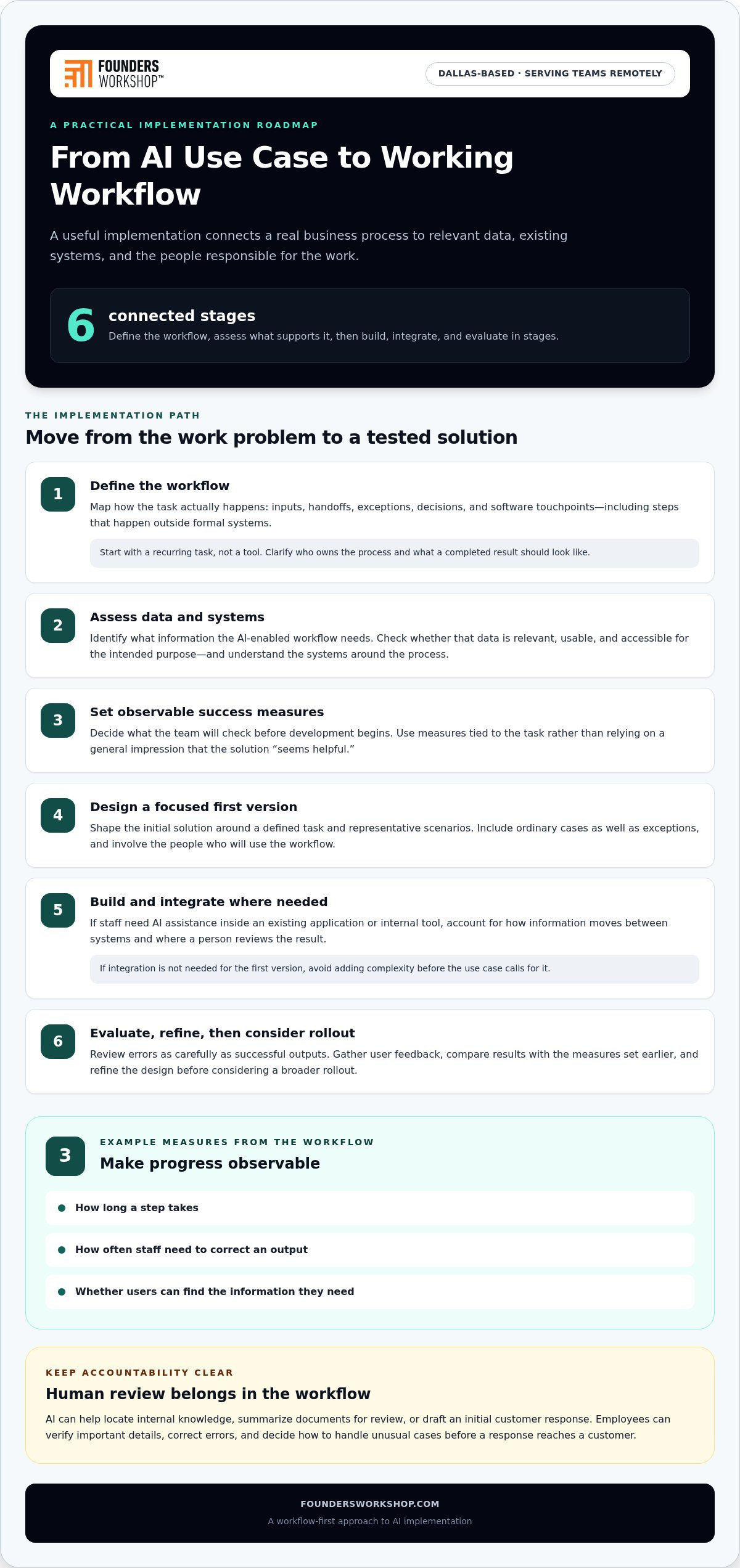
Start by mapping the process as it actually happens. Document handoffs, exceptions, decisions, and software touchpoints, including steps that may happen outside formal systems. Then identify what information an AI-enabled workflow would need and assess whether that data is relevant, usable, and accessible for the intended purpose.
Set observable measures before development begins. Depending on the task, a team might track how long a step takes, how often staff need to correct an output, or whether users can find the information they need. These measures give the team a basis for evaluating the solution instead of relying on a general impression that it “seems helpful.”
Build, integrate, and evaluate in stages
Design a focused first version around a defined task and representative scenarios. Test ordinary cases as well as exceptions, and include the people who will use the workflow. Their feedback can reveal confusing steps, missing information, or outputs that need review before the solution is expanded.
Integration should follow the workflow’s needs. If staff need AI assistance within an existing application or internal tool, account for how information moves between systems and where a person reviews the result. If integration isn’t necessary for the first version, avoid adding complexity before the use case calls for it.
During evaluation, review errors as carefully as successful outputs. Gather user feedback, compare results with the measures set earlier, and refine the design before considering a broader rollout. Adoption also depends on how well the solution fits people’s work. Harvard Business School discusses overcoming implementation barriers, including organizational resistance and skills gaps.
For Dallas-area organizations, a disciplined AI implementation in the Dallas, Texas area connects an AI capability to a real workflow and the people responsible for using it. Sound development and system integration help turn a promising capability into a working process. Learn more about Founders Workshop’s AI strategy and development.
Compare AI Implementation Approaches for Dallas Businesses
The right implementation approach depends on the task, the systems around it, and how much the workflow needs to be tailored. A standard tool may handle a contained need, while a more involved process may call for configuration or custom development. Custom AI development makes sense when specific workflow or integration requirements call for it, not simply because the technology is new.
| Approach | Best fit | Integration needs | Flexibility and tailoring |
|---|---|---|---|
| Existing AI tools | A well-defined task supported by standard capabilities | May work within current applications, depending on the tool and environment | Usually less tailoring; the workflow may need to fit the tool |
| Configurable platforms | A workflow that needs settings, rules, or connected steps adjusted | Depends on how the platform connects to the organization’s systems | More flexibility than a standard tool, within the platform’s design |
| Custom AI development | Distinctive workflows or specific integration requirements | Designed around the systems and data involved in the use case | Can be tailored to the workflow, with design and development shaped by project needs |
When existing tools may fit the workflow
Start with existing tools if the task is narrow and their standard capabilities align with how the team works. For example, an organization might assess whether a tool already in its software environment can help staff summarize material or find information. Check how it handles the inputs, outputs, and review steps the workflow requires. Don’t assume it will work with every application or fit without changes.
When custom AI development may be appropriate
Custom development may be appropriate when a process depends on organization-specific information, specialized steps, or connections between internal systems that standard tools don’t address well. The case for tailoring comes from those concrete requirements, not from a business’s size or the appeal of a more advanced-sounding solution.
For founders and executives weighing AI implementation in the Dallas, Texas area, compare the effort of adapting the workflow to a tool with the effort of tailoring a solution to the workflow. Consider how information moves, where staff need control, and which existing applications must connect. For more solution-selection criteria, see the guide to custom AI development in the Dallas, Texas area.
A Practical AI Implementation Plan for Texas Teams
Once you select a use case, move from planning to a controlled rollout in deliberate steps. For a Dallas-Fort Worth company, that might mean piloting document assistance with one operations team before introducing it to other departments. Keep the initial scope clear, assign responsibility, and learn from the actual workflow before expanding.
Prepare the pilot and the people using it
Assign a business owner who can make workflow decisions, then involve employees who handle the process day to day. They can surface exceptions, practical constraints, and integration dependencies that may not be visible in a high-level process map. Define what the pilot covers, what the AI-supported workflow is expected to do, and where a person must review or take over.
Make responsibilities explicit. Decide who reviews outputs, how users flag errors, and where unusual cases should go. Explain what will change for employees and what remains under human control. Clear communication helps users understand the purpose of the pilot and gives them a useful way to raise concerns as they work with it.
Evaluate outcomes before expanding
Before rollout, confirm that the data and system connections needed for the pilot are available and working as intended. Then compare observed results with the measures agreed before development. If a team is testing internal information retrieval, for example, review whether users can find relevant material and whether they still need to check the source before acting on an answer.
Look beyond the intended outcome. Review user feedback, exceptions, integration friction, and what it takes to maintain the workflow. If results fall short, adjust the process or solution and test again. If the workflow performs as intended and users can work with it, consider whether expansion is justified. Pausing is also sound if the evidence shows that a dependency or process issue needs attention first.
A practical AI implementation in the Dallas, Texas area should progress through defined decision points: prepare the people and systems, run a bounded pilot, evaluate evidence, then expand, revise, or pause. For project justification before committing to that path, read Building a Business Case for AI: A Practical Guide.
Explore Founders Workshop’s AI strategy and development services, which connect the use case, workflow, and technical approach.
How Founders Workshop Supports AI Implementation in the Dallas Area
A useful AI solution connects a business priority to the workflow, software, and people involved in carrying it out. Founders Workshop provides AI strategy and development alongside internal software development and system integration, helping businesses plan both the AI capability and how it fits their existing environment.
Connect business goals to technical delivery
Project discussions start with the business need and the workflow a team wants to improve. That context helps shape the technical direction: whether AI development is appropriate, what information the process depends on, and whether the solution needs to work with existing applications or internal tools.
For example, a company may want staff to retrieve internal information more easily. The implementation should consider not only how AI could support that task, but also where the information lives, how employees will use the result, and whether system integration is needed to make the workflow practical. The right scope follows from those details, not from a predetermined technology choice.
Founders Workshop’s Dallas-based team works with businesses in Dallas, Fort Worth, Plano, Frisco, and Irving, and serves clients remotely across the United States. The leadership team brings more than 30 years of experience, providing a seasoned foundation for connecting business priorities with technical execution. The appropriate solution and its outcomes depend on each project’s needs and context.
Take the next step with a focused consultation
For founders and executives considering AI implementation in the Dallas, Texas area, a useful starting point is a defined workflow or operational challenge. Bring the goal, the people involved, and what currently makes the process difficult. A focused conversation can clarify the business context, the role AI might play, and possible next steps for development or integration.
Contact Founders Workshop for an AI implementation consultation.
Put a Practical AI Plan into Motion
Effective AI implementation in the Dallas, Texas area starts with a real workflow, not a technology trend. Define the task and the people involved, assess how the solution will fit your data and systems, then test it against clear measures before expanding. Choose existing tools, a configurable platform, or custom development based on the needs of the work, not assumptions about which approach is most advanced.
Founders Workshop connects AI strategy and development with internal software and system integration. Founded in 2005, the company’s leadership team brings more than 30 years of experience. Its Dallas-based team works with local businesses and serves clients remotely across the United States.
You don’t need every technical decision settled to take a sensible next step. Start with the workflow you want to improve and the outcome your team needs. Contact Founders Workshop for an AI implementation consultation, and move forward with a plan grounded in your business.
Frequently Asked Questions
What does AI implementation mean for a business?
AI implementation means applying an AI capability to a defined business workflow, then integrating and evaluating it where people work. It involves more than choosing a model or tool. Teams need to understand the process, data, users, and intended outcome. The right scope varies by organization, so start with a specific operational need rather than adopting technology simply because it’s attracting attention.
How can a Dallas business identify the right AI use case?
Start by mapping a recurring workflow and finding where delays, repetitive tasks, or difficult information retrieval create friction. Talk with the people who perform the work and define what a useful improvement would look like. For AI implementation in the Dallas, Texas area, also assess available data, existing software, and where human review belongs. A focused use case is easier to evaluate than a broad goal such as “use AI.”
How long does AI implementation take?
The timeline depends on the workflow, data, integrations, project scope, and evaluation needs. A focused implementation may involve fewer dependencies than a solution spanning several teams or systems, but duration should be estimated for the project itself. Define the first useful scope, identify dependencies, and agree on review milestones with the delivery team before setting rollout expectations. This creates a more grounded plan than choosing a date before understanding the work.
Can AI integrate with a business’s existing software?
AI can be designed to work with existing software when the workflow, systems, and integration requirements support that approach. Map how information moves today, including relevant applications, access needs, and possible failure cases. Integration isn’t automatic; it needs project-specific design and testing. Include current systems in discovery so the AI capability is planned as part of the working process, rather than treated as a standalone feature.
What happens if employees do not trust or adopt an AI workflow?
Low adoption is a reason to examine how the workflow was designed and introduced. Gather feedback from intended users, clarify where AI assists and where people make decisions, and review confusing outputs or disruptive handoffs. Training and iteration can address practical friction. Before expanding the workflow to other teams or processes, evaluate whether it fits real working conditions and whether users can raise issues and get them reviewed.
How should a business measure AI implementation results?
Choose measures tied to the workflow before development begins. Depending on the use case, a team might review processing time, error patterns, completion rates, or user feedback. Select measures that reflect the intended outcome, establish a baseline where possible, and evaluate the solution under realistic conditions. Use what the team learns to refine the workflow, consider expansion, or reconsider whether the implementation is addressing the original need.
How much does AI implementation cost?
There isn’t one meaningful cost for every AI implementation. Scope, data preparation, custom development, integration requirements, and ongoing support can all affect the work involved. Define the business problem and first useful version before comparing project proposals. Founders Workshop tailors AI strategy and development work to project needs, so start with the workflow and intended outcome. Contact Founders Workshop for a consultation.