

What if your next machine learning project starts not with a model, but with a business decision you need to improve? Machine learning development services can help forecast demand, flag customer churn, or automate a workflow, but only when the use case, data, and operational fit are clear. Without that foundation, even capable technology can miss the mark.
If you’re unsure whether machine learning suits your challenge or whether your data and systems are ready, start by defining the decision the technology would support. A successful project takes more than building a model. It also requires a clear scope, relevant data, an integration plan, and a way to measure business value.
This guide explains what machine learning development services include, how consulting, custom development, and added engineering capacity differ, and what to expect from discovery through deployment. You’ll learn how to connect an ML use case to a real business decision, assess practical dependencies, and choose a delivery approach that fits your organization. For founders and executives in Dallas, Fort Worth, and across the country, the goal is a grounded implementation plan, not technology for its own sake. Founders Workshop is Dallas-based, with a leadership team bringing over 30 years of experience.
Key Takeaways
- Identify whether a business decision or workflow suits machine learning, rules-based automation, or generative AI.
- Use the development lifecycle to clarify the data, testing, integration, and ongoing monitoring your project will require.
- Compare internal hiring, augmented talent, and a managed project team by ownership, capacity, and coordination needs.
- Set a baseline and target business measure before development so you can evaluate whether the work is delivering value.
- Machine learning development services can connect strategy and custom model development with the workflows where teams need results.
What Machine Learning Development Services Include, and When They Fit
Machine learning development services apply data-driven models to a specific business problem. The work can include identifying a suitable use case, preparing relevant data, developing and testing a model, and connecting its output to a business workflow. The goal isn’t to add AI for its own sake. It’s to support a decision or task where data can provide useful signals.
A simple way to separate the parts:
- Input data: The information the model uses, such as past orders or incoming service requests.
- ML model: A system that learns patterns from data and applies them to new information.
- Decision: The action or judgment the model informs, such as adjusting a forecast or prioritizing a case.
For example, a Dallas-area business serving customers across Texas might use historical orders and other operational data to forecast demand by location. The forecast could inform planning, but it wouldn’t make the decision on its own. Teams still need to decide how to use the output and handle exceptions.
Which business problems are a good fit for machine learning?
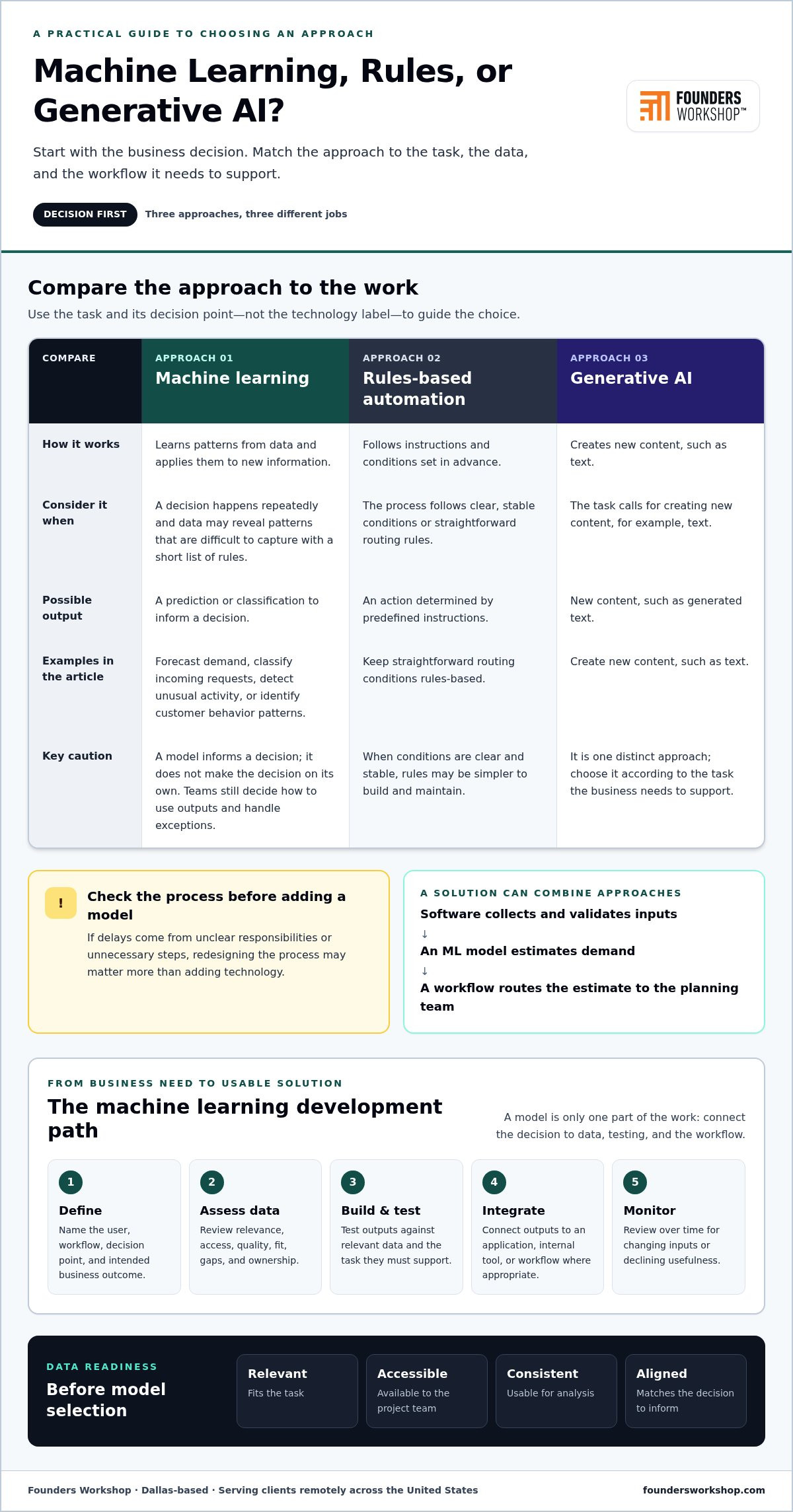
ML is worth considering when a decision happens repeatedly and historical or incoming data may reveal patterns that are difficult to capture with a short list of rules. Common applications include forecasting demand, classifying incoming requests, detecting unusual activity, identifying customer behavior patterns, and providing decision support.
Not every recurring task needs a model. If a process follows clear, stable conditions, rules-based automation may be simpler to build and maintain. If delays stem from unclear responsibilities or unnecessary steps, redesigning the process may matter more than adding technology. In a healthcare workflow, for example, a model might help sort incoming cases based on patterns in their information, while straightforward routing conditions could remain rules-based.
How machine learning differs from broader AI development
Machine learning (ML) is one approach within artificial intelligence. It uses data to identify patterns and produce outputs such as predictions or classifications. Generative AI is commonly used to create new content, such as text, while rules-based automation follows instructions set in advance. These approaches can work together, but they solve different kinds of tasks.
A practical solution may combine a predictive model with conventional software and workflow automation. For instance, software can collect and validate inputs, an ML model can estimate demand, and an automated workflow can route that estimate to the team responsible for planning. Choose the combination by starting with the business decision and the process around it. For a broader framework on assessing that opportunity, see the business case for AI guide.
How Machine Learning Development Moves from Data to Deployment
A model is only one part of an ML project. To create a solution people can use, the work must connect a business decision to suitable data, reliable testing, and the systems and workflows where its output matters. A clear lifecycle helps teams surface dependencies early and avoid treating model performance as the only measure of success.
An ML model needs relevant data and a defined decision to produce business value. Data suitability depends on whether information is relevant to the task, accessible to the project team, consistent enough to analyze, and aligned with the decision the model is intended to inform.
Start with the use case and data assessment
Before selecting a model, define who will use its output, what decision they need to make, where that decision sits in the workflow, and what business outcome it should support. Then map likely data sources. Identify access constraints, missing or inconsistent information, and who owns or maintains each source. An initial feasibility assessment can show whether the available data and business need support a focused first scope.
- Define the decision. Describe the user, workflow, decision point, and intended business outcome.
- Assess the data. Review its relevance, accessibility, quality, and fit for the specific task. Note gaps and ownership responsibilities.
- Build and test. Develop an approach and test its outputs against relevant data and the task it must support.
- Integrate. Connect the model’s output to an existing application, internal tool, or workflow where appropriate.
- Monitor. Review the solution over time to identify changing inputs or declining usefulness.
Build, integrate, and monitor the solution
Testing should reflect the intended use, not just a technical score. A model may perform well in a test environment but still create friction if its output arrives too late, is difficult to interpret, or doesn’t fit how employees make decisions. Consider usability and adoption alongside model performance, and decide how people will review or act on outputs.
Integration makes a model part of an operating process. That may mean displaying a prediction in an internal tool, passing a classification into an existing application, or routing an output to a team for review. The right approach depends on the workflow and the systems already in use.
After deployment, monitoring helps reveal whether incoming data or business conditions have shifted enough to affect the model’s usefulness. This ongoing discipline is often discussed as machine learning operations (MLOps). For organizations shaping a practical delivery plan, Founders Workshop’s AI development team can connect data, software, and workflow needs.
Compare Machine Learning Development Service Models for Your Team
The right delivery model depends on more than whether you need ML expertise. Consider who will own the product and decisions, how much capacity your current team has, how clearly the work is scoped, and who will coordinate delivery. Machine learning development services can be structured around internal hiring, added specialists, or a managed project team, each with a different balance of ownership and execution.
Choose the delivery model that matches the work, ownership, and team capacity.
| Factor | Internal hiring | Dedicated augmented talent | Managed project team |
|---|---|---|---|
| Ownership | Your organization owns delivery and team direction. | Your organization retains ownership and directs added specialists. | The project team coordinates agreed delivery work with your stakeholders. |
| Internal capacity | Builds capability within your organization. | Adds specialist capacity to an existing team. | Provides coordinated project execution without relying solely on existing capacity. |
| Scope definition | Your team defines and refines the work. | Your team sets priorities and assigns work. | Scope is shaped around the project’s business needs and intended outcomes. |
| Coordination needs | Managed through your internal structure. | Your team integrates specialists into its established process. | Coordination across project roles is part of the delivery approach. |
| Continuity | Knowledge and capability remain within your team. | Specialists contribute alongside your team while it retains its structure. | Continuity depends on project planning, documentation, and handoff needs. |
When a managed ML development project makes sense
A managed project can suit a business with a clear operational challenge that needs coordinated support to frame the problem, shape the solution, and carry it into use. That may involve connecting strategy, design, architecture, development, integration, and launch support rather than assigning model work in isolation. Founders Workshop’s managed software development capabilities bring these activities together around the project’s business needs. Scope and delivery plans are shaped to the work.
When to extend an existing team with specialists
Augmented talent can be a practical fit when your engineering team already owns the product and delivery process but needs additional software expertise to move a defined workstream forward. Nearshore specialists can collaborate with North American teams in aligned time zones, while your organization retains its existing team structure, priorities, and day-to-day direction. For more on this model, read the specialized skills staff augmentation guide.
Internal hiring may make sense when you’re building lasting in-house capability and can support ongoing recruiting, onboarding, and team development. The choice isn’t simply internal versus external. Decide where ownership should sit and what kind of support will help the project progress without creating unnecessary coordination friction.
Evaluate Machine Learning Services by Data Readiness, Integration, and Outcomes
Before development begins, evaluate whether the use case, data, and operating environment are ready to support a useful solution. Gaps don’t automatically rule out a project. They may mean discovery should come first, so the team can understand what’s feasible and set a realistic scope instead of making inflated promises.
Project success comes from measurable workflow or business outcomes, not model novelty. A technically sound model still needs to support a decision people can act on. Use this checklist to assess whether the project is grounded in the way your organization works:
- Business fit: Is there a specific decision or workflow the project should improve, and who is accountable for the outcome?
- Data readiness: Is the available information relevant, sufficiently complete and consistent, and accessible to the people building the solution?
- Appropriate handling: Are data access, ownership, and handling expectations understood for the project?
- Integration: Where will the model’s output appear, which systems or teams need it, and how will they use it?
- Accountability: Who will review performance, respond to issues, and decide whether the solution remains useful?
Assess data readiness and responsible project scope
Start by tracing the data needed for the intended task. Check whether it reflects the business situation the model must address, whether important fields are missing or inconsistent, and whether the team can access it in a usable form. Information spread across disconnected systems can add preparation and integration work. These findings may narrow the initial scope, suggest a discovery phase, or show that the project needs a different approach before model development proceeds.
Define success and plan for integration
Choose a baseline and target business measure before development starts. The measure should relate to the decision, not simply the model’s technical output. For a forecasting use case, assess whether the forecast is useful to the people planning operations. For workflow support, consider whether the output helps the relevant team complete or prioritize its work. Set targets based on your organization’s needs rather than assumed industry benchmarks.
Map how the output will reach the people and systems responsible for acting on it. A prediction that remains in a report no one uses is unlikely to change a business process. For more guidance on assessing a custom solution, see the custom AI development buying guide.
Founders Workshop’s Dallas-based team can help assess a use case, data readiness, and integration needs. Contact Founders Workshop to discuss your project.
How Founders Workshop Connects Machine Learning to Business Workflows
Machine learning creates business value when its output fits the way people make decisions and work gets done. Founders Workshop connects AI strategy and development with custom predictive analytics, automation, and workflow integration, helping businesses move from a defined opportunity toward a solution designed for operational use.
From business opportunity to a practical ML plan
A practical plan begins by clarifying the decision the business wants to support. Identify who will use the solution, what data may inform it, how the current workflow operates, and what outcome the organization wants to measure. These questions help distinguish a useful ML opportunity from a technology experiment without a clear owner or purpose.
Once the opportunity is understood, shape the development approach around the work: the model or analytics needed, the software that supports it, and how outputs will reach the people or systems that can act on them. The scope should reflect the business need, existing systems, and data constraints rather than assume every problem calls for the same technical design. For a broader look at moving from planning into execution, read the AI implementation guide.
A development partner for Texas and US teams
Founders Workshop is based in Dallas and works remotely with businesses across Texas and the United States. The team brings AI strategy, software development, and workflow integration together, with attention to how a solution fits an organization’s existing operations. Direct collaboration keeps technical decisions connected to the people who will use and maintain the work and to the business priorities it is meant to support.
That partnership matters throughout machine learning development services, from framing the opportunity to connecting a solution with its intended workflow. A human-centered approach keeps the focus on practical use: whether a forecast supports planning, an automated step removes friction, or an analytical output helps a team make a decision. The goal is technology aligned with business needs and sustainable growth, not novelty alone.
Founded in 2005, Founders Workshop brings a leadership team with over 30 years of experience to software and AI initiatives. That experience supports considered decisions about scope, integration, and how a solution can fit into the broader product or operating environment. The work is tailored to the organization’s needs, with attention to accountable execution rather than promises of predetermined results.
Contact Founders Workshop for a consultation about your machine learning use case.
Move from ML Opportunity to Measurable Business Value
The strongest machine learning projects begin with a defined business decision, not a technology trend. Before development, assess whether the data fits the task, decide how the model’s output will reach the people who need it, and set a baseline and target measure. Then choose a delivery model that matches your team’s capacity and ownership needs.
That practical focus carries through Founders Workshop’s AI strategy and development work, connecting predictive analytics with automation and workflow integration. The Dallas-based team serves businesses in Dallas, Fort Worth, Plano, Frisco, and Irving, as well as clients remotely across the United States. Founded in 2005, the company brings a leadership team with over 30 years of experience to projects shaped around real operating needs.
With the right scope and accountable technical partner, machine learning development services can become a grounded path toward better-informed decisions and more useful workflows. Start with the business challenge you want to address, then build a plan around what your organization can measure and support.
Contact Founders Workshop for a consultation and take the next step toward a practical ML plan.
Frequently Asked Questions
What do machine learning development services include?
Machine learning development services can include defining a business use case, assessing data, developing and testing a model, integrating its output into software or workflows, and monitoring its ongoing usefulness. The right scope depends on the decision the business wants to support. Founders Workshop connects AI strategy and development with predictive analytics, automation, and workflow integration for businesses in Dallas, Fort Worth, Plano, Frisco, Irving, and across the United States.
When should a business use machine learning instead of traditional software?
Use machine learning when a repeatable decision may benefit from patterns in historical or incoming data that are difficult to express as fixed rules. Traditional software is often a better fit when requirements are clear and stable, while process redesign may help more if the workflow itself is the problem. For example, rules can route a request by known criteria, while an ML model may help classify less predictable cases.
What data is needed for a machine learning project?
A project needs data relevant to its intended task, accessible to the team, and sufficiently complete and consistent for analysis. The type of information depends on the decision: demand forecasting may use historical orders, while classifying requests may require examples with meaningful categories. During discovery, review where data lives, who owns it, what access constraints apply, and whether gaps could affect feasibility or scope.
How long does machine learning development take?
There’s no single timeline for machine learning development. The work depends on how clearly the business problem is defined, the condition and accessibility of the data, the complexity of the solution, and the effort required to integrate it into existing systems. A focused feasibility assessment can clarify dependencies and help shape a realistic plan. Treat estimates as project-specific, not a standard duration for every ML build.
How much do machine learning development services cost?
Costs depend on the project’s scope, data readiness, development needs, and integration requirements, so a general figure may not reflect the work involved. Founders Workshop provides AI strategy and development, including custom predictive analytics and automation tools, with project plans shaped around business needs. Define the decision, intended outcome, data sources, and systems involved to frame the work.
Can machine learning integrate with existing business software?
Yes. Machine learning can connect with existing applications, internal tools, and workflows when the integration is designed around how teams will use the model’s output. For example, a prediction might appear in an internal planning tool or inform a workflow step. Integration planning should account for available systems, how information moves between them, and who needs to review or act on the result.
How do you measure whether a machine learning project is successful?
Measure success against a business or workflow outcome, not model novelty alone. Before development, record a baseline and define a target tied to the decision, such as whether a forecast supports planning or whether a workflow becomes more efficient. Also consider whether people use the output and whether it remains useful as inputs or conditions change. Contact Founders Workshop for a consultation about your use case.