

What makes Latin America as a tech talent hub relevant to U.S. businesses is not geography alone. The region can offer access to a range of technical capabilities and meaningful overlap with the workday. But a shared time zone won’t solve unclear expectations, communication gaps, or a hiring model that doesn’t match your needs.
It’s reasonable to ask whether the region has the skills your roadmap requires, how language and cultural differences might affect day-to-day collaboration, and whether nearshore hiring is more than a transactional way to fill a role. The answers depend on your goals, communication practices, and need for sustained expertise, not simply the country where a developer lives.
This guide explains the forces shaping Latin America’s technology ecosystem, what to assess before choosing a collaboration or hiring model, and practical ways to explore nearshore talent. For businesses in Dallas, Fort Worth, Plano, Frisco, and Irving, a nearshore partner can help connect role requirements with dedicated Latin American talent. You’ll come away better prepared to decide whether the region fits your team and what to clarify before taking the next step.
Key Takeaways
- Think of Latin America as a tech talent hub as a diverse ecosystem, not a single country or hiring channel.
- Assess candidates against your specific technical needs rather than making assumptions based on location.
- Compare nearshore, offshore, and local hiring by considering working-hour overlap, team integration, and management needs.
- Use consistent interviews, practical assessments, and role-appropriate reference checks to evaluate talent and team fit.
- Before choosing a location-based strategy, clarify the role, collaboration model, and partner fit. A nearshore partner can help U.S. teams explore dedicated Latin American talent.
Why Latin America Has Become a Tech Talent Hub for U.S. Businesses
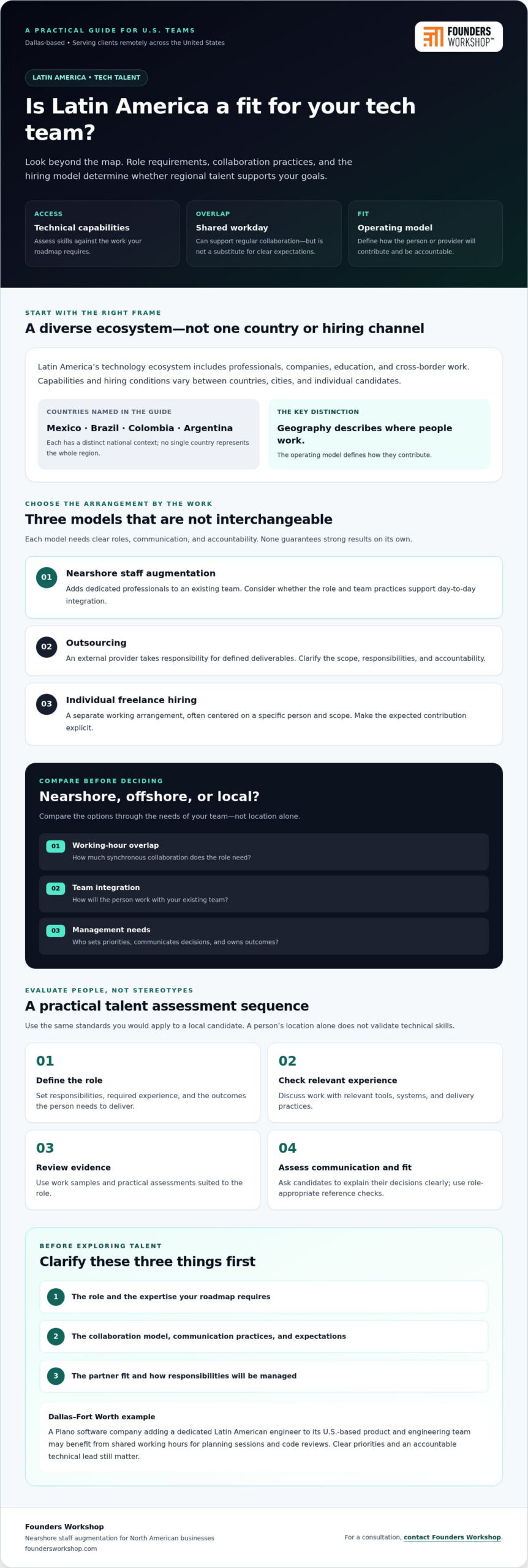
For U.S. businesses, Latin America can be more than a place to search for developers. Its value depends on the professionals available, the way a company builds working relationships, and how well the arrangement supports its goals. A “tech talent hub” is an ecosystem of technology professionals, businesses, education, and cross-border work, not a single country or hiring channel.
That distinction matters. Geography describes where people work; the operating model defines how they contribute. Nearshore staff augmentation can add dedicated professionals to an existing team. Outsourcing may place responsibility for defined deliverables with an external provider. Individual freelance hiring brings a separate working arrangement, often centered on a specific person and scope. These models aren’t interchangeable, and none guarantees strong results without clear roles, communication, and accountability.
What does Latin America as a tech talent hub mean?
Thinking of Latin America as a tech talent hub means looking at a connected but varied ecosystem. Technology professionals work alongside local companies, educational institutions, and businesses engaged in cross-border projects. The region includes established technology activity, such as the research, institutions, and innovation described in Science and technology in Brazil, but no one country represents the whole region.
Capabilities and hiring conditions differ between countries, cities, and individual candidates. A developer’s location alone won’t tell you their experience with your architecture, industry, or delivery practices. Evaluate the person and role directly rather than treating the region as a uniform supply of skills.
Why are U.S. businesses exploring regional talent?
Regional hiring may give a company access to expertise that’s difficult to add locally, while working-hour overlap can make regular collaboration easier to manage. Those advantages depend on the role, the individual’s capabilities, and the team’s practices. Remote professionals can extend an existing team’s capacity, but only when responsibilities, communication, and decision-making are clear.
For example, a Plano software company with a growing product roadmap might consider adding a dedicated Latin American engineer to work alongside its U.S.-based product and engineering team. If the role requires frequent planning sessions and code reviews, shared working hours may help. If the team lacks clear priorities or an accountable technical lead, hiring across borders won’t resolve those issues. The fit comes from the work design, not the map.
Founders Workshop provides nearshore staff augmentation, connecting North American businesses with dedicated Latin American technology talent. For a company in Plano or elsewhere in the Dallas-Fort Worth area, this can be one way to explore adding talent to an existing team. The company should still assess whether the role, collaboration model, and team practices are aligned.
The Skills and Technology Ecosystem Behind Latin American Tech Talent
A useful way to evaluate Latin America as a tech talent hub is to look beyond a list of technologies or country labels. The ecosystem includes technology companies, professional networks, education, and relationships with international clients. These factors shape how skills develop and how professionals gain experience, but they don’t make the region uniform.
Mexico, Brazil, Colombia, and Argentina each have distinct national contexts. For example, the U.S. International Trade Administration’s overview of Mexico’s dynamic IT and telecom markets offers a country-specific view of one part of the broader ecosystem. It’s a starting point for understanding context, not a substitute for evaluating a particular candidate or team.
How to assess technical capability without relying on stereotypes
Geography alone cannot validate an individual’s technical skills. Start with the role’s responsibilities, the experience required, and the outcomes the person needs to deliver. Then use the same standards you’d apply to a local candidate. Ask whether the person has worked with relevant tools, systems, and delivery practices, and whether they can explain their decisions clearly.
Use evidence suited to the role: discuss relevant work, review appropriate work samples, and check references. If you need someone to contribute to a mature product, assess how they work with an existing codebase, communicate technical trade-offs, and coordinate with other disciplines. If you’re building an early product, focus on how they make sound decisions when requirements change. Separate what you can verify about an individual from broad claims about a regional workforce.
What shapes the region’s technology ecosystem?
Technology skills grow through several connected influences: local businesses creating products, professional networks sharing experience, educational institutions developing technical foundations, and cross-border client relationships exposing teams to different workflows. The mix varies by place and over time. A company’s needs matter too: its product maturity, architecture, delivery process, and level of technical leadership all shape which experience will be useful.
That’s why hiring decisions should begin with the work, not a country shortlist. Define the capability gap, identify how the new team member will contribute, and assess candidates against consistent criteria. This gives a team in Plano, Fort Worth, or Irving a practical basis for comparing potential matches without making assumptions about skills based on location.
If you’re considering dedicated Latin American talent, a partner can help connect role requirements with the right team context. Founders Workshop provides nearshore staff augmentation for U.S. businesses. Learn more about discussing nearshore staff augmentation as one option for extending your team.
Nearshore Collaboration: What U.S. Teams Should Evaluate Beyond Location
Choosing Latin America as a tech talent hub is only the first decision. The next is how added expertise will work with your existing team. “Nearshore” describes a regional relationship, not a promise of performance. Working-hour overlap may make real-time collaboration easier, but results still depend on clear ownership, sound communication practices, and a model that fits the work.
How does nearshore work differ from other hiring models?
Local hiring, nearshore collaboration, and offshore arrangements differ in location and potential working-hour overlap, but those factors don’t determine which model is best. Local colleagues may share the same business hours and workplace context. Nearshore team members may have useful overlap with U.S. schedules, depending on their location. Offshore teams may have less overlap, which can affect when the group meets or resolves questions. In every case, integration and management expectations matter. Understanding the timezone advantages of nearshore teams can help Texas businesses assess how overlapping hours affect stand-ups, code reviews, and day-to-day decisions.
Local hiring: Consider how an employee will join your existing organization, collaborate during the workday, and fit your hiring needs.
Nearshore collaboration: Assess regional working-hour overlap, communication practices, and how dedicated talent will integrate with your team.
Offshore collaboration: Clarify how the team will handle limited real-time overlap, handoffs, and decisions that need timely input.
The engagement structure matters, too. Dedicated staff augmentation adds talent to an existing team, while project-based work may organize collaboration around defined deliverables. Neither approach is automatically right for every organization. Choose based on how much direction your team can provide, who owns day-to-day decisions, and whether the work calls for ongoing integration or a more bounded scope.
Which collaboration conditions matter most?
Before bringing in additional talent, agree on how the team will work together. Set expectations for availability and meetings, identify who owns technical and product decisions, and make sure the new contributor can reach the people who can unblock work.
- Documentation: Define where requirements, decisions, and technical context are recorded.
- Delivery practices: Align on code review, testing, releases, and how work is tracked.
- Feedback: Establish regular ways to review progress and address concerns early.
- Escalation: Name the person to contact when a blocker needs a decision.
For a Plano product team, that might mean including a dedicated engineer in planning and code reviews, giving them access to relevant documentation, and assigning a technical lead to clarify priorities. A partner can support coordination, but the team still needs agreed responsibilities and a reliable decision path. Proximity helps only when the operating model makes collaboration practical. The same checks apply to teams in Dallas, Fort Worth, Frisco, and Irving.
How to Evaluate Latin American Tech Talent for Your Organization
Strong hiring decisions start with the work, not a location. If you’re considering Latin America as a tech talent hub, use a consistent process to define the need, assess candidates or partners, and confirm that the working relationship supports business outcomes.
Define the role and engagement before you search
Before reviewing candidates, clarify what success in the role should look like. A Plano company adding capacity to an existing product team may need a dedicated engineer who can contribute to a defined roadmap. A different need, such as delivering a bounded project, may call for a different engagement structure. These distinctions help you assess fit without treating every talent need as a hiring problem.
- Specify the need. Write down responsibilities, required experience, expected outcomes, and reporting relationships. Identify whether you need additional capacity, specialized expertise, or a managed project.
- Set collaboration expectations. Define working-hour availability, communication channels, meeting cadence, and who can make product and technical decisions.
- Assess consistently. Use structured interviews tied to the actual work. Include a practical assessment that reflects relevant responsibilities, and check references using questions suited to the role.
- Plan onboarding and management. Decide how the person will access documentation, join team routines, receive feedback, and raise blockers. Make ownership of delivered work clear.
- Review fit against outcomes. Compare progress with the expectations you agreed on. Consider both the quality of the work and how effectively the working relationship supports the team before expanding the engagement.
Test the working relationship before scaling
Skills matter, but the fit also depends on how someone communicates, responds to feedback, and works within your team’s decision-making structure. Give the person context, identify a clear point of contact, and establish how contributions will be reviewed. A practical assessment can show technical judgment; structured conversations can reveal how the person approaches trade-offs and collaboration.
To compare engagement options, weigh dedicated staff augmentation against project-based work in light of your team’s management capacity and desired ownership. For a business in Plano, Dallas, or another nearby city, a nearshore partner can help assess whether dedicated Latin American talent fits existing practices. Details about nearshore staff augmentation options can help inform that comparison.
A Practical First Step for Exploring Latin America’s Tech Talent
Exploring Latin America as a tech talent hub starts with fit, not a map. Define the role your business needs, decide how the person will work with your team, and assess whether a potential partner’s approach supports your goals. A location may offer useful options, but it can’t replace a clear plan for ownership, communication, and results.
When might nearshore staff augmentation fit?
Nearshore staff augmentation may fit when your existing team needs dedicated talent to contribute to ongoing work. Your company retains its established product priorities and team practices, while the added professionals work alongside your team. That differs from a fully managed software development project, where an external provider takes responsibility for delivering an agreed scope of work. The right model depends on how much direction your team can provide and where you need additional capacity.
Before deciding, identify the responsibilities the new talent would own, who would guide the work, and how progress would be reviewed. A Plano company extending an established product team, for example, may have different needs from a business seeking a partner to develop a separate project. Comparing staff augmentation with project-based work can help clarify which engagement model fits your team.
How can Texas businesses begin a focused conversation?
Bring a specific role or business need to the discussion. Explain what your team is building, the expertise or capacity it needs, how decisions are made, and what successful collaboration would look like. You don’t need every detail finalized. A clear starting point makes it easier to assess whether dedicated Latin American talent and a nearshore model fit your organization.
Founders Workshop provides nearshore staff augmentation, connecting North American businesses with dedicated Latin American technology talent. For businesses in Dallas, Fort Worth, Plano, Frisco, and Irving, a discussion can focus on the role, your team’s working practices, and whether this model aligns with your goals. Geography alone cannot guarantee an outcome.
Contact Founders Workshop to discuss a consultation and explore whether nearshore staff augmentation fits your team.
Build a Nearshore Strategy Around Your Team’s Needs
Latin America as a tech talent hub can offer U.S. businesses access to dedicated expertise and opportunities for close collaboration, but location alone doesn’t determine fit. Start with the role and expected outcomes, then assess how new talent will work within your team’s communication, decision-making, and delivery practices. Choose an engagement model that supports the work rather than treating nearshore hiring as a shortcut.
For teams that need dedicated professionals to contribute to ongoing work, nearshore staff augmentation may be one option to explore. Founders Workshop connects businesses with dedicated Latin American technology talent. Its leadership brings more than 30 years of experience. The goal is to align talent and collaboration with business needs, not simply add capacity for its own sake.
Bring a defined role, a clear business need, and an honest view of your team’s working practices to the next conversation. Contact Founders Workshop to discuss whether nearshore talent fits your team.
Frequently Asked Questions
Why is Latin America considered a tech talent hub?
Latin America is considered a tech talent hub because technology professionals, businesses, educational institutions, and cross-border work form a varied regional ecosystem. It isn’t a single market or a guarantee of particular skills. Countries, cities, and individuals differ, so U.S. employers should assess candidates against the role and business need. For Plano teams, regional working-hour overlap may also make collaboration worth exploring, depending on schedules and team practices.
Which countries in Latin America have technology talent?
Technology professionals work across many Latin American countries, including Mexico, Brazil, Colombia, and Argentina. These are examples, not a ranking, and each country has its own business and technology context. Talent and experience also vary within each country. Rather than selecting a location based on broad assumptions, define the capabilities you need, then evaluate individual candidates or teams through relevant experience, practical discussions, and references.
Is Latin America a good place to hire software developers?
It can be a good option if the available skills, working arrangements, and collaboration model fit your organization. Consider the developer’s experience with your technology, product maturity, and team practices, alongside communication and availability expectations. For a Dallas or Plano business, nearshore hiring may add dedicated expertise to an existing team. It isn’t automatically a better choice than local hiring; evaluate candidates and the engagement against your actual needs.
How does nearshore hiring differ from offshore outsourcing?
Nearshore describes working with talent in a nearby region, often with potential overlap in business hours. Offshore refers to working with talent farther away, where schedules may create different coordination needs. Outsourcing describes an engagement model in which an external provider may take responsibility for defined work. These terms address different factors: location and responsibility. Neither geography nor model alone determines quality, accountability, or results.
Can Latin American technology teams work with U.S. companies in real time?
Yes, real-time collaboration can be possible, but it depends on where team members are located, their working schedules, and the U.S. team’s meeting needs. Confirm availability directly and agree on regular overlap for planning, reviews, and decisions. Also document how the team will handle questions outside shared hours. A Plano company should assess actual schedules rather than assume every Latin American team works the same hours.
What should I look for when choosing a nearshore technology partner?
Look for a partner that can explain how talent is assessed, how professionals integrate with your team, and how communication and ownership are handled. Ask how onboarding, feedback, delivery practices, and escalation work. Check relevant experience and references, and clarify who manages priorities and measures progress. Founders Workshop provides nearshore staff augmentation and has a leadership team with more than 30 years of experience.
Is nearshore staff augmentation the same as outsourcing a software project?
No. Nearshore staff augmentation adds dedicated talent to an existing team, which continues to guide priorities and integrate the work. A software project engagement is generally organized around defined deliverables, with the provider responsible for carrying out an agreed scope. The right approach depends on your team’s capacity to manage day-to-day work and the level of ownership you need. Contact Founders Workshop to discuss whether nearshore talent fits your team.