
A team can share your workday and still leave decisions stuck. The timezone advantages of nearshore teams matter when overlapping hours help people resolve questions, review work, and make decisions together. For founders and executives in Dallas, Fort Worth, Plano, Frisco, and Irving, shared hours can make software collaboration easier to coordinate. But overlap alone does not create clear ownership or reliable delivery.
It’s reasonable to ask whether a nearshore team will be available when your business needs input. Compared with offshore arrangements, Latin American nearshore teams often offer more overlap with a Texas workday, though schedules vary by country and team. Confirm the specific working hours before work begins. Founders Workshop provides nearshore staff augmentation, connecting North American businesses with Latin American technology talent that works in the client’s timezone and language.
This article explains how overlap can affect communication, delivery, and coordination, and which activities, such as stand-ups, code reviews, and quick feedback, benefit most from real-time collaboration. You’ll also learn how to assess timezone fit alongside skills, communication expectations, and delivery practices. The goal is a practical comparison, not the assumption that a convenient clock can replace a strong working process.
Key Takeaways
- Map which decisions and tasks benefit from live discussion, then reserve overlapping hours for those moments.
- The timezone advantages of nearshore teams are most useful when shared availability supports a clear question-to-decision workflow.
- Compare onshore, nearshore, and offshore options by actual team schedules and coordination needs, not by region alone.
- Before selecting a team, document your preferred collaboration windows, response expectations, and which work can happen asynchronously.
- Prioritize overlap when frequent clarification matters, while assessing skills, ownership, and communication practices alongside schedule fit.
What timezone advantages do nearshore teams offer Texas businesses?
Timezone overlap is the part of the workday when people in different locations are available to interact directly. For a Texas product team, that shared window can make it easier to ask a question, compare options, and agree on a next step without waiting for another workday. The timezone advantages of nearshore teams depend on how effectively the team uses that availability, not simply on where its members are located.
Consider a product meeting with a team in Dallas, Fort Worth, or Plano where a feature question comes up before development can proceed. If the relevant people are working at the same time, they can clarify the requirement, decide who owns the follow-up, and record the outcome while the context is fresh. That is a practical collaboration opportunity, not a guarantee of faster delivery or better work.
Nearshore is one form of outsourcing, a broad term for arranging work with an external provider. For foundational context on what outsourcing means, including how nearshoring and offshoring fit into the broader practice, consider both the work arrangement and the schedule. Overlap can support communication, but quality, speed, and accountability still depend on skills, clear ownership, sound processes, and follow-through.
Which software activities benefit most from shared working hours?
Live availability is most useful when a conversation can unblock work or shape a decision. Teams may use overlapping hours for planning, technical clarification, code review discussions, and product feedback. For example, a developer can raise an implementation question during a review, hear the product team’s reasoning, and confirm the agreed change.
Not every task needs a meeting. Focused development, written updates, documented decisions, and review comments can often happen asynchronously. Reserve live discussion for matters that benefit from immediate back-and-forth, and make other work easy to pick up across schedules.
Why does nearshore timing matter to Dallas and Texas teams?
For businesses in Dallas, Fort Worth, Plano, Frisco, and Irving, shared working hours can make routine conversations easier to schedule during the workday. A product lead may be able to clarify a priority directly with a nearshore colleague instead of leaving the question unanswered until a later work period. Founders Workshop provides nearshore staff augmentation, connecting North American businesses with Latin American technology talent.
Actual overlap depends on the team’s location, individual working hours, and agreed schedule. Confirm the availability that matters to your workflows rather than assuming every nearshore team follows the same hours. Set expectations for meeting windows, response times, and written handoffs so shared availability supports a reliable process.
How does timezone overlap improve everyday software collaboration?
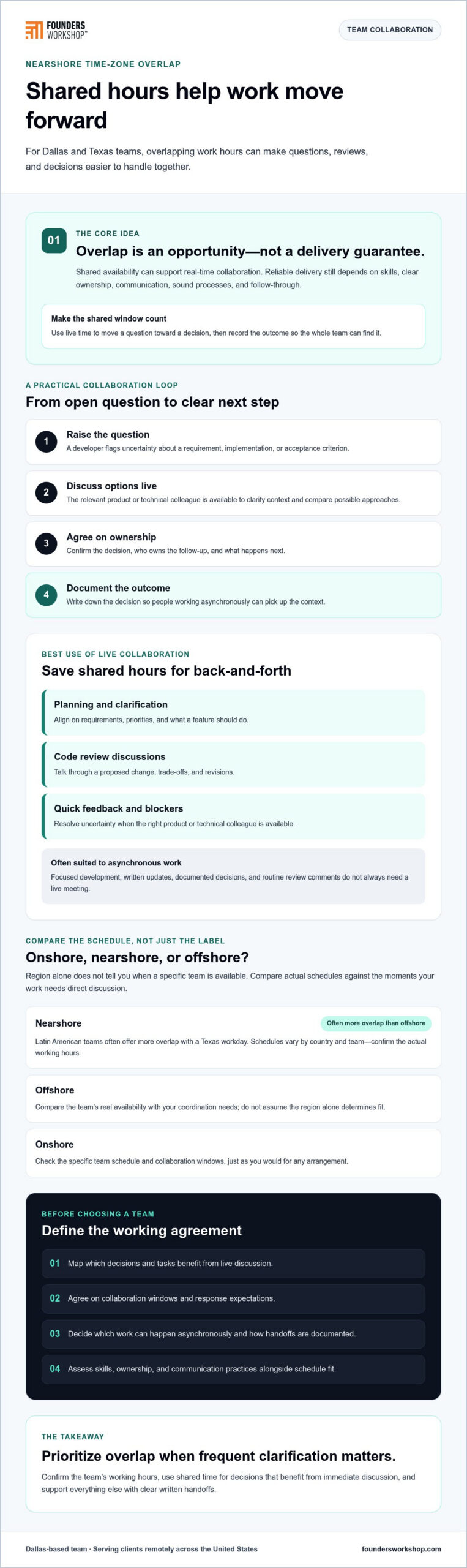
Shared working hours are most valuable when they give a team a dependable chance to move a question toward a decision. A developer might flag uncertainty about an acceptance criterion. The product owner can clarify the intended behavior, the developer can confirm the next step, and the decision can be recorded where the rest of the team will find it. This simple loop helps prevent open questions from turning into hidden assumptions.
Overlap can also support pair work and collaborative code reviews. A developer and reviewer may walk through a proposed change together, discuss trade-offs, and document any revisions. That does not mean every task should happen live. Focused coding and routine progress updates can remain asynchronous, with meetings reserved for work that benefits from immediate discussion. The broader research on time zone impact offers context for considering how schedules shape remote collaboration.
How can overlapping hours support quicker feedback cycles?
If a developer encounters a blocker while the relevant product owner or technical colleague is available, they can explain the issue and discuss possible options. Code review questions and uncertainty about whether work meets acceptance criteria are also good candidates for live clarification. This creates an opportunity to resolve ambiguity in conversation, but it does not promise a particular response or turnaround time.
Agree on response expectations rather than assuming everyone is monitoring messages continuously. Define which channel to use for a blocking issue, who can make the decision, and when a question can wait. This keeps shared availability useful without creating an expectation of constant interruption.
When should a nearshore team use asynchronous communication?
Use written updates when information needs to remain clear beyond the shared work window. A concise note can capture the question, relevant context, decision, owner, and next step. That record lets teammates review the outcome later without relying on memory or repeating the same conversation.
Reserve live discussion for urgent blockers, decisions with meaningful trade-offs, or questions that need back-and-forth. Routine status updates and non-blocking questions can usually be documented for the next work period. Good written context reduces unnecessary meetings and makes handoffs easier, especially when one teammate starts work after another has signed off.
The timezone advantages of nearshore teams become more practical when a team deliberately combines live collaboration with clear written follow-up. Product owners and developers can protect overlapping time for decisions, while asynchronous habits keep work moving between conversations. For a closer look at this staffing model, see the nearshore staff augmentation guide.
Nearshore vs. offshore vs. onshore: how does timezone fit compare?
For a Texas business, the practical difference between onshore, nearshore, and offshore collaboration is how easily team schedules support direct interaction. Onshore teams work within the United States, but a provider’s location, working hours, and meeting norms can still differ from yours. Nearshore teams are based in nearby countries, often in Latin America for U.S. businesses, where schedules may overlap with a Texas workday. Offshore teams are based farther away, which can make shared working hours less likely and require more deliberate handoffs.
These are broad patterns, not guarantees. Latin American countries do not all follow the same schedule, and neither do offshore locations. Even U.S.-based colleagues may work different hours or follow different organizational routines. Confirm the actual team’s location and agreed availability before treating a model as a fit. For a broader look at potential talent markets, see this Latin America tech talent guide.
- Onshore: Domestic location can make real-time collaboration easier to arrange, though team schedules and regional differences still matter.
- Nearshore: Schedule proximity may create more opportunities for live discussion with a U.S. team, depending on location and agreed hours.
- Offshore: A larger time difference may mean fewer convenient live meetings, making documented decisions and planned handoffs especially important.
What does nearshore overlap make easier, and what doesn’t it guarantee?
When schedules align, nearshore teams may be able to join a product discussion, clarify a technical question, or review an issue while the relevant stakeholders are available. That access is the core of the timezone advantages of nearshore teams. It does not establish whether a team has the right technical expertise, clear ownership, or sound delivery practices. Shared hours can support coordination, but they cannot replace those fundamentals or promise better quality, speed, or accountability.
How should leaders weigh timezone against other team-fit criteria?
Start with the work. If decisions regularly depend on live input from product owners, engineers, or other stakeholders, schedule compatibility deserves close attention. If tasks are well-defined and can progress through written handoffs, overlap may be less central. Evaluate it alongside skills, communication, continuity, and the level of management your team needs.
A business in Dallas, Fort Worth, Plano, Frisco, or Irving comparing staffing options should consider how each arrangement fits its workflows, not select a model on location alone. The Dallas-area staff augmentation comparison can help frame that broader evaluation. The strongest fit supports the work’s real collaboration needs and has clear practices for both shared and separate hours.
How can you assess timezone fit before choosing a nearshore team?
Do not evaluate overlap only by asking whether a team works in a similar timezone. Map the moments when your Texas-based team needs direct input, then confirm that the proposed team’s actual schedule supports them. This makes timezone fit a practical staffing question: can the right people meet when decisions and dependencies require it?
What should you ask about a nearshore team’s working hours?
Ask for the proposed team’s routine working hours in relation to your Texas workday. Confirm which hours are available for planning, reviews, and time-sensitive questions, and how the team will communicate schedule changes or daylight-saving differences. Avoid relying on a regional label or an assumed standard schedule. Get the working arrangement in clear terms before setting recurring meetings or response expectations.
How can you test whether overlap matches your workflow?
Use this evaluation sequence to compare the schedule with the way your team actually works:
- 1. Map the workflow. Identify recurring decisions, approvals, reviews, and dependencies that involve both your team and the nearshore team.
- 2. Sort by communication need. Ask which conversations need live discussion and which updates or decisions can be handled asynchronously with written context.
- 3. Compare availability. Place the required participants’ working hours beside your team’s Texas schedule. Check whether the overlap works for the tasks that matter, not just for a convenient meeting.
- 4. Walk through a sample week. Look for handoffs, likely blockers, and meeting pressure. If key decisions repeatedly fall outside shared hours, consider whether the workflow can change or whether the schedule is a poor fit.
- 5. Agree on operating expectations. Confirm meeting windows, response expectations, written updates, escalation routes, and how schedule changes will be shared.
A useful test is to trace one realistic dependency from start to finish. If a developer needs product clarification before continuing, who can answer, when are they available, and where will the decision be documented? This exposes gaps that a general promise of timezone alignment may not reveal.
The timezone advantages of nearshore teams are easiest to assess against real collaboration needs, rather than assumed hours. Founders Workshop provides nearshore staff augmentation, connecting North American businesses with Latin American technology talent. If you’re weighing schedule fit alongside your team’s needs, contact Founders Workshop for a consultation.
When are timezone advantages of nearshore teams worth prioritizing?
Schedule alignment deserves more weight when a team’s work depends on recurring decisions, stakeholder input, or shared dependencies during the business day. For a Texas company refining a product, developers may need regular input from product owners on priorities or acceptance criteria. If that input is difficult to arrange, overlapping hours may make coordination easier to plan. The value depends on the actual workflow, not simply on choosing a nearby location.
When should timezone be a high-priority selection criterion?
Prioritize overlap when work regularly calls for direct coordination across business and technical roles. This may include product reviews, decisions that affect connected work, or questions that are difficult to resolve through written notes alone. A team in Dallas with frequent stakeholder reviews may value a dependable shared meeting window; a company in another Texas city with clearly defined tasks may need less live coordination. Assess how often delayed discussion would disrupt a real dependency.
When can a team succeed with less real-time overlap?
Less shared availability can still suit work that is clearly scoped and supported by strong written handoffs. Teammates need to know who owns each task, where decisions are recorded, and what response time to expect for questions that are not urgent. Asynchronous work is not hands-off work. It requires deliberate documentation and agreed ways to flag blockers so people can act when they are available.
Before making timezone a deciding factor, weigh it alongside:
- Skills: Does the team have capabilities that match the work?
- Ownership: Are responsibilities and decision-makers clear?
- Communication: Can the team share useful context in writing and raise issues appropriately?
- Continuity: Can the collaboration model support the ongoing needs of the work?
- Schedule fit: Are the agreed shared hours available for the conversations your workflow actually requires?
The timezone advantages of nearshore teams are worth prioritizing when regular direct discussion is central to the work. If tasks can move through clear documentation and planned handoffs, other fit criteria may matter more. In either case, timezone is one part of evaluating a provider, not a standalone reason to select one. Confirm the actual schedule and assess it alongside expertise, accountability, and communication practices.
Contact Founders Workshop to discuss your team needs and schedule a consultation.
Choose a Team Schedule That Supports the Work
The timezone advantages of nearshore teams matter most when shared working hours give your people a practical way to resolve questions, coordinate decisions, and review work together. Before choosing a provider, confirm the team’s actual schedule and identify which conversations need to happen live. Clear ownership and reliable written handoffs still matter, especially for tasks that can move forward asynchronously.
Timezone fit is one part of a broader decision. Skills, communication, continuity, and delivery practices should also align with your needs. For Texas businesses in Dallas, Fort Worth, Plano, Frisco, and Irving considering nearshore staff augmentation, Founders Workshop connects North American companies with Latin American technology talent. Its leadership team brings over 30 years of experience.
With the right expectations in place, schedule alignment can support collaboration without becoming a substitute for a sound working process. Contact Founders Workshop for a consultation to discuss your team’s needs and whether nearshore staff augmentation fits the work.
Frequently Asked Questions
What are the timezone advantages of nearshore teams?
The main timezone advantages of nearshore teams are more opportunities for direct collaboration during shared working hours. Teams may be able to discuss technical questions, review work, and clarify product decisions without relying only on messages or waiting for another workday. The practical benefit depends on the team’s actual schedule and how it uses overlapping time. Shared hours support coordination, but do not guarantee quality, speed, or accountability.
Do nearshore teams work in the same timezone as Texas?
Some nearshore teams may work hours that align closely with Texas, but you should not assume every team is in the same timezone or keeps the same schedule. Working hours depend on the team’s location and agreed arrangements, and daylight-saving changes can affect alignment. Before making plans, confirm the proposed team’s routine availability against your Texas workday, including the meeting windows you need for planning, reviews, and urgent questions.
Is nearshore better than offshore for software development?
Nearshore is not automatically better than offshore for every software project. It may suit teams that rely on regular live conversations, while a model with less shared availability may still work if tasks, ownership, and handoffs are clearly documented. Compare options based on technical skills, communication practices, schedule fit, and the work’s need for real-time coordination. Choose the arrangement that fits your delivery needs rather than assuming location alone determines results.
How does timezone overlap help software development teams?
Timezone overlap gives developers and stakeholders a chance to discuss questions while the relevant people are available. For example, a developer can raise an unclear requirement, talk it through with a product owner, and record the decision for the team. Shared hours can also support pair work or a code review discussion. Routine updates and focused tasks can still happen asynchronously, so overlap does not mean every activity needs a meeting.
Can nearshore teams work with Dallas-based companies?
Yes. Nearshore teams can work with companies in Dallas, Fort Worth, Plano, Frisco, and Irving when their schedules and collaboration practices fit the client’s needs. Founders Workshop provides nearshore staff augmentation, connecting North American businesses with Latin American technology talent. Businesses should confirm a proposed team’s actual availability rather than assume location guarantees a specific overlap.
What should I ask a nearshore team about timezone overlap?
Ask which working hours the proposed team routinely shares with your Texas-based team, and whether those hours suit planning, reviews, and time-sensitive questions. Clarify response expectations, escalation routes, how schedule changes or daylight-saving differences are communicated, and what information should be documented for asynchronous handoffs. Then test the arrangement against a typical workweek. Contact Founders Workshop to discuss your team needs.