
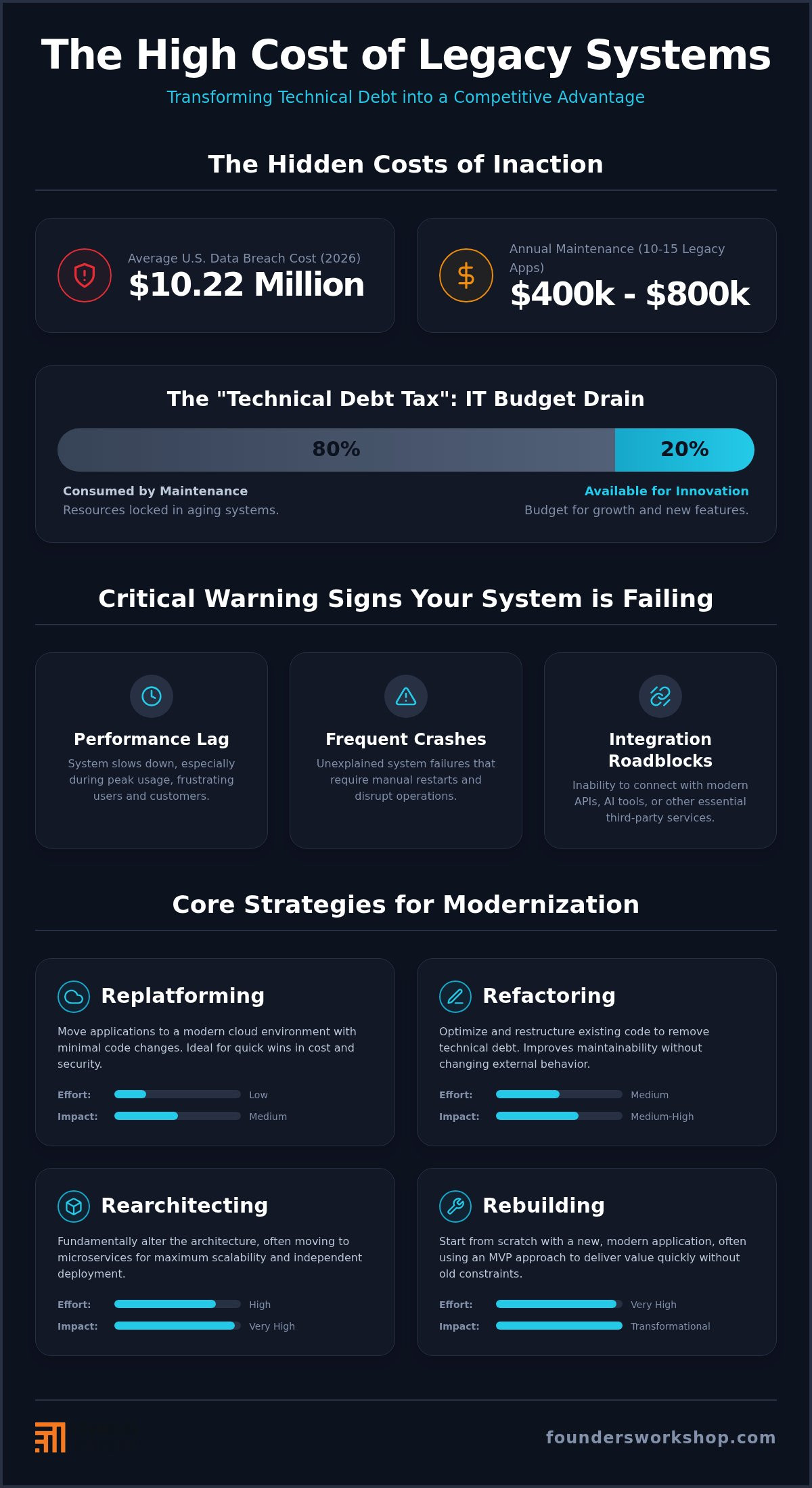
With the average cost of a U.S. data breach reaching a record $10.22 million in 2026, your aging codebase is no longer just a technical burden; it’s a significant strategic liability. You’ve likely felt the friction of high maintenance costs, which can range from $400,000 to $800,000 annually for enterprises managing just 10 to 15 legacy applications. It is frustrating to watch your feature release cycles lag behind competitors while your team struggles to find developers who still speak the languages of the past. You know that your current path isn’t sustainable if you want to scale.
This guide demonstrates how professional legacy application modernization services can transform that technical debt into a distinct competitive advantage. We’ll show you how to move beyond simple patches to achieve a scalable, cloud-native architecture that supports modern AI and advanced analytics. You’ll learn a practical framework for selecting a technical partner who prioritizes your business outcomes over just writing code. By the end, you’ll have a clear roadmap to reduce operational friction and reclaim the agility your organization needs to lead the market.
Key Takeaways
- Learn why aging systems act as a “Technical Debt Tax” that consumes up to 80% of IT budgets, and how to reclaim those resources for strategic innovation.
- Identify the most effective modernization strategies, such as replatforming or refactoring, to balance immediate cost savings with long-term scalability.
- Discover how to evaluate legacy application modernization services to find a partner who prioritizes your business outcomes over simple code delivery.
- Follow a disciplined execution roadmap that uses deep audits and MVP definitions to minimize operational risk during the transition.
- Understand how to leverage nearshore expertise to maintain existing systems while simultaneously building the modern, AI-ready foundations your business requires.
The Hidden Cost of Inaction: Why Legacy Systems Stifle Growth in 2026
Legacy application modernization is far more than a technical patch; it is the strategic transformation of aging software into a growth-ready digital foundation. Many executives view their older systems as stable assets that have served the company for decades. However, by 2026, the gap between legacy capabilities and market demands has become a chasm. What once felt like a reliable workhorse has likely become an anchor, preventing your organization from pivoting as quickly as the market requires.
The “Technical Debt Tax” is now a measurable drain on corporate capital. Industry data suggests that maintenance costs can consume up to 80% of IT budgets, leaving a mere 20% for genuine innovation. For an enterprise managing 10 to 15 legacy applications, direct annual maintenance costs often sit between $400,000 and $800,000. These figures represent the visible portion of the problem. They don’t account for the “soft” costs of lost productivity or the high price of specialized developers needed to maintain outdated codebases. When you invest in legacy application modernization services, you aren’t just fixing bugs; you’re stopping a massive capital leak that hinders your strategic vision.
Beyond the balance sheet, there’s the staggering opportunity cost of missed innovation. Modern AI models and advanced analytics require clean, accessible data pipelines that legacy architectures simply cannot provide. If your core business logic is trapped in a monolithic system, you’re effectively locked out of the AI revolution. Security presents an even more urgent threat. Outdated architectures are the primary target for modern cyber threats. With the average cost of a data breach in the U.S. hitting a record $10.22 million in 2026, the risk of maintaining unpatched, aging systems has moved from a technical concern to a boardroom crisis.
The ROI of Modernization vs. The Cost of Maintenance
The financial argument for staying on-premise is crumbling. Cloud-native systems offer long-term savings that far outweigh the rising costs of maintaining aging, proprietary hardware. Beyond infrastructure, consider your human capital. Modernization significantly improves developer retention; top-tier talent won’t stay to manage “dead” technology stacks when they could be building on modern frameworks. Understanding the core strategies for legacy modernization is essential for any leader looking to bridge the gap between historic business logic and future scalability.
Identifying the ‘Breaking Point’ in Your Software
Your software will often signal its failure long before a total system collapse occurs. Look for these critical warning signs:
- Performance lag that worsens during peak usage periods.
- Frequent, unexplained system crashes that require manual intervention.
- Integration roadblocks when trying to connect with modern third-party APIs or internal AI tools.
These legacy bottlenecks do more than frustrate your IT team; they prevent you from meeting 2026 customer expectations for speed and accessibility. If your software can’t keep up with the pace of your customers, it’s already failing your business.
5 Core Strategies for Legacy Application Modernization
Selecting the right path for legacy application modernization services is a strategic decision that dictates your ROI for years. It isn’t just about the technology; it’s about which method supports your specific growth targets. Every modernization journey is unique. Some systems require a complete overhaul, while others only need a modern interface to remain viable.
- Replatforming: This involves moving applications to the cloud with minimal code changes. It’s often the fastest way to achieve immediate cost wins and improve security without a long development cycle.
- Refactoring: Here, we optimize existing code to remove technical debt. The external behavior stays the same, but the internal structure becomes more efficient and maintainable.
- Rearchitecting: This is a deeper shift toward microservices. It allows for maximum scalability and lets your team deploy features independently without risking the entire system.
- Rebuilding (The MVP Approach): Sometimes the old system is too far gone. Scrapping it and building a modern replacement from the ground up ensures you aren’t carrying over old mistakes. Starting with a scalable MVP development strategy allows for faster market entry.
- Encapsulation: This strategy uses APIs to extend the life of legacy systems. By connecting them to modern front-ends, you can improve user experience while keeping the core logic intact for a period.
Choosing the Right ‘R’ for Your Business Objective
Executives often fall into the “Lift and Shift” trap, thinking a simple move to the cloud solves everything. It doesn’t. True transformation requires matching your strategy to outcomes like speed to market or operational cost reduction. Understanding the business case for modernizing helps you avoid expensive missteps. If you need to bridge the gap between old and new systems, our system integration services can provide a stable transition layer that maintains business continuity.
The Role of AI in Modernization Strategies
AI has fundamentally changed the speed and cost of legacy application modernization services. In 2026, AI-assisted tooling has reduced the cost of complex projects, such as COBOL modernization, by 21% in just a single year. We use custom AI development to automate the migration of legacy data, ensuring accuracy while saving hundreds of manual hours. Predictive analytics also help us identify which system components are most likely to fail or cause bottlenecks. This allows us to prioritize modernization where it delivers the highest impact on your P&L.
Evaluating Legacy Application Modernization Services: A Buyer’s Checklist
Selecting the right partner for legacy application modernization services is a high-stakes decision that requires vetting for strategic vision, not just technical depth. You need an agency that understands your P&L as well as your database. If a provider focuses exclusively on syntax and servers without discussing your business goals, they’ll likely deliver a product that’s technically sound but strategically useless. You’re looking for a partner who prioritizes alignment and long-term sustainability.
Experience with modern stacks is a non-negotiable requirement. The goal is to escape the cycle of technical debt, not to move from one outdated language to another slightly newer one. This transition must be paired with human-centered design. User experience is frequently the most overlooked component of modernization projects. If your employees or customers find the new system difficult to use, the expected ROI will vanish under the weight of lost productivity and frustration.
Why Timezone Alignment and Culture Match Matter
Communication gaps in offshore models often lead to hidden costs that erase any initial savings. When evaluating legacy application modernization services, consider the velocity that comes with true timezone alignment. Latin American tech talent offers a perfect balance for North American companies. You get high-level English proficiency and cultural alignment, meaning your developers work as an extension of your team rather than a distant, disconnected silo. When comparing Nearshore vs Offshore, the ability to collaborate in real-time is usually the deciding factor for project success and speed.
Questions to Ask a Potential Modernization Partner
Before signing a contract, dig into the practicalities of their execution model. Ask specifically about their process for maintaining data integrity during the migration. Inquire how they manage “feature parity” to ensure the new system actually supports the essential workflows of the old one. The ideal partner acts as a seasoned executive guide who has navigated these technical eras before and understands that tools are secondary to business outcomes. If you are also evaluating how to validate your rebuilt product with real users before full investment, understanding the strategic framework for outsourcing MVP development can help you structure a disciplined, low-risk launch approach. Ensure they can answer the following:
- How do you map complex dependencies before writing the first line of code?
- What is your specific strategy for minimizing system downtime during the transition?
- Can you demonstrate how this new architecture will specifically support our future AI strategy?
A partner who can’t answer these with concrete examples hasn’t spent enough time in the trenches to lead your transformation.
Managing Risk: The Modernization Execution Roadmap
Managing risk during a technical overhaul requires more than just skilled developers; it demands a disciplined roadmap that anticipates friction before it occurs. Many executives fear the “Big Bang” approach where a new system is switched on overnight. This fear is justified. A structured execution plan for legacy application modernization services ensures that your business stays operational while you build for the future. Our methodology focuses on removing technical friction through a steady, predictable process.
- Step 1: Discovery and Audit. We begin by mapping the existing architecture and identifying every critical dependency. This phase is non-negotiable. Verified data indicates that the migration line item alone can account for 15 to 20 percent of the total program cost. Understanding these complexities early prevents expensive surprises later.
- Step 2: Strategy and MVP Definition. We prioritize the features that deliver the most immediate business value. By defining a Minimum Viable Product that balances technical excellence with scalable architecture, we ensure you see ROI faster and gather real-world feedback before the entire system is rebuilt.
- Step 3: Iterative Execution. We use Agile methodologies to modernize in stages. This iterative approach reduces the risk of a single point of failure. It allows us to pivot based on technical discoveries without scrapping months of progress.
- Step 4: Testing and Validation. Testing must ensure zero data loss. In highly regulated sectors like healthcare or finance, compliance recertification can add 8 to 15 percent to development costs. We build these requirements into our validation phase to ensure a smooth transition.
- Step 5: Deployment and Support. We decommission the legacy system only after the new architecture has proven its reliability in a live environment. This ensures a seamless transition for your users and your data.
Phased Modernization: Avoiding the ‘Big Bang’ Trap
Incremental updates are safer and more cost-effective than replacing everything at once. This strategy allows you to maintain the legacy system while building its successor in parallel. By modernizing in phases, you create a safety net that protects your core operations. This approach also allows your team to adapt to the new system gradually, reducing the internal friction often associated with major technical shifts.
Ensuring Business Continuity During Migration
We use “dark launches” and feature flags to test new components with real users without affecting your entire customer base. Understanding how Engineering teams feature flags benefits the overall release cycle is key to a low-risk deployment. These tools allow us to toggle features on or off instantly, providing an extra layer of control during the rollout. If you are ready to build a roadmap that protects your operations while driving growth, the team at Founders Workshop can help you navigate the transition with seasoned expertise.
Founders Workshop: Human-Centered Modernization for Business Growth
At Founders Workshop, we recognize that legacy application modernization services are about more than just refactoring old code; they’re about aligning technical execution with your strategic business goals. With over 30 years of leadership experience, we’ve navigated multiple technical eras. We understand that tools are secondary to the outcomes they produce. This seasoned perspective allows us to act as a steady hand, helping you bridge the gap between where your technology is today and where your business needs to be tomorrow.
We move beyond the code to prioritize human-centered solutions. A system is only effective if your employees and customers actually use it. By focusing on the user experience and the specific pain points of your organization, we ensure that your modernized application becomes a catalyst for productivity rather than a source of frustration. We don’t just build software; we build a technical foundation designed to support your next decade of growth.
From Legacy to AI-Ready: Our Unique Approach
Successful modernization is the prerequisite for implementing an effective AI strategy. Once your data is liberated from siloed legacy systems, we help you implement custom AI and predictive analytics that provide a true competitive edge. We’ve helped numerous organizations transform their internal software from a maintenance burden into a scalable, modern asset that drives measurable ROI. By treating modernization as a strategic pivot, we help you turn technical debt into an engine for innovation.
Get Started on Your Modernization Journey
We believe in transparency and strategic alignment from day one. Our fixed-fee discovery process is designed to map out your specific modernization roadmap, identifying risks and opportunities without hidden costs. This process provides you with a clear, actionable plan before you commit to full-scale development. If you’re ready to stop paying the “Technical Debt Tax” and start building for the future, schedule a consultation with our veteran founders today.
Reclaiming Your Strategic Agility
The Technical Debt Tax is an optional burden. The path to reclaiming your IT budget and developer velocity starts with a clear-eyed assessment of your current architecture. By choosing a strategy that aligns with your specific business outcomes, you can transform an aging liability into a scalable, AI-ready asset. Professional legacy application modernization services are no longer just about updating code; they’re about securing your organization’s place in the 2026 digital economy.
Founders Workshop provides the seasoned guidance you need to navigate this transition. We back our work with 30+ years of executive leadership and deep specialization in complex sectors like healthcare tech and AI development. Our high-quality nearshore talent from Latin America ensures you have the communication speed and technical depth to succeed without the friction of offshore communication gaps. It’s time to stop managing the limitations of the past and start driving the growth of the future.
Frequently Asked Questions
What are legacy application modernization services?
These services are strategic technical initiatives that transform aging software into modern, growth-ready digital foundations. This process involves updating the architecture, migrating to cloud-native environments, and ensuring the system can integrate with modern tools. It is a way to preserve your core business logic while removing the technical debt that hinders your current agility.
How much does it cost to modernize a legacy application?
Modernization costs vary widely depending on the industry and system complexity. For instance, core banking system updates often range from $12 million to $50 million, while healthcare EMR modernization typically falls between $8 million and $35 million. These figures reflect the scale of enterprise transformations, though smaller internal applications will require a more modest investment based on their specific refactoring needs.
Given these substantial investments, financial institutions often engage fintech regulatory compliance consulting to ensure that their modernized systems remain compliant with evolving regulations, thereby protecting their capital from potential legal and operational risks.
How long does a typical modernization project take?
Most modernization projects span 12 to 36 months, though the timeline depends heavily on whether you choose to replatform or completely rebuild. Large enterprise programs, particularly in the public sector, often budget for a three to five year roadmap. We advocate for a phased execution model that delivers measurable business value at every milestone rather than waiting for a single final delivery.
Can we modernize our software without downtime?
Yes, it’s possible to maintain 100% business continuity by using parallel environments and blue-green deployment strategies. By building the new architecture alongside your existing system, we can transition users in small, controlled groups. This approach allows for immediate rollbacks if issues occur, ensuring your operations remain stable throughout the entire legacy application modernization services engagement.
What is the difference between rehosting and refactoring?
Rehosting is often called a “lift and shift” because it moves your application to the cloud with minimal changes to the underlying code. Refactoring is a more intensive process where we optimize the internal code structure to remove technical debt without changing the external behavior. While rehosting is faster, refactoring is necessary if you want to achieve long-term scalability and lower maintenance costs.
Why is nearshore development better for modernization than offshore?
Nearshore development provides real-time collaboration because the teams operate in your timezone. Communication gaps in offshore models often lead to delays and technical misunderstandings that can derail a complex modernization project. By utilizing Latin American talent, you get high-level English proficiency and cultural alignment, making the developers a true extension of your internal team.
How do I know if my company needs modernization or a total rebuild?
A total rebuild is usually necessary if your current technology stack is completely obsolete or if finding developers for your outdated language is impossible. Modernization is the better choice if your core business logic is still valuable but needs to be accessible through modern APIs or cloud features. A discovery audit will help you determine which path offers the best ROI for your P&L.
Does modernization help with AI integration?
Modernization is often the prerequisite for a successful AI strategy. Legacy systems typically store data in siloed, inaccessible formats that modern AI models can’t use effectively. By transitioning to a cloud-native architecture through legacy application modernization services, you create the clean data pipelines required for implementing predictive analytics and other custom AI solutions that drive growth.