
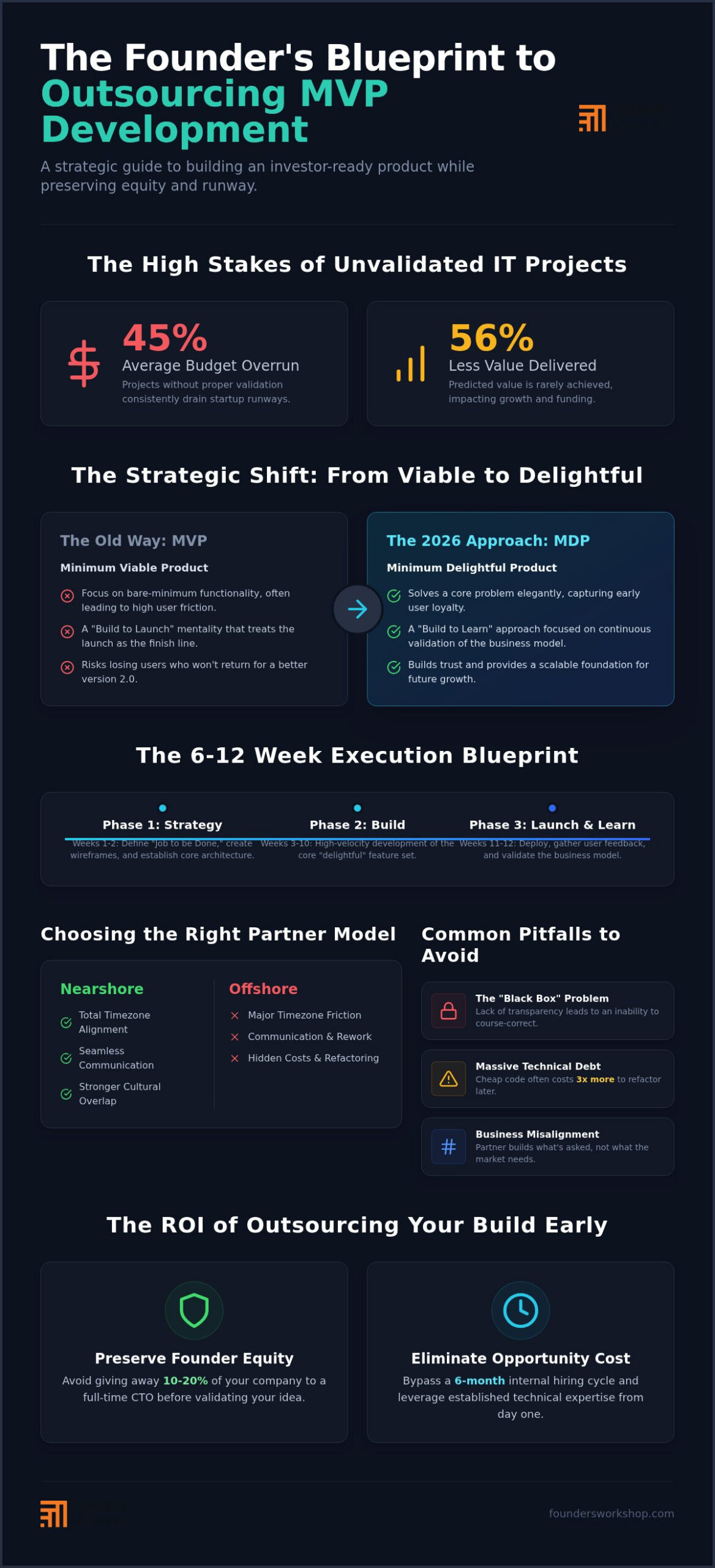
IT projects without proper validation run an average of 45% over budget and deliver 56% less value than predicted. For a startup founder, these aren’t just statistics; they’re the difference between a successful seed round and a closed business. When you begin outsourcing mvp development, you aren’t just looking for someone to write code. You’re looking for a way to bridge the gap between a bold vision and a functional product without draining your runway on unnecessary features. It’s natural to feel anxious about communication gaps with distant teams or the complexity of choosing between fixed-fee and time-and-materials contracts.
We’ve navigated these technical hurdles for decades and know that peace of mind comes from strategic alignment, not just activity. This article provides a roadmap to help you discipline your product vision and select a technical partner that prioritizes your business outcomes. You’ll learn how to execute a high-velocity build that validates your model in 6 to 12 weeks. We will explore how to avoid over-engineering and use a nearshore model to maintain total timezone alignment, ensuring your first version is both functional and investor-ready.
Key Takeaways
- Shift your mindset from building a basic prototype to creating a “Minimum Delightful Product” that captures early user loyalty and validates your business model.
- Master the “Jobs to be Done” framework to strip away non-essential features and focus your development budget on the core workflows that drive value.
- Discover why outsourcing mvp development to a nearshore partner eliminates the communication friction and hidden costs often found in offshore models.
- Implement a disciplined 6-week execution blueprint that moves your concept from a technical architecture to a functional launch without the risk of scope creep.
- Establish a path for technical sustainability by transitioning from a project-based build to nearshore staff augmentation as your user base and feature needs scale.
What is Outsourcing MVP Development? The 2026 Strategic Definition
In the current tech climate, outsourcing mvp development is no longer a simple tactical decision to save on labor costs. It’s a strategic partnership designed to build a high-value version of your software with a disciplined, feature-limited scope. While older definitions of a Minimum Viable Product (MVP) focused on the bare minimum functionality, 2026 founders recognize that “viable” is a low bar. Today, the goal is to create a “Minimum Delightful Product.” Users have zero tolerance for friction; if your initial version doesn’t solve a problem elegantly, they won’t return for version 2.0.
This shift requires moving from a “Build to Launch” mentality to a “Build to Learn” approach. A launch is a single event, but learning is a continuous process that validates your business model. To succeed, your outsourced build must rest on three pillars. First is Strategy: identifying the core problem you’re solving. Second is Design: creating a human-centered experience that builds trust. Third is Engineering: developing a scalable foundation that won’t crumble under the weight of your first thousand users.
The ROI of Outsourcing Your Build Early
Choosing to outsource early preserves your most valuable asset: founder equity. Hiring a full-time CTO in the pre-seed stage often requires giving away 10% to 20% of your company before you’ve even validated the idea. By partnering with an agency, you delay that heavy equity commitment. You also eliminate the “Opportunity Cost” of a six-month internal hiring cycle. Instead of vetting resumes, you leverage established technical architecture from day one. This allows you to focus on sales and fundraising while a seasoned team handles the technical execution.
Common Pitfalls in the Outsourcing Model
The Founder’s Roadmap: How to Plan Your MVP for Outsourcing
Success in outsourcing mvp development isn’t found in the lines of code; it’s found in the clarity of the pre-development plan. A vague vision leads to a bloated budget. To avoid this, you need a roadmap that translates business goals into technical requirements. This process begins by stripping away the “nice-to-haves” and focusing on the core utility that solves a specific user pain point. Planning is discipline, and for a founder, it’s the primary tool for risk mitigation.
Phase one is defining your “Job to be Done” (JTBD). Instead of listing features, describe the progress a user wants to make. If you’re building a healthcare app, the “job” isn’t “a calendar feature”; it’s “reducing the time it takes to book a specialist.” When you isolate the core job, you isolate the core feature set. This clarity ensures your technical partner builds for outcomes rather than just checking off a list of requirements.
This philosophy of focusing on a single, high-value outcome is universal; for example, FrostWave succeeds by mastering the specific “job” of personal climate control, proving that a well-defined core purpose is the key to any successful product.
Visual Blueprints and Wireframing
Once you’ve defined the “job,” you must create a visual blueprint. Wireframes are the most critical document in your contract because they provide a shared language between you and the engineering team. Using low-fidelity mockups allows you to validate user flows and identify friction points before writing a single line of code. For a deeper look at this process, see our guide on What is a Wireframe? The Founder’s Guide to Software Blueprints. Validating the user journey early saves thousands in development hours.
Phase three involves selecting a partner based on strategic alignment. Price is a poor proxy for value, especially when a cheap build leads to a total rewrite. You need a partner who understands your industry and can challenge your assumptions. This strategic approach to outsourcing ensures that the technical team acts as an extension of your leadership. Finally, establish a 6 to 12 week execution timeline. This window is long enough to build a production-ready product but short enough to maintain high velocity and focus.
Feature Prioritization with the MoSCoW Method
To stay within that 12-week window, use the MoSCoW method to categorize features: Must-have, Should-have, Could-have, and Won’t-have. Must-haves are non-negotiable for the “Job to be Done.” Everything else is a candidate for version 2.0. This framework is your best defense against feature creep, which is the leading cause of budget overruns. Focus your resources on the “Early Evangelist” user. If they can’t find value in your core feature, adding more functionality won’t save the product. If you need help refining your roadmap, the team at Founders Workshop can guide you through this prioritization process.
Choosing the Right Model: Nearshore vs. Offshore Outsourcing
Choosing between offshore and nearshore models is often where founders make their most expensive mistakes. While offshore rates in South Asia or Eastern Europe might seem attractive on a spreadsheet, they often hide systemic costs. When you’re outsourcing mvp development, the “sticker price” is only one variable in a complex equation. You must also account for the cost of communication lag, cultural misalignment, and the heavy overhead of managing a team that sleeps while you work. If a critical bug is found at 9:00 AM during your business hours, an offshore team might not see it for another twelve hours. That’s a full day of development velocity lost to the clock.
Nearshore development, particularly in Latin America, has become the strategic gold standard for US-based startups. It offers 100% timezone alignment, which allows for nearshore staff augmentation that feels like an extension of your internal team. You can jump on a quick call to resolve a technical blocker or iterate on a design in real-time. This proximity eliminates the “Black Box” problem by making the development process transparent and collaborative. Evaluating the pros and cons of outsourcing requires looking past the hourly rate to the total cost of engagement. A team that understands your business culture and works your hours will always outpace a cheaper, disconnected alternative.
The Timezone Advantage for MVP Velocity
Real-time feedback loops are the lifeblood of the high-stakes MVP phase. When your engineering team is in your timezone, you can run daily stand-ups that actually include the founder and key stakeholders. This alignment reduces technical friction and significantly speeds up the QA cycle. Nearshore development acts as a strategic multiplier for engineering teams by enabling synchronous collaboration. You don’t have to wait overnight for an answer to a simple architecture question. This velocity is exactly what allows a product to move from blueprint to launch in the 6 to 12 week window we prioritize.
Integrating AI Strategy into Your MVP
In 2026, a product isn’t just software; it’s a data engine. Every startup needs a clear AI strategy, whether that involves predictive analytics or sophisticated LLM integration. Your technical partner must understand how to build “AI-ready” data architectures from day one. It isn’t enough to just “add AI” later. The underlying data structures must be designed to support machine learning models to be sustainable. We focus on business efficiency and ROI rather than chasing technical novelty for its own sake. Avoid building “AI for the sake of AI.” Instead, ensure your outsourced team has the expertise to integrate intelligence that actually improves your user’s “Job to be Done.”
The 6-Week Execution Blueprint: From Blueprint to Launch
A blueprint is only as effective as the discipline behind its execution. When outsourcing mvp development, the primary risk isn’t just technical failure; it’s the loss of momentum. A compressed, 6-week timeline forces you to make hard decisions about what truly matters to your users. This high-velocity approach prevents the project from drifting into a state of perpetual development. By the end of this period, you should have a functional product that validates your core business hypothesis in the real world.
The first two weeks focus on Discovery and Technical Architecture. This phase involves finalizing the scope and establishing your cloud environment. You’re building the “bones” of the application. Weeks three and four move into Core Feature Development. Here, the team builds the high-leverage workflows that solve the “Job to be Done” identified in your roadmap. Week five is dedicated to QA and Beta Testing. We identify and resolve critical bugs before a single public user sees the interface. Finally, week six is the Launch. The goal is to get the product into the hands of your first 50 users to begin the feedback loop. For a deeper look at this process, read our guide on Bespoke MVP Development: A Guide for Modern Founders.
Managing the Development Cycle
The success of an outsourced build depends heavily on the role of the Product Manager. This individual acts as the bridge between your business vision and the engineering team’s output. You should participate in weekly “Sprint Reviews” to ensure the build remains aligned with your expectations. These meetings are not status updates; they are strategic sessions to review functional code. We also recommend using feature flags. This technical safeguard allows you to manage beta user access and turn features on or off without a full deployment, significantly mitigating launch-day risk.
Validation and Learning Post-Launch
Launch is a beginning, not an end. Once the product is live, you must define specific Key Performance Indicators (KPIs) to measure success. Are users completing the core workflow? Where are they dropping off? This data is the only objective way to decide whether to “Pivot or Persevere.” A successful MVP launch provides the proof of traction needed for your next round of funding. It also establishes a technical foundation that is ready for refactoring and scaling as your user base grows. If you’re ready to start your build, contact Founders Workshop to discuss your 6-week roadmap.
Scaling Beyond the MVP: Long-Term Technical Sustainability
Validation is a critical milestone, but it isn’t the finish line. Once your product finds traction with those first 50 to 100 users, the technical challenge shifts from speed to sustainability. The initial phase of outsourcing mvp development focuses on proving a hypothesis. Scaling, however, requires a shift toward nearshore staff augmentation. This model allows you to transition from a project-based build to a managed engineering team that grows alongside your revenue. It preserves the institutional knowledge gained during the build phase while providing the capacity for continuous iteration without the friction of a new hiring cycle.
A common mistake founders make is ignoring the “scaffolding” left behind from a high-velocity launch. Refactoring MVP code is a necessary step to address technical debt before it bottlenecks your growth. You don’t need to rebuild everything from scratch, but you must identify which components need to be hardened for enterprise-grade performance. This transition ensures your software remains a scalable asset rather than a liability. For a deeper dive into building for the long haul, see our resource on Strategic MVP Development: A Founder’s Guide to Scalable Software.
Building a Managed Engineering Team
Integrating nearshore developers into your permanent technical culture is the most efficient way to combat the global talent gap. With 90% of organizations currently affected by the software engineering shortage, a stable nearshore partnership provides a competitive edge. This model maintains development velocity even as product complexity increases. It also allows you to focus on building custom internal software that optimizes your business operations. When your back-end processes are as sophisticated as your user-facing interface, you create a moat that is difficult for competitors to bridge. Consistency in your team leads to consistency in your code.
Modernizing for Strategic Growth
As your product evolves into a core business asset, you will eventually need to replace temporary MVP components with robust, cloud-native solutions. This modernization isn’t just about technical hygiene; it’s a signal to the market. A sustainable technical roadmap is a key factor that attracts Series A and B investors. They want to see a foundation capable of supporting millions of users without a total system collapse. You can explore our framework for this transition in our guide to Legacy Application Modernization Services: The Executive’s Guide to Strategic Growth. By treating your technical architecture as a living asset, you ensure your startup remains agile enough to pivot and strong enough to lead.
Executing Your Vision with Strategic Precision
Launching a successful startup in 2026 requires more than a clever idea; it demands a disciplined execution framework that prioritizes user delight over simple functionality. By choosing a nearshore model for outsourcing mvp development, you ensure your technical team remains in sync with your business hours and strategic vision. This alignment is the primary driver of velocity, allowing you to move from a visual blueprint to a production-ready launch in a focused 6 to 12 week window. You’ve seen how a “Build to Learn” mentality preserves your runway and prepares your architecture for the scrutiny of future investors.
At Founders Workshop, we bring over 30 years of experience aligning technical execution with sustainable business growth. Our proven nearshore model facilitates the real-time collaboration necessary for complex builds, particularly those requiring sophisticated AI strategy or healthcare tech compliance. We don’t just write code; we act as a seasoned executive guide to help you navigate the transition from a project-based MVP to a scalable, managed engineering team.
The roadmap is clear and the tools are ready. Now is the time to build the product your market is waiting for.
Frequently Asked Questions
How much does it typically cost to outsource MVP development in 2026?
The cost of outsourcing mvp development varies significantly based on the complexity of your features and the level of AI integration required. Projects involving regulated industries like healthcare typically require additional security layers and compliance audits. These factors influence the total investment needed to move from a visual blueprint to a production-ready build.
How long should an outsourced MVP build take from start to finish?
A standard project for outsourcing mvp development should take between 6 and 12 weeks to move from initial discovery to a functional launch. This window is long enough to build high-leverage features that solve your core business problem. It’s also short enough to maintain market velocity and ensure you don’t over-engineer the product before validation.
Do I need a technical co-founder if I outsource my MVP development?
You don’t necessarily need a technical co-founder if you partner with an agency that provides strategic leadership. A seasoned technical partner acts as your interim CTO. They help you navigate complex architecture decisions and product strategy while you focus on fundraising, sales, and growing your user base.
What is the difference between an MVP, a prototype, and a PoC?
A Proof of Concept (PoC) tests if an idea is technically possible; while a prototype focuses on how the product looks and feels to stakeholders. An MVP is a functional version of the software designed to solve a core problem for real users. It’s the first version of your product that actually enters the market to validate your business model.
Why is nearshore outsourcing better for MVPs than offshore models?
Nearshore models offer 100% timezone alignment, which is critical for the real-time collaboration required during a high-stakes build. Offshore teams often cause communication delays that can stall a project for days. Nearshore teams work your exact hours, allowing for immediate feedback loops and faster resolution of technical blockers.
How do I protect my intellectual property (IP) when outsourcing?
Protect your IP by ensuring your contract explicitly states that you own the code and all associated assets from day one. You should also maintain control over your own cloud environments and code repositories. This ensures that you have total visibility into the development process and permanent access to your technical assets.
What features should be included in a Minimum Viable Product?
Your MVP should only include the “Must-Have” features that solve your user’s primary “Job to be Done.” Use the MoSCoW method to strip away secondary features that don’t contribute to your core hypothesis. Focusing on a limited feature set allows you to launch faster and learn from real user behavior sooner.
Can an outsourced MVP be scaled into a full-scale enterprise application?
Yes, an MVP can scale into an enterprise application if it’s built on a sustainable foundation with modern architecture. The key is to address technical debt early and transition from project-based development to nearshore staff augmentation. This allows your engineering team to grow alongside your revenue and user base.