The AAMC projects a shortage of up to 86,000 physicians by 2036. Healthcare systems are under pressure to do more with less. AI chatbots are one credible response — not as replacements for clinicians, but as a scalable layer connecting patients to information, triage guidance, and administrative support around the clock.
This article breaks down what healthcare AI chatbots actually do, the real risks and compliance requirements, and what founders or product teams need to know before building one.
Key Takeaways
- The global healthcare chatbot market hit $1.2B in 2024 and is projected to reach $4.4B by 2030
- Core use cases include symptom triage, appointment scheduling, medication reminders, mental health support, and 24/7 patient education
- Key risks include misdiagnosis potential, algorithmic bias, and data privacy vulnerabilities — human oversight is non-negotiable
- HIPAA compliance requires a signed BAA, proper encryption, and audit logging; most platforms don't qualify without proper configuration
What Are AI Chatbots in Healthcare?
Healthcare chatbots are AI-powered conversational tools designed to interact with patients and providers — answering questions, automating workflows, and connecting people to information or care resources. Most modern systems are built on large language models (LLMs) and natural language processing (NLP), enabling them to understand and respond to free-form text or voice input.
There are two broad categories worth distinguishing:
- Rule-based chatbots follow scripted decision trees. They're predictable and easy to audit, but break down outside their predefined pathways
- AI-driven chatbots use adaptive models that understand context, handle variation in how patients phrase questions, and generate nuanced responses
Most healthcare chatbot deployments today use the AI-driven approach — or a hybrid, where AI handles open-ended queries while rules govern high-stakes clinical pathways.
Key Use Cases: How AI Chatbots Are Connecting Patients to Information
Symptom Checking and Triage
Symptom checker chatbots ask patients structured questions, assess severity, and recommend next steps — whether that's self-care, an urgent care visit, or the emergency room.
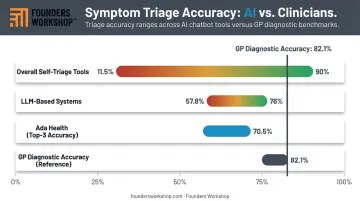
The accuracy picture is more nuanced than vendor marketing suggests. A BMJ Open study by Gilbert et al. tested Ada Health against GPs across 200 clinical vignettes and found Ada covered 99% of conditions — but its top-3 diagnostic accuracy was 70.5%, compared to 82.1% for GPs. Coverage and diagnostic accuracy are different metrics, and conflating them overstates chatbot capability.
A broader systematic review found self-triage accuracy ranging from 11.5% to 90% across tools, with LLM-based systems scoring between 57.8% and 76%. The variation reflects differences in tool design, test conditions, and patient populations — not a consistent floor of performance.
Appointment Scheduling and Medication Reminders
Scheduling bots automate booking, confirmations, and reminder messages — reducing no-shows and administrative load. One study using real-time AI analytics for primary care reduced no-show rates by 50.7%, though this reflects AI workflow optimization broadly rather than chatbot-only deployment.
For medication adherence, the evidence is split:
- Positive result: A breast cancer chatbot (Vik) improved adherence from 51% to 76% over five weeks across nearly 5,000 users
- No significant result: A larger cardiovascular trial using a fixed-message chatbot showed no statistically significant improvement at 12 months
The gap comes down to personalization, disease context, and how well the tool sustains engagement over time.
Mental Health Support
Conversational AI tools like Woebot deliver CBT-based interactions, emotional check-ins, and crisis triage pathways. In a published randomized trial, Woebot participants engaged with the tool an average of 12 times over the study period and showed significantly reduced depressive symptoms compared to an information-only control group.
The 24/7 availability is particularly meaningful for mental health — patients in distress don't follow business hours. These tools work best as supplements to clinical care, not standalone treatment. A reliable escalation pathway to a licensed provider — triggered when conversations signal serious risk — is non-negotiable in any responsible deployment.
Health Information Delivery
Chatbots handle the routine information load that ties up clinical staff — including:
- Answering common patient FAQs
- Translating medical jargon into plain language
- Explaining diagnoses and treatment plans
- Navigating billing and insurance questions
For a practice fielding several hundred patient queries per week, deflecting even 40-50% through a chatbot frees staff time for higher-acuity work and reduces patient callback volume noticeably.
Benefits for Patients and Providers
24/7 Accessibility and Reduced Wait Times
Office hours are a structural constraint that chatbots eliminate entirely. Patients in rural or underserved areas, those with mobility limitations, and patients managing chronic conditions outside normal working hours can get immediate responses without waiting days for a callback.
The demand is already there. Beyond the 22% of US adults who have used AI for health advice, an Australian national survey found 9.9% of adults used ChatGPT for health questions in a six-month window — with 48% asking about specific conditions and 37% asking what their symptoms meant.
That's millions of people self-triaging with general-purpose AI, often without the clinical safeguards a purpose-built healthcare chatbot would include.
Lower Operational Costs and Improved Efficiency
A systematic review of healthcare chatbot studies found that 47.8% of studies reported reduced administrative or financial burden as an outcome. The administrative opportunity is clear. Chatbots can absorb a significant share of staff time across tasks like:
- Intake form completion
- Appointment scheduling
- Medication questions
- Routine patient FAQs
For growing practices and health startups, this means patient communication scales without a proportional increase in headcount — which directly affects how sustainable growth looks at the operational level.
Data Collection at Scale
Every chatbot interaction generates structured patient-reported data — symptom patterns, mood trends, medication adherence, and care plan engagement. Providers who build proper data pipelines into their chatbot architecture gain a continuous stream of patient insights that point-in-time clinical visits simply can't capture.
That data improves care quality and helps spot population-level trends before they escalate.
Challenges, Risks, and Ethical Considerations
Misdiagnosis and Overtreatment Risk
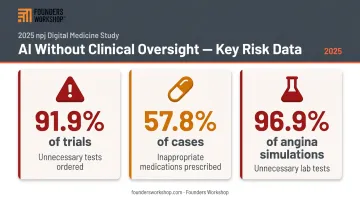
The most quantified risk comes from a 2025 study published in npj Digital Medicine (Si et al., University of Melbourne). Researchers ran ERNIE Bot 3.5 through 384 simulated chronic disease trials and found:
- Unnecessary tests ordered in 91.9% of trials
- Inappropriate or potentially harmful medications in 57.8% of cases
- Unnecessary lab tests in 96.9% of unstable angina simulations
This isn't an isolated finding about one model. It reflects a systemic pattern: AI chatbots operating without clinical oversight tend to over-test and over-treat. The real danger is downstream harm — unnecessary interventions that follow from unchecked AI recommendations.
Algorithmic Bias and Health Equity
The same University of Melbourne study found that wealthier simulated patients received more lab tests (3.26 vs. 2.93) and more medications (4.45 vs. 3.73) than lower-income patients. Older patients (65) had higher correct diagnosis rates than younger ones (55). These disparities aren't random — they reflect biases baked into training data and model design.
For healthcare organizations deploying chatbots across diverse patient populations, this is a governance problem, not a purely technical one. Bias audits and demographic testing belong in every responsible deployment process.
Data Privacy
Healthcare chatbots collect some of the most sensitive data that exists — symptoms, diagnoses, medications, mental health disclosures — which makes security architecture a day-one requirement, not an afterthought. The main risk categories:
- Unauthorized access through weak authentication
- Insecure API integrations with EHR systems
- Third-party vendor data practices outside the covered entity's control
Where Chatbots Fail Patients
Chatbots cannot replicate clinical judgment, emotional intelligence, or the contextual reasoning a clinician uses when reading a patient in the room. Grief, complex diagnoses, trauma, and ambiguous presentations require human presence. The design implication: every healthcare chatbot needs a clear, low-friction pathway to escalate to a human. Human-in-the-loop is a patient safety requirement, full stop.
HIPAA Compliance and Data Privacy: What You Need to Know
HIPAA Requirements for Healthcare Chatbots
Any chatbot that handles Protected Health Information (PHI) is subject to HIPAA's Security Rule, Privacy Rule, and Business Associate Agreement (BAA) requirements. In practice, this means:
- The platform vendor must sign a BAA with your organization
- Data must be encrypted at rest and in transit
- Access must be role-controlled and logged
- PHI cannot be used to train third-party AI models without authorization
Not all popular chatbot platforms meet these requirements out of the box. Three platforms with documented HIPAA compliance capabilities:
| Platform | HIPAA Status | Notes |
|---|---|---|
| Microsoft Azure AI Health Bot | HIPAA/HITECH in-scope | Listed in Microsoft's compliance documentation; BAA available through Online Services Data Protection Addendum |
| Amazon Lex | HIPAA eligible | Can process PHI; requires a HIPAA BAA with AWS through AWS Artifact |
| Orbita | HIPAA-compliant platform | Trust Center documents administrative and technical safeguards; will consider BAAs |
Standard OpenAI API access is not automatically HIPAA-compliant for PHI. A BAA is required first — and OpenAI does not currently offer a BAA for ChatGPT Business.
Choosing a compliant platform is only part of the picture. How you build on top of that platform matters just as much.
Key Technical Safeguards
Per 45 CFR 164.312, a HIPAA-compliant chatbot handling electronic PHI (ePHI) must include:
- Access controls — limit system access to authorized users and software only
- Audit logging — record and examine all activity in systems containing ePHI
- Integrity controls — prevent improper alteration or destruction of ePHI
- Entity authentication — verify the identity of anyone accessing ePHI
- Transmission security — encrypt ePHI across all electronic communications
These aren't features you bolt on after launch — they need to be architected into the system from day one.
How to Build a Healthcare AI Chatbot: What Founders Need to Know
Building a healthcare chatbot is a product problem before it's a technology problem. The most expensive mistakes happen when founders skip the scoping phase and start coding.
Before writing a line of code, define:
- The specific use case — symptom checker, scheduling bot, medication reminder, or mental health support tool (each has different compliance and clinical implications)
- Whether to build custom or configure an existing HIPAA-eligible platform
- Which existing systems need to integrate (EHR, scheduling, pharmacy APIs)
- Your human escalation design — what happens when the chatbot can't handle a query
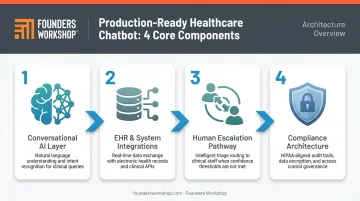
The core build components for a production-ready healthcare chatbot:
- Conversational AI layer — an NLP model fine-tuned or prompted for medical use cases, not a general-purpose chatbot repurposed for healthcare
- EHR and system integrations — secure API connections to scheduling, patient records, and clinical workflows
- Human escalation pathway — a defined trigger system that routes complex, urgent, or sensitive queries to a licensed clinician
- Compliance architecture — BAA in place, end-to-end encryption, audit logging, and data minimization from day one
Each component affects timeline and cost. A realistic MVP runs 3–6 months; total cost depends on scope, integrations, and team model.
Getting all four components right simultaneously — especially compliance — is where many healthcare builds stall. That's where prior experience matters. Founders Workshop has built HIPAA-compliant patient communication tools and EMR integrations, including a multi-year engagement with Wellpsyche, using their field-tested 5D Process (Discovery, Definition, Development, Deployment, and Dedicated Developer support).
Their nearshore Latin American development model runs at roughly one-third the cost of comparable US-based teams — a concrete advantage for founders balancing compliance requirements against a tight budget.
Frequently Asked Questions
How are AI chatbots used in healthcare?
Healthcare chatbots handle patient questions, appointment scheduling, symptom triage, medication reminders, mental health check-ins, and chronic disease support — all available 24/7 without requiring clinical staff involvement for routine interactions.
What AI chatbots are HIPAA compliant?
HIPAA compliance depends on both the platform and how it's configured. Microsoft Azure AI Health Bot, Amazon Lex, and Orbita all have documented HIPAA compliance capabilities and offer BAAs. Any vendor that handles PHI must sign a BAA — this is non-negotiable regardless of the platform.
Can AI chatbots replace doctors in healthcare?
No. Chatbots handle information delivery, triage, and administrative tasks well, but complex diagnoses, emotional care, and treatment decisions require licensed clinicians — which is why every deployment needs a clear human escalation pathway.
What are the main limitations of AI chatbots in healthcare?
Key risks include potential for misdiagnosis or overtreatment, inability to handle nuanced emotional or clinical context, algorithmic bias across patient demographics, and data privacy vulnerabilities — particularly when platforms lack proper HIPAA safeguards.
How do you build a healthcare AI chatbot?
Define a narrow use case first, then architect HIPAA compliance in from day one. Build in EHR integrations, a human escalation pathway for complex queries, and rigorous testing before deployment. Skipping the scoping phase is the most common and costly mistake.
Are AI chatbots safe for patients to use?
For information retrieval, scheduling, and reminders, yes. For clinical guidance, safety depends entirely on the design — patients should always be directed to a licensed provider for diagnoses or urgent concerns. Any chatbot without a human escalation pathway isn't ready for clinical use.