Introduction
Patients now expect to book appointments, message providers, and review test results from their phones. Healthcare organizations that can't meet that expectation are losing patients to those that can. According to Grand View Research, the global mHealth apps market is projected to reach $86.37 billion by 2030, growing at a 14.8% CAGR — numbers that reflect a fundamental change in how patients access care.
But building a healthcare app is genuinely harder than building a standard consumer app. HIPAA compliance, EHR interoperability, sensitive user populations, and FDA classification rules can trip up even experienced development teams. Miss any one of them, and you're facing a security breach — or a product nobody adopts.
This guide covers what founders and SMBs need to make smart decisions:
- Types of healthcare apps and where they fit
- Must-have features for compliance and usability
- Key trends shaping the market right now
- A step-by-step build process
- Common pitfalls and how to avoid them
- Realistic cost ranges for scoping your budget
Key Takeaways
- Healthcare apps split into two categories — patient-facing and provider-facing — and which one you're building shapes every decision that follows.
- Every successful healthcare app needs HIPAA compliance baked into the architecture, intuitive UX for all literacy levels, and one problem solved well.
- Start with a validated MVP; expand features only after real users confirm your core assumption works.
- Costs range from $40K for a basic MVP to $400K+ for enterprise platforms, with HIPAA compliance alone adding 20–30% to the total budget.
What Are the Main Types of Healthcare Mobile Apps?
Healthcare apps fall into two broad categories: apps built for patients and apps built for medical professionals. Which category you're building for determines your feature set, compliance requirements, and go-to-market strategy.
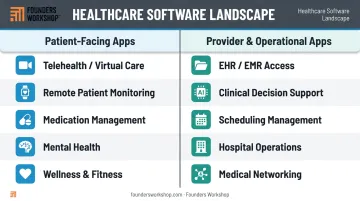
Patient-Facing Apps
These apps address care access, engagement, and self-management:
- Telehealth/virtual care — video consultations and asynchronous messaging with providers
- Remote patient monitoring (RPM) — connects to wearables and IoT devices to transmit health data in real time
- Medication management — dosage tracking, refill reminders, adherence reporting
- Mental health — therapy access, mood tracking, meditation, and digital therapeutics
- Wellness and fitness — lifestyle coaching, habit tracking, nutrition logging
Provider-Facing and Operational Apps
These apps support clinical workflows and hospital operations:
- EHR/EMR access tools — mobile access to patient records via FHIR/HL7 standards
- Clinical decision support — AI-assisted diagnostics, sepsis alerts, risk stratification
- Appointment and scheduling management — provider calendaring, patient queue management
- Hospital operations — bed management, staff coordination, supply chain workflows
- Medical networking — peer consultation, referral management, clinical communications
Some apps serve both audiences through role-based access. Patient portals are the clearest example: a patient logs in to view records and send messages, while a provider logs in to review charts and respond.
The mHealth vs. Medical App Distinction
The FDA draws a clear regulatory line between general wellness apps (low regulatory burden) and medical apps or Software as a Medical Device (SaMD). An app that tracks sleep habits sits in a different category than one that analyzes ECG data to detect arrhythmias.
The FDA's SaMD guidance defines SaMD as software that performs medical purposes without being part of a hardware device — and that classification has real compliance consequences for your architecture, testing, and timeline.
Classify your app early. Getting this wrong mid-development means reworking features, documentation, and sometimes your entire technical foundation.
Must-Have Features for a Healthcare Mobile App
Feature selection is one of the most consequential and most underestimated decisions in healthcare app development. Too many features inflate costs, delay launch, and confuse users. The goal is to separate what must exist on day one from what can wait.
Foundational Patient-Facing Features
Every patient-facing healthcare app needs these at launch:
- Secure registration and authentication — biometric login and two-factor authentication are non-negotiable for PHI protection
- Appointment scheduling and reminders — the single highest-impact feature for patient engagement and no-show reduction
- Access to personal health records — visit summaries, lab results, and medication history
- In-app secure messaging — HIPAA-compliant chat with providers (not standard SMS)
- Push notifications — medication reminders, follow-up alerts, appointment confirmations
Each of these directly affects patient adherence and retention. Miss any one of them and you're solving for acquisition while ignoring the bigger problem: keeping patients engaged after download.
Foundational Provider-Facing Features
Provider-side features have higher technical complexity but equal importance:
- EHR/EMR integration — via FHIR/HL7 APIs; this is a baseline requirement, not an advanced feature
- Digital prescription management — e-prescribing with controlled substance compliance
- Clinical dashboards — real-time patient vitals, flags, and care summaries
- Telehealth/video consultation — embedded video with recording and session documentation
- Role-based access controls — nurses, physicians, and administrators need different data access levels
Interoperability with existing hospital systems isn't optional. ONC data shows that 96% of non-federal acute-care hospitals have adopted certified EHRs — meaning your app will almost certainly need to connect to one.
Advanced Features to Consider Post-MVP
Add these in a second development phase, once your core product has real users:
- AI-powered symptom checkers or triage chatbots — valuable but require clinical validation and clear handoffs to human clinicians when needed
- RPM via IoT wearables — powerful for chronic care, but introduces hardware integration complexity
- Health data analytics dashboards — population health reporting, engagement metrics
- Augmented reality — patient education, surgical planning, anatomy visualization
Frame these as differentiators, not launch requirements. Before you get there, though, there's one non-negotiable that underpins every feature on this list.
HIPAA Compliance as a Feature, Not an Afterthought
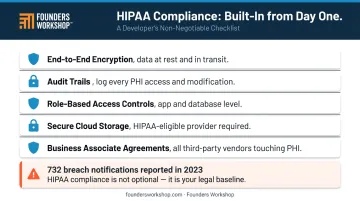
HIPAA compliance must be designed into the architecture from day one. Retrofitting it after build is expensive and often incomplete. In practice, that means:
- End-to-end data encryption at rest and in transit
- Audit trails logging every access and modification to PHI
- Role-based data access at the application and database level
- Secure cloud storage with a HIPAA-eligible cloud provider
- Business Associate Agreements (BAAs) with every third-party vendor that touches PHI — including analytics SDKs
HHS OCR received 732 large breach notifications in 2023, affecting over 113 million individuals. Many of those breaches involved third-party tracking tools that developers treated as benign. Any SDK that touches PHI is a compliance decision.
Depending on your user base and integrations, additional frameworks apply:
- GDPR Article 9 — required for any app serving EU users (health data is a special category)
- CCPA/CPRA — triggered by California-based users
- HL7/FHIR standards — required for apps connecting to hospital or EHR systems
Build for all relevant frameworks from the start — not as an afterthought once your user base grows.
Key Trends Shaping Healthcare App Development
Founders who understand where the market is moving can build products relevant for the next 3–5 years, not just today.
AI and Machine Learning Integration
Deloitte's 2025 Global Health Care Outlook reports that more than 80% of health system executives expect generative AI to have significant or moderate impact on their organizations. In practice, the most proven AI use cases in healthcare apps today are:
- Clinical documentation — JAMA research found ambient AI scribes reduced note time by 20.4% and after-hours work by 30%
- Risk stratification — ML scanning EHRs to surface early sepsis warnings or care gaps
- 24/7 patient support chatbots — triaging non-urgent questions without clinician involvement
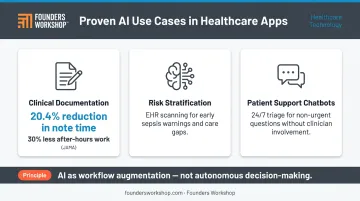
One important caveat: LLMs perform poorly on medical coding tasks, and AI triage tools require human review pathways. Position AI as workflow augmentation, not autonomous decision-making.
Telehealth and Hybrid Care Models
Telehealth has become a permanent care delivery channel. CDC data shows 52.8% of adults with diagnosed diabetes used telemedicine in 2021 — well above rates for adults without chronic conditions. Even after pandemic-era peaks, that adoption has held.
Apps winning in this space handle in-person scheduling, virtual visits, asynchronous follow-up, and care coordination within a single platform — no tool-switching required for patients or providers.
Remote Patient Monitoring and IoT Wearables
The RPM market was valued at $53.6 billion in 2024 and is projected to reach $240.8 billion by 2033. Apps that connect to glucose monitors, ECG patches, blood pressure cuffs, and consumer wearables are becoming a standard component of chronic disease management.
Development complexity here is substantial: hardware integration, data accuracy requirements, and FDA classification all come into play. An app that passively receives wearable data sits in a different regulatory category than one that uses that data to recommend clinical interventions.
Interoperability and Data Exchange Standards
FHIR and HL7 are no longer optional considerations — they're the baseline for any app that needs to connect with hospital EHR systems. ONC's Cures Act Final Rule mandates standardized APIs for patient data access and prohibits information blocking.
Still, only 70% of hospitals engaged in all four ONC interoperable exchange domains in 2023, despite near-universal EHR adoption. Building with FHIR from day one avoids the expensive rework that comes from retrofitting interoperability into a proprietary data architecture.
Mental Health and Behavioral Care Apps
The mental health app market was valued at $7.48 billion in 2024 and is growing at 14.6% CAGR through 2030. The demand gap is enormous — SAMHSA data shows 80% of people who needed substance use disorder treatment in 2024 did not receive it.
That demand doesn't guarantee retention. A 2024 JMIR scoping review found a median 70% abandonment rate within 100 days for mental health and lifestyle behavior apps, with some studies reporting 89–92% abandonment. Market size doesn't offset high churn. Mental health apps need evidence-based engagement design, clinical escalation pathways, and crisis routing built in from launch — not added later.
How to Build a Healthcare Mobile App: A Step-by-Step Guide
The sequence matters. Skipping validation or compliance planning early creates compounding costs later.
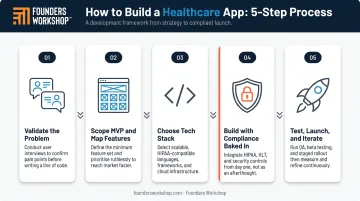
Step 1: Validate the Problem and Define Your Audience
The highest failure point in healthcare app development is building before validating. Before writing requirements:
- Conduct user interviews with patients or providers in your target segment
- Analyze competitor apps for gaps they're not addressing
- Define one problem the app will solve deeply — not five problems shallowly
- Assess regulatory classification early: wellness app, mobile medical app, or SaMD?
This step typically saves more money than any single technical optimization.
Step 2: Scope Your MVP and Map Core Features
An MVP is the minimum feature set that delivers real, demonstrable value to your primary user. Define it tightly:
- Resist adding features because they seem useful; add them because validated users requested them
- Map core data objects early — Patients, Appointments, Providers, Messages — because changing these mid-build is expensive
- Create wireframes and a clickable prototype before development begins; they're cheap to revise, code is not
A structured process makes this phase much cheaper to get right. Founders Workshop's 5D Process runs Discovery (2–4 weeks of problem validation and feature scoping) and Definition (4–6 weeks of wireframing, prototyping, and technical architecture) before development begins. Resolving scope questions in these phases costs a fraction of what mid-build changes do.
Step 3: Choose Your Development Approach and Tech Stack
| Approach | Best For | Trade-off |
|---|---|---|
| Native iOS/Android | Performance-critical apps, complex device integration | Highest cost, two codebases |
| Cross-platform (React Native, Flutter) | Most healthcare apps | Good balance of cost and performance |
| Application | Portals, dashboards, admin tools | Fastest to market, no app store |
| Custom enterprise build | Full-featured platform with EHR integration | Longest timeline, highest investment |
Let your target user demographic drive platform choice. For healthcare, security-mature backends paired with FHIR-compatible APIs are standard. Choose your platform; don't let a vendor's preferred stack choose it for you.
Step 4: Build with Compliance and Security Baked In
HIPAA compliance from day one requires these specific controls:
- Encrypted databases and encrypted API transit
- Secure API gateways with rate limiting and authentication
- Role-based access controls at the application layer
- Audit logging for all PHI access and modification
- BAAs executed with cloud providers, analytics vendors, and communication APIs before launch
Security audits and penetration testing happen before launch. Budget 2–4 additional weeks for this work — healthcare clients consistently hit this timeline, so treat it as a fixed line item, not a buffer.
Working with a development partner who has prior healthcare clients reduces compliance risk. Founders Workshop has built for healthcare clients including Wellpsyche (an 8-year staff augmentation engagement) and Verisma, applying HIPAA-compliant development practices across EMR integrations, patient portals, and telemedicine platforms.
Step 5: Test, Launch, and Iterate
Healthcare testing requirements go beyond standard QA:
- Functional testing across all target devices and OS versions
- HIPAA compliance validation — penetration testing and security audit
- Usability testing with actual patients or clinical staff (not just developers)
- Connectivity testing — healthcare users operate in hospitals, clinics, and homes with inconsistent signal
Launch in phases: soft launch to a limited user group, gather qualitative feedback, iterate, then scale.
Healthcare apps require ongoing maintenance after launch. Compliance rules change, devices update, and real usage data regularly surfaces gaps that testing missed.
How Much Does It Cost to Develop a Healthcare App?
Costs vary significantly based on complexity, compliance requirements, platform choices, and the team you work with.
Cost Tiers by Complexity
According to GoodFirms' 2026 healthcare app development guide:
| Tier | Cost Range | Typical Scope |
|---|---|---|
| Simple MVP | $40K–$80K | Symptom checker, appointment booking |
| Mid-complexity | $80K–$150K | Medication management, EHR integration |
| Telemedicine platform | $80K–$300K | Video consults, async messaging, records |
| Enterprise platform | $250K–$400K+ | AI, multi-system integration, full feature set |
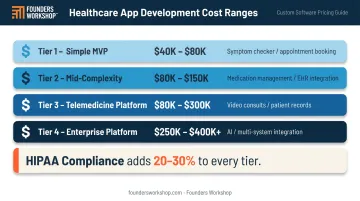
HIPAA compliance adds 20–30% to total project cost. This is the most consistently underestimated line item in healthcare app budgets.
Key Cost Drivers
- Number of platforms — iOS only, Android only, or both plus web
- EHR/EMR integration complexity — connecting to Epic or Cerner requires FHIR mapping, identity matching, and workflow testing
- Third-party integrations — payment gateways, wearable device APIs, lab data feeds
- UI/UX design depth — healthcare UX must serve users across a wide range of digital literacy
- Ongoing maintenance — plan for 15–25% of initial development cost annually
How Strategic Choices Reduce Cost
Three decisions have the biggest impact on keeping costs manageable without compromising quality:
- Start with an MVP — validate before building the full platform
- Use cross-platform frameworks — React Native or Flutter avoids maintaining two separate codebases
- Work with a nearshore team — Latin American development talent typically delivers comparable quality at roughly one-third of U.S. rates, which is worth factoring in early
For context: an internal U.S. development team runs $750K–$1M annually in salaries alone. Founders Workshop's nearshore staff augmentation model brings that figure down to a third of that cost — a meaningful difference for healthcare startups managing tight runway.
Frequently Asked Questions
How much does it cost to develop a healthcare app?
Basic MVP-level healthcare apps range from $40K to $80K; mid-complexity apps with EHR integration run $80K to $150K; enterprise platforms can exceed $400K. HIPAA compliance adds 20–30% to any tier. Get a scoped estimate from a partner with direct healthcare experience before committing to a budget.
What are mobile apps used for in healthcare?
The main use cases are: patient engagement (appointment booking, medication reminders, health records access), telehealth consultations, remote patient monitoring via wearables, clinical workflow support for providers, and administrative automation including scheduling and billing.
How long does it take to develop a healthcare app?
An MVP-level app typically takes 3–6 months from kickoff to launch. A complex platform with full EHR integration, telehealth, and compliance infrastructure runs 12–18 months. Pre-launch security testing adds 2–4 weeks regardless of tier.
Do healthcare apps need to be HIPAA compliant?
Any app that collects, stores, or transmits protected health information (PHI) in the U.S. must comply with HIPAA. Compliance must be built into the architecture from day one — covering data encryption, audit logs, and vendor BAAs. Trying to add it after launch is significantly more expensive and risky.
What should I include in a healthcare app MVP?
Focus on solving one specific problem well. Core MVP features typically include secure login, appointment booking, and basic secure messaging between patients and providers. Validate that users actually adopt these before expanding the feature set.
How do I choose the right healthcare app development partner?
Look for a partner with proven healthcare clients and hands-on experience with HIPAA compliance and EHR integration. Confirm they have a transparent development process and can support long-term maintenance beyond the initial build. Prior work in your specific app category matters more than raw development volume.