Introduction
Healthcare is under real strain. Physician burnout hit 41.9% in 2025 according to the AMA, doctors average nearly 58 working hours per week, and administrative tasks alone consume over 7 hours of that time. Meanwhile, diagnostic bottlenecks and rising costs continue to pressure health systems at every level.
Generative AI is landing in the middle of this crisis. It's already deployed, already measured, and already producing results. According to Precedence Research, the generative AI in healthcare market sits at $2.64 billion in 2025 and is projected to reach $48.23 billion by 2035 at a 33.71% CAGR. That kind of growth only happens when a technology is solving real operational problems — the same problems your competitors are starting to build around.
This article is for healthcare entrepreneurs, startup founders, and SMB healthcare leaders who want a practical understanding of where generative AI is making an impact today and what it means for building the next generation of health tech products.
Key Takeaways
- Generative AI is actively deployed across clinical documentation, diagnostics, drug discovery, patient engagement, and administrative workflows
- Healthcare organizations implementing GenAI report clinician time savings, improved diagnostic detection rates, and operational efficiency gains
- Key risks include AI hallucinations (44% of which carry patient safety risks), HIPAA compliance exposure, and model bias
- Founders can build GenAI healthcare products without large internal teams by partnering with an AI-first development firm
- Agentic AI workflows, multimodal models, and synthetic data at scale define what's coming next
What Is Generative AI in Healthcare?
Traditional AI in healthcare is mostly discriminative — it classifies and predicts using labeled data. A discriminative model looks at a chest X-ray and says "this scan is abnormal" — useful, but limited to what it was trained to categorize.
Generative AI does something fundamentally different: it creates. Given what it has learned, it produces new content — a clinical note, a molecular structure, a synthetic training image.
The Core Model Types
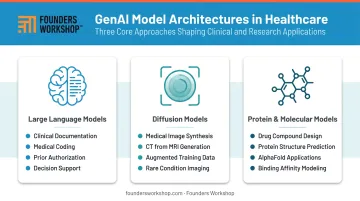
Three model architectures drive most healthcare GenAI applications:
- Large Language Models (LLMs) — process and generate clinical text; used for documentation, coding, prior auth drafting, and decision support
- Diffusion models — generate and enhance medical images; used to synthesize CT from MRI data and create augmented training datasets
- Protein/molecular models — design novel drug compounds and predict protein structures; AlphaFold is the foundational example
Model architecture is only part of the equation — domain specificity matters just as much. General-purpose models trained on internet text don't know the difference between a clinical abbreviation and a typo. Models fine-tuned on EHR data, clinical notes, and medical imaging perform significantly better on healthcare tasks. Med-PaLM 2, for example, improved on its predecessor by more than 19 percentage points on USMLE-style medical questions after domain-specific tuning.
Key Applications of Generative AI in Healthcare
Clinical Documentation and Administrative Automation
This is where the evidence is strongest and deployment is most mature. Physicians spend an average of 16 minutes and 14 seconds on EHR documentation per outpatient encounter — and that's just one visit. Multiply that across a full schedule and it becomes a serious problem.
Ambient AI scribes are the most direct solution. These tools listen to doctor-patient conversations and automatically generate structured clinical notes. A JAMA Network Open study found that after deploying an ambient scribe, after-hours documentation dropped by 0.90 hours per week and physician burnout fell from 51.9% to 38.8% within 30 days.
Adjacent administrative use cases are also gaining traction:
- Prior authorization drafting and submission
- Claims processing and coding assistance
- Discharge instruction generation
- Scheduling and intake automation
McKinsey's 2026 healthcare GenAI survey identified administrative efficiency as the single domain with the greatest perceived potential for both GenAI and multiagent workflows — ahead of clinical applications.
Medical Imaging and Diagnostics
Generative AI contributes to imaging in two ways: improving clinical performance and solving data scarcity problems.
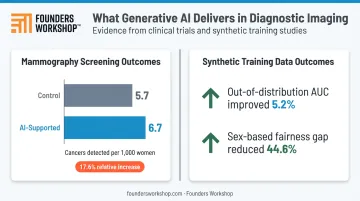
AI-supported mammography screening detected 6.7 cancers per 1,000 women versus 5.7 per 1,000 in a control group — a 17.6% relative increase — without raising the recall rate, according to a Nature Medicine study. That's a meaningful improvement in a real-world screening program.
Generative models also address data scarcity — synthesizing CT images from MRI scans to reduce radiation exposure. In chest radiology models, synthetic training data has also shown measurable fairness and accuracy gains:
- Improved out-of-distribution AUC by 5.2%
- Reduced the sex-based fairness gap by 44.6%
LLMs trained on clinical data assist with diagnostic decision support — surfacing differential diagnoses, flagging high-risk patterns in patient histories, and helping less experienced clinicians access relevant clinical evidence. Human oversight remains essential throughout. These tools expand what clinicians can see and consider; the clinical decision stays with the physician.
Drug Discovery and Life Sciences
The timelines in traditional drug discovery are brutal: years from target identification to clinical candidate, then years more through trials. Generative AI is compressing the early stages at a measurable pace.
Eight leading AI drug discovery companies had 31 drugs in human clinical trials as of a 2024 review. Exscientia compressed one discovery phase to 12–15 months versus an industry average of 4.5 years. Insilico Medicine moved from target identification to preclinical candidate in under 18 months.
These are case examples, not universal guarantees — clinical attrition rates for AI-discovered molecules remain an open question. The pipeline signal, though, is real and growing.
Patient Engagement and Mental Health Support
Patient-facing GenAI applications include:
- 24/7 symptom triage chatbots that route patients before or after clinic hours
- Medication adherence reminders and chronic disease check-ins
- Multilingual care navigation assistants for underserved populations
- Mental health support tools with conversational interfaces
Access is a genuine benefit here — a symptom checker study in an integrated health system recorded over 26,000 completed assessments in under a year, with nearly half completed outside office hours.
Mental health AI requires particular caution. The APA has warned that GenAI chatbots and wellness apps lack sufficient evidence and regulation to ensure safety. The FDA has identified specific risks including confabulation, inappropriate content, and patient misinterpretation. Any mental health GenAI product should be treated as high-risk, require trained human oversight, and maintain clear escalation paths to licensed professionals.
The Real Benefits Healthcare Organizations Are Reporting
The data on GenAI in healthcare has moved past projections — these are real outcomes from organizations already running the technology:
| Benefit Area | Evidence |
|---|---|
| Clinician time savings | After-hours documentation down 0.90 hrs/week with ambient scribes |
| Burnout reduction | Burnout dropped from 51.9% to 38.8% in 30 days post-scribe deployment |
| Diagnostic accuracy | 17.6% relative increase in mammography cancer detection with AI support |
| Drug discovery speed | Discovery phase compressed from 4.5 years to 12–15 months (Exscientia) |
| ROI expectations | 82% of healthcare leaders who implemented GenAI expect positive ROI, with returns mainly ranging 2x to 4x initial investment |
That last figure comes from McKinsey's Q4 2025 survey of US healthcare leaders, where 50% of organizations were already implementing GenAI. Those ROI figures are projections, not guarantees — but they reflect a consistent pattern: organizations that deploy GenAI are finding real, quantifiable returns, not just theoretical upside.

Challenges and Risks Healthcare Teams Must Address
Hallucinations and Clinical Safety
Generative AI models produce plausible but incorrect outputs. In healthcare, that's a patient safety problem.
A study analyzing 12,999 LLM-generated clinical note sentences found a 1.47% hallucination rate and 3.45% omission rate. More concerning: 44% of those hallucinations were classified as major safety risks. A missed drug interaction or incorrect clinical summary can harm patients.
The implication is clear: no GenAI output in a clinical workflow should reach a patient or inform a care decision without human review. Human-in-the-loop design isn't optional — it's the minimum standard.
Data Privacy and HIPAA Compliance
Healthcare data is among the most heavily regulated in any industry. Using standard consumer AI tools — ChatGPT interfaces, general-purpose APIs — to process protected health information (PHI) carries significant legal risk.
HIPAA compliance requires:
- A signed Business Associate Agreement (BAA) with any vendor handling PHI
- Data encryption in transit and at rest
- De-identified training data
- Controlled, auditable deployment environments
The ONC's HTI-1 rule adds transparency requirements for AI and predictive algorithms in certified health IT systems, including disclosure of fairness, validity, and safety characteristics. Teams building GenAI features into health IT products need to account for these disclosures from the design phase — not as an afterthought.
Model Bias and Health Equity
Compliance risk isn't the only systemic concern. A widely cited Science study found that a health management algorithm reduced the number of Black patients identified for additional care by more than half — not because of malicious design, but because the training data used healthcare costs as a proxy for health needs, which introduced racial bias.
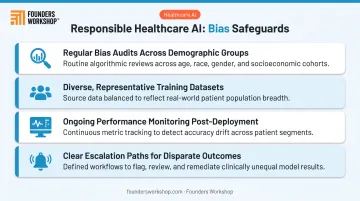
GenAI models trained on non-representative clinical datasets carry the same risk. Responsible healthcare AI products require built-in safeguards:
- Regular bias audits across demographic groups
- Diverse, representative training datasets
- Ongoing performance monitoring post-deployment
- Clear escalation paths when disparate outcomes are detected
How Healthcare Founders and SMBs Can Build GenAI Solutions
Start with a Single Painful Workflow
The founders who succeed with healthcare AI don't start with platforms — they start with problems. Identify the single most painful, time-consuming workflow in your target niche. Clinical note summarization. Prior authorization drafting. Appointment scheduling with intake automation.
Validate that specific problem with actual users before writing a line of code. Broad "AI platforms for healthcare" fail regularly; narrow, validated applications get traction.
Build Compliance In from Day One
HIPAA compliance cannot be retrofitted. Decisions about data architecture, model deployment, audit trails, and encryption need to be made at the beginning — not discovered as problems after you've built something.
Founders who treat compliance as a product feature (not a legal obstacle) close health system deals faster. Buyers want to see BAAs, de-identification processes, and audit log capabilities up front.
This also shapes your architecture decisions:
- API-based LLMs are fast to integrate but require BAAs with providers and careful PHI handling
- Self-hosted models offer more control but require significant infrastructure investment
- Fine-tuned domain-specific models deliver better clinical accuracy but require clean, de-identified training data and ongoing validation
Choose the Right Development Model
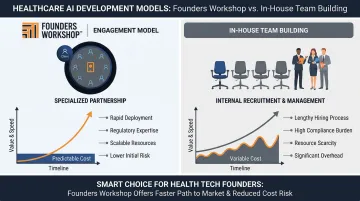
Building entirely in-house requires a rare combination of healthcare domain expertise and AI engineering talent — rarely found together, and rarely affordable. Off-the-shelf tools often can't meet compliance or customization requirements for clinical use cases.
A third path: partner with an experienced healthcare-focused software development firm that already understands clinical software requirements. This lets founders move faster and preserve equity without relying on costly in-house hires.
Founders Workshop takes this approach with health tech founders and SMBs — building HIPAA-aware, AI-powered products through a structured 5D Process (Discovery, Definition, Development, Deployment, Dedicated Support), with no equity taken. Typical engagements run 3–6 months from discovery to deployed MVP. The firm's healthcare portfolio includes an 8-year partnership with Wellpsyche and work spanning EMR integrations, telemedicine platforms, HIPAA-compliant patient communication, and medical workflow automation.
The cost difference is material: a fully managed healthcare product engagement typically ranges from $80,000–$350,000 for 3–6 months — versus $750,000–$1 million annually for an in-house team, or up to 50% equity for a technical co-founder.
What to Expect From Generative AI in Healthcare: Emerging Trends
Two shifts are worth tracking closely over the next 18–24 months.
Agentic AI and multimodal models represent the next phase beyond single-task LLMs. Agentic systems coordinate multiple AI models to handle multi-step workflows end-to-end: intake, diagnosis support, documentation, and follow-up scheduling without a human touching each handoff. McKinsey found that 19% of healthcare organizations have already reached agentic AI implementation maturity, with another 51% pursuing proofs of concept.
Multimodal models like Google's Med-Gemini process text, imaging, genomics, and clinical metadata simultaneously — moving precision medicine closer to reflecting each patient's full clinical picture rather than isolated data points.
Synthetic data and regulatory maturation will reshape both training pipelines and compliance requirements. AI-generated synthetic patient data increasingly enables model training and clinical trial simulation without privacy exposure. Meanwhile, three regulatory frameworks are converging to raise the bar:
- FDA's AI-enabled device guidance — requires rigorous validation and lifecycle monitoring
- ONC's HTI-1 rule — mandates transparency in clinical decision support algorithms
- EU AI Act — classifies medical AI as high-risk, demanding audit trails and human oversight
Products built without these foundations today face re-approval cycles, delayed launches, and costly architecture rework down the line.
Frequently Asked Questions
Is ChatGPT for healthcare HIPAA compliant?
Standard ChatGPT interfaces are not inherently HIPAA compliant for handling PHI. Compliance requires a Business Associate Agreement, data encryption, and controlled deployment environments — requirements that consumer-facing tools don't meet. Organizations need enterprise-grade or purpose-built healthcare AI with appropriate security architecture.
How is generative AI being used in healthcare?
Primary use cases include ambient AI scribes for clinical documentation, medical imaging enhancement and synthetic data generation, diagnostic decision support, drug discovery and molecular design, symptom triage chatbots, and administrative automation such as prior authorization drafting and claims processing.
What are the biggest risks of using generative AI in clinical settings?
The three primary concerns are AI hallucinations producing clinically incorrect outputs (44% carry major safety risks), HIPAA violations when PHI is mishandled, and model bias leading to inequitable care for underrepresented patient groups. Human oversight and rigorous validation are the core mitigations for all three.
What's the difference between generative AI and traditional AI in healthcare?
Traditional AI classifies and predicts from labeled data — flagging abnormal lab values, predicting readmission risk. Generative AI creates new content: drafting clinical notes, designing drug molecules, synthesizing training images. That same versatility introduces risk — GenAI can produce wrong answers with full confidence, which is why human review is non-negotiable.
How can a healthcare startup begin building with generative AI?
Identify one specific, high-pain workflow and validate it with real users. Then select a development approach that builds HIPAA compliance into the architecture from day one — not as an afterthought. Partnering with an experienced AI-first development firm like Founders Workshop can cut time-to-market and reduce technical risk compared to standing up an in-house team.