AI chatbots are frequently positioned as the answer. The more useful question for practice managers is whether the benefits are real and whether implementation is actually manageable without a full IT department.
This article answers both. It covers the specific operational benefits of AI front desk chatbots — the kind tracked by clinic operators, not marketing teams — and walks through a practical implementation roadmap for small and mid-sized practices.
Key Takeaways
- AI chatbots handle scheduling, reminders, FAQs, and after-hours routing without requiring a live staff member
- Key gains include 24/7 patient access with fewer no-shows, lower administrative burden on front desk staff, and reduced cost per patient interaction
- Skipping front desk automation means missed calls, overwhelmed staff, and revenue lost to no-shows
- Implementation requires HIPAA-compliant tooling, EHR integration, and carefully designed escalation logic — prioritize them in that sequence
- The goal is augmentation: AI absorbs repetitive volume so human staff can focus on complex, empathy-driven work
What Is an AI Chatbot for Healthcare Front Desk?
An AI front desk chatbot is software that uses natural language processing (NLP) to understand patient requests — via phone, text, or web — and responds conversationally or takes direct action around the clock, with no staff involvement required.
What These Systems Actually Do
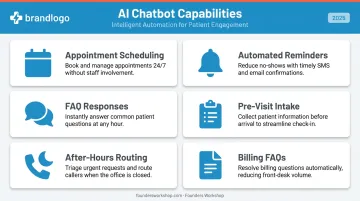
Most healthcare-focused AI chatbots handle a defined set of tasks:
- Appointment scheduling and rescheduling — patients book or change appointments through their preferred channel at any hour
- Automated reminders — outbound messages reduce no-shows without staff dialing down a list
- FAQ responses — hours, directions, insurance basics, parking, and similar questions that consume significant call volume
- Pre-visit intake collection — gathering demographic and insurance data before the patient arrives
- After-hours call routing — urgent calls escalate to an on-call provider; routine requests queue for the next business day
- Insurance and billing FAQ — basic coverage questions answered without a billing team member involved
The Capacity Multiplier Model
These systems work best understood as a capacity layer beneath human receptionists, not a replacement for them. The chatbot absorbs high-volume, low-complexity front desk work — the calls where the answer is always the same — freeing staff for interactions that actually require judgment.
That division matters because humans are genuinely better at handling a distressed patient, navigating a complex billing dispute, or supporting a nervous first-time caller. Both functions are necessary.
The problem is that right now, they're competing for the same staff member's attention at the same time.
Key Benefits of AI Chatbots for Healthcare Front Desk
The advantages below map to metrics practice managers actually track: call answer rates, no-show rates, cost per interaction, and staff turnover. Not theoretical efficiency gains.
24/7 Patient Access and Reduced No-Shows
An AI chatbot answers calls and messages around the clock, covering evenings, weekends, and holidays without after-hours staff or an outsourced answering service. Patients can book, reschedule, or confirm in real time through whichever channel they prefer.
According to Kyruus' 2023 Care Access Benchmark Report, telephone booking averaged 8 minutes per call, and fewer than half of patients secured an appointment on the first attempt. Kyruus also found that 40% of appointments were booked after business hours — a window where most practices have zero coverage.
No-shows add another layer of cost. MGMA data from 2025 estimates that no-shows and last-minute cancellations consume roughly 14% of a medical group's daily revenue and can cost up to $150,000 annually per physician. MGMA also identifies persistent reminder systems as a common factor among practices with stable no-show rates. That's automated, consistent outreach — exactly what a chatbot handles without staff involvement.
KPIs this affects: call answer rate, no-show rate, after-hours booking volume, appointment cancellation rate.
This benefit matters most for practices with high call volumes, multi-provider schedules, or a patient base that works standard hours and genuinely cannot call during the day.
Reduced Administrative Burden and Staff Burnout
Front desk staff in medical settings spend a significant share of their day on tasks that require no clinical judgment: answering the same FAQ calls, sending reminders, collecting intake information over the phone, and routing calls that could be handled automatically. AI chatbots absorb this repetitive volume.
The numbers show how unsustainable the current model is. The MGMA 2024 Compensation Data Report found front office support staff turnover hit 40% in 2022. In a 2025 MGMA poll, higher pay and staff engagement tied as the top retention tactics, signaling that burnout, not just compensation, is driving exits.
When staff are freed from repetitive call-answering, they can focus on:
- In-person patient check-ins that require real attention
- Complex scheduling situations across multiple providers
- Insurance escalations that need human judgment
- Supporting clinical staff and care coordination
- High-stakes calls from anxious or distressed patients
The front desk role doesn't shrink when AI handles volume. It shifts toward work that's harder to automate, more meaningful to do, and less likely to push people out the door.
KPIs this affects: employee turnover rate, staff-to-patient ratio, time spent on routine calls, patient wait time at check-in.
Lower Operational Costs and Scalable Coverage
The cost comparison is direct. According to the Bureau of Labor Statistics, the median annual wage for a receptionist in healthcare and social assistance is approximately $38,500, with medical secretaries and administrative assistants earning closer to $45,000. Add benefits, training time, and turnover costs — MGMA reported that front office staff compensation increased 17.23% from 2019 to 2023 — and the true cost of human coverage is substantially higher than the base salary.
Healthcare-focused AI chatbot platforms typically operate on a monthly subscription model. While major vendors like Hyro, Luma Health, Klara, and Relatient don't publish public pricing tiers, the cost structure is usage-based rather than headcount-based, which changes the math considerably when extended coverage is needed.
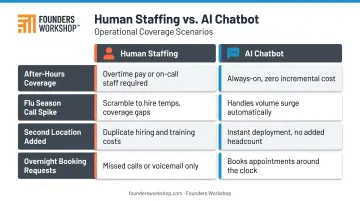
The gap widens in scenarios like these:
| Scenario | Human Staffing Approach | AI Chatbot Approach |
|---|---|---|
| After-hours coverage | On-call staff or answering service | Included in platform subscription |
| Flu season call spike | Overtime or temp staff | Scales automatically with volume |
| Second location added | Second receptionist hire | No additional headcount |
| Overnight booking requests | Missed until morning | Handled in real time |
KPIs this affects: cost per patient interaction, staffing overhead, revenue recovered from previously missed calls, return on investment timeframe.
What Happens When Clinics Skip Front Desk Automation
The costs of not automating are easy to underestimate because they're distributed and recurring, not a single visible loss. Three areas take the hardest hit:
- Revenue loss: A patient who can't reach the front desk after hours may book with a competitor, cancel without rescheduling, or simply not show. Press Ganey research from 2025 found that scheduling friction reduces a provider's "Likelihood to Recommend" score by 13.1 points. Nearly 25% of consumers said they'd leave a provider if booking wasn't seamless.
- Staff burnout: Without an automation layer, every call — regardless of complexity — routes to a human. That creates a reactive environment where front desk workers spend their day triaging volume rather than adding value. Elevated burnout and turnover follow predictably.
- Damaged patient perception: Inconsistent communication, long hold times, and missed reminders erode trust even when clinical care is excellent. Patients don't separate the experience of booking an appointment from the experience of receiving care — and a slow front desk signals a disorganized practice.
How to Successfully Implement an AI Chatbot at Your Healthcare Front Desk
Implementation fails most often not because the technology is wrong, but because the configuration doesn't match the actual workflow — or because staff weren't brought along.
Step 1: Map Current Workflows Before Selecting a Tool
Identify the specific task categories consuming the most staff time: inbound scheduling calls, reminder calls, FAQ calls, after-hours routing. This workflow audit ensures the chatbot is configured to solve real bottlenecks, not generic ones. Without it, you end up with a tool that technically works but doesn't address the actual problem.
Step 2: Prioritize HIPAA Compliance and EHR Integration From the Start
Any AI chatbot handling patient communication is a business associate under HIPAA. The vendor must provide a signed Business Associate Agreement (BAA), and protected health information (PHI) must be handled in a compliant data environment. HHS guidance is clear that covered entities may only disclose PHI to business associates with satisfactory written assurances in place.
Confirm also that the chatbot integrates with your existing EHR or practice management system for real-time scheduling sync. An AI that can answer questions but can't actually book into your system creates more work, not less.
Step 3: Configure Escalation Logic Carefully
Define clearly which scenarios the AI handles autonomously and which trigger immediate escalation:
- AI handles: routine scheduling, FAQ responses, appointment reminders, standard intake collection
- Human escalation: urgent symptoms, billing disputes, complex care coordination, emotionally distressed patients
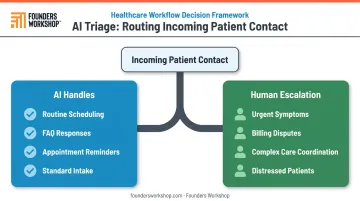
Poorly designed escalation logic is the most common source of patient frustration with AI chatbots in healthcare. If patients can't reach a human when they genuinely need one, the system erodes trust faster than it builds efficiency.
Step 4: Train Staff to Work Alongside the Chatbot
Staff buy-in is the factor most practices underestimate. If front desk workers view the chatbot as a threat to their jobs, they will route around it — and the system will underperform. Address job security concerns directly and early, and frame the tool honestly: it handles the call volume that was grinding people down, not the work that requires their expertise.
Step 5: Monitor KPIs and Iterate After Launch
Track the metrics that matter — call answer rate, no-show rate, staff time on routine calls, patient satisfaction scores — and use the data to refine chatbot responses, escalation rules, and workflow integrations in the first 60–90 days.
For practices that need a chatbot built to their specific EHR environment and workflows — not adapted from a generic platform — Founders Workshop builds custom healthcare AI solutions with compliance and integration requirements scoped before development begins. The team has delivered EMR integrations and HIPAA-compliant patient communication systems, working through a structured 5D process that runs from Discovery to Deployment.
Conclusion
AI chatbots for healthcare front desks deliver their most durable value when treated as an ongoing operational system, not a one-time technology purchase. The gains — 24/7 patient access and lower per-interaction costs — compound over time as the system is refined and staff workflows adapt around a more sustainable division of labor.
The practices seeing the strongest results aren't those that replaced their receptionists. They're the ones that used AI to make their front desk staff more effective: a hybrid model where technology handles volume and humans handle complexity. Practices that adopt that model consistently report lower no-show rates, shorter phone queues, and staff that spend their time on work that actually requires a human.
Frequently Asked Questions
What tasks can an AI chatbot handle at a healthcare front desk?
Core capabilities include appointment scheduling and rescheduling, automated reminders, FAQ responses (hours, directions, insurance basics), pre-visit intake collection, and routing urgent calls to human staff. Most platforms handle these across phone, SMS, and web chat channels.
Is an AI chatbot for healthcare front desk HIPAA-compliant?
Compliance depends on the specific vendor and implementation. Practices must verify that the vendor provides a signed Business Associate Agreement (BAA), that PHI is handled in a compliant data environment, and that patient data is not shared outside the provider's secure system.
How much does an AI chatbot for a medical practice typically cost?
Most platforms use monthly subscription pricing based on call volume, channel coverage, and EHR integrations. Pre-built tools cost less upfront; custom solutions run higher but fit complex workflows better. Either option typically costs less annually than a single receptionist's base salary of $38,500–$45,000.
Will an AI chatbot replace our human front desk staff?
The most effective implementations use AI to handle high-volume repetitive tasks while human staff focus on complex, empathy-driven interactions. The goal is augmentation — redirecting staff time from routine calls to the work where their judgment actually affects patient outcomes.
How long does it take to implement an AI chatbot for a medical practice?
Off-the-shelf solutions can go live in days to a few weeks with basic configuration. Custom-built solutions integrated with specific EHR systems typically take three to six months from Discovery through Deployment, but offer greater workflow alignment and flexibility for practices with complex or unique requirements.
Can AI chatbots integrate with EHR and practice management systems?
Most healthcare-focused platforms offer EHR and practice management integrations, but depth varies by vendor. Real-time scheduling sync is the most critical capability to verify: without it, the chatbot can answer questions but can't complete the booking actions that drive measurable results.