Introduction
Two years ago, healthcare was the industry conference speakers cited as proof that some sectors just weren't ready for AI. That's no longer the case.
According to Menlo Ventures' 2025 State of AI in Healthcare report, 22% of healthcare organizations have now implemented domain-specific AI tools — a 7x increase from 2024 and 10x from 2023. Health systems specifically hit 27% adoption. For context, the broader U.S. economy sits at 9%. Healthcare is deploying AI at 2.2x the rate of the overall economy.
For founders and SMBs building healthcare software, this creates a clear tension. The pressure to integrate AI is accelerating fast, but healthcare AI is not general-purpose software development.
It demands clinical accuracy, regulatory compliance, HIPAA-ready architecture, and EHR integration from day one — requirements that can sink projects not designed for them.
This article covers what's happening in healthcare AI right now, which applications have the strongest ROI, what makes this category so technically demanding, and how startups can build AI-powered healthcare products without the overhead of a large enterprise team.
Key Takeaways
- Healthcare AI spend hit $1.4B in 2025, nearly triple the prior year — buyers are committing budgets, not just running experiments
- Top AI categories by revenue and growth: ambient clinical documentation, prior authorization automation, billing/coding, and patient engagement
- 85% of generative AI spend in healthcare flows to startups, not legacy EHR vendors
- Building AI healthcare software requires HIPAA compliance, FDA SaMD awareness, EHR integration, and human-in-the-loop design — all from day one
- Start with one high-ROI use case, prove value, then expand — broad AI platforms rarely succeed at MVP stage
The State of AI in Healthcare Software in 2026
From Laggard to Leader
The speed of healthcare's AI adoption reversal is hard to overstate. Three structural forces drove it:
- Thin margins and cost pressure — hospitals operate on razor-thin margins, making any tool that reduces administrative overhead financially compelling
- Clinician burnout — documentation overload became a crisis; AMA data shows physicians averaged a 57.8-hour workweek in 2025, with nearly half that time spent on indirect care tasks rather than patients
- Post-pandemic staffing shortages — labor constraints made automation a necessity, not an option
These pressures turned AI from an experimental budget line into a financial imperative — healthcare AI spend hit $1.4 billion in 2025, nearly tripling year over year.
Where the Market Is Moving
Here's where that spending is actually going:
| Category | 2025 Revenue | Growth |
|---|---|---|
| Ambient clinical documentation | $600M | 2.4x YoY |
| Coding and billing automation | $450M | Major category |
| Patient engagement AI | $100M+ | 20x YoY |
| Prior authorization AI | $100M+ | 10x YoY |
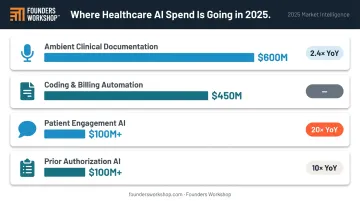
85% of generative AI spend in healthcare flows to startups, not incumbent EHR vendors. According to Menlo Ventures' 2025 State of Generative AI in Healthcare report, 80% of the healthcare AI market remains untapped — leaving the window wide open for focused, high-ROI solutions.
Key AI Applications Reshaping Healthcare Software Development
Developers building healthcare software in 2026 aren't working on one monolithic "AI" product. Each use case carries its own data requirements, compliance implications, and technical complexity. Here are the categories that matter most.
Ambient Clinical Documentation and AI Scribes
Ambient AI scribes use automatic speech recognition and natural language processing to transcribe and structure clinical conversations in real time. The value proposition is direct: eliminate the documentation burden that causes physician burnout.
This is currently the largest AI category in healthcare by revenue at $600M, and the outcomes data is compelling. A 2025 multicenter study published in JAMA Network Open across six U.S. health systems found that ambient AI scribe use reduced physician burnout from 51.9% to 38.8% in 30 days and cut after-hours documentation by 0.90 hours per week.
For software developers, this means building systems that handle:
- ASR pipelines accurate enough for clinical terminology
- Structured note generation that maps directly to EHR fields
- HIPAA-compliant audio handling throughout the session
- Physician-controlled review before any output is finalized
Diagnostic and Predictive Analytics Tools
Machine learning models are being deployed to analyze medical imaging, patient histories, lab results, and genetic data. As of mid-2025, the Bipartisan Policy Center counted over 1,250 FDA-authorized AI-enabled medical devices in the U.S. — up from 950 in 2024. Radiology leads by a wide margin, followed by cardiology and neurology.
This category is technically demanding and heavily regulated. Diagnostic AI that directly influences clinical decisions typically requires FDA clearance or approval, clinical validation studies, and ongoing performance monitoring. Developers should budget for regulatory timelines and clinical testing well before launch.
Administrative Workflow Automation
The administrative side of healthcare runs on manual, high-friction processes that AI is well-positioned to replace. Prior authorization alone consumes an estimated 13 hours of physician and staff time per week, with physicians handling roughly 40 prior auth requests weekly according to AMA's 2025 survey.
AI is compressing multi-day prior auth processes to minutes. The efficiency gains extend across the full administrative stack:
- Billing and coding automation reduces claim denials (nearly three-quarters of revenue cycle leaders reported rising denial rates in 2024)
- Conversational AI handles scheduling and patient intake
- Automated eligibility verification reduces manual lookup time
Health systems see returns quickly, which is driving faster purchasing cycles than most other AI categories in healthcare.
Remote Patient Monitoring and AI-Powered Wearables
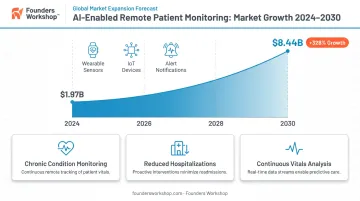
AI combined with wearable sensors and IoT devices enables continuous at-home monitoring of chronic conditions. ML algorithms analyze real-time vitals data and trigger alerts before adverse health events occur.
A 2024 prospective cohort study found that home digital monitoring significantly reduced hospitalizations, ED visits, and total hospital stay days at both 3 and 6 months post-discharge. On the market side, MarketsandMarkets projects the AI in RPM market to reach $8.44 billion by 2030, growing from $1.97 billion in 2024.
Telehealth and AI-Assisted Patient Engagement
AI is extending telehealth well beyond video visits. Key capabilities already deployed include:
- AI triage tools that route patients to appropriate care levels (a 2025 study found AI triage correctly identified 100% of emergency cases across tested platforms)
- Care navigation platforms that manage follow-up and treatment adherence
- AI chat tools handling 24/7 mental health triage and support
The services-to-software conversion opportunity here is enormous. Patient engagement and access account for over $100 billion in annual administrative spending, but software captures only about 5% of that. Most of the spend is still people-intensive.
What Makes Building AI Healthcare Software Uniquely Challenging
Healthcare AI operates in one of the most regulated, high-stakes, and data-sensitive environments in software. The technical complexity is real — but the compliance, safety, and accountability requirements are what catch most teams off guard.
Data Quality, Interoperability, and Integration
About 80% of medical data is unstructured — clinical notes, imaging reports, transcripts — that can't be fed directly into most ML models without significant preprocessing. The data that does exist is siloed across EHRs, billing systems, labs, and wearables, with no unified standard.
FHIR has made real progress here. ONC data shows FHIR-based patient-access capability increased from 56% to 69% in inpatient settings between 2021 and 2024. CMS's 2024 Interoperability and Prior Authorization Final Rule also mandates FHIR-based APIs from payers, with key implementation dates in 2026 and 2027 — a tailwind for developers building interoperability-dependent products.
EHR integration remains the hardest technical hurdle. Most healthcare software must connect to Epic, Cerner/Oracle Health, or athenahealth. Each has its own APIs and data models. Failing to plan for this early adds months to development timelines.
AI Bias, Accuracy, and the Human-in-the-Loop Imperative
AI models trained on historically biased datasets can produce outputs that harm underrepresented patients. The Obermeyer et al. study in Science demonstrated this at scale: at the same risk score, Black patients were significantly sicker than White patients. Correcting the bias would have more than doubled the share of Black patients identified for additional care.
Developers must:
- Audit training data for demographic representation
- Test model outputs across race, gender, and age cohorts
- Build transparency mechanisms that let clinicians understand and override recommendations
Bias mitigation feeds directly into human-in-the-loop design — a clinical safety requirement, not a UX preference. AI in healthcare should augment clinical judgment, not replace it without oversight.
This principle shapes UI design, liability structures, and FDA regulatory classification. The FDA's June 2024 transparency guiding principles for ML-enabled medical devices explicitly tie good machine learning practice to health equity through bias identification.
Liability and Accountability
When an AI recommendation contributes to a clinical error, nobody has clear responsibility. Was it the developer? The health system? The model itself?
Building in accountability from the start — not retrofitting it — is both a regulatory expectation and practical liability protection:
- Audit trails — logs of what data the model used and what it recommended
- Explainability features — output rationale that clinicians can evaluate
- Clear disclosure mechanisms — users should always know when AI influenced a decision
These aren't just ethical choices — they're increasingly regulatory expectations and practical protection against liability exposure.
Navigating HIPAA and Compliance Requirements
Any system handling protected health information (PHI) in the U.S. must comply with HIPAA and HITECH. This covers data privacy, security safeguards, and breach notification. Development partners handling PHI qualify as Business Associates and must execute Business Associate Agreements (BAAs) before accessing any patient data.
IBM's 2025 Cost of a Data Breach Report puts the global average breach cost at $4.4 million — and healthcare breaches consistently run higher than that figure.
Compliance exposure extends beyond data breaches for AI tools that support clinical decisions or diagnosis. FDA's Software as a Medical Device (SaMD) framework applies here. Software that directly influences clinical care may require 510(k) clearance (FDA decision goal: 90 FDA days) or De Novo classification (goal: 150 FDA days for 70% of requests).
These timelines exclude sponsor preparation time and response cycles. Plan for 12+ months on any regulated submission path.
Practical compliance requirements to build in from the start:
- Role-based access controls
- End-to-end encryption at rest and in transit
- HIPAA-eligible cloud infrastructure (AWS or Azure both offer this)
- Comprehensive audit logging
- Documented data governance and de-identification policies
Retrofitting compliance after development frequently means rebuilding core architecture from scratch, not patching a few settings. Getting these controls in place at the design stage is far cheaper than fixing them post-launch.
How Healthcare Startups and SMBs Can Build AI-Powered Software in 2026
Start Narrow, Prove Value, Then Expand
The temptation to build a comprehensive AI healthcare platform is real, but it rarely works at early stage. The better approach: pick one high-ROI, clearly scoped use case and nail it.
Ambient scribing, prior authorization automation, and remote patient monitoring all fit this model — each has documented ROI, a measurable operational impact, and an achievable MVP scope. Once you've demonstrated value in one area and built trust with a health system, expanding capabilities becomes much easier.
This "wedge and expand" strategy also reduces compliance surface area at launch. A narrower product means fewer regulatory touchpoints, shorter validation timelines, and faster time to first revenue.
Assemble the Right Expertise
Healthcare AI software requires three distinct competencies that rarely live in one place:
- Deep AI and ML engineering — model development, data pipeline architecture, LLM integration
- Healthcare compliance knowledge — HIPAA, FDA SaMD, HL7/FHIR implementation
- Clinical workflow understanding — how care actually gets delivered and documented
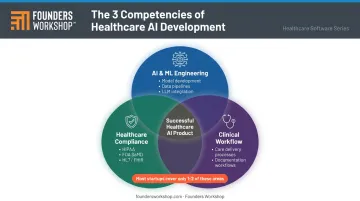
Most early-stage healthcare startups have one of these, sometimes two. Few have all three. That gap is where projects stall, budgets blow out, or compliance gets retrofitted at great expense.
For founders who need all three without hiring a full technical team, working with a development partner that already operates across all three domains can compress timelines by weeks or months. Founders Workshop's 5D Process — covering Discovery through Deployment and ongoing development support — bridges that gap with a structured path from scoped idea to compliant, shipped product.
The firm has delivered healthcare software including EMR integrations, telemedicine platforms, and HIPAA-compliant patient communication applications, with nearshore Latin American developers operating in U.S. timezones.
Consider the Cost Structure Carefully
Team expertise matters, but so does what it costs to assemble it. Enterprise healthcare software firms charge enterprise prices — that's not the only option. Nearshore development models give healthcare startups access to senior AI developers with healthcare compliance experience at roughly one-third of U.S. in-house costs. Key advantages of this model include:
- Senior developers with healthcare compliance experience already in place
- U.S. timezone alignment for daily collaboration without offshore delays
- Roughly one-third the cost of equivalent U.S. in-house hiring
For early-stage founders, that cost differential can mean the difference between reaching MVP and running out of runway before launch.
Frequently Asked Questions
How much does it cost to develop AI-powered healthcare software in 2026?
Costs vary by scope. A focused MVP typically runs $150K to $400K; complex platforms with EHR integration, AI diagnostics, or FDA SaMD paths can reach $500K to $2M+. Nearshore development models can reduce these figures by roughly two-thirds compared to U.S. in-house teams.
How long does it take to build an AI healthcare application?
A focused MVP typically takes 3 to 6 months through a structured development process. More complex systems with deep EHR integration or multi-module AI features can run 9 to 18 months. If your product requires FDA clearance as a SaMD, add 12+ months for the regulatory process on top of development time.
What compliance requirements must AI healthcare software meet?
At minimum: HIPAA and HITECH for any system handling PHI, including BAAs with development partners. Software making clinical recommendations or diagnostic decisions falls under FDA SaMD regulations, potentially requiring 510(k) clearance or De Novo classification. EHR integration adds HL7 or FHIR requirements depending on the system.
What are the most in-demand AI features in healthcare software right now?
The four highest-growth categories in 2026 are ambient clinical documentation (largest by revenue at $600M), automated prior authorization, AI-assisted billing and coding, and patient engagement automation. These categories have measurable ROI and the strongest adoption rates among health systems currently buying AI tools.
Should healthcare startups build AI in-house or outsource development?
Building in-house means hiring for AI engineering, healthcare compliance, and clinical workflow knowledge simultaneously — a slow and expensive process for most early-stage teams. Outsourcing to a partner with established healthcare development experience typically cuts both time to market and total cost, with lower compliance risk.
How is AI changing software development timelines in healthcare?
AI-assisted development tools are reducing raw coding time in measurable ways. But healthcare-specific requirements — compliance validation, clinical testing, EHR integration, and FDA review if applicable — still require careful human oversight. Technical timelines may compress; regulatory and clinical validation timelines won't.