The scale of the underlying problem is real. The World Economic Forum's 2025 Future of Jobs Report found that skill gaps are the top barrier to business transformation, cited by 63% of employers across more than 55 economies. That's not a small friction point — it's a structural challenge affecting how companies execute.
Yet despite how frequently the term appears in vendor decks and budget conversations, most business owners understand the label without grasping the mechanics. That gap leads to mismatched provider selections, poor onboarding, and leaving most of the model's value on the table.
This guide breaks down exactly what IT staff augmentation is, how it works step by step, and when it makes sense over other hiring options.
Key Takeaways
- IT staff augmentation places external IT professionals inside your existing team — temporarily, under your direction, to fill specific gaps
- Unlike full outsourcing, you keep complete control over process, priorities, and quality
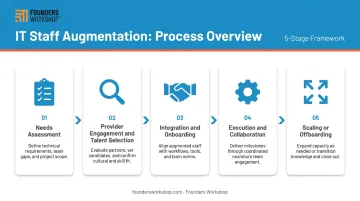
- Engagements follow a clear sequence: assess needs, select talent, onboard, execute, then scale or offboard
- Expect speed (weeks, not months), specialized skills when you need them, cost efficiency, and headcount flexibility
- Best suited for startups and SMBs with defined timelines, specific skill gaps, or budget constraints that make permanent hiring impractical
What Is IT Staff Augmentation?
IT staff augmentation is a staffing model where organizations bring in external technical professionals — developers, QA engineers, designers, or project managers — to work alongside their internal team. The engagement is scoped to a specific project, time period, or skill need, and augmented staff report directly to your team.
The model exists because both traditional alternatives have real drawbacks:
- Traditional hiring is too slow and costly for project-based or temporary needs
- Full outsourcing hands off too much control — the vendor owns the process and the timeline
Augmentation sits between the two. You get the execution capacity of external talent without relinquishing strategic oversight.
What IT Staff Augmentation Is NOT
This distinction matters because confusion here causes real operational problems:
- Not outsourcing — where a vendor owns the project and its methodology
- Not freelancing — which shifts payroll admin and management entirely to you without a provider layer
- Not permanent IT staffing — augmented professionals integrate into your team temporarily, on your tools, following your processes
Once you understand what augmentation isn't, the different ways to apply it become clearer.
The Main Types
| Type | Best For |
|---|---|
| On-demand augmentation | Variable workloads, sudden bandwidth spikes |
| Project-based augmentation | Full-duration coverage of a defined initiative (app build, system migration) |
| Nearshore/remote augmentation | Cost savings with preserved time zone and communication quality |
AI hasn't changed this dynamic. Specialized human expertise in development, QA, architecture, and design remains in high demand, and augmentation is still the fastest way to access that expertise without a long-term commitment.
How Does IT Staff Augmentation Work?
The process runs through a clear, repeatable sequence. Each stage is designed to integrate external talent as smoothly as possible into your existing team and workflow.
Stage 1: Needs Assessment and Scope Definition
The engagement starts when you identify a skill gap, bandwidth problem, or project requirement your internal team can't fulfill alone. This stage involves defining:
- The specific role and required tech stack
- Expected deliverables and success criteria
- Engagement duration
- How the augmented professional will interact with existing team members
The most common bottleneck here is a vague scope. Treat this step with the same rigor you'd apply to a permanent hire job description — the more precise your definition, the faster and more accurate the talent match.
Stage 2: Provider Engagement and Talent Selection
You engage a staff augmentation provider, who presents pre-vetted candidates from their talent network. A quality provider screens for both technical fit (specific stack, relevant project complexity) and communication fit, not just resume keywords.
For U.S. startups and SMBs, nearshore providers like Founders Workshop offer a practical option here. Their team operates throughout Latin America, giving U.S. clients access to senior developers, designers, and QA professionals at roughly one-third the cost of U.S.-based teams. Overlapping time zones and fluent English communication make daily collaboration straightforward in ways that fully offshore arrangements typically don't.
Stage 3: Integration and Onboarding
Once selected, augmented staff receive access to project documentation, communication tools, and a direct introduction to the internal team lead. How well this stage is executed determines how quickly the augmented professional reaches productive output. Skimping on onboarding almost always shows up later as extended ramp-up time and avoidable friction.
Stage 4: Execution and Collaboration
Day-to-day operations look like this:
- Augmented staff attend standups and follow sprint cycles
- They report to internal project leads
- Performance standards mirror those applied to in-house team members
- The client maintains full directional control; the augmented professional delivers execution depth
Stage 5: Scaling or Offboarding
As project demands shift, you can scale the augmented team up or down without the HR burden of formal layoffs or extended notice periods. At project completion, a proper knowledge transfer (documentation, handover sessions) ensures continuity before the engagement closes. At Founders Workshop, this includes full documentation delivery and handover sessions structured around getting the client's own team ready to take ownership.
Key Benefits of IT Staff Augmentation
Access to Specialized Talent on Demand
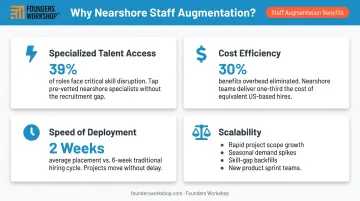
The WEF's 2025 Future of Jobs Report identifies AI/ML specialists, big data professionals, and software developers among the fastest-growing roles — and 39% of workers' current core skills are expected to be disrupted or outdated by 2030. Keeping every specialty on permanent payroll isn't just expensive; it's structurally impractical at that pace.
Augmentation lets you bring in expertise in niche areas — AI/ML, cloud architecture, mobile development, QA automation — precisely when you need it, without carrying that cost when you don't.
Cost Efficiency Without Sacrificing Quality
Augmented professionals eliminate the overhead costs of full-time employment: benefits, recruiting fees, extended onboarding, and idle capacity between projects. BLS data shows that benefits alone account for nearly 30% of total private-industry compensation costs in the U.S. — meaning the actual cost of a full-time hire runs well above base salary.
For U.S. companies using a nearshore model, the gap widens further. Founders Workshop's Latin American team operates at approximately one-third the cost of U.S.-based teams, without the time zone gaps and communication issues that come with offshore teams.
Speed of Deployment
Traditional hiring is slow. A software engineer role typically takes six or more weeks to fill — longer for specialized positions. A well-connected augmentation provider can place a vetted specialist in days; Founders Workshop, for example, typically begins work within two weeks of the initial request.
For product launches, compliance deadlines, or competitive market windows, that difference isn't administrative — it's strategic.
Scalability Without Structural Overhead
The model allows teams to expand during high-demand phases and contract afterward without carrying permanent headcount through slower periods. Common triggers include:
- Product launches that need a temporary surge in engineering capacity
- Platform migrations requiring specialized skills for a defined window
- Seasonal demand spikes where permanent hires would sit idle afterward
- Funding-driven growth phases where headcount needs outpace long-term forecasts
For startups and SMBs with non-linear growth curves, this means scaling the team to match the work — not the other way around.
IT Staff Augmentation vs. Other Hiring Models
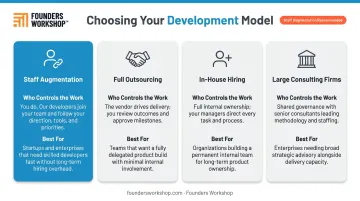
| Model | Who Controls the Work? | Best For |
|---|---|---|
| Staff Augmentation | Client manages day-to-day | Defined projects, skill gaps, bandwidth crunches |
| Full Outsourcing | Vendor owns process and outcomes | Handing off an entire function |
| In-House Hiring | Client (permanent) | Long-term institutional knowledge and core capability |
| Large Consulting Firms | Vendor-led methodology | Strategic frameworks and enterprise transformation |
Here's where those differences become practically meaningful:
- Full outsourcing transfers both the work and the control — the vendor owns the process, the methodology, and often the timeline. Augmentation keeps all of that internal. If you want execution capacity without giving up strategic direction, augmentation is the right structure.
- Full-time hiring makes sense when you're building long-term institutional knowledge and core team capability. For time-bound or specialized initiatives, it creates obligations that outlast the actual need, plus a post-project headcount problem.
- Large consulting firms sell a methodology as much as they sell execution. You often pay for the strategy deck alongside the work, and rates reflect that. A nearshore augmentation provider like Founders Workshop delivers execution-focused professionals who work your process, at roughly one-third the cost of US-based teams.
When Is IT Staff Augmentation the Right Fit?
Use Augmentation When:
- You have a defined project with a finite scope and a clear end date
- You have a specific skill gap — a niche technology or expertise area that doesn't warrant a permanent hire
- Your internal team is at capacity and can't absorb more work without compromising delivery
- Your budget environment makes permanent headcount impractical or frozen
- You need to move faster than traditional hiring allows
When Augmentation Is NOT the Right Choice:
- The work requires long-term institutional ownership and deep organizational context
- You're building core capabilities the company intends to maintain and grow permanently
- The project lacks sufficient internal technical leadership to manage external contributors effectively
In those cases, traditional hiring or a fully managed team structure is more appropriate.
When the fit criteria do line up, the cost and speed equation matters. Founders Workshop offers nearshore staff augmentation built around senior developers and designers who work in your time zone, speak your language, and cost roughly one-third of a comparable U.S. hire — without requiring equity to bring them on board.
The model has been running since 2008 across healthcare, fintech, and enterprise software. Placements typically begin within two weeks of the initial engagement.
Frequently Asked Questions
What is technology staff augmentation?
Technology staff augmentation is the practice of supplementing an internal tech team with external specialists (hired through a provider, working under the client's management) to fill skill gaps or add capacity for a defined period. The client directs day-to-day work; the provider handles sourcing and placement.
What does a staff augmentation specialist do?
A staff augmentation specialist is an external professional (developer, QA engineer, designer, project manager, and similar roles) placed within a client's team to execute specific project tasks. In practice, they function as full team members: attending standups, following sprint cycles, and reporting to internal leads, without being permanent employees.
How is IT staff augmentation different from outsourcing?
Outsourcing transfers ownership of the work and process to an external vendor, who then manages delivery. Staff augmentation keeps management and direction with the client: augmented professionals work within the client's team, on the client's terms, with the client setting priorities.
When should I consider IT staff augmentation for my business?
The clearest signals: you have a defined project with a skill or bandwidth gap, your timeline can't absorb a 6-to-12-week hiring process, or your budget doesn't support permanent headcount. If you can define the role and the deliverable, augmentation puts qualified talent in place weeks ahead of a traditional hire — at a fraction of the cost.
What are the costs associated with IT staff augmentation?
Costs vary by role, geography, and engagement model. Nearshore augmentation (Latin America for U.S. companies) typically delivers senior technical talent at roughly one-third of U.S. market rates. Offshore models may offer lower costs, but often at the expense of time zone alignment and communication quality.
What is the future of IT staff augmentation?
Nearshore and remote models are growing fastest, with real-time collaboration now rivaling cost as a selection factor. AI-assisted tools are being folded into augmented teams for documentation, code generation, and testing, while engagements increasingly measure professionals by delivery rather than hours logged.