The fastest way to burn capital on a new venture isn’t poor engineering; it’s writing code before validating the core business problem. When building a mobile app in Dallas Texas area markets, rushing straight into full production without disciplined scoping almost always leads to bloated feature sets, depleted runways, and missed market windows.
You already know the tension of balancing capital efficiency against technical excellence. Deciding between native Swift and Kotlin versus cross-platform frameworks can feel paralyzing, especially when you need accountable local leadership that treats your balance sheet with the same rigor as your product roadmap. North Texas founders don’t have to gamble their resources on unvalidated assumptions. You can systematically scope, build, and launch a high-performing mobile app MVP without burning through your budget or sacrificing long-term technical integrity.
Below, we outline an executive roadmap to validate your core product concept, select an architecture that scales reliably across iOS and Android, and align your engineering efforts directly with bottom-line business ROI.
Key Takeaways
- Explore how commercial hubs from Frisco to Fort Worth are transforming custom software from a back-office tool into a decisive competitive asset.
- Master a disciplined five-step scoping framework designed to eliminate feature bloat and protect your initial runway.
- Compare the total cost of ownership between native Swift/Kotlin and cross-platform frameworks when launching a mobile app in Dallas Texas area commercial corridors.
- Navigate the deployment pipeline from human-centered UI/UX prototypes to App Store and Google Play approvals without costly compliance delays.
- Discover the strategic advantage of pairing veteran local technology leadership with dedicated engineering execution for maximum business ROI.
Navigating the Mobile App Landscape in the Dallas, Texas Area
North Texas commercial corridors are experiencing an unprecedented surge in digital maturity. Developing a competitive mobile app in Dallas Texas area hubs means building software that operates as an enterprise revenue engine rather than a passive marketing brochure. From the telecom corridors of Richardson to the corporate headquarters lining Plano, Frisco, and Irving, businesses require software that solves operational bottlenecks and scales alongside rapid market expansion.
Many early-stage initiatives stall because organizations mistake technical activity for strategic progress. Understanding the broader process by which a mobile app is developed requires executive oversight to connect technical architecture directly with commercial milestones. Speed-to-market doesn’t stem from cutting engineering corners; it comes from ruthless prioritization of business goals over feature overload.
The Maturing DFW Tech and Venture Ecosystem
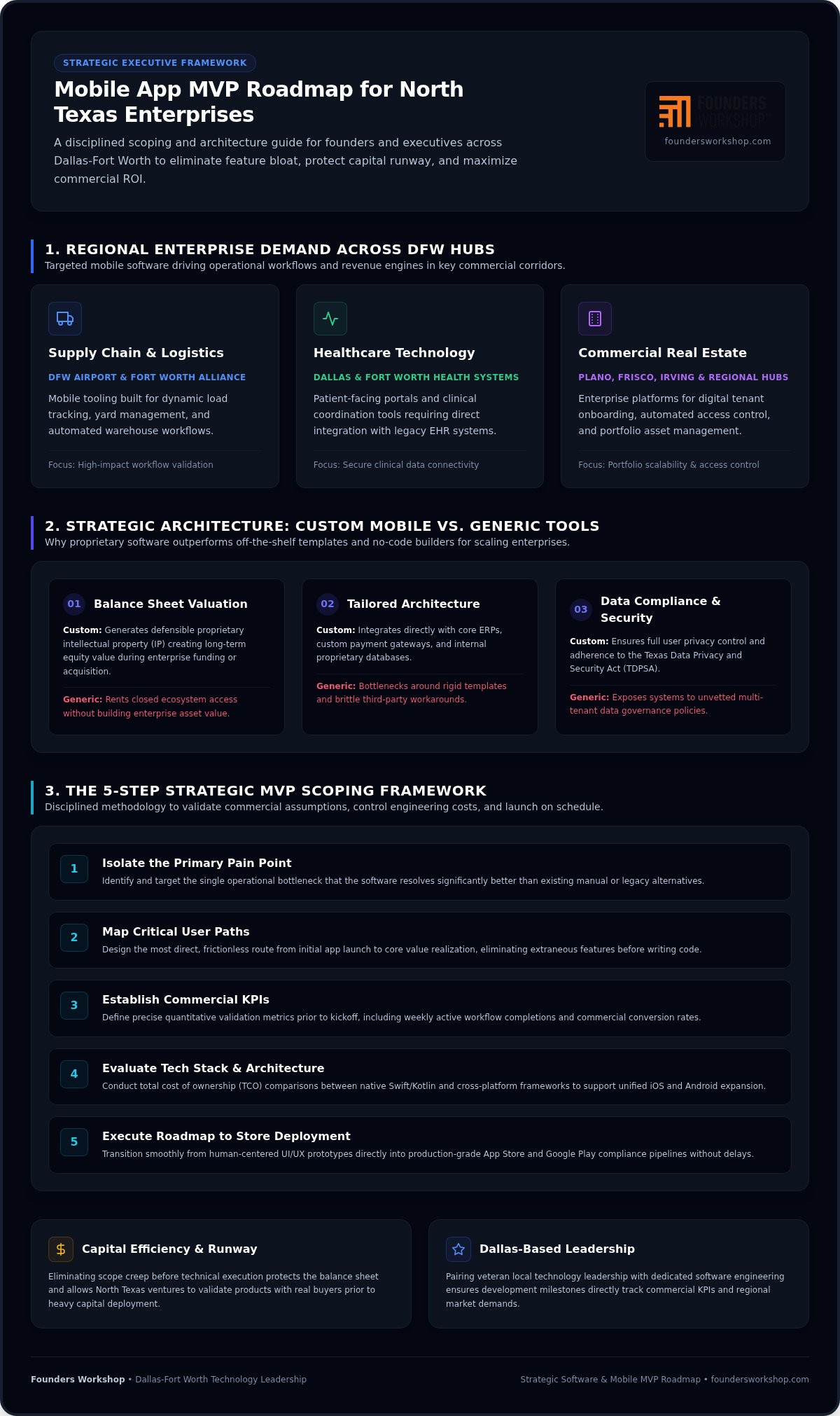
Corporate relocations and expanding private capital have transformed Dallas-Fort Worth into one of the country’s most active technology centers. This momentum drives specialized demand across several regional pillars:
- Supply Chain and Logistics: Hubs near DFW International Airport and Fort Worth Alliance rely on mobile tooling for dynamic load tracking, yard management, and warehouse workflow automation.
- Healthcare Tech: Health systems across Dallas and Fort Worth demand patient-facing portals and clinical coordination tools that integrate seamlessly with legacy electronic health record systems.
- Commercial Real Estate: Regional developers utilize mobile platforms for digital tenant onboarding, automated access control, and portfolio asset management.
Winning operators in these sectors avoid overbuilding. They validate high-impact workflows first, preserving capital while deploying production-ready tools that drive adoption.
Why Custom Mobile Applications Outperform Generic White-Label Tools
Off-the-shelf templates and no-code builders promise fast turnarounds, but they introduce structural ceilings that limit enterprise growth. When you rely on generic app wrappers, you don’t own the underlying platform; you rent access to closed ecosystems that cannot adapt to complex operational needs.
Building a proprietary mobile app in Dallas Texas area markets protects your venture by cementing three strategic advantages:
- Balance Sheet Valuation: Proprietary intellectual property creates defensible equity value during funding rounds or enterprise acquisitions, which generic platforms fail to deliver.
- Tailored Architecture: Custom builds integrate directly with your existing ERPs, payment gateways, and proprietary databases without brittle third-party workarounds.
- Data Compliance and Security: Dedicated engineering allows direct control over user privacy and regulatory mandates, including consumer protections established by the Texas Data Privacy and Security Act (TDPSA).
Scoping a Minimum Viable Product (MVP): The 5-Step Strategic Process
Most software projects exceed initial estimates not because developers write slow code, but because scope creeps before engineering even begins. An MVP is not a stripped-down, broken application; it is an executive instrument designed to test core commercial hypotheses. As researchers at Harvard Business School point out, a true minimal viable product focuses strictly on what is required to test key business assumptions with real buyers.
When launching a mobile app in Dallas Texas area commercial markets, adopting a methodical, five-step framework keeps your capital focused on market validation. Before committing to a development partner, reviewing a comprehensive MVP development in Dallas Texas area founder buying guide can help you identify the right agency model and avoid partners that prioritize billable hours over commercial outcomes:
- Isolate the primary pain point: Identify the single operational problem your software solves better than existing alternatives.
- Map critical user paths: Chart the direct route from app launch to primary value delivery, eliminating every extraneous step along the way.
- Establish commercial KPIs: Define concrete validation metrics prior to kickoff, such as weekly active workflow completions or conversion rates.
- Establish technical foundations: Choose a modern architectural pattern that accommodates future integration demands without requiring total rewrites down the line.
- Align cross-functional execution: Unify product design, backend architecture, and commercial goals under clear, accountable technical oversight.
Separating Essential Core Mechanics from Backlog Noise
Founders often succumb to feature bloat because every potential capability feels urgent during brainstorming. Disciplined scoping demands hypothesis testing: if removing a feature doesn’t prevent a user from completing their core transaction, it belongs in a later backlog.
Focus your initial release entirely on frictionless onboarding and the primary transaction engine. When planning cross-platform APIs, reviewing the fundamentals of building a scalable SaaS app in the Dallas, Texas area will show you how robust backend contracts protect your mobile client from unnecessary refactoring.
De-Risking Capital Through Iterative Milestone Releases
Traditional fixed-bid vendor contracts often create friction between founders and development teams when priorities inevitably evolve. Structuring software engineering around bi-weekly, testable milestones ensures you evaluate working software rather than static slide decks.
Implement internal alpha builds early so non-technical stakeholders can test workflows directly on physical hardware. Pairing early user testing with automated regression suites keeps your technical debt manageable while accelerating your release timeline. If you want experienced product leadership to help prune your feature backlog before writing a line of code, explore partnering with Founders Workshop to run a disciplined discovery sprint.
Scoping discipline isn’t about doing less; it’s about validating your commercial model before committing significant capital to full-scale engineering. Founders who need a practical framework for prioritizing features without overspending should review this guide to building a minimum viable product on a budget, which outlines how to identify what not to build before committing resources to development.
Evaluating Tech Stacks: Native Development vs. Cross-Platform Frameworks
Selecting your underlying technology is a permanent business commitment. When building a mobile app in Dallas Texas area commercial sectors, founders often view native versus cross-platform development as purely a technical debate. In reality, this choice dictates your engineering headcount, feature velocity, and ongoing total cost of ownership across the life of your product.
In the United States, iOS represents roughly 58% to 60% of operating system market share, with Android claiming the remaining 40% to 42%. Building two separate native codebases right out of the gate doubles your engineering surface area and splinters your development budget before you validate market demand.
When Cross-Platform Delivers Maximum Business Value
Modern cross-platform frameworks have matured past the performance bottlenecks of earlier hybrid tools. For most B2B portals, two-sided marketplaces, and operational dashboards, platforms like React Native and Flutter are now the default baseline.
- Single Codebase Maintenance: One engineering team maintains business logic, user authentication, and data models across both iOS and Android simultaneously.
- Synchronized Feature Releases: Product updates launch simultaneously in the Apple App Store and Google Play, preventing fragmented customer feedback between operating systems.
- Capital Efficiency: Engineering teams eliminate redundant work, allowing founders to allocate development resources toward customer acquisition and iterative UX improvements.
Scenarios Demanding Dedicated Native iOS and Android Builds
Cross-platform frameworks solve most operational challenges, but specific commercial applications still require platform-specific languages like Swift for iOS and Kotlin for Android. Native development remains essential when your application requires direct, uninterrupted access to low-level mobile hardware.
Consider dedicated native engineering if your mobile app in Dallas Texas area rollouts depend on high-frequency Bluetooth connectivity with industrial IoT devices, heavy local graphic processing, or complex background location polling. Regulated healthcare tools requiring specialized biometric authentication or deep integration with proprietary diagnostic hardware also benefit from direct platform execution.
Cloud Infrastructure and API Scalability Considerations
Your client-facing mobile application represents only half of your system. Without resilient cloud infrastructure, even the most polished mobile UI will stall under real user traffic. Scalable architectures rely on headless API gateways that decouple client interactions from core database operations.
This decoupled pattern allows your backend to service mobile apps, future web portals, and legacy partner systems through unified endpoints. Adopting enterprise authentication standards, such as OAuth 2.0 with biometric passkey support, protects data integrity across every session. To explore how to align infrastructure decisions with sustainable funding milestones, review our strategic MVP development guide.
Executing the Roadmap: From Concept to App Store Deployment
Turning an architectural plan into a published product requires disciplined sprint cadences. When bringing a mobile app in Dallas Texas area commercial sectors to production, many ventures encounter friction not during initial coding, but during the transition from staging to live app store distribution. A predictable engineering pipeline bridges this gap by validating usability before engineers write backend integrations, keeping timelines intact.
Agile sprints work best when front-end interface builds occur in parallel with secure backend API development. This concurrent approach ensures that user data flows properly between client devices and cloud services from day one, rather than trying to patch disparate systems together right before launch.
Clickable Prototyping and Usability Validation
Static wireframes leave too much to imagination. Developing interactive, high-fidelity prototypes lets your team test user intuition on real mobile screens before engineering begins.
Navigating App Store Review Guidelines and Compliance
Deploying to the Apple App Store and Google Play involves navigating intricate compliance gates that stall unprepared product launches. Both storefronts enforce strict guidelines regarding consumer privacy disclosures, background data access, and monetization structures.
- Developer Program Accounts: Establish your Apple Developer Program account ($99 annual fee) and Google Play Console ($25 one-time registration) under your corporate entity early to avoid business verification bottlenecks.
- Texas Privacy Alignment: Comply with data collection and consumer opt-out rules mandated by the Texas Data Privacy and Security Act (TDPSA) directly within your privacy policy and in-app permissions.
- Billing Systems: Configure merchant sandbox environments properly. Apple charges a 15% commission for businesses making under $1 million annually via its Small Business Program, while Google charges a 10% service fee plus a 5% billing fee on the first $1 million.
- Regulatory Security: If deploying healthcare solutions, ensure backend APIs and cloud datastores comply fully with HIPAA and SOC2 transmission standards before submitting application bundles for review.
Once live, your launch phase transitions immediately into behavioral measurement. Monitor real-time crash telemetry, API latency, and customer conversion funnels to identify drop-off points quickly. If you want veteran oversight to steer your product through discovery, compliance, and deployment, you can partner with Founders Workshop to execute your launch roadmap with confidence.
Partnering with Founders Workshop: Dallas-Based Leadership for Software Success
Hiring a software vendor should never feel like tossing requirements over a digital fence. When organizations set out to launch a mobile app in Dallas Texas area commercial markets, traditional vendor models often introduce major points of failure. Low-cost offshore dev shops run into extreme timezone gaps, while unguided freelance rosters lack the high-level architecture needed to build enterprise-grade software.
Founders Workshop operates mainly from the Dallas area, delivering seasoned technical leadership backed by more than 30 years of executive experience. We pair hands-on domestic product management with elite nearshore developers working directly in your timezone. This model gives North Texas founders clear, direct communication, eliminating the rework and surprise expenses common with unguided offshore outsourcing.
Executive Technical Leadership Without the Overhead
Many early-stage companies struggle to bridge the gap between commercial strategy and engineering execution. Founders Workshop functions as your executive technology partner, translating complex business objectives into disciplined sprint roadmaps.
Our veteran leadership ensures that every technical decision serves a practical commercial outcome. We apply robust architectural standards from day one, protecting your codebase from technical debt and ensuring your infrastructure handles growth without continuous refactoring. To learn how dedicated engineering capacity accelerates deployment schedules, explore our nearshore staff augmentation guide.
A Transparent Partnership Focused on Business Outcomes
Predictable delivery requires complete visibility into active development. Instead of ambiguous progress reports, our sprint workflows provide continuous access to testable builds, allowing your team to evaluate working features every two weeks.
This disciplined focus directly supports key operational milestones:
- Runway Preservation: Scoping frameworks focus your initial spend strictly on features that validate market demand and prove customer willingness to pay.
- Enterprise Scalability: Clean API design and modern cloud architectures ensure your software handles real customer volume smoothly.
- Investor and Commercial Alignment: Demonstrating working, compliant software provides clear evidence of traction to funding partners and enterprise stakeholders.
Building an impactful mobile app in Dallas Texas area ecosystems requires more than raw code; it demands an experienced partner committed to your bottom line. Ready to discuss your mobile roadmap? Book a consultation with Founders Workshop to start turning your product vision into a scalable reality.
Turn Your Mobile Vision into Market Traction
Launching a successful product requires disciplined execution from day one. By prioritizing core user workflows over feature bloat, choosing the right architecture, and actively managing storefront compliance, founders protect their runway and reach product-market fit faster. Building a winning mobile app in Dallas Texas area commercial hubs isn’t about writing code as fast as possible; it’s about aligning every technical investment directly with measurable business growth.
With over 30 years of executive and software engineering leadership, Founders Workshop delivers the strategic clarity your venture needs. We combine hands-on, Dallas-based strategic oversight with elite nearshore developers working directly in your timezone. Our proven MVP delivery methodology removes technical friction, eliminates unnecessary bloat, and keeps your product focused on bottom-line ROI.
Take the next step toward launching software built for sustainable scale. Schedule a consultation with Founders Workshop today to review your mobile roadmap.
Frequently Asked Questions
How much does it cost to build a custom mobile app in the Dallas area?
Development costs depend primarily on feature complexity, compliance obligations, and whether you build native or cross-platform applications. Simple MVPs focused on a single workflow require significantly less capital than enterprise-grade systems with complex third-party integrations or regulatory requirements. Working with a partner that emphasizes disciplined MVP scoping helps Dallas founders eliminate unnecessary backlog features early, ensuring your initial investment targets direct market validation rather than bloated technical overhead.
How long does it typically take to develop and launch an MVP mobile app?
Launching a production-ready mobile app MVP typically takes between three to six months from initial discovery to app store submission. The timeline hinges on the scope of your core user flows and the readiness of your backend APIs. By maintaining a disciplined, hypothesis-driven backlog and testing through interactive prototypes, teams eliminate design revisions early and accelerate sprint cycles without cutting corners on platform security or code stability.
Should I choose React Native, Flutter, or native iOS and Android for my app?
Choose React Native or Flutter if your primary objective is speed-to-market across both iOS and Android from a single codebase. Cross-platform frameworks suit most commercial applications, marketplaces, and SaaS portals while dramatically reducing engineering overhead. Reserve native Swift and Kotlin development for applications requiring deep device hardware access, continuous background processing, low-latency Bluetooth connectivity, or specialized graphic rendering that exceeds cross-platform framework capabilities.
Why is nearshore software development more effective than offshore outsourcing?
Nearshore software development eliminates the painful communication delays and misaligned priorities common to offshore outsourcing. By pairing Dallas-based strategic leadership with dedicated talent in Latin America, engineering teams collaborate in real time during standard US business hours. This direct timezone alignment prevents misunderstood project requirements, ensures seamless daily standups, and dramatically reduces costly rework, allowing founders to maintain continuous momentum throughout active development sprints.
What ongoing maintenance does a commercial mobile app require after launch?
Post-launch maintenance involves regular operating system updates, security patches, backend database optimization, and performance monitoring. Apple and Google release annual platform updates that require timely dependency upgrades to maintain store compliance. Commercial applications also demand active crash telemetry monitoring, API infrastructure scaling, and periodic UX enhancements based on real customer feedback to prevent user churn and ensure long-term platform resilience across the lifecycle.
Can my mobile app integrate with existing enterprise internal software and ERPs?
Yes, custom mobile architecture can integrate seamlessly with legacy ERPs, CRMs, electronic health records, and proprietary cloud databases. When engineering a mobile app in Dallas Texas area enterprises, we build secure, headless API layers that bridge modern mobile frontends with existing internal software. This decoupled approach preserves your core database integrity, enforces strict role-based authentication, and modernizes field operations without requiring a complete overhaul of your legacy systems.
How does Founders Workshop handle intellectual property and source code ownership?
You retain complete ownership of all intellectual property, proprietary source code, and design assets created during your engagement. When you develop a mobile app in Dallas Texas area markets with Founders Workshop, all deliverables transfer directly to your corporate repositories upon completion. We believe proprietary software should build long-term enterprise valuation on your company balance sheet, giving your business total control over future funding rounds, licensing, or acquisitions.