
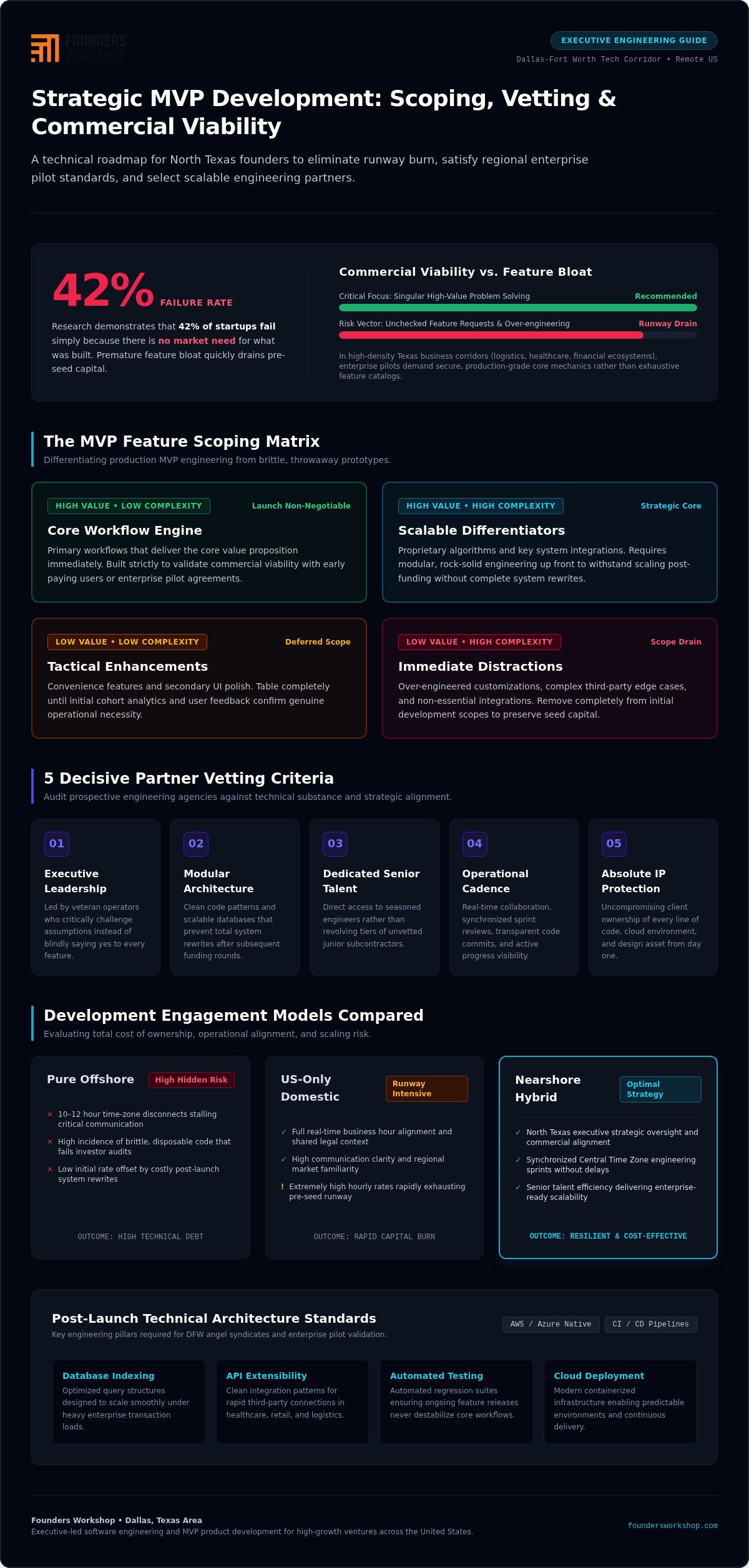
Research shows that 42% of startups fail simply because there is no market need for what they built. When evaluating options for MVP development in Dallas Texas area business hubs, that strategic risk compounds if you partner with an agency that prioritizes billable hours over commercial outcomes. Burning your seed runway on broken software or missed launch windows is a founder’s worst nightmare.
You already know the friction of managing offshore developers across conflicting time zones, just as you understand the danger of hiring unvetted contractors who deliver brittle, throwaway code you cannot scale after raising capital. Gaining early market traction requires disciplined engineering paired with executive-level strategic alignment.
In this guide, you will learn how to evaluate and select the right development partner to launch a resilient, investor-ready product on a predictable timeline. We will examine clear technical vetting criteria, compare modern agency models, and show you how to establish an architectural foundation designed to support sustainable growth.
Key Takeaways
- Define your product by core commercial viability rather than exhaustive feature lists to protect your initial capital.
- Apply five decisive technical criteria to vet engineering partners for mvp development in dallas texas area startup ecosystems.
- Evaluate total cost of ownership across offshore, domestic, and nearshore hybrid models to avoid hidden communication delays and technical debt.
- Follow a phased delivery roadmap that validates market demand while establishing a clean, scalable code architecture.
- Combine North Texas executive accountability with real-time nearshore engineering to keep development agile, cost-effective, and aligned with business goals.
Evaluating MVP Development in Dallas: Strategic Scope vs. Rapid Speed
Launching a startup software venture requires balancing immediate speed with sustainable architecture. Many agencies treat a Minimum Viable Product (MVP) as either an over-engineered enterprise prototype or a sloppy six-week hack. Both extremes burn capital without generating business value. Instead, successful founders define an MVP strictly through commercial viability: does the software solve a singular, high-value problem well enough to secure initial paying customers or enterprise pilot agreements?
Premature feature bloat quickly drains pre-seed funding. In high-density Texas business corridors, software products often serve sophisticated supply chains, healthcare networks, or complex financial ecosystems. Building every requested feature before testing core mechanics leads to stranded assets. Choosing experienced partners for mvp development in dallas texas area markets ensures you ruthlessly prioritize features that drive adoption while discarding non-essential bells and whistles.
The North Texas Startup Ecosystem Context
DFW venture capital groups and regional angel syndicates demand measurable traction before committing follow-on funding. Because North Texas hosts dozens of corporate headquarters across logistics, retail, and energy, enterprise pilots are the gold standard for validation. These regional enterprises expect secure, stable integrations, even from an early-stage product. Proving product-market fit locally requires software that meets professional standards on day one.
Minimum Viable Product vs. Disposable Prototype
Do not confuse a disposable proof-of-concept with a true production MVP. Throwaway prototypes help demo an interface, but attempting to scale them triggers catastrophic technical debt that stalls subsequent development. To prevent costly rewrites, disciplined teams evaluate features using a clear value-versus-complexity matrix:
- High Value, Low Complexity: Non-negotiable core workflows that deliver your primary value proposition immediately.
- High Value, High Complexity: Strategic differentiators that need modular, rock-solid engineering to scale smoothly.
- Low Value, Low Complexity: Tactical enhancements to table until initial cohort feedback confirms their necessity.
- Low Value, High Complexity: Distractions that should be removed entirely from initial development scopes.
By enforcing this engineering discipline, founders protect their runway, satisfy regional investor expectations, and deploy scalable products without delay.
Core Criteria for Selecting an MVP Partner in North Texas
Selecting an engineering partner requires more than reviewing a portfolio of flashy landing pages. Many agencies assign seasoned executives to pitch your business, then quietly hand off day-to-day coding to unvetted junior contractors. When vetting providers for mvp development in dallas texas area ventures, founders need clear criteria that measure technical substance and strategic alignment.
To avoid costly missteps, audit prospective teams against five decisive standards:
- Executive-Level Leadership: Engagement led by veteran operators who challenge your assumptions instead of blindly saying yes.
- Modular Architecture: Clean code patterns and scalable databases that prevent complete system rewrites after your next funding round.
- Dedicated Senior Talent: Direct access to seasoned developers rather than revolving teams of unknown subcontractors.
- Clear Operational Cadence: Real-time collaboration, synchronized sprint reviews, and transparent code commits.
- Absolute IP Protection: Complete client ownership of every line of code, cloud environment, and design asset from day one.
Vetting Technical Architecture for Post-Launch Scalability
Your early architecture dictates how smoothly your product handles growth. When engineering a scalable saas app in dallas texas area markets, ensure your vendor relies on modern, well-supported frameworks. Ask specific questions about database indexing, API extensibility, and cloud-native infrastructure on AWS or Azure. Demand automated testing suites and continuous integration pipelines so future feature releases never break core workflows.
Assessing Team Structure: Local Leadership vs. Delivery Models
Working directly with regional leaders bridges the gap between high-level business goals and ground-level technical execution. A local presence ensures genuine accountability during architectural planning and milestone evaluations. At the same time, top-tier engineering talent must be dedicated strictly to your product backlog, shielding your timeline from the disruptive turnover typical of low-tier dev shops.
Intellectual Property, Security, and Code Ownership Checks
Never leave ownership open to interpretation. Confirm in your contract that all intellectual property, repository access, and cloud hosting accounts remain under your direct control at every phase. Early-stage enterprise customers in healthcare, finance, and supply chain will review your compliance posture. Setting up strict role-based permissions, data encryption standards, and thorough architectural documentation protects your business valuation during future investor due diligence.
If you want a seasoned team to evaluate your technical scope and provide frank architectural feedback, exploring a conversation with foundersworkshop.com can help clarify your path forward before you write a single line of code.
Development Engagement Models: Offshore, US-Only, and Nearshore Hybrid
Every engineering dollar spent on your initial launch directly impacts your operational runway. Deciding how to staff mvp development in dallas texas area ventures forces founders to navigate trade-offs between hourly rates, velocity, and communication clarity. Evaluating these engagement options through the lens of total cost of ownership reveals that headline developer rates rarely tell the whole story.
The Hidden Frictions of Distant Offshore Development
Offshore firms located across ten- to twelve-hour timezone differences introduce subtle friction that destroys agile momentum. A simple requirement clarification takes twenty-four hours to cycle back, turning minor user experience tweaks into week-long blockades. Cultural gaps in interpreting product nuances often produce mechanical interpretations of features rather than thoughtful user workflows. When founders finally inspect the build, architectural shortcuts and brittle spaghetti code frequently demand a complete ground-up rewrite, wiping out initial savings.
Fully Domestic Agencies: Overhead Realities for Early Startups
Pure onshore boutique agencies eliminate timezone friction, but their cost structures reflect expensive domestic real estate and urban labor markets. Burning through seed capital on premium domestic hourly billing burns precious runway before your product ever gathers meaningful feedback from North Texas pilot users. While high-end domestic teams excel at massive enterprise transformations, pre-seed and seed-stage startups risk running out of cash long before proving their core hypotheses. Founders who need to stretch their capital further should explore strategies for building a minimum viable product on a budget to understand how disciplined feature prioritization can reduce costs without compromising quality.
The Nearshore Advantage: Real-Time Collaboration and Efficiency
The hybrid model bridges this gap by pairing Dallas executive leadership with dedicated nearshore software talent in Latin America. Operating within shared Central Time working hours transforms delivery:
- Synchronous Standups: Engineers participate actively in real-time Slack discussions, sprint planning, and emergency debugging sessions.
- Elite Technical Hubs: Latin American technology centers offer rigorous university training and deep expertise across modern frameworks.
- Runway Preservation: Founders leverage nearshore staff augmentation to achieve substantial cost efficiencies without sacrificing architectural integrity or day-to-day oversight.
Combining Dallas-based strategic accountability with high-performing nearshore engineering teams gives founders the best of both worlds: local executive guidance that protects commercial goals, backed by scalable engineering power that stretches capital further.
The MVP Delivery Roadmap: From Scoping to Market Validation
Executing software builds without a disciplined framework turns product development into an open-ended money pit. A reliable roadmap replaces guesswork with defined technical stages, ensuring that every sprint produces functional assets. When orchestrating mvp development in dallas texas area ventures, following a structured path protects capital, keeps developers accountable, and readies your product for regional enterprise pilots.
Phase 1: Strategic Discovery and Technical Scoping
Successful builds begin by converting high-level business ideas into granular user story maps and clickable wireframes. This exercise forces founders to make hard decisions about what features truly matter before writing code. Non-functional requirements, including database response targets, data security, and concurrency thresholds, are locked in early. A prioritized sprint backlog emerges, focusing resources strictly on core business logic.
Phase 2: Agile Sprints and Continuous Integration
Engineering progresses across two-week sprint cadences, with each sprint terminating in a live software demonstration rather than static status reports. Automated CI/CD pipelines compile, test, and deploy code continuously to staging environments, offering full transparency into product velocity. If your roadmap includes a native mobile app in dallas texas area launch, cross-platform frameworks ensure code reusability while keeping web and mobile interfaces synchronized.
Phase 3: Production Deployment and Feedback Loops
Deploying software into production represents the beginning of real learning, not the end of the project. Roll out the build to controlled cohorts of early adopters across North Texas corporate corridors. Built-in behavioral analytics and telemetry monitor where users convert, encounter friction, or abandon flows. These insights drive follow-on sprints, grounding future enhancements in actual user behavior rather than intuition.
To eliminate technical blind spots and build a clear delivery timeline, schedule an architecture session with foundersworkshop.com to review your scope before committing engineering capital.
Why North Texas Founders Partner with Founders Workshop for MVPs
Most development agencies operate as transactional feature factories. They accept incomplete specifications, write disconnected code, and disappear the moment their final invoice clears. Founders Workshop takes an entirely different approach to mvp development in dallas texas area communities, acting as a strategic co-founder level partner focused on durable commercial outcomes.
With over 30 years of executive and technical leadership experience, our Dallas-based team understands that code is merely a mechanism to achieve business growth. We help founders eliminate technical ambiguity, refine commercialization models, and navigate market validation without the friction common in conventional agency engagements.
Dallas-Based Executive Leadership and Strategic Partnership
Working alongside local leadership brings immediate clarity to complex product decisions. We help Texas founders stress-test their monetization mechanics, prioritize core feature roadmaps, and prepare for regional pilot opportunities. You collaborate directly with veteran leaders who speak the language of business strategy and engineering discipline, ensuring transparent communication without technical jargon or sales hyperbole.
High-Velocity Engineering with Nearshore Talent
Execution velocity hinges on seamless team communication. Our hybrid delivery model pairs Dallas executive oversight with dedicated Latin American tech talent operating across shared Central Timezone hours. These bilingual, senior-level engineers collaborate live in daily standups and sprint planning. This structure preserves precious runway while keeping technical hygiene and code documentation ready for strict investor due diligence.
Future-Proof Scaling: From MVP to Enterprise AI Workflows
Launching your initial build represents just the first step in a software company’s lifecycle. To maintain your competitive edge, our team integrates custom workflows and AI strategy consulting directly into early architecture roadmaps. Once your MVP validates market demand, our engagement transitions smoothly into ongoing dedicated engineering squads, preventing the momentum loss of onboarding an entirely new development group.
North Texas businesses require engineering partners who protect their financial runway and invest in their long-term vision. Choosing an experienced, locally guided team ensures your first product serves as a durable springboard for lasting commercial success.
Launch Your North Texas Software Venture with Confidence
Building an early-stage application doesn’t mean sacrificing engineering standards or burning your runway on misaligned vendors. Winning at mvp development in dallas texas area startup ecosystems comes down to disciplined execution. You must scope features ruthlessly for true commercial validation, establish clean architecture from your very first sprint, and secure dependable technical accountability.
With over 30 years of seasoned executive and technical leadership, Founders Workshop bridges strategic vision with dedicated, same-timezone nearshore engineering. We eliminate technical friction so you can focus on customer acquisition, regional enterprise pilots, and investor milestones. You don’t have to navigate technical unknowns alone. When you are ready to turn your product vision into a scalable reality, contact Founders Workshop for a consultation to review your roadmap and start building.
Frequently Asked Questions
How much does it typically cost to build an MVP in the Dallas Texas area?
Total investment depends on feature complexity, architectural integrations, and your chosen delivery model. Working with traditional domestic agencies often demands substantial capital to cover high metropolitan overhead. Adopting a hybrid model that pairs Dallas executive oversight with nearshore engineering reduces overall expenditure while maintaining enterprise standards. Founders should prioritize commercial viability and high-impact workflows over extensive feature backlogs to maximize their capital efficiency.
How long does the average MVP development process take from start to launch?
Most scoped MVPs reach production within three to four months. That timeline covers strategic discovery, clickable prototyping, bi-weekly sprint cycles, and beta testing. Attempting six-week shortcuts often produces unstable software that breaks during real customer onboarding. A structured three-month delivery cycle gives your team enough time to implement scalable architecture, automated deployment pipelines, and behavioral telemetry without exhausting your runway.
Can a non-technical founder manage a software engineering team effectively?
Non-technical founders can succeed by partnering with veteran technical leaders who translate commercial requirements into engineering tasks. Managing developers directly without technical experience creates communication gaps around architecture, delivery projections, and technical debt. A strategic partner acts as a fractional technology officer, managing daily standups, code hygiene, and delivery milestones so you can focus on customer acquisition and regional fundraising.
What is the difference between hiring a local agency versus an offshore team?
While distant offshore vendors advertise lower hourly rates, they introduce severe timezone drag, communication delays, and unexpected rework costs. Choosing local leadership for mvp development in dallas texas area ventures provides strategic accountability, immediate communication, and direct alignment with regional enterprise standards. A hybrid approach combines Dallas strategic leadership with dedicated Central Timezone nearshore engineers, avoiding the friction common in offshore engagements.
What happens to the code and intellectual property after the MVP is completed?
You should retain complete, unencumbered ownership of all intellectual property, source code, design systems, and cloud infrastructure environments. Reputable engineering partners commit code directly to client-owned repositories throughout each sprint cycle. Never sign contracts where a development vendor holds repositories hostage or licenses proprietary features back to your company. Full IP ownership ensures smooth technical due diligence during institutional funding rounds.
How should an MVP be built to ensure it can scale after raising venture capital?
Build with production-grade engineering principles rather than disposable prototypes. This approach requires choosing modern frameworks, designing clean database schemas, enforcing automated test coverage, and implementing continuous integration pipelines. For startups pursuing mvp development in dallas texas area hubs, this architectural discipline prevents expensive platform rewrites. When venture funds evaluate your technology, a clean, well-documented codebase proves your platform is prepared for rapid expansion.
Can Founders Workshop help integrate AI capabilities into our initial MVP build?
Yes, our team pairs Dallas leadership with specialized engineers to deliver AI strategy and custom software development within your initial build. Whether you require predictive analytics, natural language workflows, or intelligent business automation, we incorporate scalable AI components directly into foundational architectures. This equips your platform with a defensible competitive advantage, driving early traction across North Texas commercial corridors.