
What if the fastest way to control MVP costs isn’t cutting corners, but deciding what not to build? For founders building a minimum viable product on a budget, every feature competes for time and resources, while the pressure to reach the market quickly keeps growing.
That pressure is familiar to business owners across Dallas, Fort Worth, Plano, Frisco, Irving, and the wider North Texas region. U.S.-based development can strain a startup’s budget, yet choosing features without validating demand risks investing in a product customers don’t want. Add technical friction, and a promising launch can slip further away.
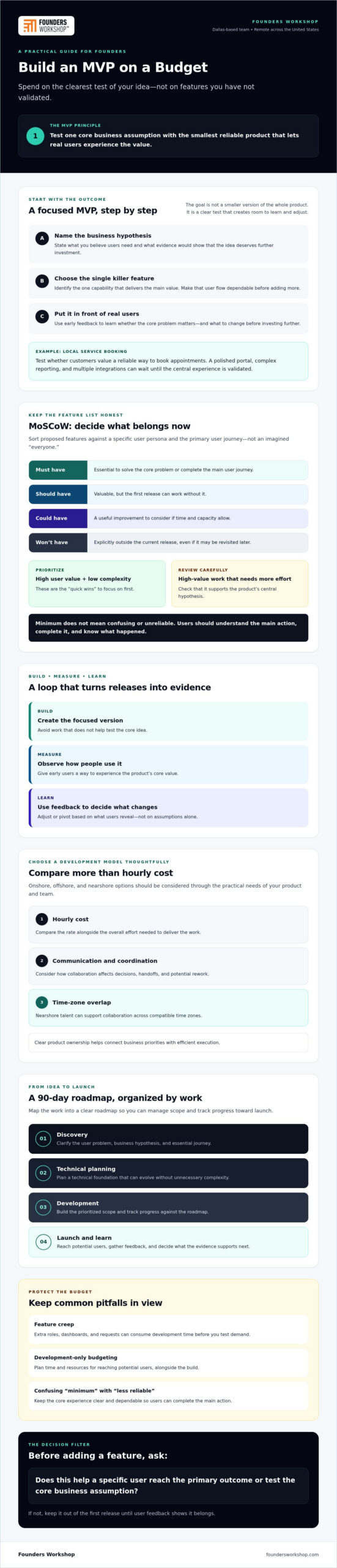
A disciplined MVP starts with one clear business hypothesis and the smallest reliable product that can test it with real users. This guide explains how to prioritize features, manage development costs, and build a technical foundation that can evolve without adding unnecessary complexity. You’ll also learn how nearshore talent can support collaboration across compatible time zones. The aim is a market-ready MVP built to learn from users and grow with evidence, on a schedule that fits the product rather than an arbitrary deadline.
Key Takeaways
- Keep the MVP focused on testing one core business assumption with early users, rather than building a smaller version of the entire product.
- Use the MoSCoW method and user personas to separate essential features from those that can wait until you have market feedback.
- Compare development models by more than hourly cost. Consider how communication and time-zone overlap may affect coordination and rework.
- Map discovery, technical planning, and development into a clear roadmap so you can manage scope and track progress toward launch.
- When building a minimum viable product on a budget, consider how nearshore talent and clear product ownership can connect business priorities with efficient execution.
Building a Minimum Viable Product on a Budget: Why Scope Matters
A minimum viable product (MVP) is the simplest version of a product that solves a meaningful problem for early adopters. It’s not just a prototype or a stripped-down version of the final product. It gives real users a way to experience the core value, so you can learn whether the idea deserves further investment. The Minimum Viable Product concept centers on learning from early releases, not polishing every possible feature before launch.
That distinction matters for your budget. Spending heavily before you’ve tested demand can leave too little capital to respond when users reveal that a different problem matters more. A focused first release preserves room to adjust, or pivot, based on what you learn. For founders building a minimum viable product on a budget, the aim isn’t simply to spend less. It’s to direct investment toward the clearest test of the business idea.
In the Dallas area, for example, a founder building software for local service businesses might begin by testing whether customers value a reliable way to book appointments. A polished customer portal, complex reporting, and multiple integrations may be useful later. First, confirm that the central booking experience solves a real problem.
The Core Philosophy of Lean Development
Identify the “single killer feature”: the one capability that delivers the product’s main value. Ask what a user must be able to do to experience the solution. Make that flow dependable, then treat other features as candidates for later, based on user feedback.
Common Budget Pitfalls for First-Time Founders
The “everything and the kitchen sink” approach can feel safer, but each extra feature expands the work required before launch. Feature creep often begins with reasonable requests, such as adding another user role or dashboard. Without clear priorities, those additions consume development time while delaying the moment you can test demand.
Another common blind spot is budgeting for development but not for reaching potential users. A product needs a path to its first customers, whether through founder-led outreach, sales conversations, or another suitable channel. Set aside time and resources for that work alongside the build. For North Texas founders, clear ownership of product decisions can help keep business priorities aligned with development, without mistaking a larger feature list for greater viability.
Prioritizing Features: The ‘Must-Have’ vs. ‘Nice-to-Have’ Framework
A useful MVP feature list isn’t the longest one. It’s the one that gives early users a complete path to the product’s core value without spending time on capabilities that don’t test your main assumption. The MoSCoW method helps teams make that distinction by sorting features into four groups:
- Must have: Essential to solve the core problem or complete the main user journey.
- Should have: Valuable, but the first release can work without it.
- Could have: A useful improvement to consider if time and capacity allow.
- Won’t have: Explicitly outside the current release, even if it may be revisited later.
Make the decisions against a specific user persona, not a hypothetical “everyone.” A persona should capture who has the problem, what they’re trying to accomplish, and what gets in their way. For example, a North Texas operations manager evaluating a workflow tool may need to assign and track a task, but not customize every report. If a feature doesn’t help that user reach the primary outcome, question whether it belongs in the MVP.
Protect the user experience, too. “Minimum” doesn’t mean confusing or unreliable. People should be able to understand the main action, complete it, and know what happened. When building a minimum viable product on a budget, clear navigation and a dependable core flow are part of viability, not optional polish.
The Value-Complexity Matrix
Plot proposed features by expected user value and development complexity. Prioritize high-value, low-complexity “quick wins,” then review high-value work that needs more effort against the product’s central hypothesis. Defer low-value, high-complexity requests. This lightweight comparison helps a team make decisions without bogging down in elaborate scoring.
When a stakeholder requests another feature, ask what user need it addresses and what evidence supports it. If it doesn’t strengthen the core journey, record it for later rather than adding it to the release. Saying “not in this version” protects the timeline while keeping the idea available for review.
User Validation on a Shoestring
Test the proposed experience before committing to code. Low-fidelity wireframes can show the sequence of screens and actions. Ask likely users to walk through a realistic task and explain where they hesitate. Conversations with founders and potential customers in the North Texas tech community can also surface assumptions to revisit. For additional mobile-product planning context, see this guide to building a mobile app in the Dallas area.
Use what you hear to revise the feature list, not to accommodate every suggestion. Look for recurring friction tied to the core problem. That discipline keeps building a minimum viable product on a budget focused on learning and user value rather than feature volume.
Cost-Efficiency Strategies: Nearshore vs. Offshore vs. Onshore
Choosing a development model is about more than comparing hourly rates. The real budget impact includes how quickly a team can resolve questions, how much oversight the work requires, and whether decisions stay aligned with the product’s goals. For founders building a minimum viable product on a budget, a lower rate may not mean a lower total cost if coordination delays or rework consume the savings.
- Onshore: A U.S.-based team can make collaboration straightforward, but its cost may be difficult for an early-stage company to sustain.
- Offshore: A team farther from U.S. time zones may offer lower rates, but limited workday overlap can slow feedback. Differences in communication practices can also create misunderstandings if expectations aren’t explicit.
- Nearshore: Latin American teams can offer a balance of cost efficiency and collaboration, particularly when their working hours overlap with Dallas and Fort Worth.
These are trade-offs, not guarantees. Evaluate the team’s experience, communication, delivery practices, and ability to work with your product stakeholders. Ask how they handle questions, document decisions, and flag risks before selecting a model.
The Nearshore Advantage for Texas Founders
For a DFW founder, overlapping business hours can make it easier to discuss a user flow, clarify a requirement, and respond to a development question during the same workday. That can reduce waiting between decisions and keep feedback connected to active work. Cultural proximity and English proficiency vary by team, so assess them directly through conversations and working examples instead of assuming they’re guaranteed.
Nearshore efficiency comes from more than geography. Clear ownership, a shared understanding of the MVP’s priorities, and practical communication routines help prevent avoidable rework. Compare proposals by the scope and delivery approach, not just the rate.
Managed Nearshore: Aligning Product and Execution
A nearshore team still needs clear product direction and accountable oversight. A product lead who understands the business can connect priorities with day-to-day execution, clarify trade-offs, and keep stakeholders aligned as the MVP takes shape. Technical architecture matters, too: even a lean first release should have a sensible path for future changes, rather than adding complexity before demand is proven. When a project requires capabilities the core team doesn’t yet have, staff augmentation for specialized skills can close that gap without committing to a full-time hire that may not fit the work ahead.
For a closer look at evaluating MVP development options in the area, read the Dallas-area MVP development buying guide. Founders Workshop provides nearshore staff augmentation, connecting North American businesses with tech talent from Latin America who can work in the client’s time zone and language. Ask potential partners how they’ll keep scope, communication, and technical decisions connected throughout the build.
The 90-Day Roadmap: From Idea to Market-Ready Product
A 90-day roadmap can give an MVP build clear checkpoints for validating scope, making trade-offs, and spotting risks before they disrupt the launch plan. It’s a working example, not a promise that every product can launch on the same schedule. Keep each phase tied to a decision or deliverable, and review scope regularly so new requests don’t quietly expand the work.
- Days 1 to 30, discovery and foundations: Clarify the target user and core problem, map the primary user journey, and test early concepts with wireframes. Agree on MVP requirements and define a technical architecture that supports the first release without building for unproven needs.
- Days 31 to 75, core development: Build the agreed user journey in short Agile sprints. At each review, compare completed work with acceptance criteria, demonstrate progress, and resolve open questions before they become rework.
- Days 76 to 90, validation and launch preparation: Test key workflows, address defects, and invite intended users to complete realistic tasks. Use their feedback to prioritize final fixes, prepare launch operations, and document issues that can wait for post-launch learning.
Set milestones around observable outcomes, such as an approved wireframe, a working core flow, and completed user acceptance testing. Pair each milestone with a scope review and a decision-maker who can approve trade-offs. That makes it easier to identify schedule or budget pressure early, while there’s still time to adjust.
Choose a Practical Tech Stack
For a budget MVP, “boring” technology can be a strategic choice. Familiar, stable tools may be easier to maintain and hire for than a newer option chosen mainly for its novelty. Cloud infrastructure can also reduce the need for upfront server investment, though ongoing usage still needs monitoring. Select technology for the product’s actual requirements, team capability, and likely next steps. For more detail, see this Dallas SaaS architecture and engineering guide.
Build Quality Into the Workflow
Continuous integration brings code changes together regularly and can run automated checks before changes move forward. This helps teams catch regressions earlier, when fixes are less disruptive than late-stage troubleshooting. Keep the initial test coverage focused on critical user journeys, and document architectural decisions so future contributors understand the foundation.
For founders in Dallas, Fort Worth, Plano, Frisco, and Irving building a minimum viable product on a budget, the goal isn’t to predict every scaling need. It’s to avoid preventable technical debt while keeping the first release focused. A team working with nearshore talent in aligned business hours can help maintain a steady feedback loop across planning and development. Discuss an MVP roadmap with a team experienced in MVP development.
Founders Workshop: A Nearshore Partner for Budget-Conscious MVPs
For Texas founders, choosing an MVP partner means trusting someone with both product decisions and execution. Founders Workshop builds MVPs and modernizes legacy applications, with project teams that can handle product strategy, UI/UX design, and technical architecture. Its nearshore staff augmentation service connects North American businesses with tech talent from Latin America, supporting collaboration in the client’s time zone and language.
For founders building a minimum viable product on a budget, the first step is to define what the product needs to prove. A focused scope gives the team a practical basis for planning design, development, and launch, while a clear agreement on deliverables helps keep work centered on the core product. Founders Workshop also offers AI strategy and development, healthcare technology solutions, internal software, and system integrations for organizations with those needs.
Why Clear Product Leadership Matters
Founders and product stakeholders need a clear point of ownership for priorities, scope decisions, and delivery questions. That doesn’t mean every conversation needs to happen in person. It means business goals and technical work have a shared context, while nearshore execution supports collaboration during overlapping working hours. Founders Workshop’s leadership team brings over 30 years of experience to its work, aligning technical execution with business growth.
Clear product leadership is especially useful when stakeholders have different views on what belongs in the first release. Bring the discussion back to the user problem, the agreed priorities, and what the team needs to learn after launch. A human-centered process keeps product decisions grounded in the needs of the business rather than technical novelty alone.
Get Started on Your MVP
A productive first conversation should clarify the problem you’re solving, who needs the solution, and which core features are essential to test the idea. It can also help you outline a business case by connecting the proposed product to user needs, business objectives, and assumptions that still require validation. You don’t need every technical decision settled before discussing the opportunity.
From there, the work is to turn a promising idea into a focused scope, a realistic delivery plan, and a product foundation that can evolve as you learn. Founders Workshop works with businesses across the United States, with nearshore talent supporting the development partnership.
Contact Founders Workshop to discuss your MVP and request a consultation.
Turn a Focused MVP Plan Into Your Next Step
A stronger MVP begins with a clear user problem, a short list of must-have features, and a build plan that leaves room to learn after launch. The right development model should support collaboration as well as cost control, while practical milestones help keep scope and decisions visible.
For founders building a minimum viable product on a budget, disciplined prioritization matters more than packing in features. Founders Workshop offers project-based software development, nearshore staff augmentation, and support for product strategy, UI/UX design, and technical architecture. Choose the engagement approach that fits the work and clarify the expected scope before development begins.
Your first step is to clarify the core problem, identify which assumptions need testing, and decide what belongs in the initial release. To discuss your MVP scope and development approach, contact Founders Workshop for a consultation.
Frequently Asked Questions
How much does it cost to build an MVP on a budget in 2026?
There’s no single reliable price for an MVP because cost depends on scope, integrations, technical requirements, and the development model. A focused product with one core user journey differs substantially from a complex platform. When comparing proposals, check what discovery, architecture, testing, infrastructure, and launch preparation include. For building a minimum viable product on a budget, define the must-have features first and request a clear scope so estimates are easier to compare.
What is the difference between an MVP and a prototype?
A prototype demonstrates or tests an idea, often through sample screens or a simulated workflow. An MVP is a usable product that delivers a core benefit to early adopters and allows you to learn from their real interactions. A prototype can help you test an approach before development; an MVP helps you evaluate the product experience and assumptions with users. Choose the method that answers your current question before investing in additional functionality.
Is nearshore development better than offshore for Texas startups?
Not in every case, but nearshore development can make collaboration easier for Texas startups because Latin American teams may share more working hours with Dallas-Fort Worth. That overlap can help teams resolve questions and review work during the same business day. Offshore teams may have less time-zone overlap, which can add coordination challenges. Compare actual availability, communication practices, language capabilities, technical experience, and project oversight rather than assuming one model always fits.
Can I build a high-quality MVP in just 90 days?
It can be possible when the product scope is focused, decisions are timely, and the core user journey is clearly defined. More complex products or unresolved requirements may need a different schedule. A practical plan uses early time for discovery and technical decisions, reserves the main development period for prioritized features, and includes testing and launch preparation. Treat 90 days as a planning example, not a guaranteed timeline. The right schedule depends on the project’s needs and agreed scope.
What are the most important features to include in an MVP?
Include the features required for a specific user to solve the core problem and complete the primary journey. Start with a persona and map the steps they need to take. For example, a booking product may need a way to find and reserve a service, while custom reports can wait if they don’t support the initial test. When building a minimum viable product on a budget, prioritize usability and a dependable core flow over feature volume.
Do I need to hire a full-time CTO to build my first MVP?
How do I choose the right tech stack for a budget-friendly app?
Choose technology that fits the product’s requirements and the team’s ability to build and maintain it. Consider the core user experience, needed integrations, data needs, security expectations, and likely next steps after launch. Established, well-supported tools can be more practical than adopting technology only because it’s new. Also understand ongoing infrastructure and maintenance needs. Ask a technical lead to explain the trade-offs in plain language before you commit to an architecture. To align your architecture and tech roadmap with broader strategic objectives, visit TechAxis Advisors.
How can a nearshore development partner support Dallas-area founders?
A nearshore development partner can connect business priorities with talent from Latin America and provide a clear point of ownership for communication and product decisions. For founders in Dallas, Fort Worth, Plano, Frisco, or Irving, overlapping business hours can make routine collaboration more direct. Founders Workshop provides nearshore staff augmentation and software development services, with talent working in the client’s time zone and language. Contact Founders Workshop to discuss your MVP plans.