Introduction
Most large enterprises have no shortage of AI pilots. What they lack is transformation.
McKinsey's 2025 workplace report found that 92% of companies plan to increase AI investments — yet only 1% of leaders describe their organizations as mature on AI deployment. Meanwhile, Gartner predicted that at least 30% of generative AI projects would be abandoned after proof of concept by the end of 2025 — citing poor data quality, unclear business value, and escalating costs.
The gap between investment and impact is real, and it's not closing on its own.
This guide walks enterprise decision-makers through what AI transformation services actually include, how to build a realistic roadmap, which use cases deliver the most measurable impact, and what to look for in an implementation partner.
AI transformation is a fundamental redesign of how an enterprise is structured and run — not a technology upgrade bolted onto existing workflows.
Key Takeaways
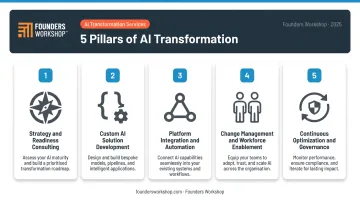
- AI transformation services span strategy, custom development, platform integration, change management, and ongoing optimization — well beyond tool deployment.
- Start with use cases tied to specific business outcomes, not AI for its own sake.
- Follow a phased roadmap: assess, pilot, scale, optimize — in that order.
- Expect data fragmentation, talent gaps, and organizational resistance to slow you down more than the technology itself.
- Choose a partner with strategic depth and hands-on implementation experience to move from stalled pilot to enterprise-wide impact.
What Are AI Transformation Services?
AI transformation services are a range of consulting, development, and implementation services that help large organizations embed artificial intelligence across their operations, products, and decision-making processes. This is different from buying an AI tool or adding a chatbot to a website.
The distinction from digital transformation matters. Digital transformation digitizes existing processes — moving paper workflows online, connecting siloed systems. AI transformation goes further: it reimagines those processes by introducing reasoning, prediction, and autonomy. You're not just making the old process faster; you're changing what the process does.
Strategy and Readiness Consulting
Before any model gets built, consultants assess an enterprise's data infrastructure, digital maturity, and existing workflows to identify where AI will create the most impact. The output is a prioritized use case map — not a general vision document, but a ranked set of initiatives aligned to specific business goals with defined success criteria.
Custom AI Solution Development
Off-the-shelf AI tools frequently underperform in enterprise contexts. They can't account for proprietary data, legacy system architecture, or unique operational constraints.
Custom models trained on an organization's own data produce more accurate, more adoptable outcomes. Founders Workshop, for example, takes an AI-first development approach — building models around a client's actual data environment rather than forcing generic tools into workflows they weren't designed for.
AI Platform Integration and Automation
Deployment targets existing enterprise systems — ERP, CRM, ITSM platforms — through automation layers, data pipelines, and capabilities like NLP or computer vision. The goal is making AI part of daily operations, not a standalone add-on that employees ignore.
Change Management and Workforce Enablement
Even a technically sound deployment fails without buy-in. Structured change management, role-based training, and transparent communication determine whether AI adoption actually sticks. AI workshops and team upskilling programs are often what separate successful deployments from technically functional systems that nobody uses.
Continuous Optimization and AI Governance
Ongoing monitoring, model retraining, performance benchmarking, and governance frameworks — including responsible AI practices, compliance alignment, and bias mitigation — are what sustain long-term value. Without this phase, models drift, accuracy degrades, and the business value erodes faster than it was built.
Key Benefits Large Enterprises Can Expect
The business case for enterprise AI is well-documented. Accenture's 2024 analysis found that companies applying generative AI to customer-related initiatives could expect 25% higher revenue after five years compared to companies focused only on productivity gains. McKinsey estimated that applying AI to customer care functions alone could increase productivity by 30% to 45% of current function costs.
Those numbers don't materialize automatically. They depend on how the transformation is executed.
Operational Efficiency and Cost Reduction
AI automates high-volume, repetitive workflows: invoice processing, compliance reporting, IT ticket routing, data entry. The efficiency gains compound when AI is deployed across multiple functions rather than in isolation. Finance teams alone spend 20–30% less time on data processing when AI is adopted robustly, according to McKinsey's 2025 finance research.
The bigger gain is what employees do with recovered time: strategic analysis, client relationships, and the problem-solving work that AI can't replicate.
Data-Driven Decision-Making
AI analytics move enterprise leaders from reactive, historical reporting to predictive and prescriptive insight. This shifts the quality of decisions at every level of the organization. Practical applications include:
- Forecasting demand fluctuations before they affect supply chains
- Detecting risk anomalies in financial and operational data in real time
- Improving planning accuracy with models that update as conditions change
Competitive Differentiation and Innovation Speed
AI accelerates product development cycles, enables customer personalization at scale, and gives enterprises the ability to respond to market shifts faster than competitors. The long-term revenue impact comes here: faster product cycles and personalization at scale compound over time in ways that cost reduction alone can't match.
Building an AI Transformation Roadmap for Large Enterprises
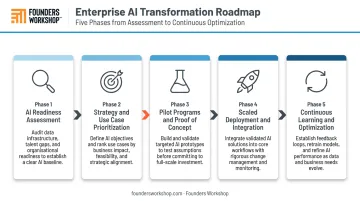
Successful AI transformation starts with deliberate sequencing — prove value in controlled environments, scale what works, and build organizational confidence through evidence. Here's how that plays out in practice.
Phase 1 — AI Readiness Assessment
A thorough readiness assessment covers:
- Whether your data is clean, accessible, and trainable
- Where integration points exist and what infrastructure constraints apply
- Which workflows carry the highest automation potential
- Whether internal talent can sustain what gets built
The output is an honest picture of where the enterprise is starting from — not where leadership wants to be. Most practitioners recommend completing this diagnostic within the first 90 days, before any pilot work begins.
Phase 2 — Strategy and Use Case Prioritization
From the assessment, rank use cases by three criteria: business impact, technical feasibility, and speed to value. Define success metrics for each initiative before a single line of code is written. Critically, align the roadmap to board-level priorities — AI transformation needs executive sponsorship, not just IT advocacy.
Phase 3 — Pilot Programs and Proof of Concept
Controlled pilots validate both technical feasibility and organizational adoption readiness. Best practices:
- Define success metrics before you start — not after results come in
- Involve end users in design so the system reflects how work actually happens
- Build a feedback loop so pilot learnings directly shape the next phase
- Keep scope tight — a focused pilot that succeeds is worth more than a broad one with ambiguous results
Phase 4 — Scaled Deployment and Integration
Scaling AI across an enterprise requires more than replicating a pilot. It demands:
- Reliable data pipelines connecting source systems
- Interoperability between AI outputs and existing platforms
- Cross-functional coordination between IT, operations, and business units
- A governance framework that keeps models compliant and observable as they expand
Phase 5 — Continuous Learning and Optimization
AI transformation is never finished. Models drift as data evolves, priorities shift, and new capabilities emerge on a regular basis. Enterprises that sustain AI gains build regular review cycles, automated performance monitoring, and a culture of iteration directly into their operating model — so AI is treated as a living system rather than a completed project.
High-Impact Enterprise AI Use Cases
The highest-performing enterprise AI initiatives share one trait: they address a specific, high-frequency business problem with measurable outcomes. Here are the use cases delivering the most consistent value.
IT Operations and Service Management
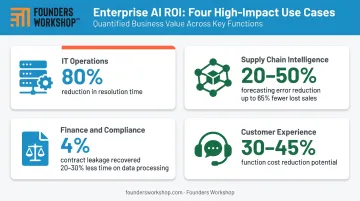
AI transforms IT by automating ticket classification and routing, providing predictive issue detection before downtime occurs, and enabling self-service resolution at scale. ServiceNow's internal Now Assist deployment reduced the time needed for each resolution note by approximately 80%, increased employee deflection rates by 14%, and saved agents 4–6 minutes per ITSM interaction. Across thousands of daily tickets, those per-interaction savings compound into a measurable reduction in total IT headcount cost.
Customer Experience and Intelligent Support
AI-powered support systems reduce response times, improve first-contact resolution, and personalize interactions based on behavioral data. Common implementations include:
- Generative AI copilots that surface relevant answers in real time
- Intelligent knowledge bases that self-update from resolved tickets
- Automated triage routing cases to the right team without human intervention
This applies equally to customer-facing and employee-facing support functions. McKinsey estimates customer care represents 30–45% of function costs — making it one of the clearest ROI targets for AI investment.
Supply Chain Intelligence and Demand Optimization
McKinsey's supply chain research shows AI-driven forecasting reduces errors by 20–50%, cuts lost sales from product unavailability by up to 65%, lowers warehousing costs by 5–10%, and reduces administration costs by 25–40%. For enterprises where inventory decisions carry significant financial weight, these figures represent a direct margin improvement.
Finance, Risk, and Compliance Monitoring
AI strengthens finance operations through automated invoice processing, anomaly detection for fraud and compliance violations, AI-driven financial modeling, and contract review automation. McKinsey described a global biotech company using agentic AI for invoice-to-contract compliance that uncovered contract leakage equivalent to approximately 4% of total spend — translating to tens of millions in recoverable margin for large organizations. Finance teams report 20–30% less time spent on data processing after robust AI adoption.
HR Automation and Talent Intelligence
AI use cases span the full employee lifecycle:
- Automated onboarding coordination that reduces manual handoffs
- Intelligent training recommendations based on role and performance gaps
- AI-assisted performance feedback drafting for managers
- Real-time answers to HR policy questions via conversational AI
The outcome is lower administrative burden on HR teams and faster, more consistent employee support.
Overcoming Common Enterprise AI Transformation Challenges
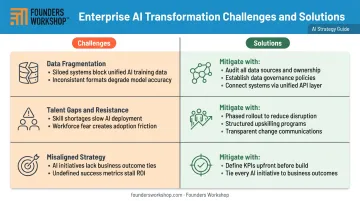
Most enterprises that launch AI initiatives never reach full-scale deployment — McKinsey research puts the failure-to-scale rate above 70%. The barriers are predictable and solvable, but only if you name them honestly.
Data Fragmentation and Governance Gaps
Most large enterprises have data spread across disconnected systems, in inconsistent formats, with unclear ownership. AI built on fragmented data produces unreliable outputs — and unreliable outputs erode organizational trust quickly.
The fix requires investing in data infrastructure before building AI models:
- Conduct data quality audits early in the roadmap
- Establish governance policies defining data ownership and usage
- Prioritize connecting source systems before training models on them
Talent Gaps and Organizational Resistance
Two interlinked challenges: the shortage of AI engineering expertise makes in-house development expensive and slow, while employee resistance emerges when AI is rolled out without transparent communication or role clarity.
Mitigation strategies that work:
- Phased rollouts that give employees time to adapt
- Upskilling programs tied to specific role changes
- Transparent communication about what AI will and won't change
- Partnering with external AI development teams to close the engineering gap
Misaligned Strategy and Unclear ROI
Enterprises that pursue AI without defining success metrics upfront end up with disconnected pilots that never justify scaling investment. Every AI initiative needs a specific business outcome and measurable KPIs defined before development begins — not retrofitted after the fact to justify sunk costs. Without that upfront definition, even well-executed pilots stall at the budget approval stage.
Choosing the Right AI Transformation Services Partner
Most enterprises cannot (and should not) build every AI capability in-house. The right partner accelerates time-to-value, reduces risk, and brings methodologies proven in real-world deployments.
What to Look for in an AI Transformation Partner
Key evaluation criteria:
- Built and deployed custom AI solutions — not just advised on them
- Translates strategy into working software, with a defined process for doing so
- Connects AI to existing ERP, CRM, and ITSM infrastructure
- Defines accountability and project ownership clearly from day one
Firms like Founders Workshop — operating since 2008 with 200+ custom software solutions delivered — represent the kind of implementation depth enterprises should look for. Their services span generative AI, RPA, conversational AI, and custom model development, combining strategic consulting with hands-on build capability under one roof. Pure advisory firms and pure builders both create gaps; the right partner does both.
Build, Buy, or Partner — How to Frame the Decision
| Approach | Pros | Cons |
|---|---|---|
| Build in-house | Maximum IP control, internal capability development | High talent cost, 3–6 months to recruit, significant time-to-value lag |
| Buy SaaS AI tools | Fast deployment, lower upfront cost | Limited customization, vendor dependency, can't account for proprietary data |
| Partner externally | Custom solutions faster, proven methodology, lower long-term cost | Requires careful partner selection and clear IP agreements |
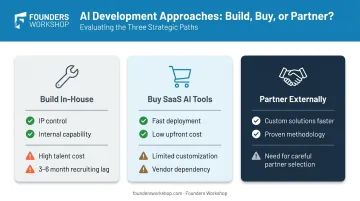
Partnering with a specialized AI development firm delivers custom solutions at a fraction of in-house cost. Founders Workshop's nearshore Latin American model, for example, provides enterprise-grade AI development teams at roughly one-third the cost of equivalent US-based teams, with full time-zone alignment. For most enterprises, that combination is the fastest path from strategy to deployed AI.
Frequently Asked Questions
What is the difference between AI transformation and digital transformation?
Digital transformation focuses on digitizing existing processes — moving workflows online, connecting systems. AI transformation redesigns how work happens by embedding reasoning, prediction, and autonomy into those workflows. AI transformation typically builds on the data and infrastructure foundation that digital transformation created.
How long does enterprise AI transformation typically take?
A readiness diagnostic and early pilots can be completed within three to twelve months. Enterprise-wide deployment and operational maturity typically takes one to three years, depending on organizational scale, data readiness, and strategic scope.
What are the most important success factors for enterprise AI transformation?
Executive sponsorship, high-quality data infrastructure, clearly defined use cases tied to business outcomes, and structured change management consistently separate scaled successes from stalled pilots.
How do enterprises measure ROI from AI transformation services?
Common ROI metrics include cost reduction from automation, productivity gains per employee, revenue impact from improved customer experience, reduction in error rates, and time-to-decision improvements. These metrics must be defined before deployment, not after — otherwise there's no baseline for meaningful accountability.
What types of AI transformation services do large enterprises typically need?
The core service categories are: strategy and readiness consulting, custom AI model development, platform integration and automation, change management and workforce enablement, and ongoing optimization and governance. Effective transformations require all five, worked through in sequence.
How should large enterprises choose an AI transformation services provider?
Evaluate the provider's implementation track record above all else — advisory credentials without deployment experience don't translate to enterprise results. Assess their methodology for moving from strategy to working software, and confirm they can integrate AI into your existing systems rather than proposing to replace them wholesale.