But for founders and business leaders, the real challenge isn't deciding if they need a chatbot—it's figuring out how to build one that works. Off-the-shelf widgets and basic bots can't handle the complex needs of a modern enterprise. You need a solution that integrates deeply with your existing systems, secures your proprietary data, and meets strict compliance standards. This guide walks you through every critical decision, from architecture and cost to security and selecting the right development partner.
TLDR: Your Enterprise AI Chatbot Guide
- Enterprise vs. Standard: Enterprise chatbots are defined by scale, deep system integrations, and compliance readiness, not just conversational quality.
- Business Value: They deliver ROI in customer support (automating responses), internal operations (IT/HR helpdesks), and sales (lead qualification).
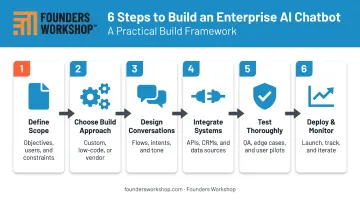
- The 6-Step Build Process: A successful project follows a clear path: define scope, choose your build approach, design conversations, integrate systems, test thoroughly, and monitor continuously.
- Realistic Costs: Budgets range from $5,000 for a simple MVP to over $500,000 for a custom enterprise build, with integrations being a major cost driver.
- Key Decisions: Your architecture (RAG, LLM orchestration) and security posture (mitigating prompt injection) are critical choices that define your chatbot's success and safety.
What Is an Enterprise AI Chatbot in 2026?
An enterprise AI chatbot is far more advanced than the simple chat widgets found on many websites. The key distinction is its underlying architecture, which is built for scale, security, and deep integration into business operations.
While a standard bot answers basic questions, an enterprise-grade bot handles thousands of concurrent interactions, pulls data from your CRM in real-time, and operates within strict regulatory frameworks like HIPAA or GDPR.
The Evolution to Hybrid Architecture
Chatbot technology has evolved rapidly. Early bots were simple, rule-based decision trees that followed rigid scripts. They were quickly replaced by bots using Natural Language Processing (NLP) to understand user intent. Today, the dominant approach for enterprise use is a hybrid architecture.
This model combines the precision of structured, rule-based flows with the flexibility of generative AI. It allows a chatbot to handle predictable tasks (like booking an appointment) with perfect accuracy while using a Large Language Model (LLM) to manage more nuanced, open-ended conversations. This balance provides a reliable user experience without the unpredictability of a purely generative system.
Chatbot vs. AI Agent: A Critical Distinction
Understanding the architecture also helps clarify another key distinction: the difference between a chatbot and an AI agent.
- A chatbot is reactive. It responds to user queries and retrieves information, escalating to a human when it reaches its limit.
- An AI agent is autonomous. It doesn't just talk; it acts by executing multi-step workflows and completing tasks without user intervention.
This distinction is critical for your budget and timeline. An AI agent delivers far more advanced capabilities but comes with significantly higher complexity and cost. For most businesses starting their conversational AI journey, building a powerful chatbot is the right first step.
Where Enterprise AI Chatbots Deliver Real Business Value
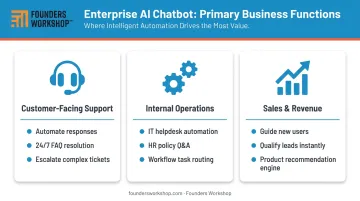
Enterprise AI chatbots create measurable value across three primary business functions. While customer-facing bots are the most visible, internal use cases are often where companies see the fastest and most significant ROI.
Three Primary Deployment Categories
- For customer-facing support, bots automate responses to common questions, qualify new leads, provide personalized product recommendations, and track orders, freeing up human agents for complex issues.
- For internal operations, chatbots act as assistants for your own teams. They can serve as an IT helpdesk for password resets, an HR assistant for policy questions, or a knowledge management tool to find information buried in internal wikis.
- To drive sales and revenue, bots guide new users through onboarding, suggest relevant upsells, and capture lead information with conversational forms that integrate directly with your CRM.
Industry-Specific Use Cases
Chatbots deliver the most value when applied to high-volume, repeatable interactions. We see strong patterns in several key industries:
- Healthcare: Automating patient triage, scheduling appointments, and answering insurance questions (while adhering to HIPAA).
- Fintech: Providing 24/7 account support, sending fraud alerts, and guiding users through loan applications.
- Retail/E-commerce: Powering product discovery, tracking shipments, and processing returns.
- Real Estate: Qualifying potential buyers or renters, recommending properties, and scheduling viewings.
A well-deployed enterprise chatbot can show value within 60–90 days, with most companies achieving a positive ROI in 8–14 months. For example, Gartner projects that by 2029, AI in customer service will cause a 30% reduction in operational costs by autonomously resolving most common issues.
How to Build an Enterprise AI Chatbot: A 6-Step Process
A successful chatbot project is built on a disciplined process. Jumping straight to the technology without a clear strategy is the most common reason projects fail to deliver value.
Define Scope and Success Metrics First Before you look at a single platform, you must define exactly what you want the chatbot to accomplish. What is the primary use case? Who is the target audience? Which channels will it operate on (website, Slack, SMS)? Most importantly, what are the measurable KPIs? A support bot, for example, might target a specific KPIs like a 60%–80% containment rate or a 30% reduction in human-handled tickets.
Choose Your Build Approach and LLM You have three main options for building your bot:
- No-Code/Low-Code Platforms (e.g., Tidio, Chatfuel): Best for simple MVPs and standard use cases. They offer fast deployment but limited customization.
- LLM API Integration (e.g., GPT-4, Claude 3, Gemini): The most common approach for custom experiences. You build your application and call a third-party LLM for its conversational intelligence.
- Fully Custom-Built: Necessary for highly regulated industries or unique workflows where you need total control over the model and data. This approach often uses open-source models.
When selecting an LLM, consider GPT for its mature ecosystem, Claude for tasks requiring long-context understanding, Gemini for Google-centric tech stacks, and open-source models like Llama or Mistral for data-sensitive, on-premise deployments.
Design Conversation Flows and Escalation Logic This is where user experience is won or lost. You must map out user journeys, define what happens when the bot doesn't understand (fallback strategies), and set clear thresholds for when to escalate a conversation to a human agent. Treat human handoff as a core feature, ensuring the transfer is seamless and preserves the full conversation context.
Build the Data Layer and Integrate with Business Systems This step has two parts. First is data curation, where you clean and structure your knowledge sources (FAQs, technical docs, support tickets) for a Retrieval-Augmented Generation (RAG) pipeline. This allows the chatbot to retrieve accurate, up-to-date information to ground its answers and avoid making things up.
Second is system integration, which involves connecting the chatbot to your CRM, ERP, and other databases via APIs. This is often the most underestimated part of the project, as connecting to legacy systems can add 20% to 50% to the total budget.
A structured methodology, like our field-tested 5D Process (Discovery, Definition, Development, Deployment, Dedicated Support), is crucial for managing this phase and preventing the costly scope creep that derails complex integrations.
Test Thoroughly Before Launch Testing goes far beyond checking for a reply. Your QA process must cover conversation accuracy, fallback behavior when the bot gets confused, performance under heavy user load, and the overall user experience. Skipping this phase erodes user trust and kills adoption before your bot even has a chance to succeed.
Deploy, Monitor, and Continuously Improve Launch day is the starting line. Post-launch, you must monitor key metrics like session volume, drop-off points, and containment rate. Implement a human-in-the-loop (HITL) process where experts review low-confidence conversations, correct errors, and feed those corrections back into the system. An unmonitored chatbot's performance will degrade within months.
Enterprise AI Chatbot Development: Costs, Timeline, and ROI
When budgeting for an enterprise chatbot, remember that the biggest costs aren't the conversational AI itself. The real drivers are complex system integrations and strict compliance needs.
Realistic Cost Tiers
- MVP/FAQ Bot ($5,000 – $30,000): A simple bot, often rule-based or with basic NLP, connected to one or two systems.
- NLP/LLM Mid-Range Bot ($30,000 – $150,000): The most common tier. This involves LLM API integration, a RAG knowledge base, 3-5 system integrations, and multi-channel deployment.
- Enterprise Custom Bot ($150,000 – $500,000+): A fully custom build for handling proprietary data, meeting strict security and compliance standards, and performing advanced workflow orchestration.
Key Cost Drivers
Pay close attention to four key cost drivers:
- Integration Scope: Connecting the chatbot to other business systems can add 20% to 50% to the total project cost.
- LLM API Costs: At scale, monthly API bills for thousands of conversations can become a significant operational expense.
- Ongoing Maintenance: Budget for 15% to 20% of the initial build cost annually for monitoring, updates, and improvements.
- Regulatory Compliance: Building for healthcare (HIPAA) or finance can increase development costs by 25% to 35% due to the required safeguards.
Timelines and ROI
- Simple Bots: 2–6 weeks
- NLP/LLM Bots with Integrations: 2–4 months
- Complex Custom Builds: 5–12 months
The ROI for a well-planned project is compelling. High-performing RAG-based systems can achieve containment rates of 70%–90%, meaning they fully resolve customer issues without human intervention. According to a 2023 report from Intercom, 58% of support leaders also saw improved CSAT scores after implementing AI and automation.
Architecture, Security, and Common Pitfalls
Building a modern enterprise chatbot means architecting for performance, security, and compliance from day one.
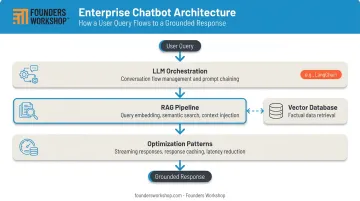
Core Architectural Layers
- LLM Orchestration: Frameworks like LangChain manage the conversation flow, control prompts, and enforce guardrails to keep the bot on topic.
- RAG Pipelines: These connect to vector databases (like Pinecone or Weaviate) to retrieve relevant information from your knowledge base, grounding the LLM's responses in factual, company-approved data.
- Optimization Patterns: Techniques like streaming responses and semantic caching are used to ensure low latency and manage API costs at scale.
Security and Compliance in the LLM Era
Switching from rule-based bots to LLM-powered systems introduces a new threat landscape. The number one risk on the OWASP Top 10 for LLM Applications is prompt injection, where a malicious user tricks the bot into ignoring its instructions.
Mitigating these threats requires a multi-layered defense: hardened system prompts, input sanitization, output filtering, and regular security testing.
On the compliance front, regulations like GDPR and HIPAA dictate everything from data storage location to user consent and audit trails. For HIPAA, this includes signing Business Associate Agreements (BAAs) with every vendor in your stack, including your LLM provider.
How to Avoid Common Failures
Most chatbot projects fail for the same few reasons. Avoid them by:
- Starting with a narrow scope: Don't try to boil the ocean. Automate 2-3 high-volume, well-defined use cases first.
- Investing in data quality: Your bot is only as good as the data it learns from. Clean and curate your knowledge base before you start building.
- Designing for failure: Build clear "I don't know" paths and graceful human handoffs from the very beginning.
- Planning for post-launch: Your project plan and budget must include resources for ongoing monitoring and improvement.
Choosing Your Build Approach and Development Partner
Choosing the right development partner is a critical final step. The right choice depends on your company's stage, internal expertise, and long-term goals.
In-House vs. Agency vs. Freelancer
- Early-Stage Startups: Often prioritize speed, making a freelancer or a small agency a good fit for an MVP.
- Growth-Stage Companies: Benefit from an experienced agency that brings a cross-functional team and proven architectural patterns.
- Enterprises: May use a hybrid model, pairing their in-house team with an agency for specialized expertise in areas like RAG architecture or compliance.
Be wary of partners who claim AI expertise but haven't shipped production-grade LLM systems. Ask them which vector databases they've deployed, how they manage token costs at scale, and what their process is for post-launch optimization.
The Founders Workshop Approach
For founders and SMBs looking for enterprise-grade results without the enterprise-level cost, Founders Workshop offers a unique hybrid model. We combine a U.S.-based team of senior AI developers and project managers with our nearshore engineering talent in Latin America.
This structure delivers development at roughly one-third the cost of a fully U.S. team without sacrificing quality, communication, or timezone alignment.
Our proven 5D Process provides a structured framework that guides clients from initial business strategy through to deployment and ongoing support. This methodology helps avoid the scope creep and integration surprises that derail most chatbot projects. It ensures your vision is translated into a market-ready product—on time and on budget.
Frequently Asked Questions
What is the difference between a chatbot and an enterprise AI chatbot?
Standard chatbots handle simple tasks with limited integrations. Enterprise AI chatbots are built for high-volume, multi-system environments with strict requirements for security, compliance, and reliability.
How much does enterprise AI chatbot development cost in 2026?
Costs range from $5,000–$30,000 for simple MVPs to $30,000–$150,000 for mid-range LLM-powered bots, and can exceed $150,000–$500,000 for complex custom builds. Integration scope and compliance needs are the biggest cost variables.
How long does it take to build an enterprise AI chatbot?
Simple bots can take 2–6 weeks, while more complex bots with deep integrations typically require 2–4 months. Fully custom enterprise solutions can take 5–12 months, with data curation and integration discovery often extending timelines.
Should I build a custom enterprise chatbot or use an existing platform?
Use a platform for rapid validation of simple use cases. Build a custom solution when you require deep system integrations, full control over proprietary data, and long-term scalability. Many companies start with a platform and evolve to a custom build.
Which LLM should I use for my enterprise AI chatbot—GPT, Claude, or Gemini?
Use GPT for its broad capabilities and mature ecosystem, Claude for tasks needing long-context understanding, and Gemini for Google-centric tech stacks. Open-source models like Llama are best for data-sensitive environments that require on-premise deployment.
How do I ensure my enterprise AI chatbot is compliant with GDPR or HIPAA?
Compliance must be architected from day one, covering data residency, retention policies, encryption, and access controls. This also requires implementing audit trails and signing Business Associate Agreements (BAAs) with all vendors.