The businesses already running AI report saving an average of 6.4 hours per week per professional. Among those with full implementations, 41% report major improvement in revenue growth.
But here's the real challenge most e-commerce operators face: they know AI matters, but the tool landscape is overwhelming. Chatbots, recommendation engines, pricing algorithms, content generators — where do you actually start? What delivers ROI for a business your size, not just for Amazon?
This guide cuts through the noise. Whether you're running a Shopify store or scaling a multi-channel operation, it maps the highest-impact use cases, the tools worth evaluating, and a framework for integrating AI without wasting budget on experiments that go nowhere.
Key Takeaways
- AI delivers measurable ROI in customer service, personalization, and marketing — not just for enterprises
- Customer support automation and personalized product recommendations are the highest-impact starting points
- Start with one specific pain point, not a broad AI rollout
- Off-the-shelf tools cover most use cases; custom development only makes sense for unique workflows or proprietary data
- Connected data across your OMS, CRM, and behavior tracking is what makes AI actually work
Why AI Is No Longer Optional for E-Commerce Businesses
The Competitive Shift Is Already Happening
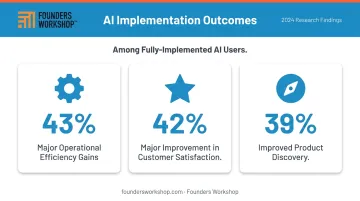
A year ago, AI gave early adopters a measurable edge. Today, it's the baseline. Salesforce data shows 84% of fully-implemented AI users report at least moderate improvements to operational efficiency and employee productivity. Among those same organizations:
- 43% report major gains in operational efficiency
- 42% report major improvement in customer satisfaction
- 39% report improved product discovery
Every month without AI is a month your competitors are resolving support tickets faster and personalizing product pages automatically. Meanwhile, those abandoned carts recover themselves — for them.
Core AI Technologies Explained Simply
You don't need to understand the engineering to evaluate AI tools. Here's what actually powers the use cases in this guide:
| Technology | What It Does for Your Store |
|---|---|
| Machine learning | Analyzes patterns in your data to make predictions — which products a shopper is likely to buy, which customers are at risk of churning |
| Natural language processing (NLP) | Lets AI understand and respond to text — powers chatbots, search, and content generation |
| Predictive analytics | Forecasts future outcomes from historical data — demand planning, inventory, email send timing |
| Computer vision | Interprets images — used for visual search, product photo generation, and fraud detection |
High-Impact AI Use Cases for E-Commerce
Personalized Product Recommendations
This is the most proven AI use case in e-commerce — and the numbers are hard to ignore. Shoppers who engage with AI-powered product recommendations show 26% higher average order value, and those who click a recommendation are nearly 4x as likely to complete a purchase compared to non-personalized suggestions, according to Salesforce research.
The mechanism is straightforward: machine learning continuously analyzes browsing history, purchase patterns, and real-time behavior to surface the most relevant products for each individual shopper. The result is both higher conversion and larger orders — simultaneously.
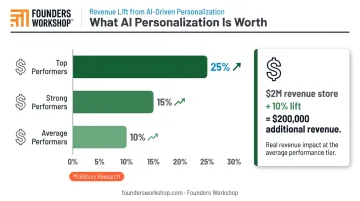
McKinsey research on personalization puts the revenue lift at 10% to 15% on average, with top performers seeing up to 25%. For a $2M annual revenue store, a 10% lift is $200,000 — from one use case.
AI-Powered Customer Service and Chatbots
The distinction that actually matters: resolution rate, not deflection rate. Basic rule-based chatbots redirect customers to FAQ articles. Modern AI agents process refunds, check order status, and update shipping addresses — and customers notice the difference.
Resolution rate is the metric that reflects real customer experience. Tidio's Lyro AI agent reports an average 64% resolution rate (peaking at 90%) with response times under 6 seconds. Gorgias positions itself as an AI agent capable of automating over 60% of support for e-commerce brands.
The key enabler: integration depth. A chatbot connected to your order management system can check order status, initiate a return, or update a shipping address. A chatbot without that connection can only suggest FAQs.
Dynamic Pricing and Demand Forecasting
AI continuously monitors your own sales history alongside competitor pricing, inventory levels, and demand signals to optimize pricing in real time. A McKinsey e-commerce dynamic pricing case documented a 10% gross margin improvement and 3% GMV gain within a few months of implementation.
For SMBs, the demand forecasting angle often delivers faster value than pricing optimization. The two costly extremes — overstock and stockouts — both stem from the same problem: inventory decisions made on intuition rather than data. AI-driven forecasting eliminates that guesswork by learning from your sales patterns, seasonal shifts, and supplier lead times.
AI for Marketing and Content Automation
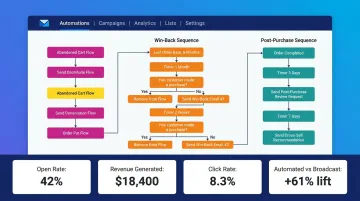
Omnisend's 2025 e-commerce marketing report analyzed 24 billion emails sent in 2024 and found that automated emails drove 37% of all email-driven sales while representing just 2% of total email volume.
That ratio is striking: one in three people who clicked an automated message made a purchase, compared to one in 18 for scheduled campaigns.
The practical takeaway: lifecycle automations (abandoned cart recovery, win-back sequences, post-purchase flows) punch far above their weight. These tools also require minimal data infrastructure to get started, making them accessible for growing businesses well before they've built sophisticated personalization systems.
AI content tools can generate product descriptions, ad copy, and visual assets at scale — cutting hours of catalog work down to minutes. Human review still matters for brand voice and accuracy, but the volume lift is real.
Smart Search and Product Discovery
Constructor's 2025 research found that shoppers who use site search drive nearly half of online revenue — and highly relevant search results produce double the click-through, add-to-cart, and conversion rates compared to poor results.
AI-powered search understands intent, not just keywords. A shopper typing "comfortable running shoes for wide feet" gets relevant results even if none of your product titles include that exact phrase. For stores with large catalogs, the improvement in product discovery directly reduces bounce rates and lifts conversion.
Fraud Detection
AI monitors transaction patterns in real time, flagging anomalies before a fraudulent charge clears. As transaction volumes grow, chargeback rates become a serious financial risk — and manual review can't keep pace.
Tools like Signifyd and Kount apply machine learning to tackle both sides of the problem:
- Catching fraudulent transactions before they clear
- Reducing false declines on legitimate orders (which represent lost revenue just like actual fraud)
The false-decline problem is underappreciated. Overly aggressive fraud filters quietly turn away real customers — and those customers rarely try again.
Which AI Tools Are Best for E-Commerce?
Customer Support Automation
The two dominant options for e-commerce:
- Gorgias — Shopify-native, built specifically for e-commerce. Claims 60%+ support automation. Pricing starts at $10/month for 50 tickets; AI Agent interactions are $1.00 each on monthly plans
- Tidio — Budget-friendly, available on Shopify. Lyro AI agent starts at $32.50/month for 50 conversations; Growth plan at $49.17/month
Evaluate on resolution rate and integration depth with your order management system (OMS), not just ticket deflection numbers.
Email and Lifecycle Marketing
- Klaviyo — The dominant platform for Shopify stores, with strong predictive segmentation and a free plan up to 250 profiles
- Omnisend — Simpler setup for multi-channel messaging; Standard starts at $11.20/month for 500 contacts
Both deliver among the fastest measurable ROI in e-commerce AI — often visible within the first billing cycle for businesses with existing list volume.
Product Search and Personalization
- Constructor and Bloomreach serve mid-market and enterprise (quote-based pricing). Bloomreach case studies document results including +35% conversion rate and 20% conversion uplift from adaptive search
- Smaller stores should start with native platform search enhancements before evaluating enterprise tools
Content Generation and Creative
- Jasper — Written content, ad copy, product descriptions
- Photoroom / Flair.ai — AI product photography. Flair.ai starts at $8/month for Pro; useful for brands without dedicated photo budgets
These tools save time on production, but human review remains necessary to keep copy and visuals on-brand.
Analytics and Attribution
- FullStory — UX friction and behavioral analytics; useful for identifying where shoppers drop off
- Triple Whale — DTC attribution and performance analytics
The value of both scales directly with how well your data sources are connected. Without integration, dashboards show you activity without revealing cause.
When off-the-shelf tools can't accommodate your operational workflows or proprietary data, a custom build becomes worth evaluating.
Founders Workshop has built custom AI capabilities — including conversational AI, RPA, and generative AI integrations — for SMBs and startups since 2008. Their nearshore development model runs at roughly one-third the cost of US-based teams.
How to Integrate AI Into Your E-Commerce Business: A 4-Step Framework
Step 1: Identify Your Biggest Pain Point First
The most expensive AI mistake is trying to deploy everything simultaneously. Before evaluating any tool, audit your operations for the single most costly or time-consuming problem:
- High cart abandonment rate?
- Customer service team overwhelmed with repetitive order questions?
- Inventory inaccuracies causing stockouts or overstock write-offs?
- Poor site search results driving shoppers to competitors?
A defined use case makes tool selection straightforward, success metrics obvious, and internal buy-in achievable. It also limits the blast radius if the first integration doesn't perform as expected.
Step 2: Start Small and Prove ROI Before Scaling
Pick one tool, implement it cleanly, and track before-and-after metrics for 60 to 90 days:
- Customer support automation: Compare ticket volume, resolution rate, and average handle time
- Email lifecycle automation: Compare abandoned cart recovery rate and revenue per email
- Product recommendations: Compare conversion rate and average order value for visitors who engage versus those who don't
Early wins create organizational confidence. They also surface data and workflow gaps you'll need to address before expanding — much cheaper to find those problems at small scale.
Step 3: Connect Your AI Tools to the Right Data Sources
Isolated AI tools underperform because they lack context. A chatbot with no OMS connection can only answer generic questions. A recommendation engine with no purchase history data can only show bestsellers, not personalized suggestions.
The biggest performance lift comes from connecting AI tools to:
- Order management system (OMS) — enables chatbots to check orders, process returns, update addresses
- CRM — enables email tools to segment by lifetime value, purchase history, and churn risk
- Product catalog and inventory data — enables recommendations and search to reflect what's actually in stock
- Behavioral data (browsing, clicks, cart) — enables personalization across the session
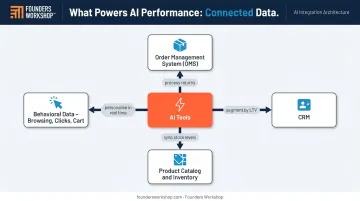
Without these connections, AI tools produce generic outputs regardless of how sophisticated the underlying model is.
Step 4: Scale What Works, Retire What Doesn't
Once a use case proves ROI, layer in adjacent capabilities using the data and infrastructure from earlier integrations. A well-integrated chatbot provides conversation data that improves your email segmentation. Better email segmentation improves your understanding of which customer segments convert on recommendations.
The goal is a progressively more connected system. To keep it that way, build in a regular review process:
- Set a quarterly review cadence for every active AI tool
- Measure each tool against its original success metrics
- Cut tools that aren't delivering measurable impact
- Reinvest that budget into integrations that are performing
Build vs. Buy: Custom AI Development vs. Off-the-Shelf Solutions
When Off-the-Shelf Is the Right Call
For most common e-commerce use cases, a proven platform already solves the problem. If a tool integrates with your stack, delivers measurable ROI at a reasonable cost, and requires no proprietary data to perform — there's no reason to build custom.
Start here. Off-the-shelf tools for email automation, customer support, and product recommendations reach production in days or weeks, not months, and the category leaders have already absorbed years of refinement.
When Custom AI Development Makes Sense
Three signals that custom development is worth exploring:
- Existing tools solve less than 80% of your problem — significant workflow gaps remain that no SaaS product addresses
- You have proprietary data that creates a competitive advantage — purchase patterns, behavioral signals, or product data no competitor has access to
- AI is core to your product's competitive value — not just an operational tool, but a differentiating feature in what you sell
When all three are true, custom development often delivers better long-term ROI than accumulating workarounds in off-the-shelf tools. Cost and time-to-market are real constraints, and a nearshore development partner can reduce both meaningfully. Founders Workshop, for example, starts new engagements in as little as two weeks at roughly one-third the cost of a US-based team. Their structured 5D process moves from discovery to deployed product in a defined, predictable sequence.
Frequently Asked Questions
Which AI tools are best for e-commerce?
The best tool depends on the problem you're solving. The main categories: customer support automation (Gorgias, Tidio), email and lifecycle marketing (Klaviyo, Omnisend), product search and personalization (Constructor, Bloomreach for mid-market), content generation (Jasper, Flair.ai), and analytics (FullStory, Triple Whale). Start with the category that maps to your biggest pain point.
How much does it cost to integrate AI into an e-commerce business?
Costs range from free or near-free (Klaviyo and Omnisend both have free tiers; Flair.ai starts at $8/month) to mid-market platforms running hundreds per month, to custom development engagements. Evaluate cost against a specific outcome — resolution rate, conversion lift, or hours saved — not against feature lists.
How long does it take to see ROI from AI integration in e-commerce?
Customer support automation and email lifecycle tools tend to show results within weeks, especially for stores with existing ticket volume or email lists. Personalization and search tools build value over time as behavioral data accumulates.
What data do I need before implementing AI?
Most tools require clean, connected data — at minimum, order history, customer behavior data (browsing and purchases), and your product catalog. The more integrated your data sources (CRM, OMS, email platform), the more your AI tools can actually do. Poor data quality is the most common reason AI integrations underperform.
Should I build custom AI or use off-the-shelf solutions?
Start with off-the-shelf for any common use case. Consider custom development only when existing tools can't address a specific workflow, or when you have proprietary data that represents a genuine competitive advantage worth training a model on.
What are the biggest mistakes e-commerce businesses make when implementing AI?
The most common: trying to implement too many tools at once, skipping the data integration groundwork, measuring deflection instead of resolution in customer support, and selecting tools based on hype rather than a specific business problem. AI doesn't fix broken processes — it accelerates them.