The market has grown fast. According to MarketsandMarkets, the conversational AI market is projected to reach $49.9 billion by 2030, growing at a 24.9% CAGR from 2024. And yet, dozens of vendors claim enterprise-grade capabilities while delivering demo-level performance in production.
This guide cuts through that noise. Below is a curated breakdown of the 10 strongest enterprise conversational AI platforms, evaluated on real criteria: scalability, integration depth, security compliance, and deployment flexibility — not just feature marketing.
Key Takeaways
- Enterprise conversational AI handles multi-turn conversations, integrates with CRM/ERP/ITSM systems, and operates across voice, chat, and messaging — far beyond basic FAQ bots
- Platform strengths vary: governance (Rasa), CRM-native (Salesforce), cloud ecosystems (Microsoft, Google, AWS), IT automation (ServiceNow), fast support resolution (Intercom, Zendesk)
- True enterprise-readiness means scalability, SOC 2/GDPR/HIPAA compliance, omnichannel support, LLM governance, and deep system integration
- Some use cases are better served by a custom-built solution than forcing a generic platform to fit a complex workflow
What Is Enterprise Conversational AI?
Enterprise conversational AI is software infrastructure that enables businesses to build, deploy, and manage AI-powered assistants capable of understanding natural language, maintaining multi-turn context, and executing real actions across enterprise systems.
What separates it from consumer chatbots:
- Connects to CRM, ERP, ITSM, and proprietary databases to take action, not just answer questions
- Maintains audit trails, LLM policy enforcement, and explainability features for enterprise governance
- Handles thousands of simultaneous interactions without degrading response quality
- Built for SOC 2, GDPR, HIPAA, and data residency requirements from the ground up
Gartner predicts that by 2028, at least 70% of customers will use a conversational AI interface to start their customer service journey. The business pressure behind that stat — reduce support costs, improve employee productivity, deliver 24/7 service — is what's driving enterprise adoption.
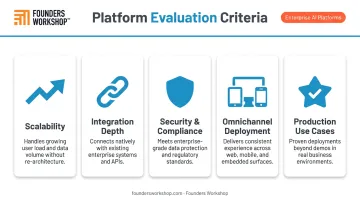
The platforms below are evaluated on exactly those criteria — integration depth, compliance readiness, and how well they perform under real enterprise load across customer experience, IT service management, and employee support use cases.
Top 10 Enterprise Conversational AI Platforms
Platforms were evaluated across seven criteria:
- Scalability and deployment flexibility
- Integration depth with enterprise systems
- Security, compliance, and LLM governance
- Omnichannel deployment (voice, chat, messaging)
- Real-world production use cases and analyst recognition
1. IBM watsonx Assistant
Built on decades of NLP research, IBM watsonx Assistant targets regulated industries — banking, healthcare, and government — with both no-code and pro-code development paths. It supports managed cloud and on-premises deployment, with HIPAA support available on Enterprise plans.
Key differentiators: advanced intent recognition even with limited training data, AI explainability features suited to compliance-heavy environments, and pre-built integrations with Salesforce, Zendesk, and ServiceNow. IBM was recognized as a Leader in the 2023 Gartner Magic Quadrant for Enterprise Conversational AI Platforms.
| Attribute | Details |
|---|---|
| Key Features | Multi-turn dialogue, RAG-powered knowledge retrieval, AI explainability, 100+ integrations, phone/chat/voice channels |
| Best For | Regulated enterprises in banking, insurance, and healthcare needing on-prem or private cloud deployment |
| Pricing | Usage-based (per monthly active user); free tier available; enterprise pricing on request |
2. Microsoft Copilot Studio
Formerly Power Virtual Agents, Copilot Studio is Microsoft's low-code conversational AI builder embedded in the Microsoft 365 and Azure ecosystem. Teams can deploy AI agents connected to SharePoint, Dynamics 365, and thousands of other services via Power Automate.
Generative AI responses are powered by Azure OpenAI, and agents publish directly to Teams and Outlook — making it the lowest-friction path for Microsoft-stack enterprises.
| Attribute | Details |
|---|---|
| Key Features | Low-code bot builder, native M365 integrations, Azure OpenAI-powered responses, voice and chat channels, Power Automate workflows |
| Best For | Enterprises running Microsoft infrastructure who want fast deployment with minimal engineering overhead |
| Pricing | Copilot Credits model; 25,000 credits at $200/month; bundled with some M365 plans |
3. Google Dialogflow CX
Dialogflow CX offers a visual state-machine flow builder for managing complex, multi-turn dialogue paths. It integrates tightly with Google Cloud Platform and supports telephony deployment through Google's Contact Center AI (CCAI).
Strong NLU accuracy across a wide range of languages, Vertex AI Search integration for knowledge retrieval, and per-request pricing ($0.007 per chat request, $0.001 per voice second) make it a fit for GCP-native enterprises with voice-heavy contact center requirements.
| Attribute | Details |
|---|---|
| Key Features | Visual flow builder, broad language support, CCAI telephony integration, webhook-based custom actions, Vertex AI integration |
| Best For | Google Cloud-native enterprises needing voice and chat with strong multilingual NLU |
| Pricing | Pay-as-you-go: $0.007/chat request, $0.001/voice second; free tier available |
4. Salesforce Agentforce
Agentforce is embedded directly in the Salesforce CRM, enabling enterprises to build autonomous AI agents for sales, service, and marketing workflows powered by Einstein AI and Data Cloud. The key advantage: native CRM data access that eliminates the integration overhead competing platforms require.
For enterprises already operating sales and service on Salesforce, this removes a separate platform migration entirely.
| Attribute | Details |
|---|---|
| Key Features | CRM-native AI agents, Einstein AI models, Data Cloud unified profiles, lifecycle automation, omnichannel deployment |
| Best For | Enterprises that run sales and service on Salesforce and want AI embedded in existing workflows |
| Pricing | $2/conversation; Flex Credits at $500/100k credits; enterprise pricing on request |
5. Kore.ai
Named a Leader in the 2025 Gartner Magic Quadrant for Conversational AI Platforms, Kore.ai offers a no-code experience platform with pre-built AI agents for banking, healthcare, retail, HR, and ITSM. Deployment options span SaaS, on-premises, and VPC — critical for regulated enterprise buyers.
Pre-built industry agents reduce deployment time significantly. Multi-engine NLP improves intent recognition across complex enterprise scenarios, and the platform's 100+ connectors cover the most common enterprise systems.
| Attribute | Details |
|---|---|
| Key Features | No-code bot builder, pre-built industry agents, multi-engine NLP, voice and chat, cloud/on-prem/VPC deployment, 100+ connectors |
| Best For | Large enterprises needing complex workflow automation across multiple departments with Gartner-recognized governance |
| Pricing | Custom enterprise pricing; usage-based options available; contact vendor for quote |
6. Rasa
Rasa is an open-core developer platform built for enterprises where data sovereignty and production reliability aren't optional. It's used by financial institutions and telcos handling millions of conversations, with a strong emphasis on self-hosted deployment.
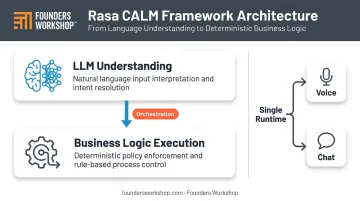
The platform's CALM (Conversational AI with Language Models) architecture separates LLM understanding from business logic execution — enabling deterministic policy enforcement without relying on prompt engineering alone. Rasa also delivers voice and chat from a single runtime, eliminating the channel fragmentation most platforms introduce.
| Attribute | Details |
|---|---|
| Key Features | Self-hosted/on-prem deployment, CALM orchestration, voice + chat from one runtime, full audit trails, code-level extensibility |
| Best For | Regulated enterprises (finance, healthcare, government) requiring data sovereignty, governance, and voice-digital parity |
| Pricing | Free Developer Edition (1,000 conversations/month); Enterprise custom pricing based on conversation volume |
7. Intercom (Fin AI Agent)
Fin is Intercom's autonomous customer support AI, trained on existing help center content and knowledge bases. Since launch, Fin's average resolution rate has grown from 23% to 71%, making it one of the strongest performers for customer-facing support deflection.
Deployment takes hours to days rather than months. Fin handles 45 languages (generally available since February 2024) and operates across a unified inbox spanning chat, email, WhatsApp, and phone. Pricing is outcome-based at $0.99 per resolved conversation.
| Attribute | Details |
|---|---|
| Key Features | Autonomous resolution from knowledge base, 45-language support, unified inbox, AI Copilot for human agents, low-code setup |
| Best For | SaaS and digital-first companies seeking fast deployment and high autonomous resolution rates for customer support |
| Pricing | $0.99/outcome; seat plans from $29/seat/month (annual); enterprise pricing available |
8. Amazon Lex
Amazon Lex uses the same deep learning technology powering Alexa — combining automatic speech recognition (ASR) and natural language understanding (NLU) in a single service. Its native integration with the AWS ecosystem (Lambda, Connect, S3) makes it a natural fit for enterprises already operating on AWS.
Amazon Connect integration enables full voice contact center deployments. Pricing is $0.00075 per text request and $0.004 per speech request, with no upfront costs. New AWS customers receive up to $200 in free tier credits.
| Attribute | Details |
|---|---|
| Key Features | ASR + NLU in one service, native AWS integrations, Amazon Connect for voice, multi-turn dialogue, serverless deployment via Lambda |
| Best For | AWS-native enterprises building voice-first or omnichannel contact center experiences at scale |
| Pricing | $0.00075/text request, $0.004/speech request; free tier credits available for new accounts |
9. ServiceNow Virtual Agent
ServiceNow Virtual Agent is purpose-built for employee-facing support: IT service management, HR service delivery, and enterprise workflow automation. It's not designed for customer-facing interactions — and that focus is its strength.
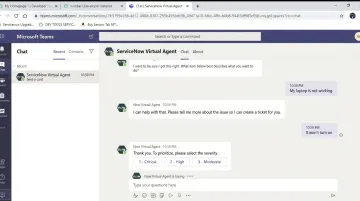
Employees can open tickets, check status, request access, and reset passwords through natural conversation in Microsoft Teams or Slack, without leaving their existing tools. Pre-built topic libraries for ITSM and HR reduce configuration time, and context-aware agent handoff preserves conversation history during escalations.
| Attribute | Details |
|---|---|
| Key Features | Native ITSM/HR workflow automation, pre-built topic library, agent handoff with context, NLU engine, Microsoft Teams/Slack integration |
| Best For | Enterprises running ServiceNow who want to automate IT, HR, and facilities support for employees |
| Pricing | Bundled with ServiceNow platform licenses; enterprise pricing based on scope |
10. Zendesk AI
Zendesk completed its acquisition of Ultimate in March 2024 and has since integrated those AI agent capabilities into a unified product. Zendesk AI layers autonomous resolution, intelligent ticket routing, generative reply suggestions, and knowledge management optimization on top of an existing ticketing workflow.
The standout feature: AI-powered knowledge gap detection that automatically identifies missing content and improves the knowledge base over time. Entry pricing starts at $19/agent/month (billed annually), with AI features available as add-ons on Professional and Enterprise tiers.
| Attribute | Details |
|---|---|
| Key Features | Autonomous AI agent, intelligent routing, generative reply suggestions, knowledge gap detection, 1,200+ marketplace integrations |
| Best For | Support teams already on Zendesk seeking AI-powered deflection and agent assistance without switching platforms |
| Pricing | Support Team from $19/agent/month (annual); AI features as add-ons on higher tiers |
How We Chose the Best Enterprise Conversational AI Platforms
The Evaluation Framework
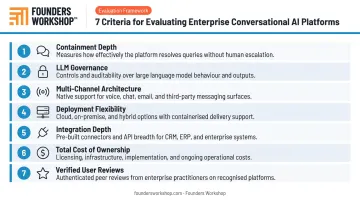
Platforms were assessed against seven criteria:
- Containment depth and multi-turn handling — can it manage complex, multi-step conversations, not just FAQs?
- LLM governance and response controls — does it enforce policies deterministically, or rely entirely on prompt engineering?
- Multi-channel architecture — voice, chat, and messaging from a single deployment or fragmented runtimes?
- Deployment flexibility and data sovereignty — cloud-only, or self-hosted options for regulated environments?
- Integration depth — native CRM/ERP/ITSM connections or generic webhook approaches?
- Total cost of ownership — license fees plus implementation, integration, training, and unresolved conversation costs
- Verified user reviews — G2, Capterra, and Gartner Peer Insights ratings in production environments
Common Buyer Mistakes
A 2024 Gartner survey found that 85% of customer service leaders planned to explore or pilot conversational GenAI in 2025 — but moving fast doesn't mean moving smart. The most common evaluation errors:
- Over-weighting demo performance on simple queries instead of testing complex, multi-step scenarios
- Ignoring data residency requirements until a cloud-only platform is already selected
- Underestimating TCO — Gartner projects GenAI cost per resolution will exceed offshore human-agent costs by 2030
When Off-the-Shelf Doesn't Fit
The "best" platform is context-dependent. A regulated bank's non-negotiables (self-hosted deployment, audit trails, deterministic policy enforcement) are completely different from a SaaS startup's (fast resolution rates, low setup time, outcome-based pricing).
Businesses with unique data sources, proprietary processes, or niche compliance requirements often find that no off-the-shelf platform fits without heavy customization. In those cases, custom AI development — through a software partner like Founders Workshop — is a more direct path than retrofitting a generic platform around a complex use case.
Before committing to any platform:
- Run a production pilot against your most complex conversation scenario
- Verify how the system handles integration failures, not just happy-path flows
- Calculate cost at your actual expected conversation volume, not demo estimates
Conclusion
The right enterprise conversational AI platform depends entirely on where AI sits within your business. Customer support deflection, IT workflow automation, regulated data handling, and omnichannel customer engagement each point to different platform strengths — and no single tool wins across all four.
Before shortlisting vendors, assess:
- Deployment model compatibility with your data governance requirements
- Total cost of ownership at your actual conversation volume, not just license fees
- Integration reliability with your existing tech stack under failure conditions
- Vendor track record in production environments similar to yours
For businesses whose requirements don't map cleanly to any platform on this list — whether because of compliance constraints, proprietary data, or workflows that would require heavy customization — a custom-built solution is often the more efficient path.
That's where Founders Workshop comes in. Since 2008, the team has delivered 200+ custom software solutions — including AI-powered applications for healthcare, financial services, and enterprise clients. If you're weighing a custom conversational AI build against the constraints of adapting to an off-the-shelf platform, start with a discovery conversation to explore what a purpose-built solution could deliver for your specific workflows and compliance requirements.
Frequently Asked Questions
What is enterprise conversational AI?
Enterprise conversational AI refers to AI platforms that automate natural language interactions at scale — across customer service, IT support, and employee workflows. These systems integrate with backend enterprise systems to execute real actions, with governance, security, and compliance architecture built for large organizations.
What is the difference between AI and enterprise conversational AI?
General AI covers a broad category of intelligent systems. Enterprise conversational AI is a specific application: purpose-built software combining NLP, LLMs, and workflow integration to handle multi-turn business conversations at scale. It adds enterprise-grade security, compliance controls, audit trails, and integration depth not found in generic AI tools or consumer chatbots.
What features should I look for in an enterprise conversational AI platform?
Prioritize these six capabilities:
- Scalability and uptime SLAs
- Compliance certifications (SOC 2, GDPR, HIPAA)
- Omnichannel deployment across voice, chat, and messaging
- Deep integration with CRM/ERP/ITSM systems
- LLM governance controls
- Real-time analytics tracking containment and resolution rates
What is the difference between a chatbot and enterprise conversational AI?
Rule-based chatbots follow scripted decision trees with keyword matching, limited to predefined flows. Enterprise conversational AI uses natural language understanding, retains multi-turn context, integrates with backend systems, and can autonomously resolve complex requests — rather than just deflecting simple ones.
How much does an enterprise conversational AI platform cost?
Pricing models vary: per-resolution (Intercom at $0.99/outcome), per-request (Google Dialogflow CX, Amazon Lex), per-seat (Zendesk from $19/agent/month), and custom annual contracts (IBM, Kore.ai, Rasa). Calculate total cost of ownership — including implementation, integration, and training — not just the license fee.
Can small businesses use enterprise conversational AI platforms?
Several platforms offer accessible entry points — Intercom, Zendesk, Amazon Lex, and Dialogflow CX all offer free tiers or low-cost plans, though on-prem deployment, governance controls, and dedicated support require higher-tier subscriptions. Startups with specific requirements may find a custom-built solution more cost-effective than an enterprise platform loaded with features they won't use.