Introduction
There's a familiar moment for software startup founders: support tickets start piling up faster than the team can respond, repetitive questions eat hours every day, and hiring another support rep feels like a losing race. AI customer support looks like the answer — but then you start pricing it out and realize the range is enormous.
A basic FAQ chatbot might cost a few hundred dollars a month. A fully automated, omnichannel system with agentic AI can run well into six figures. That gap isn't random: it reflects real differences in automation depth, integration complexity, and ongoing infrastructure.
Misreading that range leads to one of two expensive mistakes — underfunding the rollout and getting a low-accuracy bot that frustrates users, or buying enterprise-grade capabilities a seed-stage startup won't use for another two years.
This guide breaks down 2026 pricing tiers, the factors that drive costs, and the hidden expenses most startups miss — giving you a clear framework to budget for what your current stage actually needs.
Key Takeaways
- AI agents deflect roughly 45% of incoming customer queries in software and IT, with top teams resolving tickets in 32 minutes versus 36 hours without AI
- Implementation costs range from $8K–$20K (early-stage) to $20K–$75K (growth-stage) to $75K–$250K+ (mid-market)
- The biggest cost drivers are integration complexity, automation scope, and ongoing inference usage — not the platform subscription alone
- Buying a platform is faster and cheaper for most startups; building only makes sense when support workflows are inseparable from proprietary product logic
- Hidden costs like knowledge base prep, API integrations, and LLM usage fees can inflate total spend by 30–40% beyond initial estimates
How Much Does AI Customer Support Cost in 2026?
AI customer support doesn't have a fixed price. What a startup pays depends on ticket volume, automation depth, number of channels, and how much integration work existing tools require. The pricing also varies significantly by model: some platforms charge per seat, others charge per resolution or conversation.
Here's how costs typically break down by stage.
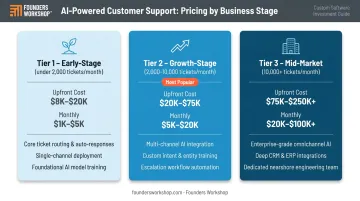
Tier 1 — Early-Stage SaaS (Under 2,000 tickets/month)
Features at this tier typically include AI chatbot for FAQ deflection, basic live chat, knowledge base indexing, and one or two platform integrations (for example, Intercom plus a CRM).
Entry-level platform pricing:
- Intercom Fin AI Agent — $0.99 per resolved outcome, no setup fees for standalone use
- Zendesk Suite Team (includes AI Agents + AI Knowledge Base) — $55/agent/month
- Tidio Lyro AI Agent — $32.50/month for 50 conversations
Typical total cost:
- Upfront (setup, configuration, knowledge base prep): $8K–$20K
- Monthly ongoing (subscription + inference + oversight): $1K–$5K
Best for: Pre-seed or seed-stage startups that need to reduce repetitive tickets and free up a founder or first support hire.
Tier 2 — Growth-Stage SaaS (2,000–10,000 tickets/month)
Features at this tier include omnichannel support across chat, email, and tickets; AI-driven routing; automated escalation workflows; and CRM and billing integrations.
Platform costs scale with volume:
- Intercom Advanced — $85/seat/month
- Zendesk Suite Professional — $115/agent/month
- Freshworks Freddy Copilot — $29/agent/month added on top of base plans
Typical total cost:
- Upfront (implementation, integrations, workflow build): $20K–$75K
- Monthly ongoing: $5K–$20K
Best for: Series A startups scaling a support team and trying to contain ticket growth without proportionally growing headcount.
Tier 3 — Mid-Market SaaS (10,000+ tickets/month)
Features at this tier include full workflow automation, agentic AI that can take actions (process refunds, update accounts), backend integrations, analytics dashboards, and security/compliance controls.
At this scale, pricing shifts to enterprise contracts. Salesforce Agentforce, a common choice here, prices at:
- $2 per conversation or $500 per 100,000 Flex Credits
- Employee-facing add-ons starting at $125/user/month
Typical total cost:
- Upfront (enterprise implementation): $75K–$250K+
- Monthly ongoing: $20K–$100K+
Best for: Later-stage startups or SaaS companies where support costs are materially eating into margins.
Key Factors That Drive AI Customer Support Costs
Four factors consistently determine where AI customer support costs land: automation scope, integration complexity, knowledge base readiness, and compliance requirements. Each one can surprise a budget if it's not scoped early.
Automation Scope
There's a meaningful gap between a bot that answers predefined FAQ questions and an agentic AI system that understands intent and triggers real actions : processing a refund, updating subscription tiers, or resetting account credentials.
The broader the automation scope:
- The more engineering effort required to map and build workflows
- The more testing needed to prevent incorrect automated actions
- The higher the platform tier (and inference cost) required to support it
Most early-stage startups should start narrow: one channel, one use case, measurable deflection rate. Expand scope once the baseline performs.
Integration Complexity
AI support systems need to connect to the tools already in use: CRM, helpdesk, billing, product analytics, and knowledge bases. Each integration adds routing logic, data mapping, and maintenance surface area.
Integration work often represents a substantial share of total implementation budget, not just the platform configuration. For startups with a complex tech stack — multiple CRMs, custom billing logic, proprietary APIs — these costs can easily exceed the platform subscription in year one.
Knowledge Base Readiness
AI accuracy depends directly on documentation quality. A startup whose support knowledge lives in Slack threads, scattered Google Docs, and an agent's memory will face a knowledge base cleanup phase before any AI can perform reliably. That prep work — organizing, writing, tagging, and indexing content — adds both time and cost.
Skipping this step doesn't save money — it just delays poor deflection rates until after launch, when they're harder to fix.
Security and Compliance Requirements
Startups in fintech, health tech, or enterprise SaaS face meaningful additional costs:
| Compliance Type | Typical Cost Range |
|---|---|
| SOC 2 Type II audit | $10K–$25K (audit fees alone) |
| Full SOC 2 all-in | $30K–$50K for small-to-midsize companies |
| HIPAA compliance | $30K–$120K for mid-sized organizations |
| GDPR (DSAR management) | €3K–€7K/year |
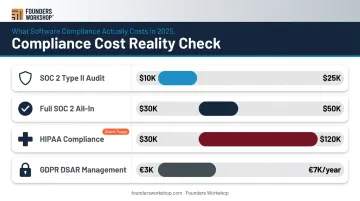
These aren't optional line items for regulated sectors — they're prerequisites for enterprise sales and customer trust.
Full Cost Breakdown: One-Time vs. Recurring Expenses
The quoted implementation price covers only a fraction of what a startup will actually spend. Platform fees get the attention, but integration work, ongoing maintenance, and inference costs stack up quietly in the background — often catching founders off guard in year one.
One-Time Costs
- Platform setup and configuration
- AI workflow creation and testing
- Knowledge base indexing and cleanup
- Initial CRM and API integration work
- Pre-launch QA and accuracy testing
For early-stage startups, these typically total $8K–$20K. For growth-stage implementations with multiple integrations, expect $20K–$75K.
Recurring Costs
- Platform subscription fees, billed per seat or per resolved conversation
- LLM/inference usage, which scales with ticket volume — OpenAI's GPT models run $0.75–$5.00 per million input tokens depending on tier
- Human oversight for QA, escalation review, and prompt optimization (even mature systems need it)
- Periodic retraining as your product evolves and AI responses fall out of date
- Integration maintenance when connected tools update their APIs and break existing connections
According to research from Glean on AI total cost of ownership, organizations that don't budget comprehensively for AI risk 30–40% budget overruns within the first year. Ongoing maintenance typically consumes 15–25% of initial deployment costs annually.
In practice, a startup that spends $30K on implementation should set aside an additional $4.5K–$7.5K per year for maintenance alone, before factoring in platform subscriptions or inference usage.
Build vs. Buy: What's More Cost-Effective for Software Startups?
LLMs and AI APIs are widely accessible in 2026, making "we'll build it ourselves" feel tempting. But a production-quality AI support system requires far more than connecting a chatbot to a website.
A full build involves:
- Workflow orchestration and escalation logic
- Omnichannel routing with context synchronization
- CRM, billing, and product analytics integrations
- Security controls, audit logs, and role-based access
- Monitoring, analytics dashboards, and ongoing model optimization
Build vs. Buy Comparison
| Dimension | Buy (Platform) | Build (Custom) |
|---|---|---|
| Deployment speed | 2–4 weeks (basic) | 6–12 months minimum |
| Engineering dependency | Low | High — 2+ senior engineers |
| Maintenance burden | Platform handles core | Fully internal |
| Cost predictability | Subscription-based | Variable; hard to forecast |
| Year 1 cost estimate | $4K–$72K+ (subscription) | ~$350K (2 engineers × 10 months) |
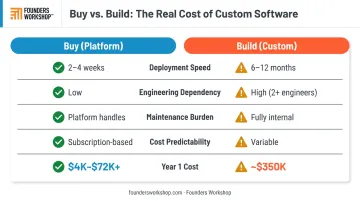
The Year 1 build estimate comes from Lorikeet's build vs. buy framework, which pegs a production-quality support AI build at approximately $350,000 — based on two senior engineers working for ten months at $175K fully loaded cost each.
Those Year 1 numbers also reveal where teams most often misjudge the investment.
The Founder Trap
The most common mistake: teams estimate the API or LLM cost and assume that's the ongoing investment. It isn't. The largest recurring costs are maintaining integrations, keeping escalation workflows accurate as the product evolves, governance controls, and model optimization. None of that is free.
When Building Makes Sense
Building a custom AI support layer is worth considering only when support workflows are deeply tied to proprietary product logic that no off-the-shelf tool can accommodate — for example, a usage-based billing system with unusual entitlement rules, or a multi-tenant platform with complex permission models.
Even then, a hybrid approach usually wins: buy a platform for the conversation layer, build custom integrations for the proprietary logic underneath.
For startups taking the custom route, a development partner like Founders Workshop can cut Year 1 costs significantly. Their model pairs U.S.-based business analysts with nearshore Latin American developers, delivering custom AI support integrations — Conversational AI, Custom GPT, workflow automation, and more — at roughly a third of a fully domestic team's cost.
Their 5D Process (Discovery, Definition, Development, Deployment, Dedicated support) also removes the guesswork from scoping. The Discovery phase alone (2–4 weeks) maps out integration requirements, knowledge base readiness, and technical architecture before committing a dollar to development.
What Most Startups Miss When Budgeting for AI Customer Support
Most AI support projects that go over budget share the same blind spots. Here are the three that consistently catch startups off guard:
1. Platform subscription is just one-third of year-one costs Integration work, knowledge base preparation, and monthly LLM inference fees together can easily match or exceed the subscription cost within year one. Budget for the full stack, not just the license.
2. Dirty documentation poisons AI output from day one AI deployed on disorganized or outdated documentation will produce inaccurate responses and frustrate customers. Fixing problems after launch costs more than preventing them upfront. If your support knowledge lives in Slack or tribal memory, plan 2–4 weeks of documentation work before any AI deployment.
3. AI support needs a human owner, not just a launch date Even well-configured AI support systems require ongoing human oversight: QA review of edge cases, escalation workflow tuning, and prompt optimization as the product changes. Startups that don't plan for this see CSAT drop within 90 days of launch as responses drift out of sync with product changes.

How to Estimate the Right AI Support Budget for Your Startup
Fit matters more than features. The right budget matches your current ticket volume, growth trajectory, and support complexity — not the most impressive vendor demo.
Before committing to a budget, assess:
- Monthly ticket volume and expected growth rate over 12 months
- Number of support channels needed now vs. one year from now
- Complexity of your existing tech stack (number and type of integrations)
- Current state of your documentation and knowledge base
- Any compliance or data security requirements for your industry
Start With a Scoped Pilot
For early-stage startups, the most cost-effective approach is a scoped pilot: one channel (typically in-app chat), one use case (FAQ deflection), and a 60–90 day measurement period. This limits upfront spend while generating real data on deflection rates, CSAT impact, and cost per ticket before any larger commitment.
A pilot also exposes hidden complexity early. If your knowledge base needs significant cleanup, better to find out during a $10K pilot than mid-way through a $60K implementation.
That scoping work — mapping integrations, auditing your knowledge base, setting measurable goals — is where most pilots succeed or stall. Founders Workshop's Discovery service covers this groundwork in a 2–4 week engagement: it maps integration requirements, identifies knowledge base gaps, and produces a prioritized implementation roadmap before any development begins.
Frequently Asked Questions
How much does AI customer support cost?
Early-stage setups (FAQ automation, single channel) typically run $8K–$20K upfront with $1K–$5K/month ongoing. Growth-stage omnichannel systems cost $20K–$75K upfront and $5K–$20K/month. Mid-market deployments with agentic AI and full workflow automation can exceed $75K–$250K+ upfront. Always factor monthly inference and maintenance costs into the total.
How long does it take to implement AI customer support for a software startup?
Basic chatbot deployments can go live in 2–4 weeks. Growth-stage omnichannel systems with CRM integrations typically take 4–12 weeks. Enterprise-grade deployments with custom workflows, security controls, and multi-system integrations often take longer — production-grade AI systems frequently take 6–12 months to fully build out when custom development is involved.
Should a software startup build or buy AI customer support?
Buying is faster and more cost-predictable for most startups — platforms deploy in weeks at a fraction of custom build costs. Building only makes sense when support workflows are tightly coupled to proprietary product logic, and even then a hybrid approach (platform conversation layer + custom integration layer) is usually cheaper and faster.
What are the hidden costs of AI customer support?
The most commonly overlooked expenses are CRM and API integration work, knowledge base cleanup, monthly LLM inference fees that scale with ticket volume, and the ongoing human oversight required to keep AI quality high over time. Together, these can add 30–40% to total first-year spend beyond the initial quoted price.
When does a software startup actually need AI customer support?
The clearest signal is when repetitive tickets consume more than a few hours per day of a founder's or support hire's time. When ticket volume grows faster than the team can scale, AI deflection typically delivers positive ROI — Gartner projects a 30% reduction in service operational costs from agentic AI handling common issues.
What ROI can software startups expect from AI customer support?
Key ROI drivers include reduced cost per ticket, faster resolution times, and higher volume capacity without added headcount. Freshworks data shows AI-enabled teams resolve tickets in 32 minutes versus 36 hours for teams without AI, and deflect roughly 45% of incoming queries in the software sector.