Introduction
AI chatbots now handle customer support, qualify leads, book appointments, and run internal workflows for businesses of every size — and adoption is accelerating fast. The global chatbot market is projected to reach $41.2 billion by 2033, growing at a 19.6% CAGR from 2026 onward.
Meanwhile, 85% of customer service leaders say they plan to explore or pilot a conversational AI solution.
But chatbot development cost remains one of the most misunderstood budget items for founders and SMBs. Prices range from $5,000 to well over $150,000 — and that spread isn't vendor markup. It reflects real differences in bot type, integration complexity, and development approach.
This guide breaks down actual 2026 price ranges, explains what moves the number, and helps you match scope to your stage and budget.
Key Takeaways
- Simple rule-based bots cost $5K–$30K; custom AI-powered bots run $30K–$150K+; SaaS platforms start free and scale to $10,000+/month
- The biggest cost drivers: bot type, number of integrations, and build-vs-subscribe decisions
- Startups with straightforward needs (FAQ handling, lead capture, booking) typically get the best ROI from a focused MVP or mid-tier SaaS platform
- Ongoing costs (maintenance, API usage, hosting, retraining) add 15–25% of build cost annually — a budget line most teams skip
AI Chatbot Development Cost in 2026: Real Price Ranges
There is no single price for an AI chatbot. The range is genuinely wide, and your starting point depends entirely on what the bot needs to do.
A quick orientation on bot types:
- Rule-based bots follow scripted decision trees — no machine learning, no NLP. Predictable, cheaper to build and maintain.
- AI-powered bots use NLP and machine learning to understand natural language, handle varied queries, and improve over time.
- Generative AI bots integrate large language models (LLMs) like GPT-5 or Claude to produce dynamic, context-aware responses at scale.
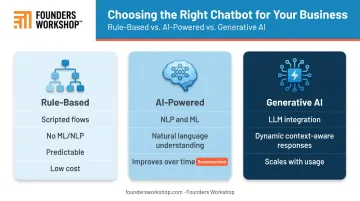
Two mistakes come up constantly in chatbot budgeting: treating all bots as equally simple (which leads to underbuilding), and buying enterprise-grade capability for a use case that only needs an MVP. The three tiers below map directly to these trade-offs.
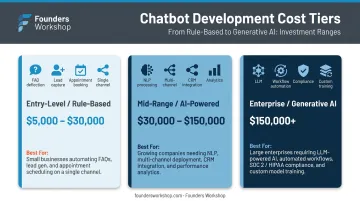
Entry-Level / Rule-Based Chatbot: $5,000–$30,000
What's included:
- Predefined decision trees and scripted conversation flows
- FAQ deflection, basic lead capture, appointment booking
- Simple channel integration (website widget or one messaging app)
- No machine learning or NLP
Best for: Small businesses needing 24/7 coverage for order tracking, scheduling, or support questions with predictable conversation paths.
Mid-Range / AI-Powered Chatbot: $30,000–$150,000
What's included:
- NLP and ML capabilities for natural language understanding
- Multi-channel deployment (web, mobile, messaging apps)
- CRM or helpdesk integration
- Sentiment detection, personalized responses, analytics dashboard
Best for: Growing companies that need varied query handling, system integrations, and measurable outcomes like lead qualification or ticket deflection.
High-End / Generative AI or Enterprise Chatbot: $150,000+
What's included:
- LLM integration (GPT-5, Claude, or proprietary model)
- Cross-department workflow automation
- Custom data training and fine-tuning
- Enterprise security and compliance controls (SOC 2, HIPAA, PCI DSS)
Best for: Enterprises with high conversation volume, regulated industry requirements, or companies building a custom conversational AI product from the ground up.
What Drives AI Chatbot Development Costs
Pricing is shaped by technical, operational, and business decisions. Understand these variables and your budget becomes predictable. Miss them and surprises hit mid-project.
Bot Type and Intelligence Level
Rule-based bots use simple conditional logic — relatively fast to build, easy to maintain. AI-powered bots require NLP engineering, training data, and periodic model updates. Generative AI bots layer on LLM API costs that scale directly with usage volume.
Current LLM API pricing illustrates the variable cost risk:
- OpenAI GPT-5.5 (short context): $5.00/1M input tokens, $30.00/1M output tokens
- Anthropic Claude Haiku 4.5: $1.00/1M input tokens, $5.00/1M output tokens
At scale, a high-traffic bot running on GPT-5.5 can generate substantial monthly API bills that weren't part of the original budget.
Number and Complexity of Integrations
Each integration — CRM, ERP, e-commerce platform, payment gateway, messaging app — adds development hours and often requires custom API work. WhatsApp Business Platform, for example, uses category-based pricing (marketing, utility, service messages) that adds ongoing operational cost on top of the development work to connect it.
A single CRM or messaging platform connection typically adds days to weeks of development time, depending on API documentation quality and required data flows — there's no flat rate.
Development Team Type and Location
Who builds it matters as much as what gets built:
| Team Type | Approximate Cost |
|---|---|
| U.S. software developer (median) | $133,080/year (BLS, 2024) |
| U.S. ML engineer | ~$162,000/year (Glassdoor, 2026) |
| U.S. QA analyst | $102,610/year (BLS, 2024) |
| Eastern Europe (hourly) | $30–$70/hour |
| Asia (hourly) | $20–$50/hour |
| Latin America (hourly) | $30–$65/hour |
Nearshore Latin American teams offer a strong middle ground — similar time zones, strong English fluency, and rates that can reduce development costs by up to two-thirds compared to U.S.-based agencies. Founders Workshop operates exactly this model from Arizona, pairing U.S.-based business analysts with nearshore Latin American developers for same-timezone collaboration at those reduced rates.
Security, Compliance, and Industry Requirements
Regulated industries face substantially higher development costs:
- SOC 2: Most small-to-midsize companies pay $30,000–$50,000 all-in for an initial SOC 2 report
- HIPAA: Compliance programs typically range from $80,000–$120,000 depending on scope
- Annual recertification adds recurring cost every year
For healthcare, fintech, and legal projects, compliance is a line item — not a post-launch fix. Build it into the initial budget or expect costly rework later.
Custom Build vs. SaaS Platform: Which Is Right for You?
The most consequential cost decision isn't which features to include — it's whether to build custom or subscribe to a SaaS platform.
The Case for SaaS Platforms
SaaS chatbot platforms deploy in days, not months. Maintenance is the vendor's problem. You can trial before committing.
Here's how three major platforms compare:
| Platform | Entry Pricing | Mid-Tier | Top/Enterprise |
|---|---|---|---|
| Quickchat AI | Free / $9/month | $299/month | $999/month or $0.50/resolution |
| Tidio | Free / $24.17/month | $49.17/month | $749/month |
| Zendesk | $19/agent/month | $55–$115/agent/month | Enterprise tier |
The key tradeoff: you don't own the underlying technology, and costs compound as your conversation volume grows.
The Case for Custom Development
Custom builds make sense when:
- No existing platform can replicate your required workflow
- You need deep integration with proprietary business systems
- Data ownership or IP control is a priority
- You're operating at significant scale
Agency-based custom development typically runs $15,000–$300,000+, depending on complexity, feature scope, and whether your team is US-based or nearshore — the latter can cut costs by roughly two-thirds without sacrificing quality.
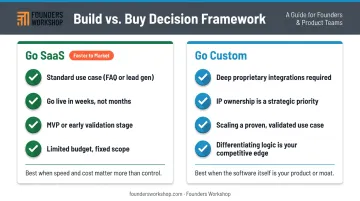
Build vs. Buy: A Decision Framework
| Criteria | Go SaaS | Go Custom |
|---|---|---|
| Use case is standard (FAQ, lead gen) | ✓ | |
| Need to go live in weeks | ✓ | |
| Deep proprietary integrations required | ✓ | |
| Currently at MVP/validation stage | ✓ | |
| IP ownership is a priority | ✓ | |
| Scaling a proven use case | ✓ |
The Hybrid Approach
Many founders start on a SaaS platform to validate the use case, then migrate to a custom build once they have real data on usage patterns and ROI. The tradeoff: you may need to rebuild conversation logic when you switch, which adds cost. Budget for that transition from the start.
Breaking Down the Full Cost of an AI Chatbot
The headline build cost is only part of the total investment. Here's a realistic view of the full cost of ownership:
One-Time Costs:
| Component | Approximate Range |
|---|---|
| Discovery and scoping | $2,000–$15,000 |
| Conversation flow design | $3,000–$10,000 |
| Development | $10,000–$200,000+ |
| Testing and QA | $2,000–$15,000 |
| Integration setup | $1,000–$20,000 per integration |
| Deployment | $1,000–$5,000 |
Recurring Costs:
| Component | Approximate Range |
|---|---|
| Hosting and infrastructure | $500–$2,000/month |
| LLM/AI API usage | Variable — scales with conversation volume |
| Maintenance and bug fixes | 15–25% of build cost annually |
| Model retraining | Periodic, varies by data complexity |
| SaaS subscription (if applicable) | $0–$10,000+/month |
Two costs consistently surprise first-time buyers: LLM API costs scale with token volume, not just conversation count. And annual software maintenance runs 15–25% of original development cost — on a $100,000 bot, that's $15,000–$25,000 per year, excluding new feature development.
How to Budget Smartly for AI Chatbot Development
The goal isn't to spend as little as possible. It's to spend the right amount on the right scope. Overbuild and you pay for features no one uses. Underbuild and you rebuild in 12 months.
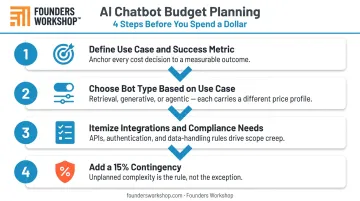
A practical 4-step budgeting approach:
- Define the use case and success metric before any vendor conversations. "We want a chatbot" is not a scope. "We want to deflect 40% of tier-1 support tickets" is.
- Choose bot type based on that use case, not aspirational features. If your conversations are predictable, rule-based works. Don't pay for NLP you won't use.
- Itemize integrations and compliance needs upfront. These are the most common sources of budget surprises, so list every system the bot needs to touch.
- Add a 15% contingency. Scope changes and unforeseen complexity are standard, not exceptional.
Two Strategies That Move the Number Most
Start with an MVP focused on one core use case. This typically reduces initial build cost by 30% or more, and gives you real usage data before you expand scope.
Use a nearshore development team. Founders Workshop, an Arizona-based firm with nearshore Latin American development teams, cuts development costs by up to two-thirds compared to U.S.-based agencies while keeping collaboration in your time zone and language. Their fully managed projects typically run $80,000–$350,000 for 3–6 months of work, covering their structured 5D Process: Discovery, Definition, Development, Deployment, and Dedicated Support.
Budget Mistakes Worth Avoiding
- Focusing only on build cost while ignoring recurring API, hosting, and maintenance expenses
- Over-specifying features before validation: build the core use case first, then layer in complexity
- Choosing the cheapest option without evaluating vendor reliability or the long-term cost of technical debt
Conclusion
AI chatbot development cost in 2026 ranges from a few thousand dollars for a focused rule-based bot to $150,000+ for a custom AI-powered solution. The right number for your business is determined by your specific use case, integration requirements, and stage of growth — not what competitors are spending.
The businesses that get the best ROI approach chatbots the same way they approach any software product: start with a clear problem to solve, match scope to current resources, and budget for ongoing iteration from day one.
That planning mindset starts before the first line of code. A 2–4 week discovery engagement — like the scoping phase Founders Workshop runs at the start of every AI project — surfaces the real requirements, surfaces integration gaps, and gives you an accurate budget before you've committed to one.
Frequently Asked Questions
How much does it cost to build an AI chatbot?
Costs range from $5,000 for a basic rule-based bot to $150,000+ for a custom AI-powered solution. The spread depends on bot type, integration complexity, and whether you build custom or use a SaaS platform. See the pricing tiers section above for a full breakdown.
What is the difference in cost between a rule-based and an AI-powered chatbot?
Rule-based bots cost $5,000–$30,000 because they follow scripted decision trees with no machine learning. AI-powered bots run $30,000–$150,000+ due to NLP engineering, model training, and the more complex development work those capabilities require.
Can a startup afford to build a custom AI chatbot?
Startups can keep costs manageable by scoping an MVP around one use case, validating with a SaaS platform first, or working with a nearshore team to cut build costs by up to two-thirds. Many startups launch a focused bot for under $20,000 using a rule-based or lightly customized approach.
What are the ongoing maintenance costs for an AI chatbot?
Annual maintenance typically runs 15–25% of the original build cost, covering bug fixes, model retraining, security updates, hosting, and API fees. LLM API costs are variable and can climb steeply above roughly 100,000 conversations per month.
How long does it take to build a custom AI chatbot?
Simple rule-based bots typically take 2–6 weeks. AI-powered NLP/LLM bots take 2–4 months depending on integration complexity. Enterprise builds can run 1–6 months. Longer timelines directly increase cost when working with hourly-rate teams.
Should I build a custom AI chatbot or use a SaaS platform?
Use a SaaS platform when speed and lower upfront cost matter and your use case is standard. Choose custom development when you need deep proprietary integrations, full data ownership, or a conversation design no existing platform can replicate.