Introduction
Missed appointments cost the U.S. healthcare system an estimated $150 billion annually, with MGMA benchmarking median no-show rates at 5% to 7% across practices. AI-powered reminder systems can close that gap — and the market is full of vendors promising to do exactly that.
Most healthcare organizations deploy these tools without fully thinking through HIPAA. An appointment reminder isn't just a notification. It contains a patient's name, provider, appointment time, and location — all of which qualify as Protected Health Information. The channel you use, the vendor you hire, and the data you transmit are all subject to federal law.
This guide is written for healthcare founders and practice operators who want to get this right. It covers:
- What HIPAA compliance actually requires for AI reminder systems
- How conversational AI differs from basic SMS blasts
- What good EHR integration looks like
- How to decide whether to buy an off-the-shelf solution or build custom
Key Takeaways
- Appointment reminders contain PHI — every vendor that touches them must sign a BAA before handling patient data
- Compliant systems need end-to-end encryption, role-based access controls, audit logging, and a data retention policy
- Conversational AI handles two-way rescheduling in natural language and syncs outcomes directly to your EHR — something basic SMS blasts can't replicate
- At $7.42M average per breach, HIPAA compliance is a financial risk calculation — not just a legal checkbox
Why HIPAA Compliance Cannot Be an Afterthought for AI Reminders
What Counts as PHI in a Reminder
A text message that says "Hi Sarah, your appointment with Dr. Patel is Thursday at 2pm at Phoenix Family Medicine" contains at least four PHI elements: patient name, provider name, appointment time, and location.
Under HIPAA's Privacy and Security Rules, that message is regulated regardless of whether it's sent via SMS, voice call, email, or a chat interface.
This catches many organizations off guard. They assume HIPAA only applies to clinical records. In practice, it applies to any information that could identify a patient in connection with their health or care — and that includes routine scheduling communications.
The Financial Exposure Is Real
The penalty exposure alone justifies building compliance into your AI reminder system from day one:
- $7.42M — average cost of a healthcare data breach in 2025, per IBM's Cost of a Data Breach Report
- $145 to $73,011 per violation — the 2026 inflation-adjusted HIPAA civil monetary penalty range for organizations that "did not know" they were non-compliant
- Up to $2,190,294 — the annual maximum for repeated identical violations at any culpability tier
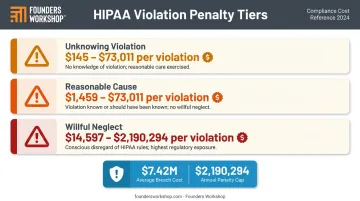
The penalty structure escalates with intent. An organization that simply didn't know it was non-compliant faces lower per-violation fines, but the annual cap applies regardless. A vendor relationship that transmits PHI without a signed BAA isn't a minor paperwork gap — it's a material liability.
A Real Enforcement Example
Those penalty figures aren't theoretical. In 2016, Raleigh Orthopaedic Clinic paid $750,000 to settle an OCR investigation after disclosing x-ray films containing PHI for 17,300 patients to a vendor without first executing a Business Associate Agreement. The clinic didn't know it was non-compliant — the vendor wasn't the problem. The missing contractual step was.
Any AI reminder vendor that handles PHI on your behalf triggers the same BAA requirement. No BAA means no legal basis for that data transfer, regardless of how routine the communication feels.
What Makes a Conversational AI System HIPAA-Compliant?
Business Associate Agreement (BAA)
Any vendor whose platform creates, receives, maintains, or transmits PHI on your behalf is a "business associate" under HIPAA — and a signed BAA is a legal prerequisite before you go live, not a paperwork step you can defer.
A compliant BAA must specify:
- The vendor's permitted uses and disclosures of PHI
- Breach notification obligations (including timelines)
- Data protection and security standards the vendor must maintain
- Requirements for subcontractors who may also handle PHI
- What happens to PHI at contract termination
Vendors like Artera and Twilio publish BAA availability publicly. That's a starting point. Review the actual BAA language and confirm it covers the specific AI workflow you're deploying — vendor claims and contractual specifics don't always match.
Data Encryption and Secure Transmission
With a BAA in place, the next layer is technical: PHI must be protected both in transit and at rest. Per NIST standards, that means:
- In transit: TLS 1.2 or higher (NIST SP 800-52 requires TLS 1.2 support and recommends planning for TLS 1.3)
- At rest: AES-256 encryption per NIST FIPS 197
Standard SMS is not end-to-end encrypted. As Holland & Hart notes, texts are generally not secure because they lack encryption. This doesn't mean you can't use SMS for reminders — it means detailed PHI should route to a secure patient portal, while the SMS itself contains only a minimal notification with a secure link.
Access Controls and Audit Logging
Encryption governs data movement, but access controls govern who touches it. The HIPAA Security Rule mandates two specific technical requirements here:
- Role-based access controls (RBAC) combined with multi-factor authentication, ensuring only authorized personnel can access PHI within the system
- Immutable, timestamped audit logs recording every access, message transmission, and data update involving patient records
Audit logs serve a purpose beyond routine compliance reviews: they're your primary evidence in a breach investigation. If you can't show exactly who accessed what and when, your exposure in an enforcement action grows considerably.
PHI Minimization and Data Retention
Beyond access controls, HIPAA's "minimum necessary" principle applies directly to what data the AI touches. The system should access and transmit only what's needed for the specific reminder task:
- Don't pull full clinical records to send a scheduling notification
- Limit API calls to the fields required: name, contact info, appointment details
- Store only what's needed for the reminder workflow, not a copy of the broader EHR record
Retention policy also matters. HIPAA requires documentation to be retained for six years from creation or last effective date. Your system needs a documented policy for how long reminder data is kept and how it's securely deleted afterward.
Consent Management and TCPA Compliance
HIPAA compliance doesn't operate in isolation. The FCC's TCPA rules (FCC 15-72) add requirements for automated healthcare calls and texts, including:
- Patients must have provided appropriate consent for automated outreach
- Messages must be concise, healthcare-purpose-limited, and include opt-out instructions
- Every channel must honor opt-outs instantly — a "STOP" reply cannot sit in a queue
- Consent status must be tracked per patient, per channel, with a full audit trail of opt-in and opt-out events
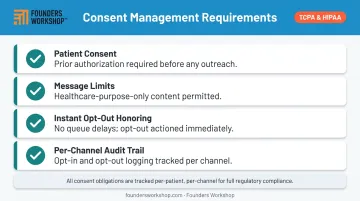
A patient who opts out of SMS but not email requires different handling than one who opts out of everything — your system logic needs to reflect that distinction, not approximate it.
How Conversational AI Elevates Appointment Reminders
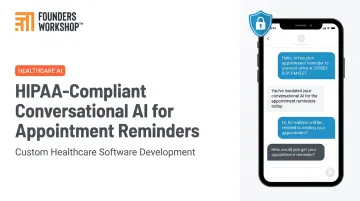
Conversational AI handles what IVR menus and SMS blasts cannot: free-form patient requests. When a patient replies "Can I move my Thursday appointment to next week?", the system understands the intent, executes the rescheduling transaction, and stays within HIPAA guardrails — all without staff involvement.
Omnichannel Delivery Tailored to Patient Preferences
An effective reminder system meets patients where they are:
- Voice call for older populations or patients with low digital engagement
- SMS with a secure portal link for PHI-sensitive details
- Email for patients who prefer written communication
Reminder timing also matters. A confirmation one week out, a 48-hour reminder, and a day-of notification each reduce the chance of a no-show. The system handles booking confirmations, pre-visit prep instructions, telehealth links, and missed-appointment follow-ups — each triggered automatically based on appointment type.
Real-Time Confirmation and Rescheduling
The write-back workflow is what makes conversational AI operationally useful. When a patient confirms, cancels, or reschedules through the conversation, that outcome is written back to the EHR or practice management system in real time.
Staff see an accurate calendar without manual data entry — the AI handles the transaction and the EHR reflects it immediately. Double-bookings and stale holds are eliminated.
After-Hours Coverage and Warm Transfers
Kyruus Health found that 40% of appointments are booked after business hours. A system that only sends outbound reminders during office hours misses nearly half the scheduling activity it should be capturing.
Conversational AI handles inbound rescheduling requests at 2am the same way it does at 2pm. When a patient's request exceeds what the AI can handle — a complex insurance question, a clinical concern — the system escalates via a warm transfer: passing the conversation plus a transcript summary to a live agent, so the patient never has to repeat themselves.
EHR Integration: The Technical Backbone That Makes It Work
Conversational AI for appointment reminders is only as good as its connection to your scheduling data. Without real-time EHR integration, you're sending reminders based on stale information — and writing outcomes to a system that doesn't know about them.
Standards-Based API Connections
Modern EHR integration uses HL7 FHIR (Fast Healthcare Interoperability Resources) as the standard for structured data exchange. FHIR-based APIs allow the AI system to:
- Read real-time appointment schedules and patient contact preferences
- Verify visit type and any pre-visit requirements
- Write back confirmations, cancellations, and reschedule requests without creating data silos
The ONC's Cures Act Final Rule advances standardized APIs specifically to support this kind of authenticated data access. That makes FHIR the practical standard for any new integration architecture.
Event-Driven Workflow Triggers
Well-built implementations trigger reminder sequences automatically from EHR events — no manual configuration per patient:
- New booking created → send confirmation with preparation instructions
- Pre-op order placed → trigger specialized pre-procedure sequence
- Appointment cancelled → initiate rebooking outreach
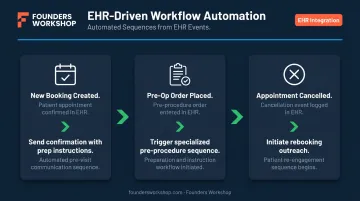
This closes the gap where patients slip through because a staff member forgot to add them to the reminder queue.
Integration Evaluation Checklist
Before committing to any AI reminder platform, verify:
- Two-way API support for your specific EHR, not just generic webhook connectivity
- OAuth 2.0 or equivalent for secure API authentication
- Error handling and retry logic for when the EHR is temporarily unavailable
- Write-back confirmation so you can verify outcomes were recorded correctly
A vendor that claims "major EHR" support but can't demonstrate working integration with your specific system is worth walking away from.
Build vs. Buy: Strategic Considerations for Healthcare Founders
When Off-the-Shelf Makes Sense
A vendor platform is the right starting point when:
- Your practice uses a common EHR with native integrations already built
- Your patient workflows are standard (single specialty, single location)
- You need deployment in weeks, not months
- Your budget doesn't support custom development
Vendors like Luma Health, Relatient, and Artera all publish HIPAA compliance claims and BAA availability. Use the checklist below to evaluate any vendor before signing.
Minimum vendor evaluation checklist:
- Will they sign a BAA covering all AI-involved services?
- Do they have a current SOC 2 Type II report available for review?
- Which EHR systems are natively supported (not just "integrable")?
- Is pricing per-minute, per-seat, or per-message — and which aligns with your volume?
- What are the uptime SLA and breach notification commitments?
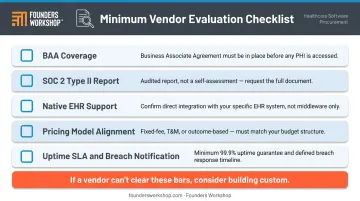
If a vendor clears those bars, you're likely in good shape. When they don't, that's usually a signal to build.
When Custom-Built Is the Right Answer
Off-the-shelf tools hit their limits quickly in certain scenarios:
- Niche or legacy EHR environments where no vendor has a native connector
- Multi-specialty or multi-location practices with complex scheduling rules
- Behavioral health and other practices with stricter consent and communication requirements
- Startups building patient engagement as a core product, not just internal tooling
The core advantage of building custom is that compliance safeguards get engineered into the architecture from day one, rather than retrofitted around a vendor's existing product constraints.
Founders Workshop builds custom HIPAA-compliant AI solutions for healthcare startups and SMBs, with experience across a range of EHR environments and clinical workflows. The 5D Process begins with a structured Discovery phase that maps compliance requirements and integration architecture before any development starts.
Frequently Asked Questions
Are appointment reminders allowed under HIPAA?
Yes. HIPAA explicitly permits appointment reminders as an allowable use of PHI for treatment-related communications. However, the delivery method and information included must still comply with HIPAA's Privacy and Security Rules — meaning encrypted channels, minimum necessary PHI, and appropriate consent.
Can you use AI with HIPAA compliance?
AI can be used in a HIPAA-compliant manner. The core requirements: a signed BAA with the AI vendor, encryption and access controls, audit logging, and PHI limited to the minimum necessary. Compliance depends on implementation, not the technology itself.
Which AI is best for HIPAA compliance?
No single product is universally "best." The right choice depends on your EHR environment, patient volume, workflow complexity, and whether off-the-shelf or custom fits your situation. Evaluate vendors on BAA availability, SOC 2 Type II certification, encryption standards, and native EHR integrations — not marketing claims alone.
What is a BAA and why is it required for AI appointment reminders?
A Business Associate Agreement is a legally required contract between a covered entity and any vendor that handles PHI on its behalf. Appointment reminder platforms transmit patient names, appointment times, and provider details — which makes them business associates by definition. Without a BAA, there is no legal authorization to share PHI.
How does conversational AI differ from basic SMS appointment reminders?
Basic SMS reminders are one-way notifications. Conversational AI enables two-way dialogue — patients can confirm, cancel, or reschedule in plain language, and the outcome writes back to the EHR automatically. That direct integration removes manual data entry and cuts no-show rates without adding staff workload.