Introduction
Startups are competing against companies with larger teams, bigger budgets, and years of operational infrastructure. That gap is real — but it's increasingly a design problem, and AI integration is one of the most effective tools for closing it.
Most early-stage startups struggle with AI adoption for one reason: they do it reactively. They sign up for tools because a competitor announced something, or because a product went viral on LinkedIn — with no defined problem, no success metrics, and no integration with existing workflows.
The result is predictable: wasted budget, technical debt, and a team that's skeptical of the next initiative.
This guide covers what actually moves the needle: the highest-ROI AI use cases for lean teams, how to make the build vs. buy decision without guessing, and how to build an AI strategy that grows more effective over time rather than just adding line items to your SaaS bill.
Key Takeaways
- AI integration lets a 3-person startup execute at a scale that would otherwise require multiple full-time hires
- The highest-ROI starting points are customer support automation, sales intelligence, product analytics, and AI-assisted development
- Custom AI is worth building only when it directly differentiates your product — use off-the-shelf tools everywhere else
- Start with one high-impact use case, clean data, and defined success metrics — not a company-wide rollout
Why AI Integration Is No Longer Optional for Startups
The Adoption Gap Is Already Closing
58% of U.S. small businesses used generative AI in 2025, up from 23% in 2023. Meanwhile, 78% of global organizations now use AI in at least one business function. The gap between early adopters and everyone else is narrowing fast, and waiting is no longer a neutral decision.
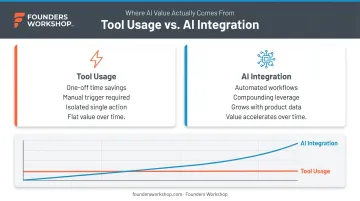
What separates tool usage from AI integration is compounding. Using ChatGPT to draft emails is tool usage. Embedding AI into your sales pipeline so it scores leads, triggers sequences, and surfaces churn signals automatically — that's integration. One produces one-off time savings. The other builds institutional leverage that grows with your product.
The "Do More With Less" Advantage
The math is straightforward for early-stage teams. According to Microsoft's 2024 Work Trend Index, 90% of AI users report saving time, and power users save more than 30 minutes per day. Across a five-person team, that's several hours of recovered capacity every single day, without adding headcount.
That capacity gain compounds. Startups integrating AI now are building workflows, data pipelines, and product features that improve over time. Competitors who wait aren't just behind on tools — they're behind on institutional knowledge that can't be shortcut later.
What AI Integration Actually Means for Early-Stage Startups
AI integration doesn't mean rebuilding your product, replacing your team, or hiring a machine learning engineer. In practice, it means:
- Identifying 2-3 workflows where AI provides clear, measurable leverage
- Connecting those workflows to your existing data and tooling
- Tracking outcomes, then expanding where results justify it
The goal is solving specific operational problems faster than your competitors — not checking "AI" off a list.
The Highest-ROI AI Use Cases for Early-Stage Startups
Customer Support and Response Automation
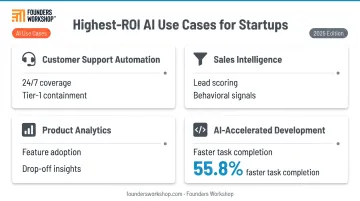
A lean support setup with AI handles tier-1 inquiries — FAQs, order status, account questions, common troubleshooting — without human involvement. Complex issues escalate automatically. The practical result: 24/7 coverage without a support team.
One important caveat: Gartner found that 64% of customers would prefer companies not use AI in customer service, and 53% said they'd consider switching providers if they felt AI was being used poorly. The takeaway isn't "avoid support automation" — it's "automate volume, preserve human escalation, and make the handoff feel seamless."
Sales Intelligence and Lead Qualification
Sales AI addresses a core bottleneck for early teams: knowing where to spend time. AI lead scoring evaluates behavioral signals and ranks prospects by conversion likelihood. Those signals include:
- Pages visited and time on site
- Email opens and click-through behavior
- Session duration and return frequency
- Feature usage patterns (for SaaS products)
A two-person sales function stops chasing every lead equally and focuses where it actually converts. HubSpot's 2024 data shows AI adoption among sales professionals jumped from 24% to 43% in a single year, with 73% reporting meaningful productivity gains. For startups, the entry point is CRM-integrated AI — not a custom scoring model — before any custom build is warranted.
Product Analytics and User Behavior Insights
Surveys tell you what users say. Product analytics tell you what they actually do. AI-driven analytics tools identify feature adoption rates, drop-off points, engagement sequences, and usage anomalies that would take weeks to find manually. That data directly informs roadmap prioritization — removing the guesswork from "what should we build next."
For a founding team with limited runway, skipping this means shipping features based on gut feel — and burning sprints on the wrong priorities.
Content and Marketing Automation
67% of marketing teams save 10+ hours per week using generative AI for content. Among small businesses specifically, 48% use AI to write emails or subject lines, and 37% use it for social content.
The framing that matters: AI doesn't replace the founder's positioning and voice. It handles execution volume — draft variations, subject line tests, repurposed content — so a two-person marketing function can produce at a volume that would otherwise require a full team.
AI-Accelerated Software Development
For startups building their own product, developer velocity is directly tied to how fast you find product-market fit. Microsoft Research's GitHub Copilot study found developers completed tasks 55.8% faster with AI coding assistance. A quarter of Y Combinator's Winter 2025 cohort had codebases that were nearly entirely AI-generated.
Faster iteration cycles mean more experiments per quarter. More experiments mean faster learning. For an early-stage product team, AI coding assistance isn't a productivity perk — it's a competitive edge.
Build vs. Buy: Choosing the Right AI Integration Approach
Every startup faces the same core question: use existing AI platforms and APIs, build custom AI features on your own data, or combine both? The answer depends on one thing: whether AI is central to your product's competitive value, or whether it's supporting internal operations.
When Off-the-Shelf AI Makes Sense
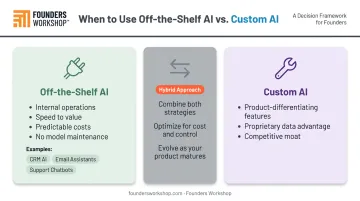
Use existing AI tools when:
- Speed-to-value is the priority
- The use case is operational, not product-differentiating
- Your team lacks the capacity for custom development
- You need to prove ROI before committing to a build
Examples: CRM AI features, AI email assistants, support chatbot platforms, analytics dashboards with built-in intelligence.
Advantages: Fast deployment, predictable costs, no model maintenance. GitHub Copilot Business runs $19/seat/month. OpenAI API access is usage-based. These are accessible entry points for teams operating on tight runway.
When Custom AI Integration Creates a Moat
Custom AI is worth the investment when:
- Your startup has proprietary data that off-the-shelf models can't access
- AI is the core of what makes your product valuable to users
- Generic tools produce outcomes indistinguishable from your competitors
More than half of VCs surveyed by TechCrunch identified proprietary data quality as a key differentiator for AI startups. The logic: a model trained on your product's behavioral data, your industry's specific patterns, or your customers' unique characteristics gets better as your data grows — and it's hard to replicate.
Custom AI requires technical depth most early-stage startups don't have in-house. Gartner predicted 30% of generative AI projects would be abandoned after proof of concept, most often due to unclear business value or poor data quality. Custom builds carry real execution risk.
The Hybrid Approach Most Startups Should Use
The practical path for most early-stage companies: use off-the-shelf AI for internal operations where speed matters, and invest in custom AI only for features that directly drive user value and differentiation.
This preserves capital while building toward a defensible product. Off-the-shelf handles sales, marketing, support, and dev tooling. Custom development targets the AI features that are core to why customers choose your product.
For startups without an in-house technical team, an experienced AI integration partner makes this executable. Founders Workshop has delivered 200+ software solutions and provides AI-first development across Generative AI, Conversational AI, Custom GPT, and RPA — giving startups access to custom AI capabilities without hiring full-time engineers or trading equity for a technical co-founder.
Their 5D Process includes an AI Integration Exploration phase during Discovery that maps where AI adds the most product leverage before any code is written. It's a structured way to make the build vs. buy decision with real data, not guesswork.
A Practical AI Integration Strategy for Startups
Start With One High-Impact Use Case
Scattered multi-tool rollouts consistently underperform focused, well-scoped integrations. The right starting point comes from a simple exercise:
- List your 3-5 biggest operational bottlenecks
- Estimate the time or cost currently lost to each
- Identify which one has a clear, measurable AI fix
- Define what success looks like before you start
Quick wins matter beyond the immediate outcome. A successful first integration builds internal confidence, proves ROI to stakeholders, and creates the organizational trust needed for broader investment. Failed first integrations erode that trust, and rebuilding it takes longer than the integration itself.
Establish Data Readiness Before You Build
AI systems are only as good as the data they run on. Gartner predicts that organizations will abandon 60% of AI projects unsupported by AI-ready data through 2026 — and RAND found data-related failures are the second most common reason AI projects fail overall.
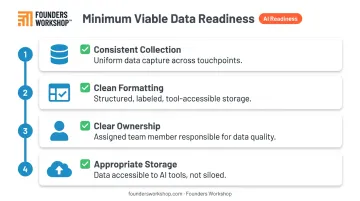
Minimum viable data readiness for an early-stage startup means:
- Consistent collection: Data is captured uniformly across touchpoints, not sporadically
- Clean formatting: Structured, labeled, and stored in a format your tools can actually use
- Clear ownership: Someone on the team is responsible for data quality, not just access
- Appropriate storage: Data lives somewhere accessible to your AI tools, not locked in spreadsheets or siloed systems
Skipping this step produces unreliable AI outputs and erodes team confidence in the entire initiative before it has a chance to prove itself.
Define Success Metrics and Review Cycles
Every AI integration needs a success definition before deployment, not after. Without a specific target, there's no way to know whether an integration is working or just running.
| Use Case | Metric Example |
|---|---|
| Customer support automation | First-response time, tier-1 containment rate |
| Sales intelligence | Lead-to-opportunity conversion rate |
| AI coding assistance | Features shipped per sprint, bug rate |
| Content automation | Content pieces produced per week, hours saved |
Review these metrics on a defined cadence — monthly at minimum. The goal isn't to prove the integration was a good idea. It's to iterate fast, double down on what's working, and cut what isn't before sunk cost kicks in.
Mistakes That Derail Startup AI Initiatives
Adopting AI without a clearly defined problem. The most common failure pattern: a startup integrates an AI tool because a competitor announced something similar, or because the category is trending. No specific outcome defined. No baseline measured. The tool gets used for a few weeks, produces no clear result, and gets quietly abandoned. Before any AI investment, ask: "What specific outcome will improve, and by how much?" If you can't answer that, you're not ready to buy.
Underestimating total cost of ownership. The subscription price is the smallest number. Real costs include:
- Data infrastructure setup and integration development time
- Staff training and ongoing prompt management
- Model maintenance as your product evolves
- Compliance reviews and internal overhead
RAND found AI projects fail at roughly twice the rate of non-AI IT projects, and Gartner noted total costs frequently exceed initial expectations. Build a realistic cost model before committing, not after the bill arrives.
Over-automating and eroding the human experience. Early-stage startups win on high-touch customer relationships that large companies can't replicate. That's a genuine competitive advantage — and it's possible to automate it away.
The right boundary: automate volume and repetition (common inquiries, recurring tasks, routine follow-ups), and preserve human judgment for high-stakes interactions where warmth and adaptability actually matter. When in doubt, automate less and measure customer satisfaction before scaling.
Frequently Asked Questions
How much does it cost to integrate AI into a startup?
Off-the-shelf AI tools range from free tiers to a few hundred dollars per month. Custom AI integration projects vary widely based on scope and complexity; Founders Workshop's development engagements typically run $80,000–$350,000 for a full build. Total cost of ownership, including infrastructure, training, and ongoing maintenance, almost always exceeds the headline price.
What are the most impactful AI use cases for early-stage startups?
Customer support automation, AI-assisted sales lead scoring, product analytics, and AI coding assistants consistently deliver the highest ROI for lean teams. These use cases produce measurable time savings quickly without requiring custom model development or significant data infrastructure.
Should my startup build custom AI features or use existing tools?
Use off-the-shelf tools for internal operations (sales, support, marketing, dev tooling) where speed matters. Invest in custom AI only when it's central to your product's competitive differentiation, specifically when you have proprietary data that generic models can't leverage. Most startups benefit from a hybrid of both.
How long does AI integration typically take for a startup?
Off-the-shelf integrations can be deployed in days to a few weeks. Custom AI feature development typically takes 2–5 months depending on scope, data readiness, and technical resources. Founders Workshop's 5D Process takes most projects from Discovery to Deployment in 3–6 months.
What are the biggest mistakes startups make when adopting AI?
The most common pitfalls are adopting AI without a defined problem to solve, underestimating total cost of ownership beyond the subscription price, and over-automating customer interactions in ways that erode the personal relationships early-stage startups depend on.
Can a startup without an in-house tech team integrate AI?
Yes. Many off-the-shelf AI tools require no engineering to deploy. For custom development, startups can partner with AI integration firms like Founders Workshop. Founders Workshop provides fully managed development with no equity requirement, and clients retain full ownership of their code.