The global software development outsourcing market hit $534.9B in 2024 and continues to grow — which means the market is flooded with options that look nearly identical from the outside. Every vendor claims Agile processes, senior talent, and seamless communication.
This guide cuts through that noise. Whether you're a founder building your first MVP or an SMB scaling an internal product, you'll find a practical framework here for making this decision with confidence.
Key Takeaways
- An outsourced development team is an external group of developers, designers, testers, and project managers hired to build or maintain software on your behalf — structured teams with defined accountability, not freelance individuals.
- The three main engagement models — staff augmentation, dedicated team, and fixed-price — each suit different situations, and picking the wrong one is as costly as picking the wrong vendor.
- Key selection factors: technical portfolio depth, engagement model fit, time zone overlap, cultural alignment, process rigor, and cost transparency.
- Red flags: vague process documentation, no verifiable references, and suspiciously low rates without explanation.
- For U.S.-based companies, nearshore Latin American partners offer real-time time zone overlap and cost savings of roughly one-third compared to domestic rates.
What Is an Outsourced Development Team?
An outsourced development team is a group of external professionals — software engineers, UI/UX designers, QA testers, business analysts, and project managers — contracted through a third-party firm to build, maintain, or scale your software product.
Unlike freelance arrangements, these teams operate with defined processes, management structures, and accountability built into every engagement.
Core Roles and Engagement Structures
A well-structured outsourced team typically includes:
- Software engineers (front-end, back-end, full-stack)
- UI/UX designers for wireframes, prototypes, and interface design
- QA testers responsible for manual and automated quality checks
- Business analysts to bridge product requirements and technical execution
- Project or delivery manager as the client's primary point of contact
The three primary engagement models differ in how much direction you retain:
| Model | Who Manages the Team | Best For |
|---|---|---|
| Staff Augmentation | You (the client) | Adding capacity to an existing team |
| Dedicated Team | Shared (vendor + client) | Standalone product initiatives |
| Fixed-Price/Project-Based | Vendor | Clearly scoped, well-defined deliverables |
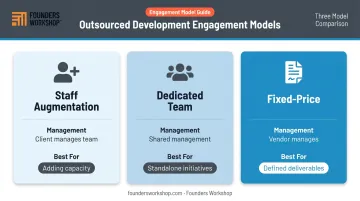
Choosing the right model is a prerequisite to selecting the right vendor — the evaluation criteria shift depending on how much oversight you plan to retain.
Why Businesses Outsource Development
Most businesses outsource development for a handful of concrete reasons:
- Access specialized technical talent unavailable locally
- Reduce overhead versus full-time hiring ($750K–$1M annually for an in-house team)
- Accelerate time-to-market without months of recruiting
- Scale development capacity without long-term employment commitments
According to Deloitte's 2024 Global Outsourcing Survey, 80% of executives plan to maintain or increase third-party outsourcing investment — and skilled talent acquisition has joined cost reduction as a primary driver.
What to Consider When Choosing the Right Outsourced Development Team
Not all outsourcing partnerships are equal. Selection criteria vary by project type, budget, timeline, and company stage. These six factors help you separate vendors who can execute from those who just pitch well.
Technical Expertise and Portfolio Depth
A strong portfolio shows whether a team can own a product end-to-end, not just execute tasks handed to them.
When reviewing a portfolio, look beyond the screenshots:
- Architecture decisions: Did the team make sensible structural choices, or just ship features?
- Product outcomes: What happened after launch? Did the product grow, pivot, or stall?
- Tech stack alignment: Does their experience match your project's requirements?
- Complete vs. component delivery: Did they ship full products, or just individual modules?
That last point has real consequences. A team that has only ever contributed modules to larger projects has never had to own architecture, scope tradeoffs, or post-launch stability — all of which become your problem if they haven't navigated them before.
Engagement Model Alignment
Mismatched engagement models are a leading cause of outsourcing failure. A founder who needs ongoing iteration shouldn't be locked into a fixed-price contract. An SMB with strong internal direction may only need staff augmentation, not a full dedicated pod managing its own cadence.
Use this as a quick guide:
- Staff augmentation — when you have internal capacity to direct day-to-day work and need specific skills
- Dedicated team — when you're running a substantial standalone initiative and need a self-contained pod
- Fixed-price — only when scope is truly defined, deliverables are measurable, and acceptance criteria are agreed upfront
Time Zone and Communication Compatibility
Time zone overlap directly affects iteration speed, decision latency, and project momentum. A team operating 9–12 hours away creates overnight handoff cycles that compound into weeks of delay over a multi-month engagement.
For U.S.-based companies, nearshore partners in Latin America offer shared working hours, real-time collaboration, and over 30% cost savings compared to domestic rates — without the asynchronous communication friction common with offshore arrangements in Asia or Eastern Europe.
Cultural Fit and Team Retention
Cultural compatibility shapes day-to-day collaboration in ways that don't show up in proposals. A team with genuine accountability standards will flag a scope problem in week two. One without them will quietly absorb it until it becomes your crisis in week eight.
Shared values around accountability, direct communication, and quality standards aren't soft considerations — they're the difference between a team that flags problems early and one that buries them.
Ask directly about engineer retention. Annual turnover rates above 20% are a practical risk: the institutional knowledge your project builds walks out the door repeatedly. Research from Robillard et al. (2021) confirms that when engineers leave mid-project, it directly affects code quality and team productivity. Request retention metrics and verify them with references.
Development Methodology and Process Rigor
Every vendor claims Agile. The real question is what structured process they actually apply to planning, sprint execution, QA, and documentation.
Ask for specifics during discovery calls:
- How do you handle scope changes mid-sprint?
- Where does QA sit in your development cycle?
- What does project documentation look like at handoff?
- What happens operationally when an engineer rolls off mid-project?
A team with real process discipline answers these questions specifically and without hesitation. Vague answers here are a reliable signal of what you'll experience once the engagement starts.
Cost Structure and Transparency
Total cost of engagement is not just the hourly rate. Account for:
- Onboarding and ramp time
- Management overhead (especially in fixed-price models)
- Potential rate escalations mid-engagement
- Licensing, tooling, and change request fees
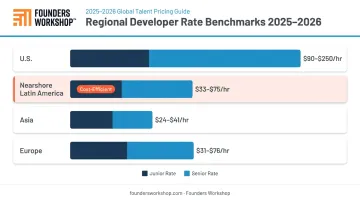
Regional rate benchmarks (2025–2026):
| Region | Junior Developer | Senior Developer |
|---|---|---|
| U.S. (small-mid firms) | $90–$160/hr | $120–$250/hr |
| Nearshore Latin America | $33–$45/hr | $60–$75/hr |
| Asia | $24–$31/hr | $31–$41/hr |
| Europe | $31–$39/hr | $64–$76/hr |
Source: Accelerance 2026 rate data; Fullstack Labs 2025 guide
Unusually low rates — well below these benchmarks without a clear explanation — are a warning sign, not a deal. Thin margins correlate with high turnover, junior-heavy teams, and cutting corners on QA.
How to Evaluate and Shortlist Outsourced Development Partners
Most selection errors don't happen at the top of the funnel. They happen at the bottom, where buyers under-invest in rigorous evaluation of a short list. Here's a practical sequence.
Where to Source Candidates
- Peer referrals — the highest-signal option. A founder who completed a similar project with a specific vendor gives you real, unvarnished information that no directory can match.
- Review platforms — Clutch, G2, DesignRush, and GoodFirms are useful for initial vetting. Clutch's own research found that 94% of B2B buyers used an online review to inform a vendor decision.
- LinkedIn — filtered by industry and geography, useful for direct outreach to vendors with demonstrated niche experience.
Once you have a short list — however you built it — the sourcing work is done. What follows is where most buyers either win or lose the decision.
What to Validate Before Committing
Three steps separate a good decision from a rushed one:
- Independent reference calls — not curated testimonials, but calls you arrange directly. Ask past clients about friction, failures, and how the vendor handled problems.
- A working session or technical conversation — observe how the team thinks, not just what they claim. Behavioral signals in a 60-minute conversation outperform any proposal document.
- Commercial alignment review — confirm IP ownership clauses, NDA terms, SLA specifics, and contract structure before any work begins.
Questions to Ask in Discovery Calls
The goal isn't just to get answers — it's to see how a vendor thinks under pressure and whether they'll be honest about past problems. These questions are designed to surface both:
- "Walk me through how your team handled a major scope change in a recent project."
- "What does your QA process look like, and where does it sit in your sprint cycle?"
- "How do you handle engineer turnover mid-engagement?"
- "Can you show me a sample of your project documentation from a recent build?"
A vendor who answers these fluently — with specifics, not talking points — is showing you their actual operating culture. One who deflects or generalizes is showing you something too.
Red Flags That Indicate Misalignment
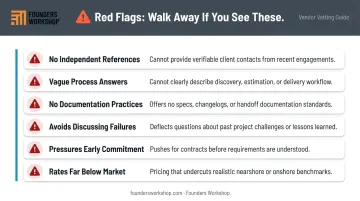
Walk away if you observe:
- Inability to provide independent references (not vendor-curated)
- Vague or inconsistent answers about process when pressed
- No clear documentation practices
- Unwillingness to discuss past failures or challenges
- Pressure to commit before completing due diligence
- Rates far below market without explanation
How Founders Workshop Helps You Build the Right Team
Founders Workshop is an Arizona-based software development firm that has been helping founders and SMBs build market-ready software since 2008 — with 200+ custom B2B and B2C solutions delivered across healthcare, fintech, real estate, and enterprise technology.
The leadership team brings 30+ years of entrepreneurial experience across 81 startups and 31 businesses owned. That background shapes how they engage with clients: as founders who've been in the same seat, not as outside vendors.
The Nearshore Model in Practice
Founders Workshop's development team — 25+ senior developers, designers, testers, and project managers located across Latin America — operates under U.S.-based leadership in Arizona. That structure directly addresses the most common outsourcing pain points:
- Time zone overlap: Real-time collaboration during standard U.S. working hours
- Communication: U.S.-based point of contact; Latin American team in your language
- Cultural alignment: Teams selected specifically for compatibility with U.S. business norms around accountability, directness, and quality
- Cost: Staff augmentation at approximately one-third the cost of comparable U.S. teams
For clients who've worked with Founders Workshop on staff augmentation, the cost model has proven sustainable over the long term. Wellpsyche, for example, has relied on the nearshore team for eight years — from startup through scaling stages — a relationship that reflects both cost efficiency and team continuity.
The 5D Process: Removing the Guesswork
What separates a development partner from a vendor-for-hire is a repeatable, documented process. Founders Workshop's field-tested 5D Process covers every stage:
- Discovery (2–4 weeks) — Define goals, scope features, identify integrations
- Definition (4–6 weeks) — Build roadmap, wireframes, clickable prototypes
- Development (2–3 months) — Agile execution against the defined roadmap
- Deployment (1 month) — Launch with 24/7 monitoring and cloud hosting
- Dedicated Support (80–160 hours/month) — Ongoing maintenance and iteration
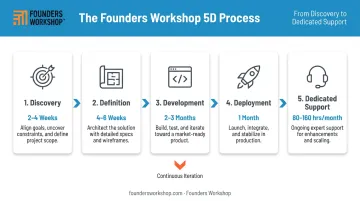
Each phase produces documented deliverables. Clients hold the keys to their source code from day one — no equity required, no lock-in.
ALBedFill's MVP launched in three months. Booster Athletes shipped just in time for college football season, with 10+ custom integrations for payments, video streaming, and SMS. Both timelines held because the process was defined before a single line of code was written.
Conclusion
Selecting the right outsourced development team is one of the highest-leverage decisions a founder or SMB makes. Most selection mistakes come from under-investing in evaluation — moving too fast, skipping reference calls, or choosing on price alone.
The right partner isn't the cheapest or the one with the most impressive website. It's the one whose process, communication style, and team structure align with where your product actually is right now — not where you hope it will be in 12 months.
This isn't a one-time decision. As your product evolves, your team requirements will shift. A strong outsourcing partner should grow with you — not require a full restart every time your roadmap changes.
Founders Workshop has helped founders and SMBs work through exactly this decision since 2008 — matching the right engagement model to the right stage. Start with a discovery conversation to see which approach fits your project.
Frequently Asked Questions
What is outsourced development?
Outsourced development is the practice of hiring an external team or firm to design, build, or maintain software rather than relying solely on in-house staff. It spans everything from augmenting an existing internal team to handing off an entire product build to a third-party firm.
What are the 4 types of outsourcing?
The four common models are:
- Staff augmentation: adding specific talent to your existing team
- Dedicated team: a full external pod working exclusively for you
- Fixed-price/project-based: paying for a defined deliverable
- Managed services: an external partner handling ongoing operations
Most custom software product work falls into the first three.
Is outsourcing illegal in the US?
Outsourcing is entirely legal in the United States. Legal considerations to manage include IP ownership agreements, NDAs, and data privacy compliance — such as HIPAA for healthcare or CCPA for companies handling California consumer data. A competent outsourcing partner will have standard documentation for all of these.
How much does it cost to hire an outsourced development team?
Costs vary by engagement model and geography. U.S.-based firms typically run $90–$250/hr; nearshore Latin American teams range from $33–$75/hr depending on seniority; offshore Asian teams generally fall between $24–$41/hr. Nearshore models offer roughly one-third the cost of U.S. teams with significantly less communication friction than offshore arrangements.
What is nearshore outsourcing and how is it different from offshore?
Nearshore means partnering with a team in a nearby country — for U.S. companies, typically Latin America. Offshore refers to more distant locations like Asia or Eastern Europe. The practical differences come down to time zone overlap, shared language ease, and cultural alignment: all areas where nearshore arrangements outperform offshore for real-time collaboration.
How do I protect my intellectual property when outsourcing?
Require a signed NDA and IP assignment clause before any work begins, confirming that all code, designs, and documentation belong to you. Reputable outsourcing partners provide standardized agreements for this and should raise no objection to signing them upfront.