Unlike a standard software build, healthcare AI apps must navigate overlapping compliance frameworks, clinical data pipelines, model validation, and real-world workflow integration simultaneously. Any partner without specific experience in all four areas creates compounding risk.
The market pressure is real: according to MarketsandMarkets, the AI in healthcare market is projected to grow from $21.66B in 2025 to $110.61B by 2030 — a 38.6% CAGR. Founders racing to capture that opportunity often rush the partner selection process, which is where most healthcare AI projects go wrong.
This guide covers the six factors that distinguish qualified healthcare AI development partners from general software agencies, plus the red flags that signal you're talking to the wrong team.
Key Takeaways
- Healthcare AI partners need clinical workflow knowledge, HIPAA compliance experience, and ML model expertise — most general agencies lack at least one.
- Six factors matter most: domain expertise, regulatory compliance, proven AI/ML capability, development process, post-launch model support, and cost transparency.
- Watch for vague compliance answers, no healthcare portfolio, and budgets that ignore model validation.
- The right partner cuts compliance risk, shortens time to market, and keeps your AI performing in real clinical environments.
What Makes Healthcare AI App Development High-Stakes
Healthcare AI development demands proficiency across three demanding disciplines: healthcare regulatory compliance (HIPAA, HL7, FHIR), clinical workflow design, and AI/ML engineering. Most development teams are strong in one, maybe two.
What separates AI-enabled healthcare apps from standard healthcare software isn't just complexity — it's the failure mode. A buggy patient portal can be patched. An AI diagnostic tool trained on unrepresentative data can produce systematically biased outputs before anyone notices. The consequences aren't just technical; they affect patient outcomes.
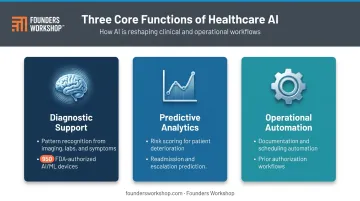
The Three Core Functions of Healthcare AI
A qualified development partner needs demonstrated experience in at least one of these categories:
- Diagnostic support — pattern recognition from imaging, lab data, or symptom inputs to detect conditions (the FDA has authorized 950 AI/ML medical devices, with 723 in radiology alone)
- Predictive analytics — risk scoring patients for deterioration, readmission, or care escalation needs
- Operational automation — automating clinical documentation, scheduling, prior authorization, and administrative workflows
An AI model is only as good as the clinical data feeding it — and this is where most general-purpose agencies fall short. A partner who cannot curate clean, representative training data will ship a product that fails in practice.
The failure rarely happens at launch. It surfaces six months later, when the model's predictions stop making clinical sense against real patient populations.
Key Factors for Choosing a Healthcare AI Development Partner
Selecting the right partner means evaluating both healthcare-specific knowledge and AI/ML depth. These six criteria translate that into verifiable questions you can ask before signing a contract.
Healthcare AI Domain Expertise
Start with the fundamentals: does the partner actually understand how healthcare data works?
Ask whether they have hands-on experience with HL7, FHIR, and EHR integrations. This isn't theoretical — in 2022, 9 in 10 hospitals used APIs to give patients access to EHR data, and more than two-thirds used FHIR APIs specifically. A team that cannot navigate these standards cannot build a product that fits into real clinical environments.
Go beyond project names in their portfolio. Ask them to explain:
- How they've handled PHI data pipelines and de-identification
- Specific EHR interoperability challenges they've solved
- How they conduct clinical user research and usability testing
Detailed, specific answers signal genuine experience. Vague responses about "following industry best practices" usually mean they haven't done the work.
HIPAA and Regulatory Compliance Track Record
Compliance depth matters more than a checkbox answer. Ask how the partner implements HIPAA requirements throughout the development lifecycle — not just at the end.
Key areas to probe:
- Encryption at rest and in transit
- Audit trail implementation
- Role-based access controls
- BAA management with cloud infrastructure providers (AWS, Azure, GCP)
Beyond HIPAA, understand the AI-specific regulatory layer. The FDA distinguishes between Software as a Medical Device (SaMD) — which requires premarket review — and general wellness tools that fall outside device regulation. Clinical Decision Support software has its own guidance framework. A qualified partner must be able to tell you which category your app falls into before a single line of code is written.
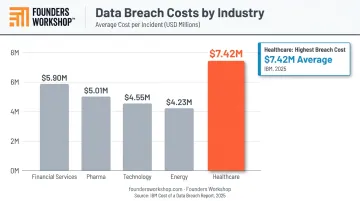
The cost of getting this wrong is substantial. IBM's 2025 Cost of a Data Breach Report found that healthcare remained the highest-cost industry for breaches at $7.42M on average — more than any other sector.
Proven AI/ML Development Capability
Don't accept "yes, we do AI" as an answer. Push for specifics on their model development process:
- How do they ensure training datasets are diverse and representative?
- How do they evaluate model performance (sensitivity, specificity, AUC)?
- What is their bias auditing process before deployment?
This last point is not optional. Research by Obermeyer et al. found that a widely used commercial health-risk algorithm was racially biased — at the same risk score, Black patients were measurably sicker than White patients. Correcting the bias would have increased the proportion of Black patients receiving additional care from 17.7% to 46.5%. That's not a technical footnote; it's a patient safety issue and a product liability issue.
A credible AI partner will have a documented process for subgroup evaluation and bias testing. No documented process means no real process.
Development Process and Methodology
A structured, milestone-based development process is non-negotiable for healthcare AI. Black-box engagements — where requirements go in and a finished product emerges months later — produce rework cycles and compliance gaps.
Look for a process that includes:
- Discovery — clinical problem definition, user research, and feasibility assessment
- Definition — compliance architecture, data pipeline design, and technical roadmap
- Development — iterative builds with defined AI/ML validation checkpoints
- Deployment — compliance review, security testing, and staged rollout
- Ongoing support — model monitoring and continuous improvement
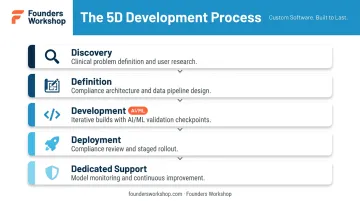
Founders Workshop's 5D Process (Discovery, Definition, Development, Deployment, Dedicated Support) reflects this kind of structured, repeatable framework. Front-loading clinical problem definition and compliance architecture before development begins eliminates the rework cycles that plague less disciplined teams.
One question worth asking before you sign: what happens if the AI model underperforms in clinical use after launch? How a partner answers that tells you whether they've thought through production deployment — or just delivery.
Post-Launch Support and Model Monitoring
That question matters because healthcare AI apps require ongoing support well beyond standard bug fixes. AI models degrade over time as clinical data distributions shift — a phenomenon called model drift — and a partner who disappears after launch leaves you with a product that silently loses accuracy.
Research published in JAMA Network Open confirms that harmful data shifts in deployed clinical AI are detectable and addressable — but only if monitoring infrastructure exists. Drift-triggered model updating outperformed maintaining a stale model in the study context.
Ask specifically what their post-launch AI support includes:
- Continuous model performance monitoring
- Retraining pipelines when performance degrades
- Alerting protocols if model accuracy drops below clinical thresholds
- Dashboards for tracking key performance metrics over time
Scalability Planning and Cost Transparency
A partner who builds only for current requirements creates expensive technical debt. Healthcare platforms regularly need to scale across user types, data volumes, and regulatory environments — expanding from one state to multiple, or adding new clinical use cases that bring new compliance requirements.
On cost: require complete transparency upfront. Development costs vary based on compliance requirements, EHR integration complexity, model training infrastructure, and team location. Nearshore development models — such as teams based in Latin America operating in U.S. time zones — can deliver comparable quality at substantially lower cost.
Founders Workshop uses this model: U.S.-based business analysts lead strategy and client communication, while senior Latin American developers handle execution — in the same time zone, at roughly one-third the cost of a fully U.S.-staffed team.
Red Flags That Signal the Wrong Partner
Some warning signs are obvious only if you know what to look for.
Vague compliance answers are the clearest signal. A partner who cannot explain their encryption implementation, their BAA management process, or how they classify your app under FDA guidance has not built compliant healthcare AI products before. Real experience produces specific, confident answers — not "we handle all the compliance stuff."
AI treated as a feature, not an engineering discipline. If AI and ML are presented as an add-on, bolted onto a standard app build, the partner is applying generic toolkits to a problem that requires custom clinical reasoning.
Ask specifically for:
- Dedicated data science expertise on the team
- Documented model validation processes
- Bias mitigation protocols for clinical use cases
If those don't exist, your model won't meet clinical validation standards.
Unrealistic timelines and suspiciously low pricing. Healthcare AI development involves compliance architecture, clinical data curation, model training and validation, EHR integration, and security testing. Any partner promising to complete all of this in a few weeks, or for a fraction of realistic market rates, is either cutting corners or doesn't understand the scope. Either way, you'll be the one dealing with the fallout.
How Founders Workshop Can Help
Founders Workshop is an AI-first software development partner with over 18 years of experience building 200+ custom B2B and B2C software solutions, including work in healthcare and senior care. The leadership team — CEO Vincent Serpico, CPO Wayne Neale, and COO Michael Vanderslice — each bring 30+ years of experience as founders, investors, and business operators, so every product decision gets evaluated through the lens of business viability, not just technical execution.
The 5D Process de-risks healthcare AI development by prioritizing clinical problem definition, compliance architecture, and user research before development begins. This eliminates the rework cycles that inflate timelines and budgets on unstructured engagements.
The nearshore staffing model pairs U.S.-based business analysts leading strategy and communication with Latin American development teams in the same time zone — delivering projects at approximately one-third the cost of fully U.S.-staffed teams. Healthcare clients like Wellpsyche have worked with Founders Workshop for over eight years, from early startup stages through scaling.

That long-term track record reflects consistent technical evolution. Since 2008, the team has adapted through every major platform shift and now integrates AI and ML from the ground up on applicable projects, with AI tooling enabling faster delivery timelines. A few other credentials worth noting:
- Delivered 200+ custom software solutions across B2B and B2C since 2008
- Integrated AI and ML natively — not as an add-on — across applicable healthcare projects
- Four team-built solutions recognized by the Arizona Innovation Challenge, one of the largest business plan competitions in the country
Conclusion
The right healthcare AI development partner brings more than engineering hours to the table. They understand clinical workflows, know how to build within HIPAA and FDA constraints, and treat your product's outcomes as their own accountability — not just a project milestone to close.
Healthcare AI isn't a one-time build. As clinical data evolves, regulations tighten, and AI models require retraining, your development partner directly determines your product's long-term performance and credibility. Vet for post-launch commitment and regulatory fluency, not just launch-day capability. Those qualities separate partners who build products that last from teams that hand off and move on.
Frequently Asked Questions
What should we consider when applying AI in healthcare?
The core considerations are data quality and representativeness, regulatory classification (FDA SaMD versus general wellness), HIPAA compliance for any PHI used in model training, bias auditing across patient subgroups, and a clearly defined clinical problem before development begins. Getting these wrong produces models that fail clinically or create compliance exposure.
What are the main three roles of AI and ML in the healthcare setting?
AI and ML serve three core functions in healthcare: diagnostic support (analyzing imaging, labs, or symptoms to detect conditions), predictive analytics (risk-scoring patients for deterioration or readmission), and operational automation (documentation, scheduling, and admin workflows). A qualified partner should have production experience in at least one of these areas.
How do I verify if a healthcare app development partner is truly HIPAA compliant?
Request proof of BAAs with their cloud providers, ask how they implement encryption at rest and in transit, confirm they have documented audit trail and access control procedures, and ask for examples of past healthcare projects with HIPAA requirements. Vague answers to any of these questions indicate the compliance capability isn't real.
What does the AI/ML development process for a healthcare app typically look like?
Expect these phases in sequence: clinical problem definition, data curation and annotation, model training and validation, compliance review (including FDA classification if applicable), clinical deployment, and ongoing retraining as data shifts. Each phase needs defined exit criteria before the next begins.
How much does it cost to build a healthcare app with AI and ML features?
Budget $80K–$350K for a three-to-six month fully managed healthcare AI build, depending on compliance requirements, EHR integration complexity, and model training scope. Nearshore development models — like Founders Workshop's Latin America-based teams — bring that cost down to roughly one-third of U.S.-staffed equivalents without compromising quality or communication.
What questions should I ask a healthcare AI development partner before signing a contract?
Focus on production track record, model validation and bias testing practices, HIPAA process documentation, and what post-launch support covers for AI performance specifically. Ask what happens if the model underperforms after go-live. Any partner worth hiring answers those questions with specifics — not reassurances.