Introduction
The wrong development partner doesn't just delay your product — it can end your company. McKinsey's analysis of over 5,400 IT projects found that large IT projects run 45% over budget on average while delivering 56% less value than predicted. For startups and SMBs, those numbers aren't statistics — they're existential.
The challenge is that the market gives you almost no reliable signal. Every firm has a polished website, a curated portfolio, and a sales team that promises seamless delivery. Most founders only discover a partner's real capabilities after they've signed a contract and burned through half their budget.
This guide gives you a practical framework for evaluating firms beyond the sales pitch. You'll find the key selection criteria, the red flags experienced founders spot too late, and the questions that separate genuine partners from shops that will treat your project like a ticket in a queue.
Key Takeaways
- Evaluate development process and methodology first — portfolio aesthetics second.
- Communication fit predicts project outcomes as much as technical skill.
- Nearshore models deliver roughly one-third the cost of US-based teams without the timezone gaps or collaboration friction of offshore.
- Vague proposals, no QA process, and blocked access to developers are disqualifying — walk away.
- The right partner protects your budget, your IP, and your time to market.
What Is a Custom Software Development Company?
A custom software development company designs, builds, and delivers software specifically tailored to your business needs, workflows, and goals — rather than selling you an off-the-shelf product and asking you to work around its limitations.
The market offers three main engagement structures:
- Full-project development — the firm owns the complete build, from discovery through launch
- Staff augmentation — developers embedded in your existing team under your direction
- Nearshore/offshore outsourcing — dedicated teams based in lower-cost regions, with varying levels of timezone alignment
Understanding which model fits your situation before you start evaluating firms saves significant time. A startup with no internal technical team has different needs than a company that already has developers and needs to scale capacity.
That model choice also shapes the kind of firm you should hire. Choosing a development company is a strategic decision — the right partner brings business insight alongside technical execution, helping you scope an MVP that reaches the market before your runway runs out, not an over-engineered product that launches 18 months late.
Key Factors to Evaluate When Choosing a Custom Software Development Company
With thousands of firms competing for the same clients, surface-level signals like a clean website or a smooth sales call aren't enough. These factors connect directly to what actually matters: time to market, budget integrity, product quality, and scalability.
Proven Development Process and Methodology
A repeatable, structured methodology is one of the strongest predictors of project success. The data backs this up: according to the Standish Group CHAOS Report, Agile projects succeed at a 39% rate compared to just 11% for waterfall — and firms without any defined methodology tend to produce the worst outcomes of all.
Ask specifically how the firm handles:
- Initial discovery and requirements documentation
- Design approval before development begins
- Sprint cadence and client feedback cycles
- Change request management
- Milestone tracking and delivery sign-off
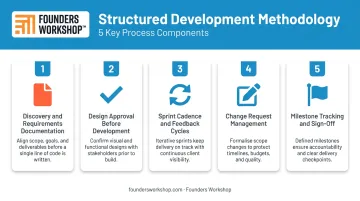
A firm with a real process can describe it in concrete terms, unprompted. If all you get is "we use Agile" without specifics on sprints, sign-off, or change requests — that's a process problem dressed up as a methodology answer.
Technical Expertise and Tech Stack Alignment
The right tech stack should match your project's requirements, not the firm's preferred defaults. Ask about experience with relevant technologies, cloud platform options, AI integration capabilities, and how they think about long-term maintainability.
This matters more than most founders realize. Poor technical decisions made early create compounding costs. CISQ estimated accumulated software technical debt in the U.S. at approximately $1.52 trillion — much of it originating in early architectural shortcuts. A firm that picks a stack because it's fastest for them to build in, rather than easiest for you to scale and maintain, transfers that cost directly to you.
A strong firm adapts their stack to your project requirements, explains their rationale plainly, and accounts for what you'll need 18 months after launch — not just at MVP.
Portfolio, Case Studies, and Domain Experience
Reviewing a portfolio should go beyond aesthetics. The real question is whether the firm has solved business problems similar to yours — ideally in your industry vertical.
Domain experience matters because a firm that has built healthcare software before understands HIPAA compliance, EMR integration patterns, and patient-facing UX constraints from day one.
A generalist firm starts from scratch on all of that — and bills you for the learning curve.
When reviewing case studies, look for:
- Evidence of measurable business outcomes, not just shipped products
- Projects at a similar complexity level to yours
- Relevant industry experience that reduces assumptions
Then contact references directly. Ask specifically about communication quality, how the firm handled problems when they arose, and whether they'd hire them again — not just whether the project shipped.
Communication Style and Collaboration Fit
Poor communication is a direct cause of software project failure. PMI found that one in five unsuccessful projects is attributed to ineffective communications — and that's likely an undercount, since communication issues are often buried inside scope and timeline failures.
The sales process is your preview. How quickly does the firm respond to your emails? Do their proposals use plain business language or impenetrable jargon? Can they explain a technical tradeoff in terms a non-developer would understand?
For founders without in-house technical staff, these factors become critical:
- Timezone overlap — real-time communication vs. 24-hour message cycles
- Language proficiency — not just fluency, but business vocabulary
- Cultural compatibility — shared work norms and communication expectations
A team that works in your timezone and communicates in plain language reduces misalignment more than any project management tool can compensate for.
Post-Launch Support and Maintenance
Software isn't finished at launch. Bug fixes, security patches, performance monitoring, and feature updates are ongoing requirements — and academic research in software engineering estimates that roughly 90% of total software lifecycle cost occurs in the maintenance phase.
That figure reframes the vendor selection decision entirely. Whoever you hire to build your software will likely be managing it for years — which means their support model deserves as much scrutiny as their development process.
Before signing, ask specifically:
- What does the post-launch support SLA include?
- What's the response time commitment for critical issues?
- How are feature update requests scoped and prioritized?
- Are support hours consumed by bug fixes or only by enhancement work?
A firm that disappears after delivery leaves you exposed — and finding a new team to inherit an unfamiliar codebase adds time and cost you didn't budget for.
Pricing Transparency and Engagement Model
Understanding pricing structures upfront prevents the most common budget surprises. The three standard models:
| Model | Best For | Key Risk |
|---|---|---|
| Fixed-price | Well-defined scope, MVPs | Scope creep leads to change orders |
| Time-and-material | Evolving requirements | Budget predictability is lower |
| Milestone-based | Staged delivery with defined checkpoints | Milestone definitions must be precise |
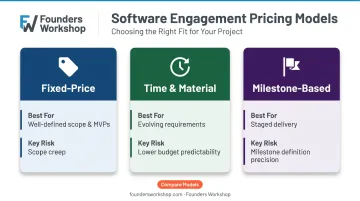
According to GoodFirms' 2026 custom software cost survey, 65.6% of software firms report that frequent requirement changes increase total project costs by 10–25%. The firms that protect you from this are the ones with strong discovery and definition processes — not the ones with the lowest quote.
On cost: small-to-mid projects typically run $30,000–$100,000; enterprise-grade builds often exceed $200,000. Whatever model you choose, build in a 15–20% contingency and evaluate total cost of ownership — including post-launch maintenance — not just the initial build.
Red Flags to Watch for When Vetting Software Development Firms
Some warning signs are subtle early on but become expensive problems mid-project. These are early disqualifiers.
Vague Proposals and Missing Scope Detail
A proposal without specific deliverables, defined milestones, or a clear breakdown of responsibilities is a preview of how that firm manages execution. Ambiguity at the proposal stage reliably leads to scope creep and budget overruns at the delivery stage. If they can't define what they're building before the contract, they won't be more precise once the engagement starts.
Unrealistic Timelines or Suspiciously Low Quotes
Firms that promise compressed timelines or significantly below-market rates are typically compensating somewhere — through junior developers, limited QA, or offshore teams with communication gaps that slow everything down.
The real cost of a failed project exceeds any initial savings. If a quote is 40% below others you've received for the same scope, that difference has to come from somewhere.
No Access to Developers or Project Leads
If a firm shields you from direct contact with the team building your product, expect slower feedback cycles and less accountability. A credible development partner gives clients meaningful access to project leads and relevant technical staff — not just an account manager who relays messages between you and a team you've never met.
Absent or Informal Quality Assurance Process
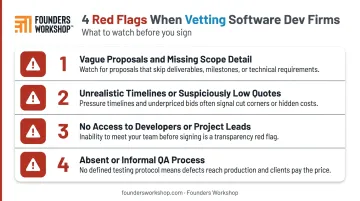
Firms without a dedicated QA workflow ship software with hidden issues, passing the repair costs on to you in post-launch maintenance. Ask three specific questions before signing:
- When does testing begin in the project lifecycle?
- Who owns QA, and is it a dedicated role or shared with developers?
- How are defects tracked from discovery through resolution?
If QA is an afterthought in their process description, it will be an afterthought in your build.
How Founders Workshop Can Help
Founders Workshop is a custom software development company built by entrepreneurs, for entrepreneurs. Founded in 2008 and headquartered in Arizona, the firm has delivered more than 200 custom B2B and B2C software solutions for startups and SMBs across the U.S., Latin America, and the Western Hemisphere.
CEO Vincent Serpico, CPO Wayne Neale, and COO Michael Vanderslice are each seasoned founders and business owners with over 30 years of experience. They evaluate software decisions through the lens of business outcomes — what ships, what sells, and what scales — not just technical execution.
The 5D Process
Founders Workshop's field-tested 5D Process directly addresses the failure points this guide covers:
- Discovery (2–4 weeks) — A dedicated Project Champion scopes features, identifies integrations, and aligns the product vision with real market needs before any design or code begins
- Definition (4–6 weeks) — A Designer and Project Manager create wireframes, interface designs, and clickable prototypes that confirm features and eliminate ambiguity before development starts
- Development (2–3 months) — Agile execution with iterative feedback loops, preventing the misaligned delivery that plagues firms building ad hoc
- Deployment (1 month) — Managed launch with cloud hosting, 24/7 monitoring, and disaster recovery
- Dedicated Support (80–160 hours/month) — Ongoing maintenance, feature updates, performance optimization, and code reviews post-launch
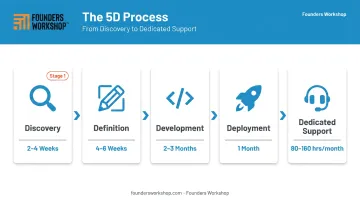
This structure is why clients like ALBedFill received a market-ready MVP in three months, and why Wellpsyche has maintained an eight-year partnership with Founders Workshop through multiple growth stages.
Nearshore Model: Collaboration Without the Offshore Tax
Founders Workshop pairs U.S.-based business analysts, project managers, and client leads with senior developers, designers, testers, and project managers based in Latin America. The result: same-timezone collaboration, no language or cultural friction, and development costs at one-third of a fully U.S.-staffed team. Unlike traditional offshore outsourcing — where communication gaps compound delays and cost savings erode through rework — the nearshore model keeps collaboration tight without inflating the budget.
Additional Differentiators
- Generative AI, RPA, Conversational AI, and Custom GPT built into projects from the start — not bolted on later
- Founders retain full IP and source code ownership from day one; no equity required
- 4 solutions recognized by the Arizona Innovation Challenge, one of the country's largest business plan competitions
- 25 senior team members across development, design, QA, and project management
- Active track record across healthcare, fintech, real estate, retail, senior care, and more
Conclusion
The right custom software development company isn't the most recognized firm or the lowest bid. It's the one whose process, expertise, communication style, and business values match where your product needs to go — and how your organization actually works.
The practical framework: define your requirements before you start talking to firms. Evaluate process and portfolio with equal weight. Prioritize partners who think about your product's market fit alongside its technical execution — that combination is what separates a vendor from a true business partner. Treat this decision with the same rigor you'd apply to hiring a key executive. The firm you choose will shape your product, your timeline, and your competitive position for years to come.
Frequently Asked Questions
How do I choose the right custom software development company?
Define your project requirements clearly before approaching any firm. Evaluate candidates on their development process and relevant experience — not portfolio aesthetics alone. Test communication fit early in the sales process, and prioritize partners offering transparent pricing and post-launch support. The process a firm uses predicts outcomes better than their client list.
What are the 7 models of SDLC?
The common SDLC models are Waterfall, Agile, Scrum, Kanban, Spiral, V-Model, and Iterative. Each represents a different approach to planning, building, and delivering software. When vetting a development partner, asking which model they use — and why — quickly reveals how disciplined and adaptable their process actually is.
How much does custom software development typically cost?
Costs vary widely based on complexity, team composition, and engagement model. Small-to-mid projects usually range from $30,000–$100,000; enterprise builds often exceed $200,000. Always build in a 15–20% contingency and evaluate total cost of ownership — post-launch maintenance can represent the majority of your long-term software investment.
What is the difference between nearshore and offshore software development?
Nearshore teams are in adjacent regions — for U.S. companies, typically Latin America — sharing the same or overlapping timezones. Offshore teams are in distant regions with larger time gaps. Nearshore development offers a strong balance of cost savings and collaboration quality, avoiding the communication delays that erode offshore advantages.
How long does it take to build a custom software product?
Timelines depend on scope, complexity, and team size. A well-scoped MVP generally takes 3–6 months from discovery through launch. Treat unusually fast delivery promises with caution — compressed timelines usually mean skipped steps, not faster work.
Should I choose a large agency or a small boutique development firm?
Larger agencies may offer more resources but often deprioritize smaller clients. Boutique firms typically provide more direct access to senior talent and more personalized engagement. The right fit depends on your project's scope and how much direct involvement you need from senior decision-makers throughout the build.