The stakes are incredibly high. Wasted capital, missed market windows, and a product that doesn’t solve the core problem can sink a startup before it ever sets sail. With data from the U.S. Bureau of Labor Statistics showing that only about a third of new businesses survive their first 10 years, getting this foundational partnership right is not just important; it's essential for survival.
Key Takeaways
- Seek a strategic partner who provides business advice, not just a vendor who codes.
- Define your business goals and core MVP features before starting your search.
- Evaluate partners on technical expertise, industry experience, and cultural fit.
- Vet candidates by reviewing portfolios, checking references, and asking tough questions.
- Explore nearshore partners for an ideal balance of cost, time zone, and cultural synergy.
Why Your Startup Needs a True Partner, Not Just a Vendor
The words "vendor" and "partner" are often used interchangeably, but for a startup, the difference is critical. A vendor is a transactional relationship; you provide a list of tasks, and they execute them. A partner, on the other hand, is invested in your business outcome. They act as a strategic advisor, bringing their expertise to the table to help you succeed.
For a non-technical founder, a true software partner is like gaining a technical co-founder without giving up equity. They should:
- Challenge your assumptions by asking tough questions, using their experience to identify risks and opportunities you may have missed.
- Offer product strategy insights to help you prioritize features, refine your user experience, and build a scalable technical foundation.
- De-risk the project with a proven development process and senior-level expertise, reducing the chances of technical debt, budget overruns, and launch delays.
This is the philosophy we've built at Founders Workshop. Our leadership team of seasoned founders brings over 30 years of experience in building and scaling businesses. Having been in your shoes, we bring that entrepreneurial perspective to every project.
Step 1: Define Your Project Before You Start Looking
Before you can find the right partner, you need to know exactly what you're looking for. A clear, well-defined project brief is your single most powerful tool. It attracts high-quality firms that value strategy and repels low-quality ones looking for a quick, vague contract.
Start by outlining the essentials:
- The Business Problem: What specific pain point does your software solve? Be able to articulate this in one or two clear sentences.
- The Target Audience: Who are you building this for? Define your ideal user with as much detail as possible.
- The Success Metrics: How will you know if your product is successful? Is it daily active users, conversion rates, or something else? Define your key performance indicators (KPIs) from day one.
With this foundation, you can map out your Minimum Viable Product (MVP). An MVP isn't just a basic version of your final product. It’s the simplest version that solves the core problem for your target audience and allows you to start gathering valuable feedback.
Resist the urge to create a long "wish list" of features. Focus is your greatest asset at this stage.
Key Criteria for Evaluating Potential Partners
Once your brief is ready, you can start evaluating potential partners. Look for firms that align with your specific business needs, not just those with flashy websites.
Technical Expertise and Tech Stack Alignment
Your partner's technical skills must match your project's requirements. Look for proven experience in the technologies relevant to your product, but also consider their ability to look ahead. A good partner will advise you on the right tech stack for long-term scalability and maintainability.
Don't be afraid to ask about their experience with forward-looking technologies like AI integration. You want a team that can not only build your MVP today but also help you evolve your product for tomorrow.
Industry Experience and Portfolio Review
Go beyond surface-level portfolios. A list of past projects is a good start, but you need to dig deeper. Look for case studies that show measurable business results in your industry or a similar one.
Pro Tip: Ask a potential partner to walk you through a past project that faced significant, unexpected challenges. How they navigated roadblocks and collaborated with the client to find a solution will tell you more about their capabilities than a dozen perfect success stories.
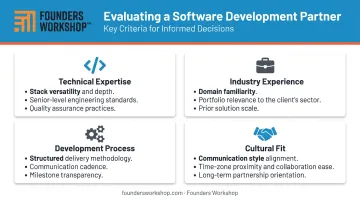
Development Process and Communication
A transparent and structured development process is non-negotiable. Look for partners who use an Agile methodology—an iterative approach focused on flexibility, continuous feedback, and rapid execution. This ensures you have clear visibility into the project's progress at all times.
Strong communication requires a predictable rhythm. Key elements to look for include:
- A clear schedule for meetings, such as daily stand-ups or weekly demos
- A designated, single point of contact for your project
- Shared access to project management tools like Jira or Trello
This is where a partner’s location matters. A nearshore model with teams in Latin America, for instance, offers the advantage of overlapping time zones. This enables real-time collaboration during your standard business day—no 3 a.m. calls required.
Cultural Fit and Team Structure
The partner's team will become an extension of your own. Their working style, values, and problem-solving approach must align with yours. Are they transparent and accountable? Do they take ownership of their work?
Ask about the specific team members who would be assigned to your project. You want to ensure you're getting experienced, senior-level talent, not a junior team supervised by one senior architect. Understanding their team structure helps guarantee the quality and expertise you're paying for.
The Vetting Process: Questions to Ask and Red Flags to Spot
After creating a shortlist of 2-3 potential partners, it's time for the final due diligence. These questions and red flags will help you confirm you've found the right fit.
Essential Questions for Your Shortlist
- "How do you handle scope changes or unexpected roadblocks during a project?"
- "Who will own the intellectual property (IP) and source code?"
- "Can you describe your process for quality assurance and testing?"
- "What does your post-launch support and maintenance look like?"
- "Can I speak to 2-3 of your previous clients, preferably ones in a similar stage or industry as mine?"
Common Red Flags to Watch Out For
- Vague or non-transparent pricing. If a potential partner can't provide a detailed cost breakdown, it's a major concern.
- An exclusive focus on being the "cheapest." The best partners emphasize the value and ROI they deliver, not just a low hourly rate.
- Poor communication during the sales process. Slow or unclear responses upfront will likely get worse once the project is underway.
- Hesitancy to provide client references. A confident firm with happy clients should be eager for you to speak with them.
- A "yes-man" attitude. A team that agrees to everything without offering strategic input isn't a partner—they're an order-taker.
How Founders Workshop Bridges the Gap for Startups
Choosing a software partner is a defining moment for any startup. At Founders Workshop, we've built our entire model around the unique challenges founders face because we are founders ourselves. We understand the journey from a raw idea to a market-ready product.
Here’s how we address the key challenges discussed in this guide:
- Benefit from entrepreneurial expertise. We provide strategic business guidance to de-risk your venture, drawing on our leadership team’s 30+ years of experience as founders.
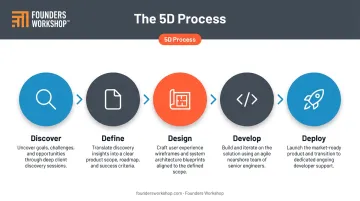
- Follow a field-tested 5D Process. Our framework—Discover, Define, Design, Develop, and Deploy—provides a transparent roadmap from vision to a successful MVP.
- Leverage the nearshore advantage. Our model combines U.S.-based leadership with senior developers in Latin America for significant cost savings and seamless, same-time-zone collaboration.
You don't have to navigate the startup journey alone. Partner with a team that has been in your shoes and is committed to building your success.
Frequently Asked Questions
What's the difference between a software partner and a freelance developer?
A freelancer is ideal for specific, well-defined tasks within a larger project. A partner is better for end-to-end product development, providing strategic guidance, project management, and a full team of specialists from design to deployment.
How much does it cost to hire a software development partner?
Costs vary, with MVPs ranging from $40,000 to over $300,000. Nearshore partners in Latin America offer significant savings, often charging $25-$99/hr for talent that would cost $100-$149/hr in the U.S., according to Clutch data.
What are the biggest red flags to watch for when choosing a partner?
The biggest red flags are unclear pricing, poor communication during the sales process, an inability to provide client references, and a lack of strategic input or pushback on your ideas.
Should I choose a partner based on a fixed-price or time & materials model?
A time & materials (T&M) model is usually better for startups than a fixed-price contract. T&M provides the flexibility to adapt to user feedback and changing market needs, which is essential for Agile development and finding product-market fit.
What is a nearshore development partner and why is it beneficial for startups?
A nearshore partner is located in a nearby country with a similar time zone, like a U.S. firm working with a team in Latin America. This model provides major cost savings, better cultural alignment, and real-time collaboration, avoiding the delays common with offshore teams.
Who owns the intellectual property (IP) when working with a partner?
Your startup must always own 100% of the IP and source code. U.S. law can default IP ownership to the developer, so your contract must include a clear IP assignment clause that transfers all rights to your company, as advised by legal experts at Orrick.