
Most founders view a software development agreement as a defensive legal shield, but the reality is that your contract is actually your most powerful offensive tool for growth. You’ve likely felt the anxiety of reviewing a vendor’s standard terms and wondering if you’re accidentally signing away your intellectual property or opening the door to endless scope creep. It’s a valid concern; in a year where AI-assisted development has triggered dozens of major copyright lawsuits, the legal ground for technical ownership is shifting rapidly. If you want to protect your equity and your peace of mind, you need a robust software development agreement checklist to navigate the negotiation with confidence.
This guide will help you master the critical clauses that protect your assets and ensure high delivery velocity. We’ll provide a clear framework for building a partnership rooted in accountability and transparency rather than rigid, restrictive terms. From securing full ownership of all technical assets to ensuring timezone alignment for better collaboration, you’ll learn how to transform a standard legal document into a strategic blueprint for long-term business success.
Key Takeaways
- Reframe your contract as a strategic roadmap that removes technical friction and aligns your engineering team with your long-term business goals.
- Utilize a comprehensive software development agreement checklist to define a precise Statement of Work and select the most effective pricing model for your project.
- Protect your technical moat by enforcing “Work Made for Hire” clauses that guarantee your company full ownership of every line of code and design asset.
- Build accountability into your partnership by structuring financial terms around value-based milestones and clearly defined performance standards.
- Leverage timezone alignment as a critical contractual requirement to ensure your nearshore team maintains high delivery velocity and operational transparency.
Why Your Software Agreement is a Strategic Business Asset (Not Just Legal Fluff)
Founders often view the contracting phase as a necessary evil; a hurdle to clear before the real work begins. This mindset is a mistake. In 2026, your agreement isn’t just a legal shield. It’s a strategic blueprint. It removes technical friction by codifying how you and your partner will navigate the complexities of modern software builds. A well-structured contract ensures that your technical execution stays perfectly aligned with your business outcomes. It transforms a vendor relationship into a true partnership built on accountability and shared vision.
The 2026 landscape demands this level of precision. With the rapid evolution of agentic AI and autonomous transactions, your contract must provide the flexibility to integrate new technologies without triggering a complete renegotiation. Using a comprehensive software development agreement checklist helps you address these future-proofing requirements early. It ensures you aren’t just building for today, but scaling for tomorrow.
Aligning Technical Execution with Business Growth
Effective partnerships thrive on predictability. Your agreement should set clear expectations for reporting cadences and communication protocols. This is particularly vital for strategic MVP development, where speed and pivot-readiness are paramount. By defining a strict “Definition of Done,” you eliminate subjective disputes. Everyone knows exactly when a feature is ready for production, which maintains delivery velocity and keeps your roadmap on track. This clarity allows you to focus on growth rather than micro-managing technical tasks.
The Cost of a Weak Agreement
Handshake deals fail because they ignore the inevitable “what-ifs.” Vague clauses lead to technical debt and missed launch dates, costing you market share. Without a defined exit strategy, you also risk vendor lock-in; a situation where your code is held hostage by a partner who no longer fits your needs. Most importantly, 2026 founders must secure their intellectual property with extreme care. As of early 2026, over 70 infringement lawsuits have been filed against AI companies regarding copyrighted training data. This makes the work for hire doctrine a non-negotiable part of your software development agreement checklist. You must ensure your company owns every line of custom code, every design asset, and every AI model weights from the moment they’re created. A weak agreement doesn’t just hurt your current project; it can permanently damage your company’s valuation and long-term viability.
The Core Checklist: Defining Scope, Deliverables, and Timelines
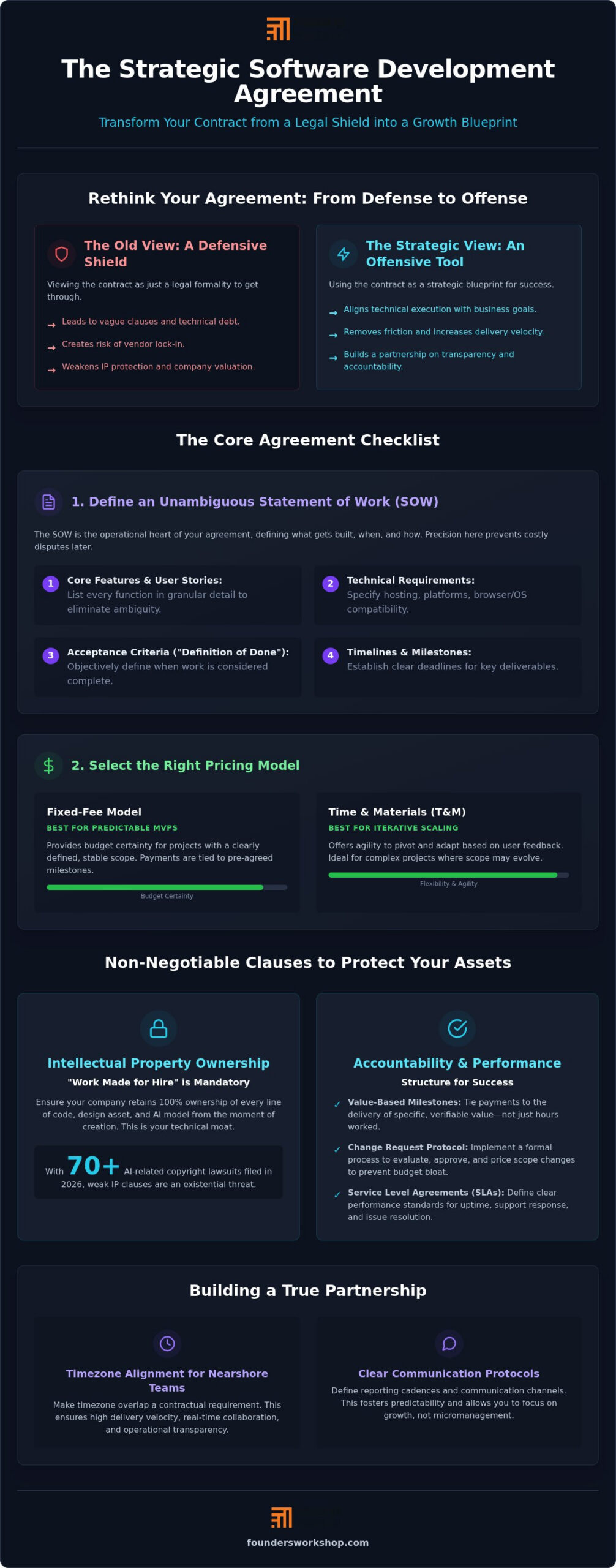
The Statement of Work (SOW) is the operational heart of your partnership. While the Master Service Agreement (MSA) covers the high-level legalities, the SOW dictates exactly what gets built, how much it costs, and when it ships. In 2026, founders must choose between fixed-fee models for predictable MVPs and Time and Materials (T&M) for iterative scaling. Fixed-fee provides budget certainty, but T&M offers the agility required to pivot based on real-time user feedback. Regardless of the model, your software development agreement checklist must include clear milestones. These act as quality gates, ensuring that payments only trigger when specific, verifiable value is delivered.
Managing change is an inevitable part of the process. A robust agreement includes a formal change request protocol to prevent scope creep from ballooning your budget. By documenting how new features are evaluated and priced, you maintain control over the roadmap without stifling innovation. This disciplined approach removes technical friction and keeps the partnership focused on business outcomes.
5 Steps to Define an Unambiguous Scope
Building a solid software development agreement checklist starts with a granular scope. Follow these steps to ensure alignment:
- Step 1: List all core features and user stories. Vague descriptions lead to friction; granular stories lead to results.
- Step 2: Define technical requirements. Specify hosting environments, browser compatibility, and mobile OS versions early to avoid late-stage surprises.
- Step 3: Establish a rigorous User Acceptance Testing (UAT) period. This ensures the product meets your specific standards before final sign-off.
- Step 4: Outline the deployment process. Clarify who handles the push to production and how post-launch support is managed.
Timelines vs. Velocity: What to Measure
Rigid calendar dates often fail in complex software builds. Instead, focus on “sprint velocity.” This metric measures the amount of work a team can tackle in a set period, providing a more accurate forecast for delivery. Always include buffers for third-party API integrations and system dependencies, as these external factors often cause delays. For legacy application modernization, set “Stop/Go” points to evaluate progress before committing to the next phase. This approach ensures you aren’t throwing good money after bad code. Because ownership is king, you should always ensure your contract aligns with U.S. Copyright Law on work for hire to keep your IP secure from day one. If you want to ensure your contract is as strong as your code, you can partner with a seasoned guide to review your technical strategy.
Intellectual Property and Data Security: Protecting Your Technical Moat
Your intellectual property is the foundation of your company’s valuation. If your agreement doesn’t explicitly secure your rights to every line of code, you’re building on borrowed land. A comprehensive Software Development Agreement Checklist must prioritize the transfer of ownership from the moment of creation. This protects you from the legal uncertainty currently surrounding AI-generated code and third-party data usage. In 2026, where high-profile cases like the $1.5 billion Bartz v. Anthropic settlement have redefined fair use, your contract must be ironclad regarding how your data is used to train models. You should also pay close attention to documenting human contributions in AI-assisted inventions to strengthen potential patent claims. This documentation ensures that your software remains a defensible asset during future funding rounds or acquisitions.
IP Ownership Models: Which is Right for You?
Selecting the right IP model depends on your long-term strategy. Full ownership is the non-negotiable standard for MVPs and core proprietary logic. If a partner suggests a licensed model where you pay for their internal framework, proceed with caution. This can lead to vendor lock-in that makes it impossible to move your project to a new team later. For critical systems, include a source code escrow clause. This ensures that if the partner goes out of business, your technical assets remain accessible, protecting your business continuity and removing technical friction.
Data Security and Compliance Standards
Robust security protocols extend beyond simple passwords. Your software development agreement checklist should mandate strict encryption for data at rest and in transit, especially when working with nearshore teams accessing internal systems. Mandate the use of secure VPNs and multi-factor authentication for all developers. Specify the frequency of security audits and who bears the cost of remediating any discovered vulnerabilities. For founders in regulated spaces, such as healthcare software development, these clauses must specifically address HIPAA compliance and the protection of patient data. This level of detail ensures your partnership is built on a foundation of trust, reliability, and human-centered results.
Financial Terms and Service Level Agreements (SLAs) for Scaling Teams
Financial clarity is the bedrock of a stable technical partnership. Your software development agreement checklist must move beyond simple hourly rates to focus on value-based milestones. This approach ensures that capital is deployed effectively and that your partner remains incentivized to hit delivery dates. In a nearshore staff augmentation model, “Acceptable Performance” needs a precise definition. It isn’t just about hours logged; it’s about code quality, documentation standards, and consistent meeting of sprint commitments. When these expectations are clear, you remove the friction that often plagues scaling operations.
You also need to address the auxiliary costs that can quietly erode your budget. Clearly define responsibility for third-party software licenses and cloud hosting fees. Expense reimbursements for travel or specialized hardware should always require prior written approval. Finally, find a balance in your termination clauses. Termination for cause protects you against gross negligence or breach, while termination for convenience provides the flexibility to pivot or scale down if your business strategy shifts. This structural balance provides the peace of mind necessary for long-term growth.
Structuring Fair Payment Terms
The right payment structure depends on your project’s maturity. Project-based fees offer high predictability for clearly defined MVPs, while monthly retainers provide the steady capacity needed for ongoing staff augmentation. To manage the inevitable scope creep, your contract should include a streamlined process for additional work orders. This keeps the project moving without constant legal re-evaluations. Consider including early completion bonuses to reward high velocity, alongside modest late payment penalties to protect your partner’s cash flow and maintain mutual respect.
SLAs that Actually Drive Performance
Service Level Agreements should be practical, not just punitive. Focus on metrics that impact your users, such as uptime, system latency, and bug response times tiered by severity. Every robust agreement should include a “Right to Cure” period. This gives your partner a fair window to remediate issues before financial credits or termination options trigger. By linking these SLAs directly to financial credits, you ensure that accountability is a core component of the daily workflow. If you’re ready to build a high-performing team without the usual legal friction, you can partner with our executive team to refine your technical roadmap and scale with confidence.
Navigating Nearshore Contracts: Alignment for Long-Term Partnership
Offshore models often fail because they underestimate the friction of a 12-hour timezone gap. In contrast, nearshore contracts prioritize real-time collaboration. This isn’t just about convenience; it’s about maintaining delivery velocity. When your engineering team in Latin America works your same hours, you eliminate the “wait-and-see” cycle that stalls development. Your software development agreement checklist should explicitly mandate overlapping working hours to ensure your agile ceremonies remain productive. This alignment allows for immediate feedback loops, which are essential for high-growth startups.
Managing cross-border legal jurisdictions requires a pragmatic approach. Most US-based founders prefer agreements governed by US law, specifically in the state where the company is headquartered. This simplifies dispute resolution and provides a familiar framework for enforcing IP rights. However, your contract should also account for the local labor laws of your nearshore partner to ensure compliance and sustainability. Language proficiency is another critical clause. Mandating English fluency for all key personnel prevents the communication breakdowns that often lead to technical debt.
The Nearshore Advantage in Contracts
A well-structured agreement for nearshore staff augmentation captures the cost benefits of Latin American talent without the risks of offshore distance. Senior engineers in LatAm typically range from $50 to $90 per hour, providing a 40% to 60% saving compared to domestic US hires. To maximize this value, define “On-Site” versus “Remote” expectations clearly. Even if the team is remote, specifying their availability for key milestones or quarterly strategic planning sessions ensures they feel like an extension of your internal team rather than a detached vendor.
Building a Long-Term Strategic Partnership
Founders Workshop moves beyond the transaction to act as a seasoned executive guide. We align our agreements with your 2026 growth goals, ensuring the contract supports scaling rather than just maintenance. For non-technical founders, this means the agreement acts as a bridge between business vision and technical execution. Before you sign, use this final software development agreement checklist to review your terms:
- Confirm timezone overlap is explicitly stated for all core team members.
- Verify that U.S. Law governs all IP and ownership clauses.
- Ensure the agreement includes cultural alignment and language proficiency standards.
- Check for clear dispute resolution paths that avoid international court systems.
By addressing these nuances, you build a partnership rooted in transparency and shared success. This structured approach removes technical friction and allows you to focus on what matters most: growing your business.
Securing Your Technical Future
A well-crafted agreement is more than a safety net; it’s the operational foundation that allows your business to scale without the drag of technical friction. By prioritizing a comprehensive software development agreement checklist, you ensure that every line of code adds to your company’s valuation and every milestone moves you closer to market leadership. You’ve learned how to protect your intellectual property in an AI-driven landscape and why timezone alignment is the secret to maintaining high delivery velocity with nearshore teams.
At Founders Workshop, we bring 30+ years of software leadership experience to every partnership. We specialize in building scalable MVPs for US startups and providing seamless nearshore integration with elite Latin American tech talent. We understand the struggles of scaling a company and are here to offer a steady hand as you navigate your technical roadmap. If you’re ready to align your technical execution with your long-term strategic vision, download our Founder’s Guide to Nearshore Engineering today. You have the vision; let’s build the framework that makes it a reality.
Frequently Asked Questions
Who typically owns the source code in a software development agreement?
In a professional partnership, the client typically owns all source code, designs, and technical assets once payment is made. This ownership is secured through an assignment of intellectual property rights or a “Work Made for Hire” provision. It’s vital to verify that this transfer includes all custom-built components and not just a license to use them. Full ownership is a non-negotiable requirement for startups seeking to protect their valuation and maintain long-term operational control.
What is the difference between a fixed-price and a time-and-materials contract?
Fixed-price contracts are built on a predetermined budget and a strict scope of work, making them suitable for predictable MVP launches. Time-and-materials contracts charge for the actual resources and hours utilized, which provides the agility needed for scaling teams or evolving product requirements. While fixed-price offers budget certainty, the time-and-materials model is often preferred in 2026 for its ability to accommodate the rapid iterations required in modern software development and nearshore staff augmentation.
How do I handle “scope creep” within a legal agreement?
Scope creep is best handled through a structured change management protocol within the legal agreement. This process requires that any additions to the project scope be documented in a written change order that specifies the impact on costs and schedules. By utilizing a comprehensive software development agreement checklist during the initial negotiation, you can establish a clear baseline. This clarity makes it much easier to identify when a request falls outside the original agreement’s boundaries.
Why is a “Work Made for Hire” clause so important for startups?
A “Work Made for Hire” clause is the primary mechanism for ensuring your company owns the intellectual property from the moment of its creation. Without this specific language, the legal authorship might default to the individual developer or the agency. For startups, this ownership is essential for securing patents and passing the rigorous due diligence required during funding rounds or acquisitions. It eliminates the risk of future legal disputes over who truly owns the core product.
What happens if the software development company misses a deadline?
When a developer misses a milestone, the agreement should outline specific remedies, such as a “Right to Cure” period where the partner can fix the delay. If the issues persist, Service Level Agreements (SLAs) can trigger financial credits to offset the loss of business momentum. It’s important to differentiate between delays caused by technical challenges and those caused by negligence. Clear contractual consequences ensure that your partner remains focused on maintaining a high delivery velocity.
Can I terminate a software development agreement if I am unhappy with the quality?
You can terminate an agreement for cause if the developer consistently fails to meet quality standards or “Acceptable Performance” metrics defined in the contract. Additionally, most founders insist on a “termination for convenience” clause. This allows you to end the partnership for any reason by providing a notice period, usually 30 days. This flexibility ensures you aren’t locked into a relationship with a poor-performing partner and can pivot your resources toward more effective technical solutions.
How should intellectual property for third-party APIs be handled?
While you won’t own the third-party APIs or open-source libraries themselves, your agreement must guarantee that you have the perpetual right to use them within your software. The contract should require the developer to list all third-party components and confirm they are used in compliance with their respective licenses. You should own all the custom integration code that connects these APIs. This distinction protects you from future licensing disputes and ensures your technical moat remains secure.
What security standards should I insist on in the contract?
You should mandate encryption for all data at rest and in transit, alongside multi-factor authentication for developer access. Your software development agreement checklist should also specify the frequency of security audits and the responsibility for vulnerability patching. If your product handles sensitive information, such as in healthcare tech development, ensure the contract requires compliance with relevant regulations like HIPAA or SOC 2. These standards protect your users and reduce the liability risks associated with data breaches.