
What if the strongest AI proposal starts by questioning whether AI is needed at all? When you’re building a business case for an AI project, the first task isn’t choosing a model or tool. It’s identifying a business problem important enough to solve, then showing how a measured test could prove whether AI is the right approach.
That can be difficult when potential benefits are uncertain and decision-makers need a clear view of costs, risks, ownership, and success measures. A promising idea can stall if it leads with technology instead of connecting to an operational or strategic priority. Rather than promise a return you can’t yet verify, make the assumptions visible and test them.
This guide explains how to define the opportunity, establish a baseline, estimate potential value, and assess data, integration, security, and adoption risks. You’ll also learn how to frame a focused next step with clear measures for success. For organizations in Dallas, Fort Worth, Plano, Frisco, and Irving, the goal is the same: build a credible case that earns the next decision through evidence, not hype.
Key Takeaways
- Start with a business problem that matters, not a tool or trend looking for a use case.
- When building a business case for an AI project, link expected benefits to outcomes you can observe and measure.
- Compare AI with improving the current process or using conventional software, and account for the work required to implement and maintain it.
- Identify key risks and assign clear ownership for business results, technical delivery, data, and ongoing operations.
- Make the next decision easier with a concise case for a bounded test, clear success measures, and a defined decision point.
Building a Business Case for an AI Project Starts with a Business Problem
Building a business case for an AI project means making a reasoned proposal that connects a defined business need to expected outcomes and the investment required to pursue them. The case should explain why the issue matters, who is affected, what might improve, and how the organization will judge whether the approach is worthwhile. It also belongs within the broader technology strategy, where technology choices support business objectives rather than dictate them.
Starting with a tool or trend can reverse that logic. A team may focus on introducing a chatbot, predictive model, or generative AI feature before confirming that it addresses a meaningful problem. That can direct attention toward technical capability while obscuring the workflow, its users, and the consequences of leaving it unchanged.
A business case explains why the organization should invest to improve an outcome; a technology proposal explains how a particular tool could be built or deployed. The technology may be part of the answer, but it shouldn’t substitute for a clear business rationale.
Describe the workflow problem before proposing AI
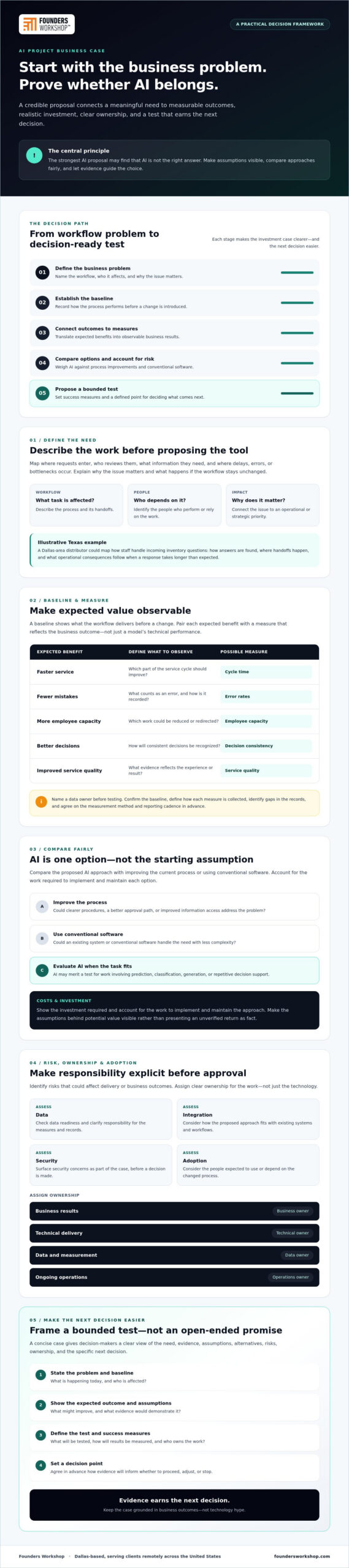
Start with the task and the people who perform or depend on it. Map where requests enter, who reviews them, what information they need, and where delays, errors, or bottlenecks occur. Establish how the process works today using evidence the organization already has, such as processing times, rework, backlogs, service records, or staff observations. This baseline makes the problem specific and gives later comparisons a fair starting point.
For example, a Dallas-area distributor might examine how staff handle incoming inventory questions from business customers. First establish how employees find the answer, where handoffs occur, and what operational consequences follow when a response takes longer than expected. Organizations seeking to strengthen customer experience and improve operations often partner with consulting firms like Blossom Nova Tech to diagnose these bottlenecks and evaluate whether process adjustments or technical solutions are warranted. This is an illustrative scenario, not a claim about a particular company or result.
Check whether AI is a sensible fit
With the workflow defined, consider what kind of work is involved. AI may be worth evaluating when a task requires prediction, classification, generation, or repetitive decision support. First separate the need from any preferred technique. Ask whether clearer procedures, better information access, or conventional software could address the same issue with less complexity.
For instance, if delays stem from duplicate data entry or an unclear approval path, redesigning the process or improving an existing system may be more appropriate than adding AI. If the task involves sorting varied requests or extracting patterns from information, an AI approach may merit a test. Let the business need guide the choice, not the appeal of a particular model.
Build the AI Project Business Case Around Outcomes and Evidence
A credible case turns the workflow problem into a testable proposition. Define the problem, establish how the process performs today, identify the outcomes that matter, test the assumptions behind the proposed approach, and decide how success will be measured. This sequence keeps the investment discussion grounded in evidence rather than an attractive but untested promise.
Connect every expected benefit to something people can observe. If the proposed value is faster service, measure the relevant part of the service cycle. If it’s fewer errors, define what counts as an error and track how often it occurs. Claims about employee capacity should specify which work could be reduced or redirected. A model’s accuracy or response speed can be useful technical information, but it doesn’t by itself show whether customers or operations are better off.
A baseline makes projected improvement assessable because it shows what the workflow delivers before a change is introduced. Without one, a team can’t reliably distinguish a real improvement from normal variation, incomplete tracking, or an optimistic estimate.
Choose measures that reflect business value
Choose a small set of measures that match the task, such as cycle time, error rates, service quality, employee capacity, or decision consistency. For a hypothetical Fort Worth service business, a team evaluating AI-assisted request routing might track how long it takes to assign a request and whether it reaches the appropriate group. Those measures connect the proposed intervention to workflow performance rather than treating the tool’s technical output as the end result.
Name a data owner before the test begins. That person should confirm the baseline, define how each measure is collected, and flag gaps in the records. Agree on the measurement method and reporting cadence in advance so results can be compared consistently.
Make assumptions and scenarios visible
Separate what’s known from what’s projected. Label baseline figures as measured, and identify estimates, hypotheses, and qualitative benefits distinctly. Scenario ranges can help decision-makers understand uncertainty, but use conservative, expected, and optimistic cases only when available evidence supports meaningful assumptions. Don’t present possible time savings or capacity gains as guaranteed financial savings.
Document what projections depend on: whether employees will use the workflow, whether the data is suitable, whether existing systems can support the connection, and what ongoing review may require. Harvard Business School’s guidance on weighing costs against value creation reinforces the need to evaluate implementation effort alongside potential benefits. Founders Workshop can help organizations connect AI strategy and development to business outcomes and practical measures.
Compare AI Project Value, Costs, and Alternatives Fairly
A fair business case compares more than one way to address the same need. Put the proposed AI approach beside the current workflow, a process redesign, and conventional software. Compare each option over the same period and against the same desired outcome. This helps decision-makers see whether AI offers a meaningful advantage or simply adds complexity.
Account for the full effort, not just the visible build. Depending on the approach, that may include implementation, integration with existing systems, data preparation, monitoring, maintenance, employee time, change management, and human review. Evaluate these factors against the organization’s priorities before treating a potential benefit as a reason to invest.
| Option | Value drivers | Assumptions and resource needs | Risks and evidence gaps |
|---|---|---|---|
| Current workflow | Provides a comparison point for service, time, and quality. | Requires reliable baseline records and staff input. | Incomplete tracking may make current performance difficult to assess. |
| Process redesign or conventional software | May reduce handoffs, repeated entry, or unclear steps. | Requires process ownership, configuration or development, and staff time. | May not address tasks that depend on interpreting varied information. |
| Limited AI test | Can test whether AI improves a defined part of the workflow. | Requires suitable data, integration planning, user participation, and human review. | Test results may not predict performance at broader scale. |
| Full AI build | May support wider use if a limited test establishes value. | Requires ongoing monitoring, maintenance, integration, and adoption effort. | Commits more resources before unresolved assumptions are tested. |
Estimate return without overstating certainty
ROI compares expected value with relevant investment over a defined period. State what counts as value and which costs are included, then make the calculation assumptions clear. Quantified benefits, such as measured reductions in processing time, should remain distinct from qualitative gains, such as a smoother employee experience. Don’t turn an unmeasured benefit into a promised saving.
Account for alternatives and total effort
Building a business case for an AI project means testing whether its expected value justifies the full effort relative to credible alternatives. A limited test may answer key questions with less commitment than a full build. If a simpler process change solves the same problem, it may be the stronger choice. Compare staff time, data readiness, integration work, ongoing human review, and maintenance for each option, then make evidence gaps explicit before seeking approval.
Address AI Project Risks, Governance, and Adoption Before Approval
A proposal is stronger when it explains not only what could go right, but what might fail and how the organization will respond. When building a business case for an AI project, make risks and ownership part of the decision, not issues to resolve after approval. Consider data quality, privacy, security, reliability, system integration, user adoption, and the need for human oversight.
Set boundaries before deployment. Define acceptable failure modes, such as an output that needs correction, and specify what should happen if an output is unsafe, unreliable, or unavailable. Establish who can pause or override the process, how concerns are escalated, and who decides whether the project can continue. If organizational policies or sector requirements may apply, involve the appropriate internal or external experts rather than assuming the project is exempt.
Set practical safeguards and decision ownership
Document what data the project needs, where it comes from, who can access it, and who is responsible for reviewing its suitability. Assign distinct owners for the business outcome, technical delivery, data, and ongoing operations. For outputs that could affect a customer or important business decision, specify when a person must review the result and when they can override an automated recommendation.
Plan for people and workflow adoption
AI changes work as well as software. Identify the teams whose daily tasks may shift, then involve them in discovery so the design reflects how the workflow actually runs. Plan for training, feedback, and support as implementation effort. After launch, assign someone to review real-world performance and user feedback. If quality drifts or the process stops meeting its measures, define how it will be investigated, corrected, or paused.
These choices can clarify whether AI belongs in a wider software change or whether a different approach would better serve the workflow. With risks, safeguards, and accountability established, the business case can move forward with clearer expectations. Founders Workshop offers AI strategy and development to help connect technical work with business priorities. To discuss how it could fit your needs, learn about Founders Workshop.
Turn the AI Business Case into a Small, Decision-Ready Next Step
A business case doesn’t need to settle every implementation question before leaders can act. It should support a clear, limited decision: authorize a discovery effort or test, change the proposal, or stop pursuing it. When building a business case for an AI project, make the requested next step proportionate to the evidence available, with a defined scope and a point where decision-makers review what has been learned.
Scope a useful first test
Keep the test focused on one workflow, a defined user group, and a specific business question. For example: can an AI-supported step help staff categorize incoming requests consistently enough to improve routing? Before work begins, document the data needed, who will review outputs, the success measures, and what the test is intended to establish. Set a review point in advance. A promising result may justify considering broader implementation, but it doesn’t automatically prove that the approach will work at scale. For organizations planning to pilot custom AI agents or applications to tackle workflow bottlenecks, learn more about Engineer Up to explore practical development options.
Agree on decision criteria before interpreting the results. Continue if the test meets its measures and key safeguards hold. Change direction if it shows value but exposes a fixable issue, such as an integration or workflow gap. Stop if the outcome doesn’t improve the business process, essential data is unavailable, or risks can’t be managed acceptably. A clear decision gate prevents a test from becoming an open-ended commitment.
Prepare an executive-ready recommendation
Give decision-makers a concise memo that states the problem, proposed approach, expected outcomes, supporting evidence, assumptions, risks, required resources, and accountable owners. Distinguish measured facts from estimates and open questions. End with the specific approval being requested, including the test’s scope, success measures, and review point.
This structure makes the recommendation useful even if the answer is no. It gives leaders a basis to approve a bounded test, request stronger evidence, consider a non-AI alternative, or decline further investment. The purpose isn’t to make uncertainty disappear. It’s to make uncertainty visible enough to support a responsible next decision.
Once a real opportunity is established, Founders Workshop can help connect business priorities with AI strategy and development. The Dallas-based team works with clients remotely across the United States. Contact Founders Workshop to discuss your AI opportunity.
Move Forward with Evidence and a Clear Next Step
A sound AI investment begins with a business priority, not a technology trend. Building a business case for an AI project means defining the workflow problem, connecting expected benefits to measurable outcomes, and comparing AI with simpler alternatives. It also means making assumptions, full implementation effort, risks, and ownership visible before asking for a broader commitment.
The next step doesn’t have to be a full-scale build. A focused discovery effort or test can help your team learn whether the approach delivers enough value to continue, needs adjustment, or should be set aside. Clear success measures and a decision point keep that learning tied to business priorities.
Founders Workshop is a Phoenix-based software development agency founded in 2005, with a leadership team bringing over 30 years of experience. Its AI strategy and development services include opportunity identification, custom development, and workflow integration. For businesses in Dallas, Fort Worth, Plano, Frisco, and Irving, the team can help assess an opportunity and plan a measured next step. Contact Founders Workshop to discuss your AI project.
Frequently Asked Questions
How do you build a business case for an AI project?
Start by defining a business problem and documenting how the current workflow performs. Identify outcomes AI might improve, then set measures and record assumptions, resource needs, and risks. Compare the proposed approach with process changes and conventional software. Building a business case for an AI project also means separating measured facts from estimates so decision-makers can judge the evidence. Finish with a bounded test and clear criteria for continuing, changing direction, or stopping.
What should an AI business case include?
An AI business case should explain the problem, affected users, current-state evidence, proposed approach, expected outcomes, and how results will be measured. Include assumptions, resource needs, data readiness, integration, oversight, adoption, and operational risks. Compare alternatives and assign accountable owners for the business outcome and delivery. A useful case also states what evidence would justify continuing, changing direction, or stopping, so approval for an initial step isn’t mistaken for approval to scale.
How do you calculate ROI for an AI project?
Define the value the project may create and the relevant investment over a stated period, then make your calculation assumptions clear. Include implementation and integration effort, along with ongoing monitoring, maintenance, and human review. Use available baseline evidence to estimate potential changes, and label uncertainty rather than presenting forecasts as facts. Benefits that are hard to quantify can still be described, but keep them distinct from measured or calculated value. Avoid generic savings claims.
How can you tell whether a business problem is a good fit for AI?
A problem may suit AI if a defined workflow involves prediction, classification, generation, or decision support that could improve a measurable outcome. Check whether usable data and appropriate human oversight are available. Then compare AI with process redesign or conventional software. For example, unclear approval steps may call for a workflow change, while sorting varied requests may warrant an AI test. If the problem, owner, or success measure isn’t clear, continue discovery first.
What risks should an AI project business case address?
Address data quality, privacy, security, unreliable outputs, integration, user adoption, and ongoing oversight. Name who is accountable for the business outcome, technical delivery, data, and operations. Specify when a person must review or override an output, and how issues will be escalated. Include the effort needed to manage these risks. If organizational policies or sector requirements may apply, have the appropriate experts review them rather than making unsupported compliance assumptions.
Should a company pilot an AI project before scaling it?
A bounded test can show whether an AI approach improves a defined workflow before the company considers wider implementation. Set its scope, users, data needs, safeguards, success measures, and review point in advance. Agree on what evidence would support continuation, a change in approach, or stopping. The test should answer a material business question, not simply demonstrate new technology. Its findings can inform the next decision, but may not prove that broader use will perform the same way.
Who should be involved in building an AI business case?
Involve the business owner who understands the workflow, employees who perform or rely on the work, and technical contributors who can assess data and integration needs. Include data, security, or operational owners where relevant, and appoint one person accountable for the intended business outcome. For organizations in Dallas, Fort Worth, Plano, Frisco, or Irving, Founders Workshop can help connect business priorities with AI strategy and development. Contact Founders Workshop for a consultation.