

A project can lose momentum when the team has nearly everything it needs, except one specialized skill. Staff augmentation for specialized skills can close that gap without committing to a full-time hire that may not fit the work ahead. The key is to define the business need before bringing someone in.
It makes sense to hesitate. An external specialist can add needed expertise, but only if the role, responsibilities, and working relationship are clear. Otherwise, the team risks adding another person without resolving the delay.
This guide will help you identify which skills gap warrants outside support, compare staffing options based on the work and timeline, and set expectations for access, ownership, and progress. You’ll also see how needs such as AI development, healthcare technology, or system integrations can call for different expertise. Founders Workshop is based in Phoenix and works remotely with businesses across the United States, including teams in Dallas, Fort Worth, Plano, Frisco, and Irving. It connects North American businesses with nearshore technology talent from Latin America. The goal is straightforward: bring in the right capability, help that specialist work effectively with your team, and keep the effort tied to business outcomes.
Key Takeaways
- Use staff augmentation for specialized skills when a defined capability gap is blocking important work, not simply to add capacity without a clear purpose.
- Before onboarding a specialist, agree on the outcome, responsibilities, decision-making authority, and communication routines.
- Compare staff augmentation, full-time hiring, and outsourced delivery by scope, continuity, control, and who remains accountable for delivery.
- Assess candidates through relevant work examples and problem-solving discussions tied to the challenge your team needs to address.
- Prepare the team’s tools, access, and working context so the specialist can contribute within the existing team rather than operate in a silo.
When does staff augmentation for specialized skills solve the right problem?
Staff augmentation for specialized skills adds an external professional with a specific technical capability to an existing team. It can address a gap the team can’t readily fill itself, such as a project that repeatedly stalls on a task requiring expertise the team lacks, or an important initiative delayed by uncertainty about a technical decision. Staff augmentation is one approach within the broader business practice of bringing in outside expertise while keeping the specialist integrated into the client’s team.
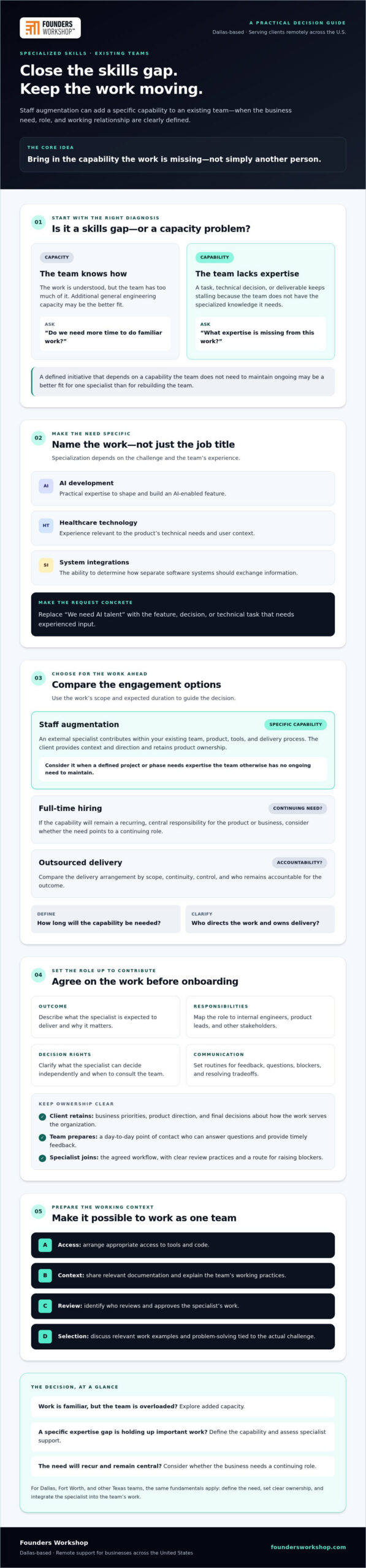
First, distinguish a skills gap from a capacity problem. If the team knows how to do the work but has too much of it, additional general engineering capacity may be the better fit. If the work depends on knowledge the team lacks, adding people with the same general skill set may not resolve the bottleneck. Adding one specialist may be more suitable than rebuilding a team when a defined initiative depends on a capability the existing team otherwise has no ongoing need to maintain.
What counts as a specialized technology skill?
Specialization depends on the work and the team’s current experience, not on whether a job title is fashionable. For one team, AI development may mean practical expertise to shape and build an AI-enabled feature. A healthcare technology initiative may require experience with the product’s technical needs and user context. A system integration effort may call for someone who can determine how separate software systems should exchange information. In each case, the business need is specific. The title alone doesn’t define the right expertise.
How can leaders recognize a capability gap?
Look for work that stalls for the same reason: a technical decision keeps getting deferred, a deliverable repeatedly needs outside input, or the team lacks confidence in how to approach a specialized task. Ask which decisions and outputs require expertise the current team can’t supply. Be precise. “We need AI talent” is less useful than identifying the feature or technical decision that needs experienced input.
Then consider how long the need is likely to last. A capability needed for a defined project or phase may call for temporary support. A recurring responsibility that will remain central to the product or business may point to a continuing role. This distinction helps leaders avoid treating every delay as a hiring problem and makes it easier to decide whether staff augmentation fits the work, timeline, and team’s longer-term needs.
How specialized staff augmentation fits into an existing software team
An augmented specialist contributes within your team’s existing product, tools, and delivery process. They bring a capability your team needs, but the client still provides the context and direction that make the work relevant. Adding expertise doesn’t automatically transfer ownership of the product or its delivery.
For a company in Dallas, Fort Worth, Plano, Frisco, or Irving, the practical fit depends on clear working agreements, not just technical credentials. Before the specialist starts, decide who sets priorities, approves work, makes technical decisions, and resolves tradeoffs. Then map how the role connects with internal engineers, product leads, and other stakeholders. A specialist working on an integration, for instance, needs to know who owns decisions about the systems involved and how changes will be reviewed.
Which responsibilities should the client retain?
The client should keep ownership of business priorities, product direction, and final decisions about how the work serves the organization. Assign a day-to-day point of contact who can answer questions and provide timely feedback. Clarify where the specialist can make technical decisions independently and when to consult the team. This prevents stalled work and conflicting direction.
Make practical onboarding part of the plan, too. Arrange appropriate access to tools and code, share relevant documentation, and explain the team’s review and approval practices. Set expectations for what the specialist will deliver, who will review it, and how questions or blockers should be raised.
How should a specialist join the team’s workflow?
Start with the working context, not just a task list. Explain the product, its architecture, the current state of the work, and why the initiative matters to the business. Then align the specialist with the team’s communication routines and delivery practices, including how work is tracked and how decisions are recorded. Nearshore talent from Latin America can work with North American teams in a compatible time-zone context, but teams should agree on actual collaboration hours rather than assume them.
A practical workflow moves through a few deliberate steps:
- Define the role: Connect the capability to a specific responsibility and intended deliverable.
- Prepare onboarding: Provide context, access, documentation, and introductions to key collaborators.
- Agree on collaboration: Set communication channels, review expectations, and decision paths.
- Check progress: Use regular feedback points to surface blockers and adjust priorities early.
Those check-ins are working sessions, not just status reports. They give both sides a chance to clarify assumptions before small questions become delivery problems. For a broader overview of how the model works, see this nearshore staff augmentation guide. If you’re weighing how to bring in specialized expertise, learn more about a consultation with Founders Workshop.
Staff augmentation, full-time hiring, or outsourced delivery: how to compare
Choose a staffing model based on the work your business needs done and who can lead it. With staff augmentation for specialized skills, an outside specialist joins your team while your organization typically directs day-to-day work. Hiring makes sense when the capability is an ongoing part of the business. Project-based software development may be a better fit when you need an accountable team to deliver a defined outcome.
Adding a specialist doesn’t automatically transfer delivery responsibility. With augmentation, your team remains responsible for priorities, decisions, and coordinating the work. A project team, by contrast, takes responsibility for carrying out the agreed project, while your organization remains responsible for defining business needs and making key decisions.
| Model | Control | Scope | Continuity | Who owns delivery? |
|---|---|---|---|---|
| Full-time hire | Direct employment and team oversight | Ongoing responsibilities shaped by the organization | Designed for a continuing role, subject to staffing changes | The internal team and its leaders |
| Staff augmentation | Client directs the specialist’s work | Defined skills and responsibilities within the existing team | Linked to the team’s needs and engagement terms | The client owns priorities and coordinates delivery |
| Project-based delivery | Client sets the desired outcome; the project team manages its work | A defined project or deliverable | Focused on the project rather than an ongoing internal role | The project team is responsible for carrying out the agreed work |
When does augmentation fit better than a full-time hire?
Consider augmentation if a defined initiative needs expertise your current team can direct, but the business doesn’t have a clear ongoing need for that role. For example, a Dallas-Fort Worth software team may need specialized integration experience for a particular phase of work. If the expertise will remain central to future priorities, a full-time role may offer a better foundation. Temporary support isn’t a universal substitute for permanent capability. For a detailed comparison of staff augmentation options in the Dallas, Texas area, including how local hiring, nearshore talent, and project-based delivery differ in control and ownership, that breakdown can help clarify which model fits your team’s situation.
When is a managed development project more appropriate?
Choose project-based delivery when you need a team accountable for a defined outcome and your organization can’t provide day-to-day direction for each contributor. If your internal team has the capacity to guide a specialist, augmentation may fit. If you need a team to manage the project work, project-based delivery may be more suitable. For legacy system work, this legacy code modernization guide offers related context.
Compare the models by the ownership and working relationship each requires, not by assumed savings or speed. The right fit gives the business the needed capability while keeping accountability clear.
How to define the role, select a specialist, and prepare for onboarding
A clear role starts with the business outcome, not a list of technologies. Identify what the work needs to accomplish, the capability required to move it forward, and how the specialist will contribute alongside the existing team. This sequence keeps staff augmentation for specialized skills focused on a real business need rather than a title that may not match the work.
Use the role brief to assess relevant experience. Ask candidates to walk through examples of comparable work, explain their decisions, and discuss how they would approach a challenge in your context. The goal isn’t to find someone who has seen an identical system. It’s to understand how they reason, communicate tradeoffs, and apply relevant experience.
What should a specialist role brief include?
Describe the business objective, current technical context, and work the specialist will own. Separate essential experience from preferences and skills your team can support. For example, a role focused on connecting existing systems should describe the integration challenge and relevant environment, rather than simply requesting a broad list of tools. Specify how progress will be reviewed and what evidence will help you determine whether the role is working.
Technical requirements are only part of the brief. Include expected collaboration with engineers and stakeholders, communication channels, and how the specialist should raise questions or blockers. For a Texas team working remotely with nearshore talent, discuss working-hour overlap and preferred times for joint sessions without assuming a particular schedule. Confirm practical collaboration needs before the engagement begins.
What should happen before the first working session?
Prepare the working context in advance: relevant documentation, appropriate system access, communication channels, and a point of contact who can answer questions. Introduce the product, its users, constraints, and the reason the work matters. Explain existing team responsibilities, too, so the specialist knows who owns decisions and how their contribution fits.
Agree on feedback, escalation, and knowledge-sharing routines before work starts. Set expectations for how work will be reviewed, how quickly questions should be surfaced, and where important decisions will be recorded. Regular feedback helps the team identify mismatched assumptions early and adjust responsibilities or priorities before they affect delivery.
- Define the outcome: State the business need and what progress should address.
- Identify the capability: Distinguish essential expertise from preferences.
- Set responsibilities: Clarify ownership, decision paths, and collaboration.
- Plan integration: Prepare access, context, communication, and feedback routines.
For teams considering this approach, review Founders Workshop’s software development services.
How Founders Workshop can help close a specialized skills gap for Dallas-area teams
Once you’ve identified the capability your team lacks and clarified who will direct the work, the next step is finding a staffing partner whose model fits that plan. Founders Workshop provides nearshore staff augmentation, connecting North American businesses with technology talent from Latin America. The approach is to integrate specialists into a client’s existing team and working context, with collaboration expectations discussed when assessing the fit.
Founders Workshop is based in Phoenix and works remotely with businesses across the United States. For technology leaders in Dallas, Fort Worth, Plano, Frisco, and Irving, it offers a nearshore staffing model to consider for a defined skills gap. The company was founded in 2005, and its leadership team brings over 30 years of experience.
Which specialist needs align with Founders Workshop’s services?
Start with the work, not a job title. Founders Workshop’s offerings include AI strategy and development, healthcare technology development, and system integrations. Each may align with a different capability gap: a team shaping an AI initiative may need additional expertise to plan or build relevant software; a healthcare technology effort may need development capability suited to the product’s technical context; and an integration initiative may need expertise to connect software systems within the client’s environment.
These examples help frame the conversation, but they don’t establish that a particular role or candidate is automatically the right fit. For an AI initiative, the AI strategy and implementation guide can help clarify the work and business objective before discussing the skills needed to support it.
What should a first consultation clarify?
Bring a concise account of what the business is trying to achieve, where work is getting stuck, and what expertise the existing team can’t provide. Explain the current technical context, who will direct the specialist, and how the role would fit with internal engineers and stakeholders. These details help determine whether augmentation is a reasonable model to explore or whether another approach may better match the need.
It’s also useful to discuss collaboration expectations early: the team’s working routines, practical overlap for meetings, access and onboarding needs, and how progress and blockers will be reviewed. A clear conversation about responsibilities can surface assumptions before they affect delivery. Founders Workshop can use that context to discuss whether its Latin America tech talent offering aligns with your team’s situation.
Turn a critical skills gap into a clear next step
The right staffing choice starts with a precise business need. Identify whether work is blocked by a missing specialty or a broader capacity constraint, then choose a model that matches how much direction your team can provide and who should own delivery. With staff augmentation for specialized skills, clear responsibilities, onboarding, and regular feedback help the specialist contribute within your team while keeping progress connected to business outcomes.
Founders Workshop is a Phoenix-based software development agency that works remotely with clients across the United States. Founded in 2005, the company has a leadership team with over 30 years of experience. For teams in Dallas, Fort Worth, Plano, Frisco, and Irving, a consultation can help clarify the skills gap, working context, and whether nearshore staff augmentation aligns with the need.
Frequently Asked Questions
What is staff augmentation for specialized skills?
Staff augmentation for specialized skills adds an external specialist to an existing team to address a defined capability gap. The client retains day-to-day direction while the specialist contributes expertise needed for specific work, such as AI development or system integration. The need is for a particular area of experience, not simply more people to share the workload. The specialist works within the team’s context, priorities, and established ways of collaborating.
When should a company use staff augmentation instead of hiring a full-time specialist?
Consider staff augmentation when a defined initiative requires expertise the current team lacks, but the business doesn’t have a clear, ongoing need for a permanent role. It can fit when internal leaders have the capacity to guide the specialist and integrate their work. If the capability will remain central to the organization’s long-term work, a full-time hire may be a stronger fit. The choice depends on the enduring business need and who can direct the work.
How do you identify which specialized skills your software team needs?
Start by tracing work that stalls, decisions that keep being deferred, or deliverables that repeatedly need expertise the team doesn’t have. Name the business objective and the specific tasks or decisions creating the bottleneck. Then compare those needs with the team’s current experience. For example, a planned connection between software systems may reveal an integration expertise gap, while a large backlog of familiar work may point to a capacity need instead.
How does an augmented specialist work with an existing development team?
An augmented specialist contributes within the client’s team, using its product context, tools, and delivery practices. Before work begins, clarify who sets priorities, approves contributions, and makes product or technical decisions. Provide relevant documentation and access, introduce key collaborators, and explain how work is tracked and reviewed. Regular check-ins help the specialist and team raise questions, share feedback, and address blockers while there’s still time to adjust the plan.
What should a role description include when sourcing a specialized developer?
Describe the business objective, current technical environment, and work the specialist will own. Separate essential experience from preferences, and note which skills the internal team can support. Include collaboration expectations, such as who the specialist will work with and how progress will be reviewed. Use the role description to assess practical experience through relevant work examples and a discussion of how the person would approach a challenge in your context.
Can nearshore specialists collaborate with Dallas-Fort Worth teams?
Founders Workshop is based in Phoenix and works remotely with businesses across the United States, including teams in Dallas, Fort Worth, Plano, Frisco, and Irving. Its nearshore staff augmentation connects North American teams with technology talent from Latin America as a tech talent hub, with the intent of integrating specialists into the client’s team and working context. Discuss expected meeting windows and collaboration hours directly so both teams understand the practical overlap needed for the work.
How is staff augmentation different from outsourcing a software project?
With staff augmentation, an external specialist joins the client’s existing team, and the client directs priorities and day-to-day work. With project-based software development, an external team takes responsibility for carrying out an agreed project, while the client provides direction on the business need and outcome. The key distinction is who manages the work and owns delivery responsibilities. Contact Founders Workshop for a consultation to discuss which approach may fit your team.