
What if the best AI project for your Dallas-Fort Worth business isn’t the most advanced one, but the workflow that’s costing your team time every week? That’s the practical question behind custom AI development in the dallas texas area. A promising idea can become an expensive distraction if the use case is vague, the data is scattered, or the solution doesn’t fit the systems employees already use.
AI should address a specific business need, not add another layer of complexity. This guide explains how to identify a useful, well-scoped use case and assess the roles of data readiness, system integrations, and human review. It also covers how to compare delivery approaches and connect project decisions to business outcomes. Whether the opportunity is automating a repeatable process or improving forecasts, start with the work your business needs to improve. Founders Workshop is a Dallas-based team serving businesses across Texas and remotely throughout the United States, bringing strategy and technical delivery together to turn AI goals into practical plans.
Key Takeaways
- Pinpoint a specific workflow where AI could reduce manual effort or improve operational insight before defining a project.
- Assess the full solution, including data, user workflows, integrations, and human oversight, rather than focusing only on the AI model.
- Compare custom AI development in dallas texas area by how well the proposed scope, delivery plan, and success measures address your business need.
- Use a focused first release to test key assumptions, evaluate results, and guide decisions about what to build next.
- See how AI strategy and custom development can support predictive analytics, automation, and existing business workflows.
When Does Custom AI Development Make Sense for a Dallas-Area Business?
Manual work, fragmented systems, and limited operational insight often appear together. A team may enter the same information into multiple tools, spend time sorting requests, or struggle to spot patterns in sales or service data. These pressures are worth examining, but they don’t automatically mean a business needs custom AI. Start with a specific workflow and an outcome worth improving.
For a company considering custom AI development in dallas texas area, an opportunity might be reducing the time spent routing incoming service requests or helping managers forecast demand from existing business data. Define the intended result, such as faster processing or more informed planning. “Add a chatbot” is a technology request, not yet a business case. Identify who needs help, what task is slowing them down, and how the business will recognize improvement.
AI includes a range of techniques, not one standard tool. Artificial intelligence provides a broad overview of the field, but the right approach depends on the work at hand. A solution might automate a repeatable step, analyze data to support a prediction, or use generative AI to draft or organize information. Generative AI can be useful, but it isn’t the default answer for every workflow.
Which business problems are strong candidates for AI?
Look for work that happens repeatedly, follows recognizable steps, and consumes staff time or creates avoidable handoffs. A distributor might review order information across systems; a professional services firm might sort and route incoming requests. Predictive analytics may be useful when historical business data could help teams anticipate demand or identify patterns. In each case, first define the workflow and the task or decision the solution should support.
When is custom development preferable to an off-the-shelf tool?
Assess whether an existing tool fits your process, users, and current systems. Buying a product may suit a common need. Configuration can adapt standard features to a particular team, while integration can connect tools that otherwise operate separately. Custom development becomes more relevant when a distinctive workflow, specialized decision process, or integration requirement isn’t well served by those options.
These are alternatives, not steps every company must take. A tailored build isn’t automatically more effective or economical. Compare the practical fit: how well each approach supports the work, connects to the systems employees rely on, and produces an outcome the business can evaluate. That keeps the project grounded in operational value rather than novelty.
What Should a Custom AI Solution Include Beyond the Model?
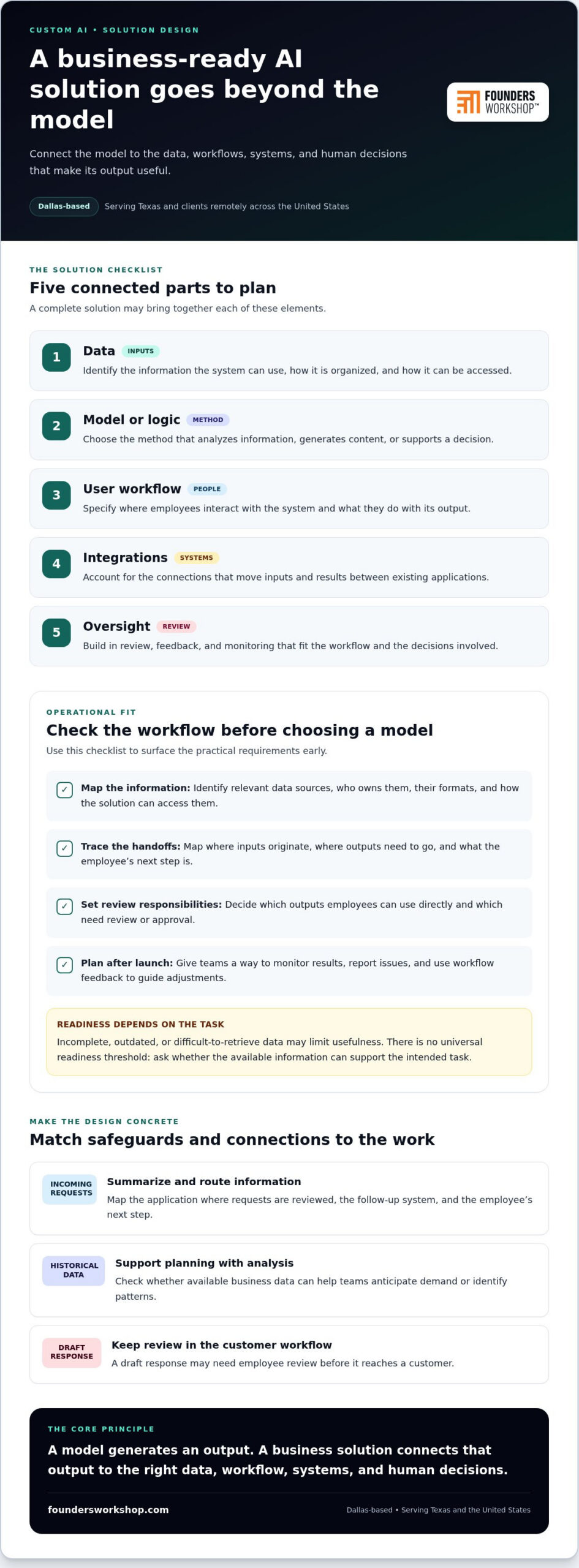
A model alone doesn’t complete a business task. An AI model generates an output; a deployed business solution connects that output to the right data, workflow, systems, and human decisions. When assessing custom AI development in dallas texas area, look beyond model selection to how employees will use the solution in the work it’s meant to improve.
A complete solution may bring together five elements:
- Data: The information the system can use, and how it’s organized and accessed.
- Model or logic: The method that analyzes information, generates content, or supports a decision.
- User workflow: Where employees interact with the system and what they do with its output.
- Integrations: The connections that move inputs and results between existing applications.
- Oversight: Review, feedback, and monitoring that fit the workflow and its decisions.
The right architecture depends on the use case and the business’s existing environment. A tool that summarizes incoming requests has different needs from one that analyzes historical data to support planning. Map the full workflow before choosing a model so you understand where and how its output will be used.
How do data and existing systems shape the solution?
Identify relevant data sources, who owns them, what formats they use, and how the solution can access them. Incomplete, outdated, or difficult-to-retrieve data may limit the usefulness of an otherwise capable model. There’s no universal readiness threshold. The practical question is whether the available information can support the intended task.
Next, map where inputs originate and where outputs need to go. If a team reviews service requests in one application and tracks follow-up in another, the project needs to account for that handoff and the employee’s next step. Include integration requirements in the initial design alongside model selection, not as an afterthought.
Where should human review and operational controls fit?
Decide which outputs employees can use directly and which need review or approval. A draft response might be reviewed before it reaches a customer; a forecast might inform a manager’s decision without making it on their behalf. The appropriate control depends on the consequences of an incorrect or incomplete output and the workflow’s existing responsibilities.
Plan for monitoring and feedback after launch, too. Teams need a way to notice when results no longer fit the task, report issues, and use experience from the workflow to guide adjustments. The NIST AI Risk Management Framework offers a reference for organizing AI risk considerations across design and use. Clear ownership makes oversight part of operating the solution, rather than a one-time launch task.
How to Compare Custom AI Development Partners in Dallas-Fort Worth
Compare proposals by how clearly they connect the business problem to the work, not by how much technical terminology they contain. A directory listing or catalogue of AI applications can help you understand what’s available, but it won’t show whether a team understands your workflow, data, systems, and desired outcome. For context on the regional ecosystem, explore the Dallas AI community.
Partner fit depends on your business context, not rankings alone. For executives considering custom AI development in dallas texas area, a useful proposal should explain what will be built, how it will fit into operations, and how the business will judge its value.
| Area | What to look for | Question to resolve |
|---|---|---|
| Discovery | A clear description of the workflow, users, pain point, and intended business outcome. | Does the scope address the underlying problem or jump to a preferred technology? |
| Technical scope | Defined functionality, data sources, assumptions, dependencies, and what the first release will cover. | Can you tell what is in scope and what remains undecided? |
| Integration | A plan for how the solution will exchange information with relevant systems and support user workflows. | Are existing applications and handoffs accounted for? |
| Delivery ownership | Clear responsibilities for decisions, communication, implementation, and ongoing support. | Who coordinates work and resolves issues as the project progresses? |
| Success measures | Practical measures tied to the original business need, with a plan to evaluate results. | How will the team determine whether the solution is useful? |
What should a useful AI development proposal make clear?
A strong proposal names the problem, intended users, proposed scope, and expected business outcome in language that technical and business stakeholders can follow. It should explain which data sources and integrations are involved, what assumptions the plan relies on, and which dependencies could affect delivery. Look for a defined way to review progress and evaluate results, rather than a promise of improvement without a way to assess it.
How should Dallas-area businesses compare delivery approaches?
A defined, fixed scope can suit work with clear requirements; a more flexible engagement may fit projects where discovery will shape later decisions. In either case, understand who owns decisions, how communication works, and how directly your team works with the people delivering the solution. Founders Workshop is based in Dallas and serves clients remotely, so agree on practical communication and review routines that keep stakeholders aligned across locations.
How to Scope an AI Project from Discovery Through Launch
A disciplined project moves from a business problem to a solution people can use, with decisions at each stage informed by what the team learns. For custom AI development in dallas texas area, a focused first release can test important assumptions before the solution expands. It should address a meaningful part of the workflow while giving the team a way to evaluate fit, data, and user response.
What belongs in discovery and technical planning?
Discovery turns a broad goal into a workable project. Document how the process runs today, where friction occurs, who will use the solution, and what business objective it should support. Then map relevant data, applications, access needs, constraints, and integration points. Define practical success measures before development begins so the team has a shared basis for evaluating progress.
A useful sequence is:
- Define the problem: Describe the task or decision the project should improve.
- Assess data and systems: Identify information sources, access, formats, and application dependencies.
- Shape the scope: Select the first workflow and clarify what the initial release will and won’t cover.
- Build and integrate: Develop the solution and connect it to the tools and steps employees use.
- Evaluate and refine: Review technical performance, user feedback, and fit with the actual workflow.
Keep the first release narrow enough to learn from. If a team wants help routing requests, for instance, the initial scope might focus on organizing one type of request for employee review, rather than automating every step across all request categories. That gives stakeholders a concrete way to test whether the approach fits before committing to broader functionality.
How can a team manage launch and continued improvement?
Plan for adoption before release. Identify who will use the solution, how it will fit into their routine, and where they can share feedback when an output is confusing or unhelpful. Evaluate both technical behavior and practical use: a system can function as designed yet still create extra work if it interrupts the workflow or employees aren’t sure how to act on its results.
Launch also requires clear ownership. Assign responsibility for monitoring performance, reviewing user feedback, coordinating maintenance, and deciding how future changes are prioritized. Treat the release as the start of measured use, not the end of planning. Regular reviews can help the business decide whether to adjust the workflow, refine the solution, or expand its scope.
How Founders Workshop Connects AI Strategy with Custom Development
Founders Workshop is a Dallas-based software development agency serving businesses remotely across the United States. For founders and executives exploring custom AI development in dallas texas area, the focus is connecting a practical business objective to a solution that fits how their teams work. Strategy and technical delivery belong in the same conversation, keeping project decisions grounded in the workflow, available data, and systems the business already relies on.
What does a strategy-led development engagement address?
The work starts with the business objective, not a predetermined tool. The team can identify where AI may support a process, clarify the users and desired outcome, and consider whether predictive analytics, workflow automation, or another approach fits the need. Data access, integrations, and employee involvement all shape the technical plan. This alignment keeps development tied to an operational purpose instead of expanding around technology for its own sake.
For guidance on evaluating an opportunity before development, read the AI business case guide. It offers a next step for connecting an AI initiative to business priorities and a reasoned project scope.
How does experienced software delivery support AI implementation?
Founders Workshop’s leadership team brings over 30 years of experience. That experience informs software decisions, from shaping the scope to considering how an AI capability will work alongside existing applications and employee processes. Relevant development work includes custom predictive analytics and automation tools, as well as integrating AI into existing business workflows.
An analytics capability needs to fit the way decision-makers access and use information. An automation tool needs to support the handoffs and tasks employees already manage. Considering these operational details alongside the AI component helps define a solution people can use and assess over time. It doesn’t promise a particular result; it clarifies the intended business purpose and implementation choices.
For a broader roadmap, the AI strategy consulting guide offers additional planning context, including how to connect strategic priorities with implementation decisions.
Turn Your AI Opportunity into a Practical Plan
Successful AI development starts with a defined business need, not a model or feature chosen in isolation. As you evaluate custom AI development in dallas texas area, keep three priorities in view: select a workflow with a clear potential benefit, account for data and integrations from the start, and set measures that reflect technical performance and day-to-day usefulness.
A focused first release can help your team test assumptions and learn from real use before expanding functionality. The right development approach should fit your processes, systems, and users, with clear ownership for review and ongoing improvement.
Founders Workshop is a Dallas-based team serving businesses remotely across the United States. Its leadership team brings over 30 years of experience connecting AI strategy with custom development, predictive analytics, workflow automation, and system integration. Contact Founders Workshop for a consultation to discuss a practical next step for your business.
Frequently Asked Questions
What is custom AI development?
Custom AI development creates an AI-enabled software solution around a business’s specific workflow, data, users, and systems. It can involve predictive analytics, workflow automation, or integrating AI into existing applications. The model is only one part of the solution; the surrounding software and process determine how employees use its outputs. For Dallas-Fort Worth businesses, the aim is to connect technical choices to a defined operational need.
When should a business choose custom AI development instead of an off-the-shelf tool?
Consider a custom approach when available tools don’t fit a clearly defined workflow, user need, or integration requirement. If an existing product supports the process with suitable configuration, a new build may be unnecessary. Compare options against the business objective, the systems employees already use, and how results will be evaluated. A tailored solution should address a specific gap, not add complexity simply because custom technology is available.
What types of business problems can custom AI help solve?
Custom AI can support repetitive workflows, help teams draw insights from business data, or assist with tasks involving information classification and generation. Predictive analytics may help inform planning, while automation can reduce manual steps in a defined process. Generative AI is another option for tasks such as organizing or drafting information, but it isn’t the right fit for every need. Begin with the business problem, then assess which approach supports it.
Does a business need clean data before starting an AI project?
No, every data source doesn’t need to be perfect before project discovery begins. Identify relevant information, its ownership, format, accessibility, and limitations, then assess whether it can support the intended use. Gaps may shape the project scope or require data preparation. For businesses in Dallas, Fort Worth, Plano, Frisco, and Irving, reviewing data alongside current systems helps clarify a practical path forward.
How much does custom AI development cost?
There isn’t one reliable price for every custom AI project. Scope depends on the business problem, data condition and access, required integrations, solution complexity, and ongoing operational needs. A focused first release may involve different work from a solution spanning several workflows and systems. Define the expected outcome and technical requirements first; those details provide a meaningful basis for estimating project effort without relying on a generic cost range.
How long does a custom AI development project take?
Project timing depends on the scope, data readiness, integration needs, and how quickly stakeholders can make decisions and review work. A focused first release can center initial scope on a specific workflow, while broader capabilities may require additional planning and development. Discovery helps identify dependencies and shape a realistic delivery plan. Contact Founders Workshop for a consultation to discuss an AI project for your business.