

The most expensive mistake a founder can make isn’t hiring the wrong developer; it’s choosing between mvp development pricing models that prioritize agency hours over your business outcomes. You’ve likely felt the anxiety of watching a monthly invoice climb while the launch date remains a moving target. It’s a frustrating, common struggle where scope creep threatens to deplete your runway before you even reach the market. When you’re reporting to investors, vague updates about ongoing development don’t provide the budget transparency you need to scale with confidence.
In this guide, you’ll discover how to select a pricing model that eliminates budget risk and aligns your technical execution with strategic growth. We’ll move beyond the unpredictability of hourly billing to explore how fixed-price certainty provides the peace of mind required for a successful launch. You’ll learn to identify a technical partner who understands business ROI as well as they understand code. We’ll preview the shift toward disciplined discovery processes that ensure your market-ready product arrives on time and without the anchor of technical debt.
Key Takeaways
- Understand why fixed-price agreements offer the budget transparency needed for investor reporting and runway preservation.
- Learn how a dedicated discovery phase de-risks your project by preventing technical debt before the first line of code is written.
- Compare different mvp development pricing models to select the framework that best balances speed, quality, and financial predictability.
- Identify your product’s “Critical Path” to ensure your development partner focuses on the single most important user outcome.
- Discover how a founder-to-founder partnership model applies owner-level discipline to every dollar of your technical budget.
The Strategic Value of Fixed-Price MVP Development in 2026
In the high-stakes environment of 2026 tech, capital efficiency isn’t just a metric; it’s a survival trait. Fixed-price MVP development is a strategic agreement where scope, timeline, and cost are defined before the first line of code is written. It acts as a hard boundary for your budget, ensuring your vision doesn’t outgrow your bank account. When building a Minimum Viable Product (MVP), you need a partner who values your runway as much as you do. This model removes the technical friction that often slows down early-stage companies, allowing founders to focus entirely on market validation rather than managing developer hours.
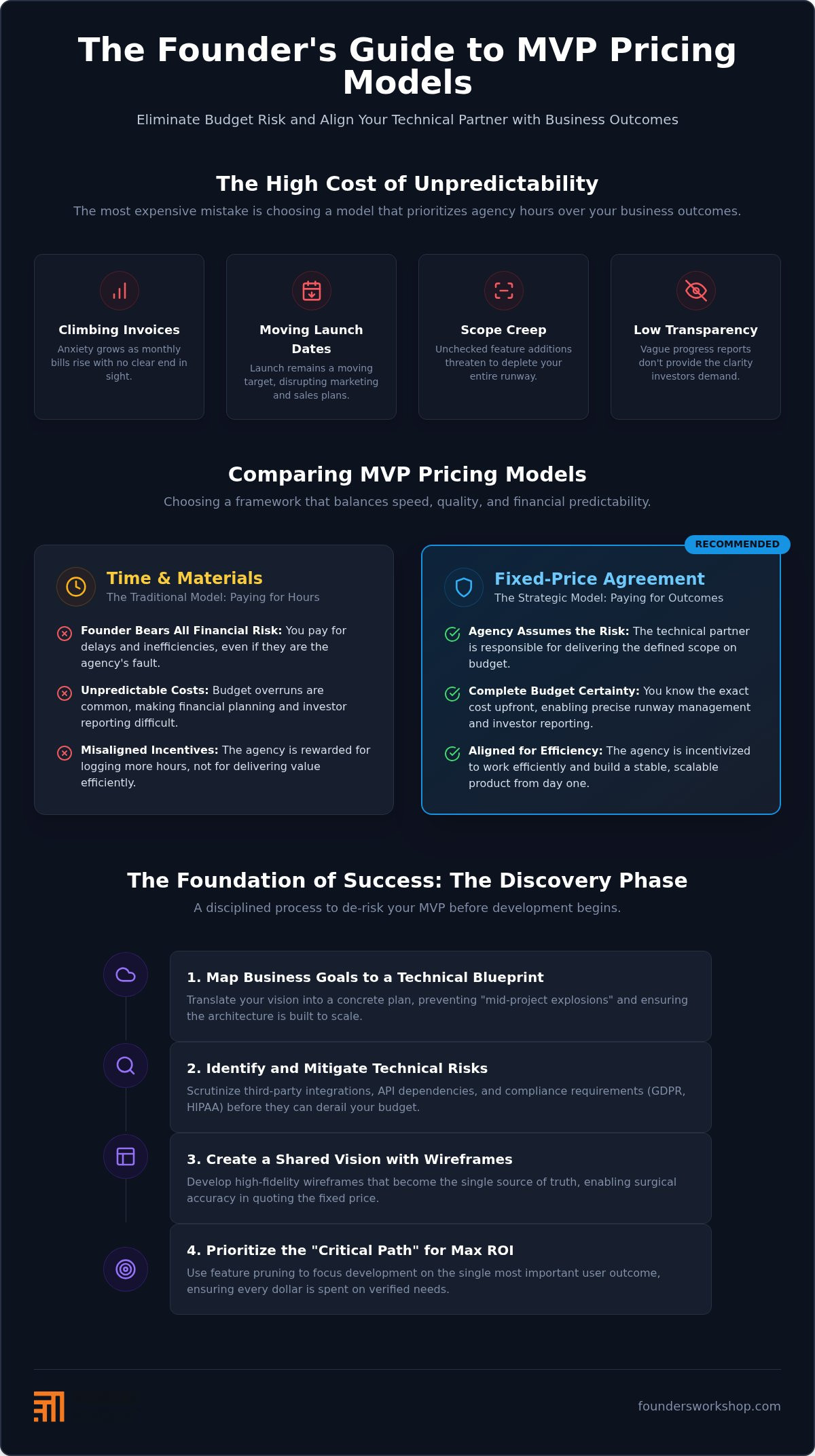
Comparing various mvp development pricing models reveals that the fixed-fee approach is a powerful forcing function. It requires both the founder and the technical partner to prioritize core business value over “nice-to-have” features. Founders are pivoting away from the traditional “Time and Materials” model because it often places the financial risk solely on the startup. If an agency is slow or hits a technical snag, the founder pays the price. A fixed-price commitment shifts that risk back to the agency, demanding a higher level of discipline and accountability from the start.
Why Predictability is a Startup’s Greatest Competitive Asset
Budget certainty is a powerful tool when speaking with venture capital or angel investors. It demonstrates that you have a disciplined grasp of your operations and a clear path to delivery. Investors in 2026 look for teams that can execute within specific constraints. Furthermore, having a guaranteed launch date allows your marketing and sales teams to align their efforts with surgical precision. You can build anticipation and secure early adopters without the fear of a “mid-project explosion” delaying your entry into the market. This predictability reduces management overhead by eliminating the weekly billing surprises that often derail a founder’s focus. For founders looking to extend this level of transparency to their back-office, Financial Foothold offers the outsourced accounting and payroll services necessary to maintain investor-ready operations.
The modern startup ecosystem has moved beyond the idea that more hours equals more value. In a remote-first world, 2026 founders prioritize shippable value over time-sheet entries. Selecting the right framework among different mvp development pricing models is about aligning the agency’s incentives with your own. When the price is fixed, the agency is incentivized to work efficiently and build a stable product from day one. This alignment ensures that every sprint moves you closer to a market-ready launch rather than just filling a developer’s calendar. Fixed-price MVP development is a commitment to business outcomes rather than technical tasks.
The Architecture of a Scope: De-Risking Your MVP
De-risking a project begins long before the first line of code is written. While many mvp development pricing models offer a price tag, few provide a roadmap for technical sustainability. A successful build relies on a rigorous discovery phase, which serves as the non-negotiable foundation of a Fixed-price contract. This phase isn’t just about listing features; it’s about building a strategic blueprint that prevents the “mid-project explosion” of technical debt. By defining the technical architecture early, we ensure the product can scale without requiring a complete rebuild six months post-launch.
The Discovery Phase: Mapping Business Goals to Code
Identifying technical unknowns happens during the discovery phase, long before they can derail your budget. We look closely at factors that often cause friction later in the build:
- Third-party integrations and complex API dependencies.
- Regulatory compliance requirements, such as the EU AI Act or updated COPPA rules.
- Security protocols and data privacy standards like GDPR or HIPAA.
Mapping the user journey ensures the MVP solves the right problem for the right people. High-fidelity wireframes become the most important document in your strategic MVP development journey. They create a shared vision between the founder and the agency, turning abstract ideas into a concrete, visual plan that everyone understands. This visual clarity is what allows for “surgical accuracy” in quoting a fixed price.
Prioritizing the ‘Must-Haves’ for Maximum ROI
Effective MVP development requires the art of feature pruning. We use human-centered design to find the “minimum” in Minimum Viable Product, ensuring every scoped feature serves a verified user need. If a feature doesn’t directly contribute to the user’s critical path, it’s a candidate for a later phase. This focus keeps the project within the fixed-price agreement while maximizing business ROI. When “nice-to-have” ideas emerge during development, we document them for future iterations rather than letting them inflate the current scope. If you’re ready to define your product’s critical path, you can partner with a veteran founder to audit your roadmap.
A fixed-price scope shouldn’t be viewed as a rigid constraint that stifles innovation. Instead, think of it as a strategic boundary that protects your runway. It allows you to test your core hypothesis with a market-ready product delivered on a specific date. By navigating the complexities of different mvp development pricing models with a clear architectural plan, you move from a place of technical uncertainty to a position of market-ready confidence.
MVP Development Pricing Models: Fixed-Price vs. Time & Materials
Choosing between mvp development pricing models is often the first real test of a founder’s strategic vision. It’s a decision that balances risk, flexibility, and speed to market. While many agencies push for open-ended billing, early-stage startups with finite runways must be cautious. Time and Materials (T&M) contracts can be fatal when you’re still trying to prove your core concept. In a T&M structure, the financial risk sits entirely on your shoulders. If the project hits a technical snag or the scope drifts, your bank account pays the price. This creates an “Incentive Gap” where hourly billing can actually reward inefficiency. The longer a problem takes to solve, the more the agency earns, which is the direct opposite of what a lean startup needs.
A fixed-price model serves as the ideal v1.0 foundation. It forces a level of discipline that T&M lacks, ensuring that every dollar spent contributes directly to a shippable product. By locking in the cost and timeline, you create a stable platform for later team expansion. Once you’ve validated your product in the real world, you can then consider more flexible scaling options without the fear of runaway initial costs.
When the Fixed-Price Model Wins
Fixed-price agreements are superior when you have a clear market entry point and well-defined user personas. If you need to prove a concept to stakeholders, investors, or early customers on a non-negotiable budget, this is your best path forward. It provides the transparency required for high-level reporting and removes the “billing anxiety” that plagues many founder-agency relationships. This model is particularly effective for custom software development at the startup stage, where the goal is to reach a specific milestone rather than iterate indefinitely.
The Reality of Time & Materials (T&M)
There is a place for Time and Materials, but it’s rarely at the launch phase. T&M makes sense for post-launch scaling and continuous product evolution where requirements shift based on live user data. However, for an MVP, it carries the risk of “The Never-Ending MVP.” Without a fixed boundary, it’s easy to keep adding “just one more feature” until your runway is gone. A smarter strategy is to use a fixed-fee launch to establish your baseline. After the product is live and generating feedback, you can transition to a long-term nearshore staff augmentation model. This allows you to scale your engineering team with timezone-aligned talent while maintaining the strategic discipline established during your initial build.
Preparing Your Vision for a Fixed-Price Agreement
Entering a fixed-price agreement without preparation is a recipe for friction. To leverage the certainty found in various mvp development pricing models, you must first define your product’s “Critical Path.” This is the single, non-negotiable journey a user takes to achieve value. If your app is a marketplace, the critical path is the transaction. If it’s a diagnostic tool, it’s the result. Documenting this path prevents scope creep and ensures the agency quotes with surgical accuracy. This human-centered approach ensures you build for long-term sustainability rather than just a quick, unstable launch.
Documenting Your Core Value Proposition
Start with the “10-second test”: can you explain the problem you solve and for whom in ten seconds? If the answer is buried in jargon, the technical execution will inevitably suffer. You should gather all existing brand guidelines, competitor benchmarks, and current workflow diagrams. This preparation is vital when looking for a technical partner for non-technical founders. It bridges the gap between your business vision and the engineer’s code, ensuring the final build aligns with your strategic goals. Providing these assets early allows the agency to visualize the end-state, which is the secret to maintaining high quality within a fixed budget.
Identifying Integration and Compliance Needs
High-stakes industries require more than just functional code; they require a commitment to accountability. For instance, healthcare technology solutions demand specialized security scoping from day one. You must list every external API and data source, whether it’s Stripe for payments or Salesforce for CRM. These integrations are often where technical unknowns hide, and identifying them early is a key differentiator among mvp development pricing models. Be explicit about data privacy and regulatory compliance, such as HIPAA or the updated 2026 COPPA rules. Clear expectations here prevent costly retrofitting later in the development cycle and ensure your product is production-ready upon launch.
If you’re ready to document your critical path and secure your runway, you can book a strategy session with our veteran team, leveraging over 30 years of leadership experience to guide your build.
Preparation is the difference between a project that scales and one that stalls. When you provide a clear list of technical constraints and business objectives, you empower your partner to deliver on the promise of fixed-price certainty. This disciplined approach is what makes the fixed-fee model so effective for founders who value their runway. By treating your budget with the discipline of an owner, we move from a vendor relationship to a true business partnership.
The Founders Workshop Approach: Build Once, Scale Forever
Founders Workshop isn’t just a development shop; we’re a partner in your growth. We apply a founder-to-founder philosophy, meaning we treat your capital with the same discipline we’d use for our own ventures. Our 30 plus years of executive leadership and technical experience allow us to offer surgical accuracy when evaluating mvp development pricing models. We don’t guess at scope; we define it through a lens of seasoned confidence. This methodology ensures that your fixed-fee project stays on track, delivering a market-ready product without the typical agency friction. For founders who apply this same level of strategic discipline to their personal investment portfolios, you can explore Mentorship Program at Multifamily Schooled to learn the fundamentals of investing in apartment and commercial real estate.
We prioritize human-centered design because code is useless if it doesn’t solve a human problem. Every project begins with a deep dive into user experience before a single line of code is written. This focus ensures that your MVP is built on a modern, sustainable stack. By doing this, we help you avoid the crushing weight of technical debt that often plagues low-cost builds. Our commitment is to produce modernization-ready software from the very first commit, so your foundation is ready for the next decade of growth. It’s about building for long-term sustainability rather than just a quick, unstable launch.
Leveraging Nearshore Talent for Maximum ROI
The secret to maintaining high quality within a fixed budget is our Latin American nearshore model. Unlike offshore teams that work while you sleep, our developers are aligned with your timezone. This alignment creates a high communication velocity, allowing for real-time collaboration and faster problem-solving. It’s the key to maintaining executive-level accountability throughout the build. After your launch, our model allows for a seamless transition. You can move from a fixed-price MVP to a dedicated nearshore engineering team through our staff augmentation services. This gives you the ability to scale your operations instantly based on market feedback and investor requirements.
By navigating different mvp development pricing models with a veteran guide, you ensure your product is built to last. Our approach bridges the gap between a successful initial launch and long-term business scaling. We provide the steady hand you need to move from a strategic concept to a production-ready reality. We don’t just build apps; we build businesses that are prepared to scale from day one.
Securing Your Technical Foundation for Growth
Choosing between mvp development pricing models is about more than just managing costs; it’s about establishing a predictable path for your startup’s future. By prioritizing a fixed-price approach, you eliminate the financial friction that often stalls innovation. You’ve seen how a disciplined discovery phase and a human-centered design focus can turn a vague concept into a market-ready product. This strategic alignment ensures your technical execution matches your business vision from day one.
Founders Workshop brings over 30 years of executive product leadership to your build. We treat your budget with the discipline of an owner, utilizing predictable, transparent pricing models to protect your runway. Launch your vision with a fixed-price MVP; book your strategy call today. Your journey from initial concept to a scalable enterprise begins with a single, certain step. We’re here to help you take it with confidence.
Frequently Asked Questions
Is fixed-price MVP development truly ‘fixed’ if I want to change a feature mid-build?
The price is fixed for the agreed scope defined during discovery. If you decide to pivot or add a feature mid-build, we manage the change through a formal addendum. We assess the impact on your timeline and provide a separate fixed fee for the new work. This process maintains budget transparency and ensures that your original launch date isn’t compromised by unmanaged scope creep.
How long does a typical fixed-price MVP build take from discovery to launch?
A production-ready build typically takes about 10 weeks to develop from start to finish. If your objective is a leaner, investor-ready MVP with three to five core workflows, the timeline is often compressed to approximately 6 weeks. These durations include the essential discovery and testing phases. We prioritize a steady, deliberate rhythm to ensure the final product is stable and ready for real-world users.
What happens if the project scope needs to expand during development?
Scope expansion is handled by prioritizing your product’s “Critical Path” first to protect your primary launch date. If a new requirement is essential for the initial release, we document it as a separate work order with its own fixed price. Less critical ideas are moved to a post-launch backlog. This disciplined approach prevents the “Never-Ending MVP” trap and keeps your investment aligned with urgent business outcomes.
Can complex AI or healthcare applications be built under a fixed-price model?
Yes, complex applications are ideal for fixed-fee structures provided they undergo a rigorous discovery phase. For healthcare, this includes scoping for HIPAA compliance and data privacy from day one. In AI development, we account for the August 2, 2026, EU AI Act requirements. By identifying these regulatory hurdles early, we can quote with surgical accuracy and remove the technical friction associated with regulated industries.
How do you ensure code quality remains high when the price is capped?
Quality is maintained by selecting mvp development pricing models that incentivize efficiency rather than cutting corners. Our model focuses on a modern tech stack and human-centered design to ensure the code is “modernization-ready.” Because we specialize in long-term partnerships, building high-quality code from the first commit is essential. It ensures a smooth transition to nearshore staff augmentation when you’re ready to scale.
What is the difference between a prototype and a market-ready fixed-price MVP?
A prototype is a validation tool often built with no-code platforms to test a basic hypothesis. In contrast, a market-ready MVP is a production-grade application featuring full test suites and secure user authentication. While a working pitch demo might take only 10 days to build, a market-ready build is designed for long-term sustainability. It provides the robust foundation needed to handle actual transactions and data.
Do I need a technical co-founder to get an accurate fixed-price quote?
You don’t need a technical co-founder if you partner with a seasoned executive guide who understands business ROI. We specialize in working with non-technical founders by translating their strategic vision into technical requirements. Our discovery process acts as your fractional CTO, identifying technical unknowns and integrations early. This ensures your quote for mvp development pricing models is based on business logic rather than abstract tasks.
What documentation do I need to provide to start the discovery process?
Start with your core value proposition and any existing workflows or brand guidelines you’ve developed. You should also list necessary third-party integrations, such as Stripe or Salesforce, and any specific compliance needs like GDPR. Providing a clear description of the problem you’re solving helps us map the user journey accurately. This initial documentation allows us to move quickly into the technical architecture phase, securing your roadmap.