

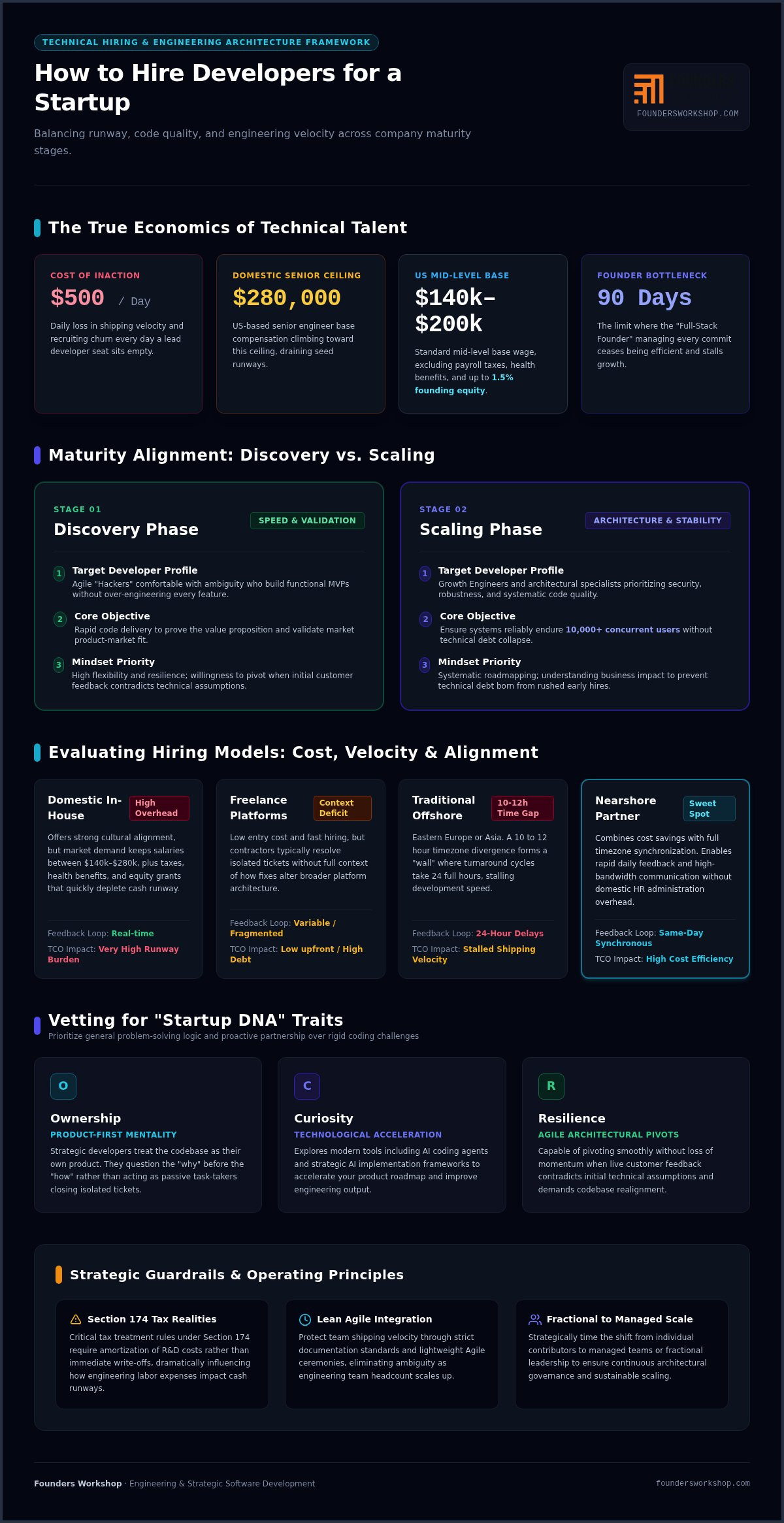
Every day your lead developer seat remains vacant, your startup loses approximately $500 in velocity and recruitment churn. It is a staggering figure, yet many founders still struggle with how to hire developers for a startup without burning through their seed capital or compromising on code quality. You’ve likely felt the friction of US-based salaries for senior engineers climbing toward $280,000, or the frustration of technical debt left behind by initial hires who didn’t share your vision. The pressure to ship faster often leads to hasty decisions that haunt your architecture for years.
Building a technical team is a high-stakes commitment, not just a line item on a budget. We agree that you need more than just coders; you need strategic partners who prioritize business outcomes over technical novelty. This guide provides a strategic framework for identifying, vetting, and integrating high-quality developers who align with your growth goals. We’ll walk through the 2026 compensation landscape, the tactical advantages of nearshore staff augmentation, and the critical tax implications of Section 174, giving you a clear path to a reliable, high-velocity engineering department.
Key Takeaways
- Identify whether your venture is in the Discovery or Scaling phase to avoid the common pitfalls of the “Full-Stack Founder” trap.
- Master the strategic nuances of how to hire developers for a startup by evaluating the total cost of ownership across in-house, freelance, and nearshore models.
- Implement a vetting framework that prioritizes “Startup DNA” traits, such as ownership and resilience, over traditional, static coding challenges.
- Maintain high shipping velocity by establishing clear documentation standards and lean Agile ceremonies that ensure seamless team integration.
- Determine the optimal time to transition from individual contributors to managed teams or fractional leadership to support sustainable technical scaling.
Understanding Your Startup’s Technical Stage and Talent Requirements
Determining your current maturity level is the first step in mastering how to hire developers for a startup. Too often, founders recruit based on where they want to be in three years rather than the immediate hurdles they face today. This mismatch leads to expensive specialists sitting idle or generalists struggling with complex architecture as the product scales. Successful hiring requires a clear-eyed assessment of whether you are in the Discovery phase or the Scaling phase.
MVP vs. Scaling: Different Developers for Different Goals
During the Discovery phase, your primary objective is speed and market validation. You need foundational developers who are comfortable with ambiguity and can build a functional MVP without over-engineering every feature. These individuals prioritize flexibility; they are “hackers” in the best sense of the word, focused on shipping code that proves your value proposition. A Strategic Developer acts as a partner who questions ‘why’ before ‘how’.
As you move into the Scaling phase, the requirements shift toward growth engineers. These professionals focus on architecture, security, and long-term sustainability. They are the ones who ensure your platform doesn’t collapse under the weight of its first 10,000 concurrent users. When you are researching how to hire developers for a startup, you must look beyond their technical stack and evaluate their problem-solving logic. Technical debt is often a hiring problem rather than a coding problem. If you hire a developer who doesn’t understand the long-term business roadmap, they’ll build a product that works today but breaks under tomorrow’s load.
The Non-Technical Founder’s Dilemma
Many founders fall into the “Full-Stack Founder” trap, believing they can manage every commit and architectural decision indefinitely. This approach works for the first ninety days, but it quickly becomes a bottleneck that prevents the business from scaling. For many US-based founders, nearshoring software development provides a balance between cost efficiency and the high-level communication required for complex builds.
The challenge for a non-technical leader is identifying a true technical partner rather than a simple task-taker. A task-taker waits for instructions; a partner anticipates risks. In 2026, a developer’s ability to implement AI Strategy Consulting insights is just as important as their ability to write clean code. To build a resilient team, look for these traits:
- Ownership: They treat the codebase as their own product, not just a ticket to close.
- Curiosity: They explore how new tools like AI coding agents can accelerate your specific roadmap.
- Resilience: They can pivot when user feedback contradicts the original technical plan.
Bridge the gap between your vision and execution by hiring for general problem-solving ability first. Specific languages can be learned, but the discipline to build scalable systems is a seasoned trait that cannot be rushed.
Evaluating Hiring Models: In-House, Freelance, and Nearshore Partners
Freelance marketplaces offer low entry costs, but they often fail when building a cohesive product. A contractor might fix a specific bug, yet they rarely possess the context to understand how that fix affects your entire architecture. Similarly, traditional offshore models in Eastern Europe or Asia introduce a 10 to 12 hour timezone gap. This creates a “wall” where feedback loops take 24 hours to complete, stalling your development velocity precisely when you need to be lean. Nearshore staff augmentation offers a sweet spot, allowing you to scale your team without the massive overhead of a domestic HR department.
Real-time collaboration isn’t a luxury; it’s a requirement for shipping high-quality code. By choosing talent in Latin American timezones, your team works alongside you, allowing for synchronous stand-ups and immediate PR reviews. This cultural proximity means your developers align with US business logic and communication styles. If you’re looking to scale without administrative friction, this 2026 Nearshore Staff Augmentation Guide explains how to integrate these partners into your existing workflow.
The Fixed-Fee vs. Retainer Debate
Protecting your runway requires choosing the right contract structure for your current stage. Project-based fixed fees are ideal for building a Startup MVP where the scope is strictly defined. It gives you a predictable cost for a specific outcome. Once you move into continuous product evolution, transitioning to a monthly retainer provides the flexibility to pivot based on user data. This hybrid approach ensures you aren’t overpaying for capacity you don’t use while maintaining a reliable technical team that understands your vision. Having a veteran leadership team as a safety net ensures these transitions happen without losing momentum or code quality.
The 5-Step Framework for Vetting High-Performance Developers
The democratization of generative AI has led to an explosion of AI-generated resumes and boilerplate repositories. This “signal vs. slop” problem makes it harder than ever to distinguish between a coder who can prompt an LLM and an engineer who understands system architecture. When you are determining how to hire developers for a startup, you need a vetting process that prioritizes real-world impact over academic syntax. Traditional LeetCode questions are being phased out in 2026; they simply don’t predict how a developer will handle a production outage at 2:00 AM.
We recommend a five-step framework designed to filter for high-velocity talent:
- Technical Assessment: Skip the algorithmic puzzles. Instead, conduct a live debugging session or a PR review of a production-like codebase.
- Startup DNA Test: Vet for ownership and resilience. Ask how they handled a previous pivot or a failed deployment.
- Communication Audit: Assess their ability to explain technical trade-offs to non-technical stakeholders. Proactive reporting is non-negotiable.
- Reference Checks: Don’t just verify dates. Ask previous founders if the candidate was a “force multiplier” for the rest of the team.
- The Trial Project: A two-week paid engagement is the ultimate interview. It reveals how they handle feedback and integrate into your workflow.
Startups must also remain mindful of legal classifications, consulting the IRS independent contractor versus employee guidance to ensure they aren’t misclassifying talent during the trial phase. Getting this wrong can lead to significant tax liabilities that drain your runway.
Vetting for Problem-Solving Over Syntax
Seniority in years matters less than seniority in product thinking. You need engineers who understand that code is a means to a business end, not the end itself. In 2026, 84 percent of developers use AI coding agents like Cursor or GitHub Copilot. Your vetting should test if they can use these tools to double their velocity without introducing security vulnerabilities. An Accountable Developer is one who provides solutions, not just bug reports.
Cultural Alignment and Communication
Remote environments fail without a “same-page” mentality. During the initial interview, look for red flags like a lack of curiosity about your customers or an inability to explain “why” they chose a specific framework. If a developer cannot articulate the business value of a technical decision, they will likely build features that don’t scale with your vision. Proactive communication is the only way to avoid the friction that typically plagues distributed teams. Master how to hire developers for a startup by focusing on these human-centered results rather than just technical novelty.
Onboarding and Managing Your Team for Maximum Velocity
Hiring is only half the battle; the real work begins when your new engineers open their first tickets. Successful onboarding transforms individual contributors into a high-performance unit that ships quality code without constant supervision. To achieve this, you must establish clear standards from day one. A robust “definition of done” ensures that every feature includes documentation, unit tests, and peer reviews before it reaches production. This clarity prevents the communication friction that often stalls early-stage growth.
Startups don’t need the heavy, bureaucratic Agile ceremonies found in large corporations. Instead, focus on keeping ceremonies light but effective. Use tools like Jira for task transparency, Slack for real-time problem-solving, and Loom for asynchronous updates. Asynchronous video walkthroughs are particularly effective for distributed teams, as they allow developers to explain complex logic without requiring a synchronous meeting. This approach fosters a “one team” culture where nearshore and in-house staff operate with the same context and urgency.
The First 30 Days: Setting the Foundation
The first month is critical for establishing a weekly sprint cadence. Use this time to identify technical friction before it hardens into permanent technical debt. If a developer struggles with the environment setup or deployment pipeline, address those bottlenecks immediately. For founders moving from a prototype to a market-ready product, our Strategic MVP Development Guide offers a roadmap for building scalable software that survives this initial growth spurt.
Human-Centered Leadership in a Remote World
Effective management in 2026 focuses on outcomes rather than hours logged. When you master how to hire developers for a startup, you’re essentially hiring for trust. Timezone alignment plays a massive role here, as it reduces the management fatigue that occurs when founders have to wait until midnight for a status update. Encourage your team to use proactive AI-driven automation for repetitive tasks like code linting or test generation. This allows your senior talent to focus on high-level architecture and strategic vision. If you are ready to build a technical team that scales with your ambition, partner with an expert guide to remove the friction from your development process.
Scaling Smarter: Leveraging Strategic Partners for Growth
Transitioning from a single lead developer to a managed team is a pivotal moment for any founder. It marks the shift from survival to scale. While you initially focused on how to hire developers for a startup to get an MVP out the door, scaling requires a more robust structure. This often involves bringing in a Fractional CTO or a Technical Advisor. These veterans provide high-level strategy without the $300,000 plus price tag of a full-time executive. They help you avoid growth plateaus by ensuring your architecture can handle increased traffic and data complexity. Without this guidance, technical debt can quietly erode your profit margins and stall your time-to-market.
Modernizing legacy code is another critical step as you move toward Series A and beyond. Code written in the early “move fast and break things” stage often becomes a liability as you scale. Strategic partners help you refactor these systems while maintaining feature velocity. Founders Workshop bridges this gap by providing seasoned leadership that understands how to align technical execution with your specific business outcomes. We focus on human-centered results, ensuring that your tools serve your people and your customers rather than becoming a burden to manage.
Moving from Technical Friction to Strategic ROI
Technical execution must serve business growth metrics. If your development team ships code that doesn’t move the needle on user retention or revenue, you have a strategic misalignment. Nearshore staff augmentation allows you to maintain a continuous development cycle, effectively creating a 24/7 production engine when combined with your domestic leads. This bridges the gap between your vision and a market-ready product. Understanding how to hire developers for a startup in 2026 means recognizing that your needs will change as you move from seed to growth. For a deeper look at these dynamics, consult our Custom Software Development Strategic Guide.
The Peace of Mind Promise: Why Partnership Matters
The true value of a strategic partner lies in the peace of mind they provide. With 30 plus years of technical leadership experience, we act as a safety net for founders who can’t afford a hiring mistake. This allows you to focus on your core business, fundraising, and customer acquisition while we handle the complexities of the technical stack. You don’t just need more hands on keyboards; you need a disciplined methodology that ensures long-term reliability and sustainability. We invite you to schedule a strategy session with Founders Workshop to discuss your roadmap and remove the technical friction from your path to growth.
Building a Technical Team That Drives Growth
Mastering how to hire developers for a startup requires shifting your focus from filling seats to finding strategic partners. We have explored the necessity of matching talent to your specific stage of maturity, whether you are shipping an MVP or scaling for Series A. By prioritizing timezone alignment and vetting for “Startup DNA,” you remove the technical friction that often stalls ambitious founders. A reliable team doesn’t just write code; they build the foundation of your long-term business equity.
Founders Workshop brings 30 plus years of leadership experience to your project, offering specialized expertise in AI and Healthcare tech. Our Latin American talent works in your timezone, ensuring real-time collaboration and seamless integration with your existing vision. We bridge the gap between high-level strategy and technical execution, providing the peace of mind you need to focus on your core business. Scale your startup with expert nearshore developers. Schedule a strategy call today. Your vision deserves a technical team that is as disciplined and innovative as you are.
Frequently Asked Questions
How much does it cost to hire a developer for a startup in 2026?
Mid-level US base salaries range from $140,000 to $200,000, while senior roles in major tech hubs often exceed $280,000. Total compensation, including benefits and equity, adds significant overhead to your burn rate. Nearshore developers in Latin America typically bill between $50 and $90 per hour for senior talent. This represents a 40 to 60 percent reduction in fully loaded costs compared to domestic hires, allowing startups to extend their runway while maintaining quality.
Is it better to hire a freelance developer or a software agency?
How do I vet a developer if I am not a technical person?
Focus on “Startup DNA” and problem-solving logic rather than syntax. Ask candidates to explain how they handled a previous system failure or a major product pivot. You should also conduct a communication audit to ensure they can translate technical trade-offs into business outcomes. A two-week paid trial project is the most effective way to assess their real-world impact and cultural alignment before making a long-term commitment to a new hire.
What is the difference between nearshore and offshore development?
The primary difference lies in timezone alignment and cultural proximity. Nearshore development involves teams in Latin America that share US working hours, allowing for real-time collaboration and synchronous stand-ups. Offshore development usually involves teams in Eastern Europe or Asia with a 10 to 12 hour timezone gap. This lag often creates communication friction and slows down shipping velocity, making nearshore the preferred scaling mechanism for lean, high-growth startups today.
Should I give equity to my first developer hire?
Equity is standard for founding engineers to align their incentives with the company’s long-term success. In 2026, the median grant for a first hire sits between 1.0 percent and 1.5 percent on a four-year vesting schedule with a one-year cliff. It’s important to provide transparency regarding strike prices and exercise windows. However, you must balance these grants carefully, as equity allocations for subsequent early hires typically drop to 0.30 percent or less by employee number five.
How long does it typically take to hire and onboard a new developer?
Software engineering roles take an average of 41 to 62 days to fill globally. This timeline includes sourcing, technical vetting, and multiple interview stages. Once hired, full onboarding usually takes another two to four weeks to reach maximum velocity. Startups often lose $500 per day in lost velocity while technical roles remain vacant. Leveraging specialized employment services like BlueBridge Group Placement Corp or nearshore partners can shorten this cycle by providing pre-vetted talent ready for immediate integration into your workflow.
What are the most important technical skills for a startup developer today?
Beyond core languages, developers must be proficient with AI coding agents like Cursor or GitHub Copilot to accelerate shipping speed. Experience with cloud-native architecture, system integrations, and cybersecurity is also essential for scaling, which is why specialized talent platforms like saas nine focus on pre-qualified cloud engineers. When considering how to hire developers for a startup, look for those who understand AI strategy and can implement automated testing. This ensures your code remains resilient and secure as your user base grows across different national markets.
How do I manage a remote development team effectively across timezones?
Success depends on a mix of synchronous communication and asynchronous transparency. Use Slack for real-time problem-solving and Loom for video walkthroughs of code changes. Establishing a “one team” culture between in-house and remote staff requires clear documentation and a shared definition of done. Timezone alignment with Latin American talent minimizes management fatigue, as it allows founders to conduct sprint ceremonies during regular business hours rather than late at night or early in the morning.