

The closest hire isn’t always the best way to close a delivery gap. If you’re weighing staffing augment in dallas texas area options, start by asking who should direct the work and how closely new talent needs to integrate with your team. A local hire, nearshore team member, and project-based partner can all strengthen execution, but each offers a different level of day-to-day control.
That distinction matters when a product milestone is slipping or your team needs specialized skills without giving up direction. Local hiring can add a permanent team member. Nearshore staff augmentation can bring dedicated talent into your existing workflow. Project-based development can put delivery in the hands of a managed team. The right model depends on the work and the ownership you want to retain.
This comparison explains how the three approaches differ, how nearshore developers from Latin America can collaborate with teams in Dallas, Fort Worth, Plano, Frisco, and Irving, and what to evaluate before speaking with a provider. Founders Workshop is based in Phoenix and serves clients remotely across the United States. The focus here is practical: choosing an engagement model that fits your team structure and delivery needs.
Key Takeaways
- Identify whether your bottleneck is a specific skills gap or a broader need for delivery ownership.
- Compare providers using the same criteria: skill fit, communication, team integration, and accountability.
- Choose local hiring when you need a directly employed team member. Consider staff augmentation when dedicated talent should work within your existing team.
- When assessing staffing augment in dallas texas area options, look beyond location to how the engagement fits your workflows and responsibilities.
- Compare nearshore augmentation with fully managed, project-based development to decide how much delivery ownership your team wants to retain.
Staff Augmentation in the Dallas Area: Which Problem Are You Solving?
A hiring gap in Dallas-Fort Worth can become a delivery bottleneck when your developers are already committed to product work. Before comparing local hiring with external options, define what needs to change: do you need added capacity and specialized skills inside your team, or a partner to take responsibility for delivering a defined outcome?
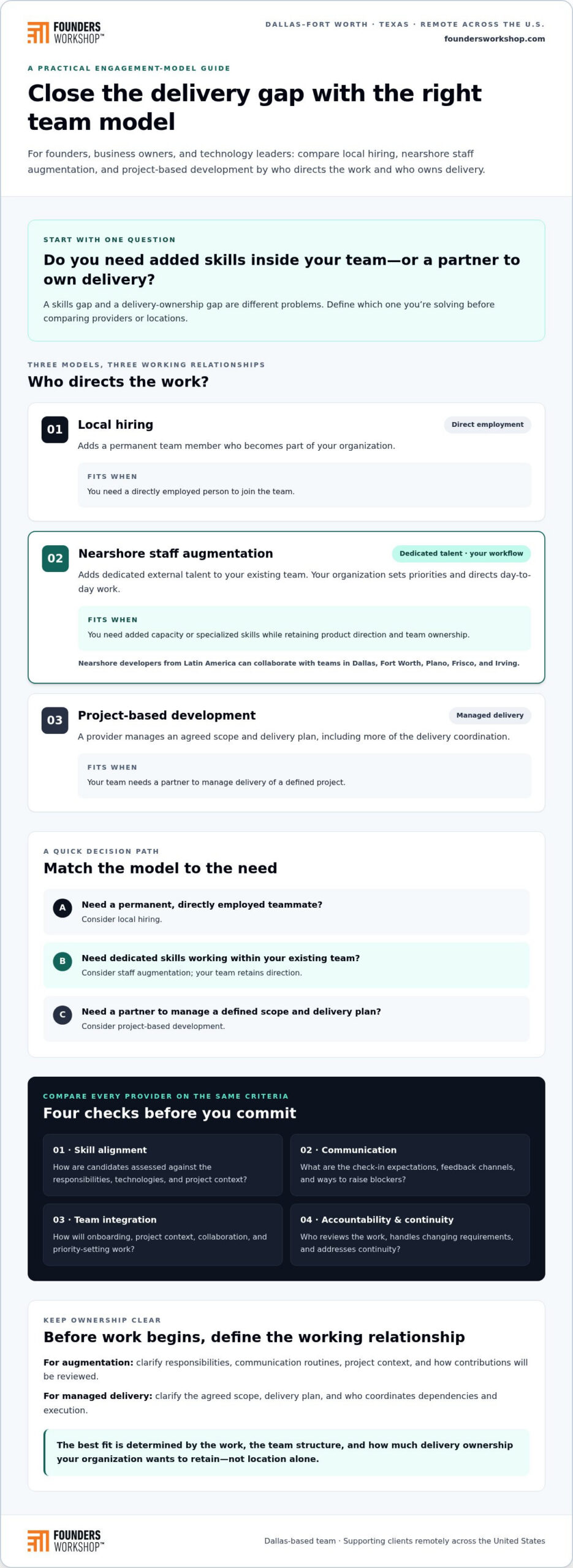
Staff augmentation means adding dedicated external talent to an existing team. The added professional works within your team’s processes, while your organization retains direction over priorities and day-to-day work. In a managed project engagement, the provider instead takes responsibility for coordinating an agreed scope and delivery plan.
For leaders evaluating staffing augment in dallas texas area options, geography is only one consideration. Compare how each model provides the skills you need, how closely the person or team will work within your workflows, who manages dependencies, and where delivery accountability sits. The best fit depends on the work and how much control your team wants to retain.
What does staff augmentation mean for a Dallas technology team?
Consider a Texas product team preparing a new feature while maintaining its existing application. If the team lacks a particular development skill, an augmented developer can join its workflow, coordinate with its product lead, and take on agreed work alongside internal staff. The client continues to set priorities, review progress, and make day-to-day decisions. The additional talent contributes capacity without moving product direction outside the business.
This model works best when your team can provide technical direction and has a clear role for the added person. Before work begins, clarify responsibilities, communication routines, access to relevant project context, and how contributions will be reviewed. Those details help determine whether the engagement will address the team’s actual needs, rather than simply fill a role on paper.
When is augmentation different from outsourcing a project?
With augmentation, your team directs the work and manages its place within broader product priorities. With project-based development, a provider manages an agreed scope and delivery plan. That changes who coordinates tasks, handles dependencies, and steers execution. If you need another contributor within an established team, augmentation may fit. If your team needs a partner to manage delivery of a defined project, such as an end-to-end website or app build managed by a digital agency like PING Works, a managed engagement may be more appropriate.
The distinction also affects how you assess value. Augmentation supports internal ownership and team integration; project-based development shifts more delivery coordination to the provider. Founders Workshop offers both dedicated nearshore talent integrated into client teams and fully managed, project-based software development. For a closer look at when dedicated expertise can help, read this staff augmentation guide for specialized skills.
How to Compare Staffing Augment in Dallas Texas Area Options Before You Commit
A provider’s rate or résumé alone won’t tell you whether an engagement will work for your team. Compare the role, working relationship, and responsibilities together. For local context, review the Dallas-Fort Worth labor market statistics, then use the same evaluation criteria for every provider you consider.
Use this checklist to structure conversations and make proposals easier to compare:
- Skill alignment: Ask how candidates are assessed against the responsibilities, technologies, and project context, not just a job title.
- Communication: Clarify check-in expectations, feedback channels, and how the developer will raise blockers or ask for clarification.
- Team integration: Discuss onboarding, access to project context, collaboration with existing staff, and who sets priorities.
- Accountability and continuity: Confirm who reviews the work, how responsibilities are handled when requirements change, and what process the provider uses to address continuity.
These questions help reveal whether a provider’s model matches how your team operates. If your technical lead will assign tasks and review contributions, confirm that the engagement supports that structure. If you expect the provider to manage scope and dependencies, define those responsibilities explicitly rather than assuming they’re included.
Which provider questions reveal team fit?
Ask how the provider connects a candidate’s skills to your specific work and what information it needs to make that assessment. Clarify who directs daily priorities, how feedback reaches the developer, and who resolves competing requests. Also ask how the provider handles changing skill requirements or a need to maintain continuity. Clear answers help you assess fit before work begins.
How should you evaluate nearshore collaboration?
For nearshore talent, assess practical overlap with your team’s working day and confirm the language used for day-to-day collaboration. Ask how onboarding will introduce the person to your codebase, product goals, and team practices. These factors can support coordination, but the right fit depends on your working habits and the role. Understanding the timezone advantages of nearshore teams for Texas businesses can help you assess how shared working hours affect stand-ups, code reviews, and day-to-day decision-making. See this nearshore staff augmentation guide for engineering for additional evaluation context.
To compare value, request proposals based on the same role, expected responsibilities, and engagement assumptions. Consider the full working arrangement, including integration effort, communication expectations, and who manages delivery, rather than looking at a rate in isolation. For founders and technology leaders assessing staffing augment in dallas texas area options, comparable scopes make trade-offs clearer and provider conversations more productive.
Nearshore Augmentation vs. Local Hiring vs. Project-Based Development
These models differ most in who employs the talent, who directs daily work, and who owns delivery. DFW economic conditions can inform planning; the Federal Reserve Bank of Dallas tracks regional trends through its DFW economic indicators. But the best choice for your team depends on the role, scope, and management capacity, not regional data alone.
| Model | Ownership and integration | Flexibility | Suitable work |
|---|---|---|---|
| Local hiring | Your company employs the person and sets priorities within its team. | Builds internal capacity for an ongoing role; plan for the responsibilities of direct employment. | Long-term roles where internal knowledge, continuity, and direct ownership matter. |
| Nearshore staff augmentation | Dedicated external talent joins your workflow; your team directs the work. | Adds skills and capacity while keeping product direction in-house. | Existing projects that need additional technical expertise or contributors. |
| Project-based development | A provider-managed team takes responsibility for an agreed scope and delivery plan. | Centers the engagement on a defined outcome rather than adding an individual to your team. | Projects where your organization needs a partner to manage delivery from scope through launch. |
When does nearshore staff augmentation make sense?
Choose nearshore augmentation when you have a clear role for dedicated technical talent within your existing workflow and your team has capacity to direct priorities and coordinate the work. Founders Workshop provides nearshore talent from Latin America as a tech talent hub that works in the client’s time zone and language. Before committing, confirm role fit, communication expectations, and integration needs with the provider.
For a product team in Dallas, Fort Worth, Plano, Frisco, or Irving, this could mean adding a specialist to an established roadmap while internal leaders retain product decisions. Nearshore talent can offer practical time-zone alignment, but confirm working-hour overlap and agree on how the person will collaborate with your team.
When should you choose hiring or a managed project instead?
A Practical Decision Framework for DFW Founders and Technology Leaders
A clear decision starts with the work, not a provider’s pitch. Use this sequence to prepare for a useful conversation, whether your team is in Dallas, Fort Worth, Plano, Frisco, Irving, or elsewhere in Texas.
- Define the business need. Identify the delivery bottleneck and what needs to change. A temporary gap in a specific skill may call for added team capacity. A broader need to plan and own a product deliverable may point to a managed project.
- Describe the role or outcome. For augmentation, list the capabilities needed and the contribution you expect from the person. For project-based development, describe the intended scope and outcome. Avoid relying on a broad title or an undefined request for “more developers.”
- Map team dependencies. Note which internal people, systems, and decisions the work depends on. Clarify who sets priorities, reviews contributions, and resolves technical blockers. This makes management responsibilities visible before an engagement begins.
- Plan for integration. Identify onboarding needs, relevant project context, and the tools or processes the new contributor must use. Decide who will provide that context and how existing team members will collaborate with the added talent.
- Agree on how to assess progress. Define practical measures tied to the work, such as completion of agreed tasks or progress against a project milestone. Make sure the measures reflect the engagement model and are understood by everyone involved.
Compare proposals on the same assumptions
Once your requirements are documented, ask each provider to describe responsibilities, communication routines, onboarding assumptions, and how changing needs will be handled. For project-based work, clarify the scope and delivery responsibilities. For augmentation, confirm how the person will join your existing team and who will direct daily priorities.
Then compare the full working arrangement, not just the quoted fees. Account for your team’s expected management effort, time spent sharing project context, and coordination across dependencies. A proposal that appears straightforward may require more internal oversight; another may have a different division of responsibilities. Comparing equivalent assumptions helps reveal the practical value of each option.
This preparation gives Dallas-area founders and technology leaders a focused way to evaluate staffing augment in dallas texas area options. Bring your documented role or outcome, team responsibilities, and integration questions to the provider conversation. Discuss your staffing needs with Founders Workshop.
How Founders Workshop Supports Dallas-Area Teams with Nearshore Talent
For businesses in Dallas, Fort Worth, Plano, Frisco, and Irving, the right engagement should strengthen the team without blurring who guides the work. Founders Workshop is a Phoenix-based software development agency serving clients remotely across the United States. Its nearshore staff augmentation option brings dedicated technology talent from Latin America into a client’s existing team, working in the client’s time zone and language.
This model is designed for organizations that have technical direction in place and want an additional contributor to work within their processes. Your team retains responsibility for priorities and day-to-day guidance. If you need a partner to manage delivery of a defined outcome instead, Founders Workshop also provides fully managed, project-based software development. The key distinction is whether you need integrated talent or a provider-managed project.
What should a first staffing conversation establish?
Start with the business need and the team structure around it. Describe the technical context, the skills you’re seeking, the work the person would contribute to, and how your team expects to provide direction. Discuss communication preferences, relevant project knowledge, and how the new contributor would work with existing staff. These details help assess whether augmentation fits your operating model.
It’s also useful to share the responsibilities and priorities that could shape the role over time. Be direct about what your team can manage internally and what support you expect from a provider. A clear conversation can surface questions about fit and collaboration before you make a decision, without assuming a particular timeline, rate, or outcome.
How do you take the next step with Founders Workshop?
Bring a concise description of the gap, the skills involved, and how work is currently directed. If your team will manage priorities and integrate a dedicated contributor into its workflow, nearshore staff augmentation may be worth discussing. If you need a managed team to take responsibility for delivery against a defined scope, project-based development is a separate option to consider.
For founders and technology leaders evaluating staffing augment in dallas texas area options, start by aligning the engagement with the work and your team’s capacity to lead it. Contact Founders Workshop for a consultation to discuss which approach fits your needs.
Choose the Engagement That Moves Your Team Forward
The right staffing model depends on the work and the ownership your team wants to retain. Local hiring can build lasting internal capability. Nearshore augmentation adds dedicated talent to your existing team while your leaders continue to direct priorities. Project-based development is a better fit when you want a provider to manage delivery of a defined scope—such as when businesses discover Boostinger to build modern, conversion-ready websites without needing to oversee day-to-day technical tasks.
As you compare staffing augment in dallas texas area options, look beyond location and fees. Assess skill alignment, communication, integration needs, and accountability. Founders Workshop’s nearshore technology talent comes from Latin America and works in the client’s time zone and language, supporting collaboration with teams in Dallas, Fort Worth, Plano, Frisco, Irving, and elsewhere in Texas.
Founders Workshop is based in Phoenix and serves clients remotely across the United States. Founded in 2005, the company’s leadership team brings over 30 years of experience. Whether you need dedicated contributors within your team or a fully managed project, start with a clear view of the work and the support you need.
Contact Founders Workshop for a consultation to discuss the right fit for your team and move forward with greater clarity.
Frequently Asked Questions
What is staff augmentation for a Dallas business?
Staff augmentation adds dedicated external talent to a Dallas business’s existing team. The person contributes technical skills within the company’s workflows, while the business continues to set priorities, provide direction, and review the work. For example, a product team could bring in a developer to support an existing roadmap while its internal leaders retain responsibility for product decisions and coordination.
Is nearshore staff augmentation different from offshore outsourcing?
Yes. Nearshore staff augmentation typically means adding talent from a nearby region, while offshore outsourcing generally refers to working with talent farther away. The specific collaboration setup matters more than the label: clarify time-zone overlap, working language, team integration, and who directs the work. Founders Workshop provides dedicated nearshore technology talent from Latin America that works in the client’s time zone and language.
How much does staff augmentation cost in Dallas, Texas?
There isn’t one standard cost for staff augmentation; fees depend on the role, required skills, and engagement terms. Founders Workshop’s dedicated nearshore talent model uses recurring monthly fees, but the specific fee should be confirmed for the role and needs under consideration. When comparing staffing augment in dallas texas area options, request proposals based on comparable responsibilities and clarify what each engagement includes instead of judging by a headline figure alone.
Can nearshore developers work with a Dallas-based team?
Yes. Nearshore developers can collaborate remotely with a Dallas-based team, particularly when the engagement establishes clear communication routines, responsibilities, and access to project context. Founders Workshop’s nearshore talent comes from Latin America and works in the client’s time zone and language. Before starting, discuss how the developer will join team workflows, receive priorities, share progress, and coordinate with existing contributors.
When should a company choose staff augmentation instead of project-based development?
What should I ask a staff augmentation provider before signing?
Ask how the provider assesses skills against your role and project context, how communication and feedback will work, and who sets priorities and reviews contributions. Clarify onboarding, continuity, and how the arrangement can respond if skill requirements change. Confirm responsibilities and engagement assumptions in the proposal. To discuss your team’s needs with Founders Workshop, contact us for a consultation.