The difference between a transformative AI initiative and an expensive pilot that quietly dies after six months often comes down to one decision made early: who you hired to help. Gartner predicted that at least 30% of GenAI projects would be abandoned after proof of concept by end of 2025 due to poor data quality, inadequate risk controls, escalating costs, or unclear business value. The technology wasn't the problem in most of those cases. The approach was.
A poor AI consulting partner means wasted budget, compliance exposure, failed integrations, and teams that lose faith in AI entirely. The right one accelerates your path from idea to measurable impact.
This guide covers the criteria that actually matter when evaluating AI consulting partners, the red flags most organizations miss, and the questions worth asking before you sign anything.
Key Takeaways
- Most AI projects fail because of partner mismatch, not technology — technical capability alone is an insufficient filter
- The right partner leads with business outcomes, not demos or model specs
- Domain expertise, production-readiness track record, and a pilot-to-deployment methodology are non-negotiable
- Data governance and compliance must be baked into the engagement from day one, not addressed at the end
- Use a structured vetting process — any partner who resists detailed scrutiny is signaling execution risk
What Should You Expect from an Enterprise AI Consulting Partner?
An AI consulting partner is not a software vendor or a tool reseller. Their job is to help your organization identify the right problems to solve with AI, align those initiatives to your business strategy, manage implementation risk, and build buy-in across teams that may be skeptical or underprepared.
A mature AI consulting engagement typically spans several phases:
- Discovery and readiness assessment — understanding your goals, data, and constraints
- Use-case prioritization — identifying where AI can deliver the highest-impact results
- Solution design and development — building, testing, and refining the AI solution
- Integration and deployment — connecting the solution to your actual systems and workflows
- Ongoing optimization — monitoring performance, retraining models, and measuring outcomes
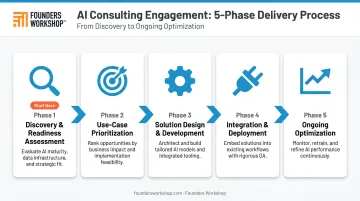
How deeply each phase gets executed varies considerably by partner. Some firms run through discovery in a week and jump straight to building. Others invest weeks in assessment before writing a line of code — and that upfront rigor is usually what separates deployments that stick from ones that get shelved.
Matching Partner Size to Your Needs
Partner type matters as much as capability. Global consulting firms bring broad resources and brand credibility, but they also come with significant cost and a tendency to over-engineer solutions for mid-market or growth-stage organizations. Specialized boutique firms tend to move faster, cost less, and bring tightly focused expertise.
The right match depends on your scope, budget, and how much organizational change management your initiative requires. A startup validating an AI-powered product feature has very different needs than a 10,000-person enterprise replacing a core underwriting process.
Key Criteria for Evaluating an Enterprise AI Consulting Partner
Most organizations evaluate AI partners too narrowly — comparing technical claims without examining how those claims translate to business outcomes. Here are the criteria that separate partners worth hiring from expensive learning experiences.
Business Outcome Focus and ROI Methodology
This is the single most important criterion, and it's the one most often assessed too casually.
IBM reported that only around 25% of AI initiatives deliver expected ROI, with just 16% scaled enterprise-wide — despite 79% of executives observing general productivity gains. The gap between "AI is doing something" and "AI is delivering measurable business value" is where most engagements fall short.
A strong AI consulting partner starts with your business goals — revenue growth, cost reduction, process efficiency — and works backward to the technology. A partner who leads with demos or model benchmarks before defining measurable success criteria is signaling the wrong priorities.
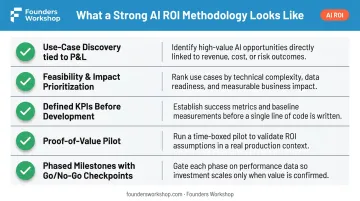
What a strong ROI methodology looks like:
- Structured use-case discovery tied to your P&L
- Prioritization based on feasibility and business impact, not technical novelty
- Defined KPIs agreed upon before development begins
- A proof-of-value pilot before full-scale commitment
- Clear milestones with go/no-go checkpoints at each phase
Press them on specifics: How do you define and measure success for an engagement like ours? What does ROI look like at the 6-month mark versus 18 months?
Industry and Domain Expertise
Generic AI expertise is not enough. A partner who has never worked in your sector will underestimate compliance requirements, misread operational realities, and recommend solutions that are technically sound but practically unusable.
Gartner projects that by 2027, more than 50% of GenAI models used by enterprises will be specific to an industry or business function, up from roughly 1% in 2023. That shift isn't accidental — domain-specific models reduce hallucination risk, lower development costs, and deploy faster than general-purpose alternatives.
Your consulting partner needs to understand your vertical deeply enough to guide those decisions.
Before shortlisting any partner, ask for case studies specific to your industry. References from organizations facing similar regulatory constraints and operational realities are worth more than a long list of logos.
What strong domain expertise looks like in a case study:
- Demonstrates familiarity with your industry's compliance environment
- Shows measurable outcomes, not just technology deployed
- Includes references willing to discuss operational challenges
- Reflects experience with organizations at a similar scale and complexity
Technical Depth and Production-Readiness
There is a significant difference between a firm that can run a compelling AI demo and one that can deploy a reliable, scalable solution in production.
Gartner reported that only 41% of GenAI prototypes reached production. Getting a prototype to work in a controlled environment is relatively straightforward. Handling real data volumes, managing latency, preventing model drift, reducing hallucinations, and maintaining accuracy over time — that's where many firms fall short.
Questions worth asking any prospective partner:
- How do you move a solution from prototype to production?
- What does your validation and QA process look like?
- What happens when the AI output is wrong in a live environment?
- How do you handle model drift after deployment?
A capable partner answers these with specificity and acknowledges the hard parts. Vague references to "agile sprints" or "iterative improvement" without concrete protocols are a red flag.
Data Governance, Security, and Compliance
Handling sensitive enterprise data during an AI engagement creates real legal and reputational exposure. This is not a concern to address after development begins.
McKinsey reported that security and risk concerns were the top barrier to scaling agentic AI for nearly two-thirds of organizations, with 74% identifying inaccuracy and 72% citing cybersecurity as highly relevant AI risks.
A credible consulting partner treats data governance, privacy architecture, access controls, audit trails, and regulatory compliance as foundational — not add-ons requested at the end of a project.
Compliance requirements vary by industry:
- Healthcare: HIPAA Privacy Rule governs individually identifiable health information
- Financial services: SOC 2 Trust Services Criteria cover security, availability, and confidentiality
- EU operations: GDPR governs data handling; the EU AI Act adds AI-specific obligations
- Retail and consumer data: GDPR where applicable, with sector-specific data retention rules
Find out whether compliance is part of their discovery process from day one — not a checklist item added during testing.
Systems Integration and Post-Deployment Support
AI only creates value when it fits into how work actually gets done. A standalone AI tool that isn't connected to your CRM, ERP, data pipelines, or existing workflows will be used by no one.
Nearly 60% of AI leaders cited legacy-system integration as a primary hurdle for AI adoption, according to Deloitte. Look for partners who ask about your existing tech stack early and plan integration architecture from the start — not partners who treat it as a Phase 2 problem.
Signs of strong integration competence:
- Asks about your current systems before proposing solutions
- Has built APIs or middleware in environments similar to yours
- Understands your data governance constraints before designing data flows
- Has references from clients with comparable infrastructure complexity
On post-deployment support: AI models degrade over time without maintenance. Data shifts, user behavior changes, and model performance erodes. The right question to ask before signing: What does your engagement look like six months after deployment? Who owns incident response? How do you transfer knowledge to our internal team? A partner who can't answer that clearly is one you'll be replacing sooner than expected.
Red Flags to Watch for When Evaluating AI Consulting Firms
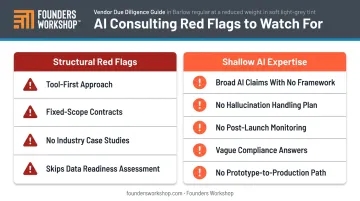
Even firms with impressive websites and recognizable client logos can carry real delivery risk. Watch for these warning signs:
Structural red flags:
- Leads with a specific tool or platform before understanding your business goals
- Insists on fixed-scope contracts for exploratory AI work
- Cannot provide industry-specific case studies or references
- Skips data readiness assessment in their proposal
Signs of shallow AI expertise:
- Claims expertise in "AI" broadly, with no defined delivery framework
- Cannot explain how they handle hallucinations or model failures in production
- No post-launch support model or monitoring protocols
- Vague answers on compliance, data security, or governance architecture
- Unable to articulate how a prototype becomes a production system
Ignoring these signals leads to predictable outcomes: failed implementations, budget overruns, compliance breaches, and internal teams who lose confidence in the entire AI initiative.
Treat every discovery conversation as a two-way evaluation. Partners with genuine depth welcome detailed vetting — those who deflect specific questions or default to generalities will behave the same way once the project gets difficult.
Questions to Ask Before Signing an Engagement
Organize your vetting questions across four areas:
Business alignment:
- How do you define and measure success for an engagement like ours?
- Can you walk us through a case study in our industry?
- What KPIs have you tied AI initiatives to in past engagements?
Technical process:
- How do you move a project from pilot to production?
- What does your data readiness assessment look like?
- What's your QA and validation process before deployment?
Governance and security:
- How do you handle data privacy and compliance in our sector?
- What gets logged, audited, or reviewed in your AI systems?
- How do you manage model drift and output accuracy over time?
References:
- Can you connect us with a client in a similar industry before we sign?
Once you have answers, evaluate how they were delivered — not just what was said. Partners with genuine depth respond with specificity, real examples, and candor about limitations. Partners who deflect, overpromise, or retreat to generalities are signaling execution risk. That extends to references: a capable partner connects you with relevant clients without hesitation. Reluctance to do so tells you something important before you've signed anything.
How Founders Workshop Can Help
Founders Workshop is a software innovation partner that has been building custom B2B and B2C software solutions since 2008 — more than 200 delivered across healthcare, fintech, real estate, senior care, and enterprise applications.
What makes the firm a practical option for founders and growing businesses is the leadership model: three cofounders with 30+ years each as business owners, operators, and investors — not just technologists. They understand the real constraints of building against competitive timelines with limited resources.
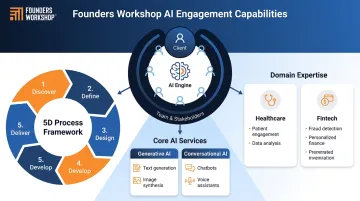
Key capabilities for AI engagements:
- AI-first project development — AI is scoped and embedded from the first Discovery session, not added after the fact
- Full AI services suite — Generative AI, Conversational AI, Custom GPT, AI RPA, model training, vector databases, and AI consulting
- Domain experience in regulated industries — healthcare (HIPAA-compliant systems, EMR integrations), fintech (predictive analytics), and enterprise applications
- Nearshore Latin American development team — senior talent at approximately one-third the cost of comparable U.S.-only firms, working in the same time zone with no language or cultural barriers
- 5D Process — a field-tested framework with defined milestones from Discovery through Deployment and ongoing optimization
- 200+ custom solutions delivered, including four recognized by the Arizona Innovation Challenge
Founders Workshop offers discovery calls to assess fit before any commitment is made — a practical first step for teams that need clarity on scope, approach, and cost before moving forward.
Frequently Asked Questions
How do you choose an AI strategy consulting partner?
The right AI strategy partner starts with your business goals, not the technology stack. Look for a structured methodology linking use-case selection to measurable KPIs, proven industry experience, and documented examples of strategy-to-execution work in organizations similar to yours in size and sector.
What are the key evaluation criteria for selecting an enterprise AI consulting partner?
Six criteria matter most: business outcome alignment, domain expertise, technical production-readiness, data governance and compliance capability, systems integration experience, and post-deployment support. Prioritize based on your organization's biggest risks — compliance exposure and integration complexity tend to get less attention than they deserve during vendor selection.
How much does enterprise AI consulting typically cost?
Costs vary widely based on project scope, data complexity, team size, and engagement model. Gartner has noted that AI deployment TCO frequently exceeds initial expectations due to hidden costs — compliance reviews, model retraining, and internal overhead. A credible partner provides a total cost of ownership view, not just a project quote.
What is the difference between AI consulting and AI development?
AI consulting covers strategy, use-case prioritization, governance, and roadmap planning — AI development handles the actual engineering, model training, and deployment. The strongest enterprise partners integrate both within a single engagement, so strategy and execution stay aligned throughout.
What are the top red flags when evaluating an AI consulting firm?
Leading with tools before understanding business goals, no industry-specific case studies, vague answers on data security and compliance, no defined process for moving from prototype to production, and reluctance to provide client references. Any one of these warrants a harder look; seeing multiple together is a strong signal to keep evaluating other options.
How long does an enterprise AI consulting project typically take?
Gartner reported that organizations spend an average of 29.3 weeks moving from idea to production on GenAI projects. A focused proof-of-value pilot may take 8–12 weeks; a full enterprise deployment can run six months to over a year, with phased milestones and clear go/no-go checkpoints along the way.