Introduction
Most founders and SMB leaders reach the same frustrating crossroads: AI is clearly changing how businesses operate and compete — but knowing where to invest, what to build, and how to avoid costly mistakes feels impossible without the right expertise.
The stakes are real. A 2024 RAND study found that more than 80% of AI projects fail, roughly twice the rate of non-AI IT projects. And 84% of industry practitioners traced those failures back to business-leadership decisions, not bad technology.
Poor strategic alignment, miscommunicated problem definitions, and lack of expert oversight are what sink most AI initiatives before they ever reach production.
This article breaks down what AI consulting services actually are, why they matter specifically for founders and growing businesses, what a strong engagement looks like in practice, and how to choose a partner that delivers outcomes — not just strategy decks.
Key Takeaways
- Over 80% of AI projects fail due to strategic misalignment, not technical failure
- AI consulting moves projects from experimentation to working, deployed systems
- Strong engagements follow three phases: discovery, build/integrate, and ongoing optimization
- Look for a partner with genuine entrepreneurial background, not just technical depth
- Red flags include vague success metrics, no post-launch plan, and zero concrete case studies
What Are AI Consulting Services?
AI consulting services combine strategic advisory, technical implementation, and ongoing operational support. The goal is to move organizations from AI experimentation to measurable business outcomes — something neither a solo developer nor an off-the-shelf tool can reliably deliver on its own.
The distinction comes down to starting point. A developer writes code; a SaaS tool solves a predefined problem. An AI consultant starts with your business problem and works backward to find the right solution.
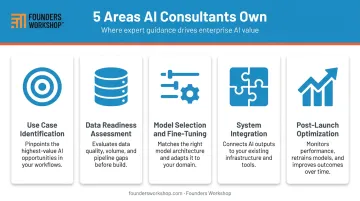
What AI Consultants Typically Own
- Use case identification — determining which AI applications will actually move business metrics
- Data readiness assessment — evaluating whether existing data infrastructure can support AI reliably
- Model selection and fine-tuning — choosing or adapting models for specific use cases
- System integration — connecting AI capabilities to existing products, workflows, and data sources
- Post-launch optimization — monitoring performance, retraining models, and expanding solutions
According to ResearchAndMarkets, the global AI consulting and support services market reached $14 billion in 2024 and is forecast to grow to $72.8 billion by 2030, a 31.6% CAGR. The SME segment is growing even faster at 35.9% CAGR — largely because 37% of companies cite lack of in-house expertise as a key barrier to AI adoption.
Why Founders and SMBs Can't Afford to Skip AI Consulting
Most startups and small businesses don't have data scientists, ML engineers, or AI architects on staff. AI now touches product development, customer experience, and core operations — but without expert guidance, teams end up investing in the wrong tools or building on unstable foundations.
The Pilot Trap
One of the most common and costly patterns: a business completes an AI proof of concept, shows it to stakeholders, and then... nothing happens. Gartner predicted in 2024 that at least 30% of GenAI projects would be abandoned after proof of concept by end of 2025, citing poor data quality, inadequate risk controls, escalating costs, and unclear business value.
Consultants bridge the demo-to-deployment gap by addressing these failure points before they become expensive.
Strategic Alignment
AI initiatives disconnected from business goals produce activity, not outcomes. A good consultant helps founders prioritize use cases by business impact rather than technical novelty — ensuring every AI investment maps to a KPI or revenue driver.
Without this alignment, teams spend months building impressive-looking models that never change a revenue line or reduce a meaningful cost.
Risk and Governance
Misaligned strategy is one problem. Ungoverned deployment is another. Even for small businesses, AI introduces real compliance, data privacy, and bias risks.
The FTC's 2023 action against Rite Aid shows what's at stake: the company was banned from using AI facial recognition for five years after deploying it without reasonable safeguards. Experienced consultants build those guardrails from the start — retrofitting them after the fact costs far more.
The Cost of Inaction
Skipping consulting isn't the safe choice. Poor data quality alone costs organizations an average of $12.9 million per year, according to Gartner. IBM found that over a quarter of organizations estimate losses above $5 million annually from data quality issues.
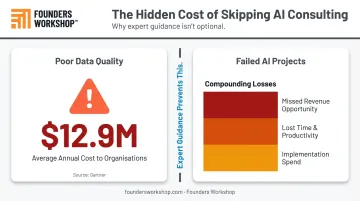
Failed AI projects layer implementation costs, lost time, and missed revenue on top of that — costs that expert guidance is specifically designed to prevent.
What a Strong AI Consulting Engagement Actually Looks Like
A quality engagement doesn't start with model selection. It starts with business problems.
Phase 1: Discovery and Strategy
This phase establishes whether AI is the right solution, and if so, which applications will deliver the highest return. It typically includes:
- Stakeholder interviews to understand business priorities and existing workflows
- Data infrastructure assessment to identify gaps before they become blockers
- Use case prioritization based on potential impact and feasibility
- Success metric definition — what does a win actually look like?
At Founders Workshop, the Discovery phase of their 5D Process runs two to four weeks and produces goal definitions, feature priorities, integration requirements, and technology stack recommendations. For AI engagements, this includes an AI Integration Exploration service to identify where AI will genuinely move the needle — not just confirm that it could.
Phase 2: Build and Integrate
This is where roadmaps become working systems. A strong build phase covers:
- Model selection or fine-tuning for the specific use case
- Data pipeline preparation and validation
- Integration into existing products or workflows
- User-facing interfaces designed for actual adoption (not just technical functionality)
For founders building AI-powered products rather than just deploying AI tools internally, this phase should include design thinking, user validation, and a clear path to MVP. Founders Workshop's 5D Process addresses this through a dedicated Definition phase, where the team builds wireframes and clickable prototypes before writing a line of production code.
Sophisticated model architecture means nothing if users don't adopt the product. Practical delivery — working software that real people actually use — is the only measure that matters.
Phase 3: Operate, Optimize, and Scale
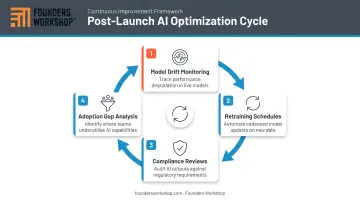
Deployment is not the finish line. AI systems degrade without attention. Post-launch priorities include:
- Model drift monitoring — catching when model performance degrades as real-world data shifts
- Retraining schedules — keeping models accurate as patterns evolve
- Compliance reviews — staying ahead of regulatory changes
- Adoption gap analysis — identifying where users aren't engaging and why
The stakes are real. A JAMA Internal Medicine study evaluating a widely deployed sepsis prediction model found an AUROC of just 0.63 — meaning the model performed barely better than chance at identifying at-risk patients — and missed 67% of sepsis cases despite broad rollout across health systems. That's what happens when AI is shipped without ongoing governance.
Founders Workshop's D5 Dedicated Developer Support phase provides structured post-launch support at 80–160 hours per month, including 24/7 server monitoring, user analytics, and product support — a foundation that can be extended for AI-specific monitoring needs.
Real-World Results: Where AI Consulting Delivers Measurable Impact
Healthcare
A 2025 JAMA Network Open study across 263 physicians and advanced practice practitioners at six US health systems found that ambient AI scribes reduced clinician burnout from 51.9% to 38.8% in 30 days. Severe burnout dropped from 18.4% to 12.2%. Time spent documenting after hours decreased by 0.90 hours — equivalent to 10.8 minutes saved per workday.
For healthcare clients, this kind of administrative burden reduction is where AI consulting ROI is clearest. Founders Workshop has served healthcare clients including Wellpsyche and Verisma, with experience in EMR integrations, HIPAA-compliant patient communication platforms, and telemedicine applications.
Financial Services
HSBC's AI-based financial crime system found 2x to 4x more financial crime than previous systems, reduced false positives by 60%, and cut analysis time from several weeks to a few days — across approximately 980 million transactions per month.
For fintech clients, this translates directly: AI-powered fraud detection and risk scoring catches more bad actors while dramatically cutting the manual review burden on compliance teams. Founders Workshop has worked with fintech clients including Cash1 and Bigg Whale, where a predictive analytics engine gave investment advisors a measurable competitive edge.
Operations and Product Intelligence
Klarna's AI assistant handled 2.3 million customer service conversations in its first month — equal to two-thirds of all customer service chats — with the work equivalent of 700 full-time agents. Resolution time fell from 11 minutes to under 2 minutes. Klarna estimated $40 million in profit improvement in 2024.
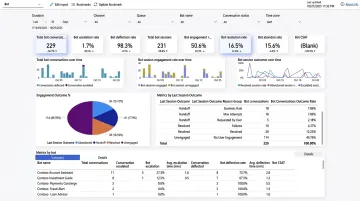
For SMBs and startups, the scale here is less important than the underlying approach. Embedding AI into a customer-facing workflow — with the right integration and UX design — consistently cuts resolution time, reduces headcount pressure, and improves margins with each interaction handled.
How to Choose the Right AI Consulting Partner
Before signing anything, ask these questions in the first conversation:
- What AI projects have you actually shipped? Not strategy deliverables — working products. Ask to see case studies with specific outcomes.
- How do you define success before the project starts? If they can't name a KPI, that's a warning sign.
- What does post-launch support look like? If the answer is vague or optional, expect a fading pilot.
- Who owns the IP, models, and training data? This should be explicit in the contract before work begins.
- What's your process when things don't go as planned? Every real implementation hits unexpected obstacles. The answer tells you a lot.
What Separates Strategic Partners from Vendors
The right consulting firm does more than advise — it builds. For founders who don't want to give up equity to secure technical AI expertise, a partner who has actually run companies (not just consulted for them) makes a real difference.
Founders Workshop fits that profile. The leadership team carries 30+ years of experience as founders, operators, and investors, with 200+ software products shipped since 2008. Their nearshore Latin American delivery model puts senior AI talent at roughly one-third of US rates, with none of the time zone and communication gaps that come with traditional offshore arrangements.
Red Flags to Avoid
- Vague outcome framing ("we'll improve efficiency") instead of business metrics
- No concrete case studies, or case studies that describe technology without results
- No structured plan for post-launch ownership — only project delivery
- Ambiguous IP and data ownership terms
- Pure-play strategy firms with no execution capability in the same team
Frequently Asked Questions
What are the 5 most used AI platforms?
The leading platforms in consulting engagements are OpenAI/GPT, Microsoft Azure OpenAI Service, Google Vertex AI, AWS Bedrock, and Meta's Llama. Platform choice depends on use case requirements, data sensitivity, existing cloud infrastructure, and cost structure — the right fit varies by project.
What does an AI consultant actually do?
An AI consultant assesses your business needs, identifies high-impact use cases, oversees the build and integration of AI solutions, and supports ongoing optimization after deployment. The real value is translating a business problem into a production-ready system — without requiring you to become a technical expert first.
How much do AI consulting services cost for small businesses?
Clutch reports average AI consulting rates of $200 to $500 per hour, with costs driven by project complexity, consultant experience, and scope. For SMBs, a focused discovery or strategy engagement is typically the most accessible entry point before committing to a full build.
How do I know if my startup is ready for AI consulting?
Readiness is less about company size and more about having a clear business problem, some usable data, and willingness to tie AI investment to measurable goals. A good consultant will help you assess readiness as part of the engagement — you don't need to have all the answers before starting.
What's the difference between AI consulting and hiring an AI developer?
Consulting covers strategic and architectural decisions — what to build, why, and how it connects to business goals. Development is hands-on code execution. The best engagements combine both, and founders typically benefit most from partners who offer end-to-end support rather than pure development capacity alone.
How long does an AI consulting engagement typically take?
A strategy and readiness assessment typically takes two to four weeks. A full build-and-deploy engagement — from discovery through deployment — generally runs three to six months, depending on complexity and defined scope.