The problem is treating AI as a collection of subscriptions rather than a strategic capability. Signing up for five tools without a coherent integration plan doesn't create efficiency — it creates fragmentation. That's the gap AI consulting fills.
This guide is written for small business owners who know AI matters but aren't sure how to evaluate consulting options, where to start, or how to avoid burning budget on the wrong things. We'll cover what AI consulting actually involves, where it delivers the clearest ROI, how to evaluate a potential partner, and the mistakes that derail most implementations before they get traction.
Key Takeaways
- AI consulting helps small businesses implement AI strategically, not just experimentally
- The biggest wins come from automating operations, marketing, and customer service — not random tool adoption
- Clarify your goals, data situation, and budget before hiring a consultant
- The 70-20-10 rule offers a practical framework for prioritizing AI investment
- Choose a partner with business strategy depth and hands-on technical experience
What Is AI Consulting for Small Businesses?
AI consulting for small businesses is a structured service that helps SMBs identify where AI can deliver measurable value, select the right tools or custom solutions, integrate them into existing workflows, and track outcomes over time. It's meaningfully different from purchasing software licenses or running ChatGPT experiments.
Tools, Strategy, and Consulting Are Three Different Things
It helps to separate these three concepts:
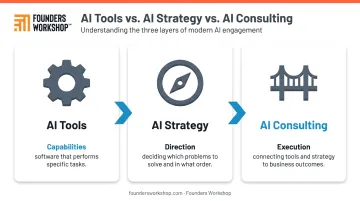
- AI tools are capabilities — software that performs specific tasks
- AI strategy is direction — deciding which problems are worth solving with AI and in what order
- AI consulting is the execution layer — connecting tools and strategy to actual business outcomes
Most small businesses have access to the first. Many have a rough version of the second. Very few have the third.
Why Small Businesses Need Structured Guidance
Small businesses face a specific set of constraints that make unguided AI adoption particularly risky:
- Lean teams with limited capacity to evaluate, test, and troubleshoot tools
- No internal AI expertise to distinguish genuine capability from vendor hype
- Tight budgets with low tolerance for wasted investment
- Existing systems (CRM, accounting, operations) that new tools need to connect with
Without strategic guidance, most small businesses either under-use the tools they've adopted or create disconnected tech stacks that generate more overhead than value. A consultant's first job is clarity — mapping what you have, what's automatable, and what actually needs to change.
Founders Workshop starts every AI engagement with a Discovery phase designed to surface exactly this — which workflows are genuinely automatable, where current tools are falling short, and which changes will move the needle on revenue or efficiency. The goal is a clear action plan before any technology gets deployed.
Where AI Delivers Real Value for Small Businesses
The highest-ROI AI applications for small businesses fall into a handful of core operational areas. A good consultant helps prioritize which to address first based on impact, feasibility, and your current data readiness.
Operations and Administration
Administrative work is where the time savings are most immediate and easiest to measure. SBE Council research found that small businesses using AI reported median weekly savings of 13 owner hours and 13 employee hours — and that 76% said AI freed them to focus on higher-value work.
Common automations with fast time-to-value:
- Invoice processing and expense categorization
- Scheduling and calendar management
- Data entry and report generation
- Document drafting and internal communications
For a three-person team, reclaiming even five hours per week per person has a real dollar value — especially when those hours shift from administrative overhead to customer-facing or revenue-generating work.
Marketing and Sales
Constant Contact found that 60% of small businesses using AI or marketing automation saved time and improved efficiency, and 91% of current AI users said it made their business more successful. The impact on small sales teams is particularly tangible.
AI enables small businesses to:
- Personalize email campaigns using customer behavior data
- Automate follow-up sequences without manual oversight
- Draft proposals and content faster
- Score leads and prioritize outreach
A small sales team using AI-assisted tools can operate with the output velocity of a much larger team — without adding headcount.
Customer Experience
36% of small businesses now use AI for customer service, and the consumer preference is clear: 51% of consumers prefer interacting with bots over human agents when they want immediate service, according to Zendesk.
AI-powered customer service tools allow small businesses to offer 24/7 availability without 24/7 staffing. Key tools include:
- Chatbots that handle first-response queries around the clock
- Automated ticket routing that directs complex issues to the right person
- Sentiment analysis that flags unhappy customers before they churn
Financial Visibility and Inventory
Financial management alone consumes an average of 22 hours per month for US small business owners — time that could be redirected. AI tools can analyze cash flow patterns, flag anomalies, categorize transactions, and predict inventory needs.
This is about risk reduction. Catching a cash flow problem three weeks earlier, or avoiding a stockout during peak demand, has compounding value that's hard to quantify but easy to feel.
A good consultant evaluates which of these areas is most urgent for your specific business before recommending any tools — the goal is a targeted plan, not a generic software stack applied to every client.
The 70-20-10 Rule: How to Prioritize Your AI Investment
For small businesses with constrained budgets, the hardest question isn't "should we use AI?" It's "where do we put limited resources first?" The 70-20-10 framework — originally applied to innovation portfolio allocation in Harvard Business Review's foundational work by Bansi Nagji and Geoff Tuff — translates cleanly to AI investment prioritization.
How the Framework Works
| Allocation | Focus | Description |
|---|---|---|
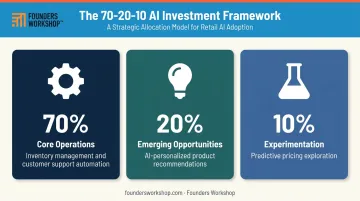
| 70% | Core operations | AI that optimizes what your business already does well |
| 20% | Emerging opportunities | AI that opens new capabilities or revenue channels |
| 10% | Experimentation | Higher-risk AI exploration with uncertain payoff |
Applying It in Practice
Take a retail business as an example:
- 70% — Automate inventory management and customer support responses. These are proven, high-frequency workflows where automation delivers fast, measurable returns.
- 20% — Test AI-generated personalized product recommendations. There's real upside here, but it requires customer data infrastructure and some trial and error.
- 10% — Explore predictive pricing based on demand signals. High ceiling, but unproven for this business's specific context and data maturity.
The framework guards against two failure modes most small businesses fall into:
- Over-investing too early — chasing speculative AI before foundational automations are running
- Under-investing by default — using AI for one low-impact task and calling it done
Start at 70%. Build a win. Then move up the stack.
What to Look for in an AI Consulting Partner
The quality of your consulting partner determines whether AI becomes a competitive asset or a sunk cost. Gartner reported that at least 50% of generative AI projects were abandoned after proof of concept by end of 2025, citing poor data quality, unclear business value, and escalating costs as the primary culprits. Most of those failures are consultant-selection problems in disguise.
Evaluate candidates across five dimensions:
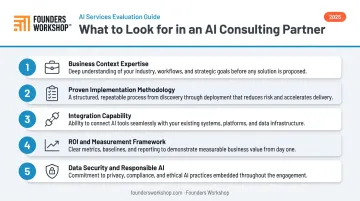
1. Business context expertise The consultant should understand the operational reality of running a small business — not just enterprise IT deployments. Ask whether they've built businesses, worked directly with founders, or managed lean teams under real budget constraints. Founders Workshop's leadership has 30+ years of entrepreneurial experience across 31 owned or co-owned businesses and 81+ startups. They recognize tradeoffs a generalist tech agency simply hasn't encountered.
2. Proven implementation methodology Ask whether they use a documented, repeatable process for scoping, building, integrating, and validating AI solutions. Structured approaches — like a phased discovery-to-deployment framework — significantly reduce delivery risk. Vague "we figure it out as we go" answers are a red flag.
3. Integration capability AI tools that don't connect to your existing CRM, accounting platform, or operations software create fragmentation, not efficiency. Confirm the consultant has hands-on experience integrating AI with the specific systems your business runs on.
4. ROI and measurement framework Any serious engagement should define success metrics before work begins — time saved, conversion rate improvement, cost reduction, or revenue uplift. If a consultant can't articulate upfront how results will be measured, walk away.
5. Data security and responsible AI Ask directly how proprietary data is handled, what their policy is on feeding client information into third-party AI systems, and whether they follow responsible AI governance principles. This is non-negotiable for businesses in healthcare, fintech, or any sector handling sensitive customer data.
How AI Consulting Typically Works
Before signing anything, understand what a structured engagement actually looks like.
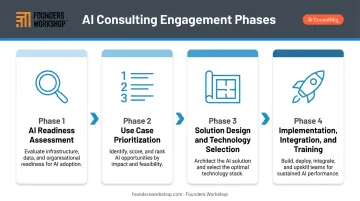
Phase 1 — AI Readiness Assessment
The consultant audits existing workflows, evaluates data quality, identifies bottlenecks, and determines which processes are genuinely automation-ready versus which need foundational work first. Many businesses discover their "AI problem" is actually a data quality problem.
Phase 2 — Use Case Prioritization
Opportunities are ranked by impact, feasibility, time to value, and risk — producing a prioritized roadmap. The 70-20-10 lens gets applied here. You leave this phase knowing what you're building and in what order.
Phase 3 — Solution Design and Technology Selection
The consultant recommends specific tools, platforms, or custom-built solutions, and explains the tradeoffs. Some workflows are well-served by off-the-shelf AI tools; others need custom AI software development integrated directly into an existing platform.
Phase 4 — Implementation, Integration, and Training
AI solutions are deployed, connected to existing systems, and staff are trained on new workflows. Governance protocols are established to ensure data is handled responsibly and outputs are reviewed appropriately.
Before committing, ask any prospective consultant: is ongoing optimization included, or is it a separate engagement? Monitoring performance, retraining models, and scaling successful automations over time turns a one-time project into compounding business value.
Common Mistakes Small Businesses Make with AI
Automating Without a Strategy
The typical small business now uses a median of five AI tools. Without a coherent integration plan, that becomes AI sprawl — five disconnected subscriptions that don't talk to each other and create more complexity than they remove. A consultant's first job is to build clarity, not add more tools to the pile.
Skipping Employee Training
Technical deployment is only half the work. If your team doesn't understand how to work within new AI-assisted workflows, adoption stalls and the investment is wasted. According to McKinsey, 22% of employees receive minimal or no support for AI capability building — and that gap reliably kills adoption. Change management needs to be a core part of the consulting engagement, not an afterthought.
Expecting Immediate Transformation
AI consulting is a strategic investment with a ramp-up period. The timeline typically breaks down like this:
- 30–90 days: Quick wins — automating specific tasks, deploying a chatbot, reducing manual data entry
- 6–12 months: Full operational transformation as more workflows are optimized and teams adjust
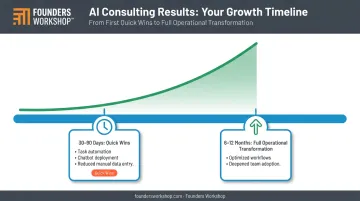
Businesses that abandon their AI strategy after the first month almost never see returns. Staying the course through the ramp-up period is where the real gains happen.
Frequently Asked Questions
How much does AI consulting for small businesses cost?
Project-based engagements for a single workflow can range from a few thousand to tens of thousands of dollars, while retainer-based ongoing consulting costs more but delivers compounding value. Market rates at established consulting firms typically run $200–$500 per hour.
What is the best AI for small businesses?
Common starting points include AI-powered CRMs, chatbot platforms, marketing automation tools, and AI writing assistants — but the right fit depends on the specific workflow being addressed. A consultant's value is in matching the right tool to the right problem, not recommending whatever's trending.
What is the 70-20-10 rule for AI?
It's a framework for allocating AI investment: 70% toward optimizing existing core operations, 20% toward emerging AI-enabled opportunities, and 10% toward experimental or higher-risk projects. It helps small businesses prioritize foundational automations before chasing speculative AI trends.
What does an AI consultant actually do for a small business?
An AI consultant assesses workflows, identifies automation opportunities, selects and integrates tools or custom solutions, trains staff, and tracks measurable outcomes. The real value isn't in the software recommendation — it's in the implementation, integration, and ongoing optimization that follows.
How long does it take to see results from AI consulting?
Targeted quick wins — automating a specific administrative task or deploying a customer-facing chatbot — can be achieved within 30–90 days. Broader operational transformation typically develops over 6–12 months as more workflows are optimized and adoption deepens across the team.
Can small businesses implement AI without a consultant?
Off-the-shelf tools can be adopted independently, but without strategic guidance, most small businesses underutilize them or build fragmented tech stacks that don't integrate. A consultant accelerates ROI and reduces the cost of trial-and-error — especially valuable when budgets are tight and there's little room for wasted experimentation.