
Introduction
Hiring pressure is real. The Bureau of Labor Statistics projects 129,200 annual openings for software developers, QA analysts, and testers through 2034 — and 32% of small business owners already report job openings they can't fill. For founders and SMB leaders trying to ship faster, that gap has consequences.
Traditional hiring is slow and expensive. You spend months recruiting for a role you might need for six months — and while that search drags on, your launch window shrinks and your competitors ship.
IT staff augmentation offers a direct answer to this problem, but most descriptions focus on what it is rather than what it actually does for your business. This article covers both: a clear definition, the three operational advantages that drive real outcomes, and what it costs companies that keep scaling the old way.
Key Takeaways
- IT staff augmentation embeds external specialists directly into your team — under your management, on your timeline
- Core advantages: lower costs, faster access to niche talent, and quicker delivery — without giving up control
- Unlike outsourcing, you keep ownership of process, quality, and direction
- Nearshore models (Latin America) add timezone alignment and cultural fit at roughly one-third the cost of U.S. rates
- Without it: slower launches, higher burn, and talent gaps that compound over time
What Is IT Staff Augmentation?
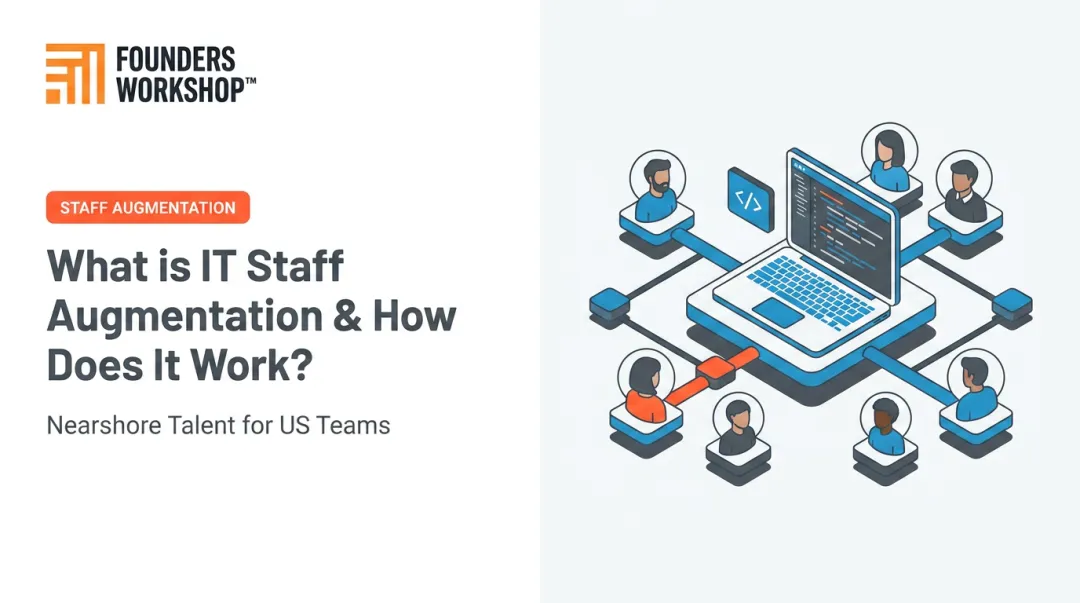
IT staff augmentation is a flexible staffing model that brings external IT professionals — developers, designers, testers, analysts, project managers — directly into your existing team under your management and oversight. They work your hours, follow your processes, and report to you. The staffing partner handles sourcing and placement. You handle everything else.
The distinction from outsourcing matters: in outsourcing, a vendor owns the deliverable. In staff augmentation, you own the project — the external professionals are just additional capacity inside your operation.
When Companies Use It
The model fits several distinct situations:
- Filling a skill gap your internal team doesn't cover (AI integration, cloud architecture, DevOps)
- Accelerating a project when your existing team is already at capacity
- Scaling up for a launch without committing to full-time headcount you won't need afterward
- Preserving equity by bringing in senior technical talent without a co-founder arrangement
The goal isn't to add headcount. It's to put the right expertise on the right problem at the right moment, without the long-term cost structure of a full-time hire.
Key Advantages of IT Staff Augmentation
These advantages aren't abstract capability claims. They show up in budget, timeline, and team performance — which matters most to founders and SMB leaders managing lean operations.
Cost Efficiency Without Compromising Quality
The headline savings in staff augmentation aren't just about avoiding a salary. The real cost reduction comes from eliminating everything layered on top of salary in traditional hiring:
- Recruiter fees — SHRM puts the average cost per hire at nearly $4,700, with total hiring costs reaching 3 to 4 times the position's salary when manager time and soft costs are included
- Benefits overhead — BLS data shows benefits represent 31.1% of total compensation for management and professional roles
- Onboarding delays — weeks or months before a new hire reaches full productivity
- Payroll for temporary needs — you're paying full-time rates for part-time requirements
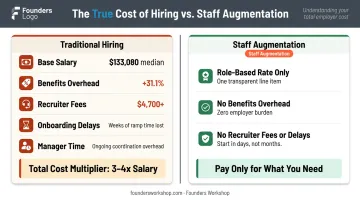
Add those up against a U.S. software developer median wage of $133,080, and the true cost of a single FTE hire becomes significant fast.
Nearshore augmentation amplifies the savings further. Founders Workshop's Latin America-based model delivers senior technical talent at approximately one-third the cost of U.S. teams, without the timezone friction or communication barriers that offshore models typically introduce. For startups watching burn rate and SMBs juggling concurrent projects on fixed budgets, that's a meaningful structural advantage.
KPIs most affected: monthly burn rate, cost per project, hiring cycle time, payroll-to-output ratio.
When it matters most: funding constraints, multiple concurrent projects, or when raising a technical co-founder would mean giving up significant equity.
Access to Specialized Talent On Demand
The tech talent market has gotten more specialized, not less. The U.S. faces a cybersecurity workforce shortage of 225,200 workers according to Lightcast's 2024 data, and the global gap sits at 4.8 million. AI skills aren't any easier to find — more than one-third of tech job postings now require them.
Finding a developer with specific expertise through traditional hiring can take months. You post the role, screen candidates, interview finalists, make an offer, wait out a notice period, onboard — and still risk a poor fit.
Staff augmentation solves this differently. Reputable providers maintain pre-vetted talent pools across disciplines and can deploy matched specialists in days rather than months. Founders Workshop can begin work within two weeks of initial engagement, compared to the three-to-six months it typically takes to recruit an in-house team through conventional channels.
When a project needs a niche capability — AI/ML, cloud architecture, DevOps, full-stack development in a specific framework — augmentation gets that skill into your project immediately. When the engagement ends, you release the resource cleanly. No severance, no extended notice, no stranded payroll.
KPIs most affected: time-to-hire, time-to-productivity, skill coverage per project, reduction in project delays.
When it matters most: niche capability gaps, immovable deadlines, or when your internal team is already fully committed to core work.
Faster Time to Market with Full Project Control
Augmentation and outsourcing look similar on the surface. The difference shows up in who controls the work.
With outsourcing, a vendor takes ownership of a deliverable. You hand over direction, process, and quality control — and get output back. That creates real risk: quality inconsistency, knowledge drain when the engagement ends, and limited ability to pivot when requirements change.
With staff augmentation, none of that happens. Augmented professionals plug into your existing workflows — standups, sprints, code reviews, your tooling — and contribute from day one. You remain in control of:
- Project direction and priorities
- Quality standards and review processes
- Timelines and iteration decisions
- IP ownership and process documentation
You gain capacity without handing over the wheel. That distinction matters most when IP retention or quality consistency is non-negotiable.
McKinsey has noted that delayed product launches can cost companies billions of dollars in technology-heavy industries — a figure that reflects how directly delivery speed maps to revenue. Augmentation shortens the gap between "we need this capability" and "this capability is in production."
KPIs most affected: sprint velocity, time to first deployment, iteration speed, defect rate, team burnout.
This model fits best when speed-to-market is a competitive differentiator, when past outsourcing experiences left quality control gaps, or when protecting your IP is non-negotiable.
What Happens When IT Staff Augmentation Is Ignored
Sticking with traditional hiring under scaling pressure doesn't just slow companies down. It creates compounding costs that quietly drain resources and limit options.
The failure patterns are consistent:
- Overextended internal teams become bottlenecks fast. Atlassian's 2025 research found 97% of developers lose significant time to inefficiencies — a problem that accelerates when teams are understaffed and burning out.
- Hiring aggressively to cover short-term demand inflates payroll without flexibility. Harvard Business School research on layoffs documents the hidden costs companies absorb when unwinding headcount they added too quickly.
- Full outsourcing trades speed for control. The institutional knowledge, process context, and codebase understanding walks out with the vendor when the engagement ends.
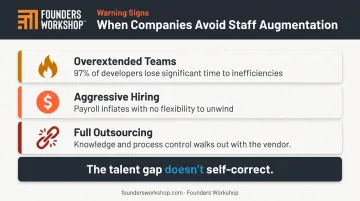
The talent gap doesn't self-correct. Without a flexible staffing model, companies face a binary choice: stall on growth or lock in cost structures that become harder to unwind with every quarter that passes.
How to Get the Most Value from IT Staff Augmentation
Augmentation delivers its full value only when the engagement is set up deliberately. Vague briefs and unclear ownership produce slow starts and misaligned output.
Before the Engagement Starts
Define these clearly before any augmented professional joins your team:
- The specific skill gaps you're filling (not just "we need developers")
- Deliverables, milestones, and success metrics for the engagement
- Which internal team member owns day-to-day management
- Timeline and any hard deadlines
Founders Workshop recommends a Discovery session before staff augmentation begins — a structured alignment process that surfaces these decisions and matches talent to the actual project requirements. This typically takes two to four weeks and cuts the risk of a slow start.
Once your team is in place, how you run the day-to-day determines how much value you actually get.
During the Engagement
- Include augmented professionals in planning sessions — treat them as team members, not vendors, and set communication rhythms from day one
- Review performance consistently, not just at project end; course-correct early if output or collaboration quality drifts
- Capture institutional knowledge as you go: decisions made, architecture rationale, process documentation — so it stays with your company when the engagement wraps

The best augmentation engagements are nearly indistinguishable from a strong internal team. Build toward that from the start, and the transition out will be just as smooth as the work itself.
Conclusion
IT staff augmentation delivers real results — faster delivery, lower costs, better output — but only when the model is used with intention. The companies that get the most from it aren't necessarily the ones moving fastest. They're the ones that treat augmentation as a repeatable capability, not a one-time patch.
The companies that scale with the least friction aren't the ones that hire fastest or outsource most aggressively. They're the ones that build repeatable processes for sourcing, integrating, and managing augmented talent — treating it as an ongoing strategic capability rather than a one-time fix.
If you're a founder or SMB leader who needs senior technical talent without the overhead of full-time hiring, nearshore augmentation is the most practical path forward. Founders Workshop has been placing Latin American development talent with US companies since 2008 — at roughly one-third the cost of domestic teams, with no timezone friction. Reach out to start a conversation.
Frequently Asked Questions
What is the IT staff augmentation process?
Start by identifying the skill or capacity gap, then select a staffing partner who sources pre-vetted candidates. Augmented professionals onboard into your existing team and work against your defined project goals — with you managing them directly, not the vendor.
What is the difference between team augmentation and staff augmentation?
Team augmentation typically refers to adding a pre-formed group of professionals who work alongside your internal team. Staff augmentation places individual specialists directly into your existing team structure. Both models keep management control with the client company.
What is the difference between IT staff augmentation and outsourcing?
Outsourcing transfers project ownership to an external vendor. Staff augmentation embeds external professionals inside the client's team, under the client's management — preserving full control over quality, process, and outcomes. The vendor never owns the deliverable.
How quickly can augmented IT staff be onboarded?
Timelines vary by provider and role complexity. Founders Workshop can begin work within two weeks of initial engagement, significantly faster than traditional hiring, which typically takes three to six months for a specialized technical role.
Is IT staff augmentation cost-effective for startups and small businesses?
It's particularly well-suited for startups and SMBs. It eliminates fixed overhead (benefits, training, severance), scales costs with project demand, and provides access to senior expertise without a long-term commitment or equity trade.
How do I maintain control over projects when using augmented staff?
Control is built into the model. Augmented staff work under the client's direction, follow internal workflows and protocols, and are managed by the client's team leads — not the staffing provider. The staffing partner's role ends at placement.