This scenario isn't rare. It's the dominant experience for founders and SMBs who shop for custom software on price alone. The upfront build cost wasn't the real affordability problem. What happened after launch was.
This post is for entrepreneurs and small businesses who want to understand what genuinely affordable custom software development looks like when it includes long-term support. You'll learn how to think about true total cost, what post-launch support must include, and how to evaluate any partner before signing.
TL;DR: What This Post Covers
- Custom software's real cost goes well beyond the initial build — maintenance, updates, and support add up fast
- "Affordable" means cost-efficient delivery from a partner who stays accountable after launch
- Post-launch support belongs in your contract — know exactly what to ask before you sign
- Nearshore development and AI-accelerated builds both cut costs without sacrificing output quality
- Red flags appear at the proposal stage — learn to spot them before you commit
The Real Problem: Most Custom Software Vendors Stop After Launch
The "Ship and Abandon" Model
Most development firms are structured to close projects, not sustain them. Once the final invoice is paid, clients receive source code and a handshake — then they're on their own, without the institutional knowledge of how the product was built or who to contact when something breaks.
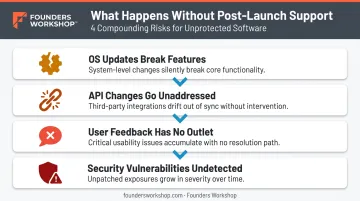
The months following launch without a support agreement tend to follow a predictable pattern:
- OS updates break features with no one patching them
- Third-party API changes go unaddressed
- User feedback accumulates with no mechanism for iteration
- Security vulnerabilities go undetected
For a startup or SMB without an internal engineering team, this isn't just inconvenient. It stalls growth and creates compounding technical debt.
The Financial Exposure Is Real
ITIC's 2024 research found that 90% of firms say a single hour of downtime costs more than $300,000. For SMBs specifically, ITIC's data shows 47% of businesses with 200–500 employees estimate that same hour at $100,000 or more.
Emergency fixes compound the problem. Bringing in a contractor to diagnose a production bug in an unfamiliar codebase isn't a quick patch — it's an expensive, time-consuming process that could have been prevented with a structured support agreement in place from day one.
Vendor vs. Partner
A vendor delivers a scope and invoices for it. A partner stays accountable for outcomes, understands your business context, and helps your software evolve as your market does.
This distinction matters most to founders without internal IT teams. When a vendor disappears post-launch, there's no institutional knowledge left behind — no one who understands what was built, why, or how to fix it when things go wrong. A true partner builds continuity into the engagement from the start.
That continuity has to be negotiated before launch, not scrambled for after. The structure of the contract — specifically whether post-launch support is scoped in — determines whether your software investment holds its value or quietly erodes.
What "Affordable" Custom Software Actually Costs — And Where the Savings Hide
The True Cost Equation
The upfront build number in any proposal is incomplete. A realistic cost picture for a startup-level MVP includes:
- Discovery phase (typically 2–4 weeks) to define scope and architecture
- QA and testing throughout the build, not just at the end
- Third-party integrations for payments, APIs, authentication, and data services
- Post-launch support for the first 12–18 months, covering bugs, updates, and iteration
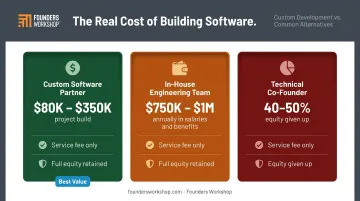
Founders Workshop's MVP engagements range from $80,000 to $350,000 for a 3–6 month project — a fraction of what building an in-house team costs ($750,000 to $1M annually in salaries and benefits) and significantly less than the equity and salary cost of a technical co-founder.
How Nearshore Development Creates Genuine Savings
The nearshore model doesn't reduce cost by cutting corners. It accesses senior engineering talent in Latin America at rates that reflect regional labor markets, not reduced capability.
According to Deloitte, the median U.S. software developer salary is twice the global median for the same role — and Brazil and Mexico alone have more than 2.2 million software engineering professionals, with over 350,000 engineering graduates annually.
Founders Workshop's model pairs U.S.-based strategy and business analysis with nearshore Latin American execution at roughly one-third the cost of a comparable all-U.S. team. The teams also work in the same timezone and language, which removes the coordination friction that makes far-offshore models unreliable.
AI-Accelerated Development
AI tooling is compressing development timelines without compromising quality, which directly reduces build costs. GitHub's controlled research found developers using Copilot completed coding tasks 55% faster. McKinsey reports generative AI can allow developers to complete some tasks up to twice as fast.
Faster timelines mean fewer billable hours, a direct cost reduction that compounds on fixed-milestone engagements.
The Equity Cost Nobody Calculates
For non-technical founders, one "affordable" option that isn't actually affordable is handing equity to a technical co-founder. Carta's 2025 Founder Ownership Report found that 45.9% of two-person founding teams split equity equally — meaning a technical co-founder typically takes 40–50%, not a small advisory slice.
Custom software partners charge a service fee. You keep full ownership of the product — and the equity you retain at Series A is worth far more than any development invoice.
What Good Post-Launch Support Actually Looks Like
The Four Pillars of a Solid Support Structure
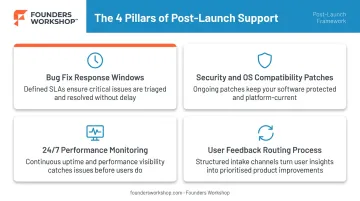
Post-launch support isn't a vague promise to "be available." Good support is a documented structure. At minimum, it should include:
- Defined bug-fix response windows tiered by severity
- Security and OS compatibility patches delivered on a regular cycle
- 24/7 performance monitoring to catch issues before users notice them
- A structured process for routing user feedback into planned feature updates
Founders Workshop's D5 — the fifth phase of their 5D Process — is built around this structure. It includes 24/7 server monitoring, user analytics, database backup, monthly reporting, and dedicated project managers and developers available on ongoing retainers. Packages start at $625/month for up to 5 hours, scaling to custom team arrangements for more complex products.
Reactive vs. Proactive Support
There's a meaningful difference between these two modes:
| Support Type | What It Means | When It Matters |
|---|---|---|
| Reactive | Fix what breaks after users report it | Minimum acceptable standard |
| Proactive | Monitor, catch issues early, recommend improvements | What separates good partners from adequate ones |
The best post-launch arrangements include both. Ask any prospective partner which they provide — and how.
Service Level Agreements (SLAs)
An SLA is the written commitment that governs how support works. Don't accept a support arrangement without one. Key fields to review:
- Response time: how quickly does the partner acknowledge an issue?
- Resolution time: what's the target window to close it out?
- Severity tiers: is a production outage handled differently from a cosmetic bug?
- Supported hours: does coverage align with your business hours?
- Escalation path: who do you reach when normal channels fail?
For a startup-scale product, reasonable SLAs define response windows for critical bugs in hours, not days, with clear escalation paths. Enterprise platforms warrant tighter commitments and broader coverage windows.
Knowledge Continuity
The team that builds your product carries context no handoff document fully captures. Ask any partner directly: what happens to that knowledge at launch?
The strongest answer is that the same team stays involved. Founders Workshop handles post-launch support within the same 25-person team of developers, designers, testers, and project managers that built the product — continuity by design, not by exception. WellPsyche, one of their clients, has maintained that partnership for eight years, from startup through multiple scaling stages.
How to Evaluate Any Custom Software Partner Before You Sign
Pricing and Contract Transparency
Affordable partners show you exactly what's in and out of scope before the contract is signed. Ask for itemized estimates that break out:
- Discovery and requirements definition
- Development and QA
- Third-party integrations
- Post-launch support
Any proposal that skips these line items isn't reducing cost — it's deferring it.
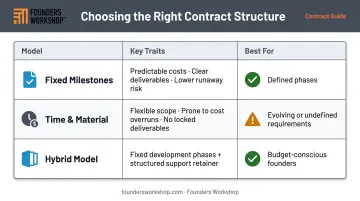
Contract structure matters as much as the estimate itself. Three common models, and what they mean in practice:
- Fixed milestones: Predictable costs, clear deliverables, lower runaway risk — best for defined phases
- Time-and-material (no scope): Flexible but prone to cost overruns when scope isn't locked
- Hybrid model: Fixed milestones for development phases plus a structured support retainer — often the most workable option for founders watching the budget
Post-Launch Structure and SLA
Ask every prospective partner these questions before signing:
- What post-launch support is included in this engagement?
- What is the SLA for a critical production bug?
- Who is my point of contact after launch?
- What is the cost structure for feature updates and ongoing maintenance?
- Can you connect me with a client who's been with you 12+ months post-launch?
A partner with real post-launch infrastructure will answer these without hesitation. Vague or deferred responses to questions 2 and 5 are the clearest warning signs.
Team and Process Transparency
Verify the following before committing:
- Dedicated QA separate from developer self-testing (not the same person writing and approving the code)
- A named project manager accountable to you throughout the engagement
- Documented processes for discovery, development, and handoff
Red Flags That Signal a "Ship and Disappear" Vendor
Some vendors are structured to build and move on. These three patterns tend to surface before a contract is signed — if you know what to look for.
No post-launch support plan in the proposal. If a vendor doesn't raise this unprompted, they're not structured to provide it. A serious partner includes ongoing support in their standard engagement. Having to ask for it as an add-on is a warning sign.
Time-and-materials pricing with no defined scope. Without a scope agreement, there's no accountability mechanism for cost escalation. The reverse is equally risky: a fixed-price proposal with no milestone structure puts all accountability on one side, with no checkpoints along the way.
References only from the build phase. If a partner can't connect you with a client who's been with them 12+ months post-launch, there's a reason. Ask directly — and pay attention to any hesitation.
Frequently Asked Questions
How much does custom software development cost for a startup or small business?
A startup-level MVP typically ranges from $80,000 to $350,000 for a 3–6 month build, depending on complexity and team location. U.S.-based teams cost significantly more than nearshore alternatives. Discovery, QA, and post-launch support add to the total — budget for the full lifecycle, not just the build.
What should post-launch software support include?
At minimum: bug fixes with defined response times, security and OS compatibility patching, 24/7 performance monitoring, and a structured process for incorporating user feedback into planned updates.
How do nearshore development teams reduce cost without reducing quality?
Latin American development teams work in U.S. timezones, share cultural context, and draw from a deep pool of senior engineering talent. Brazil and Mexico together have over 2.2 million software engineering professionals — a talent base that rivals any onshore market. Regional labor costs are lower; the caliber of engineers is not.
What is the difference between a fixed-price and time-and-material contract?
Fixed-price contracts define scope and cost upfront, making them a better fit for MVPs with clear requirements. Time-and-material contracts bill for actual hours worked, which suits projects where scope is likely to shift. For budget-conscious buyers, milestone-based fixed pricing is generally the safest structure: predictable costs with defined checkpoints throughout the build.
Can a startup afford custom software development without giving up equity?
Yes. Custom software partners charge a service fee rather than taking ownership. A technical co-founder often commands 40–50% equity plus significant salary. For founders who want to retain full ownership, a development partner is the more financially sound path.
How long does post-launch support typically last after a custom software build?
There's no universal standard. At minimum, negotiate a defined support period immediately following launch, followed by a structured ongoing retainer. Founders Workshop builds this into their standard engagement model, so post-launch support is a planned phase rather than an afterthought.